The Twelve Labors of Hercules Myth Meaning & Symbolism
A demigod, driven mad by a goddess, must complete twelve impossible tasks to purify his soul and achieve immortality.
The Tale of The Twelve Labors of Hercules
Hear now the tale of the strongest man who ever lived, and the heaviest burden he was forced to bear. It begins not with glory, but with a scream in the night. [Hercules](/myths/hercules “Myth from Greek culture.”/), son of Zeus and the mortal Alcmene, writhed under a madness not his own. The goddess Hera, in her eternal wrath at her husband’s infidelity, poured a fit of divine frenzy into his heart. In the red mist, he saw not his beloved wife and children, but monstrous shapes. When the fog lifted, he was surrounded by their still forms, his own hands stained.
The horror was absolute. To purify a blood guilt of this magnitude required a penance of equal magnitude. The Oracle at Delphi, speaking for the god Apollo, delivered the sentence: he must enter the service of his cousin, King Eurystheus of Tiryns, a small, cowardly man. From him, Hercules would receive twelve tasks. Not simple chores, but labors—athloi—feats so impossible they were meant to break him.
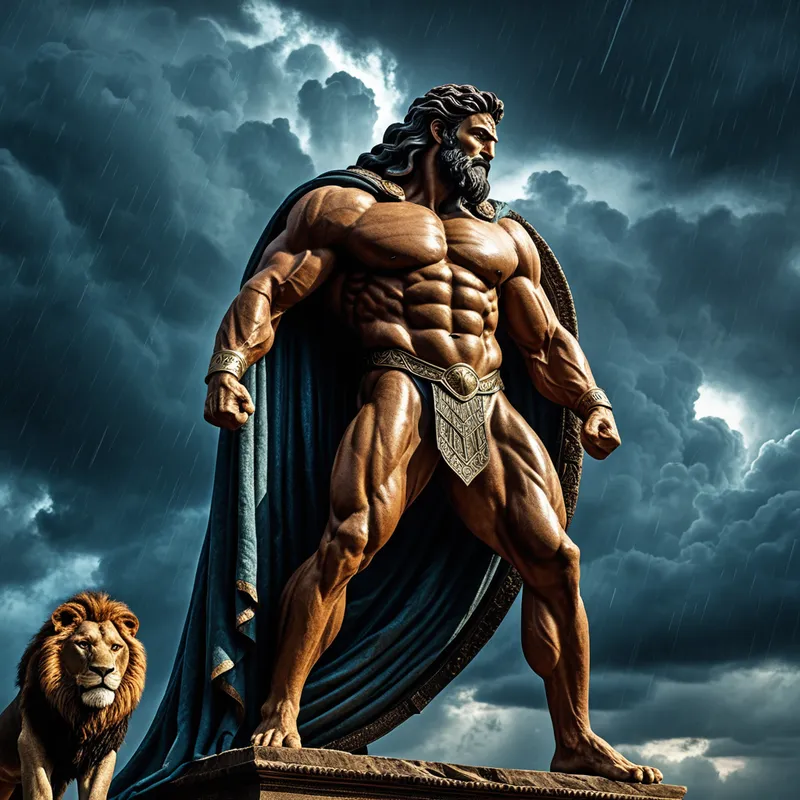
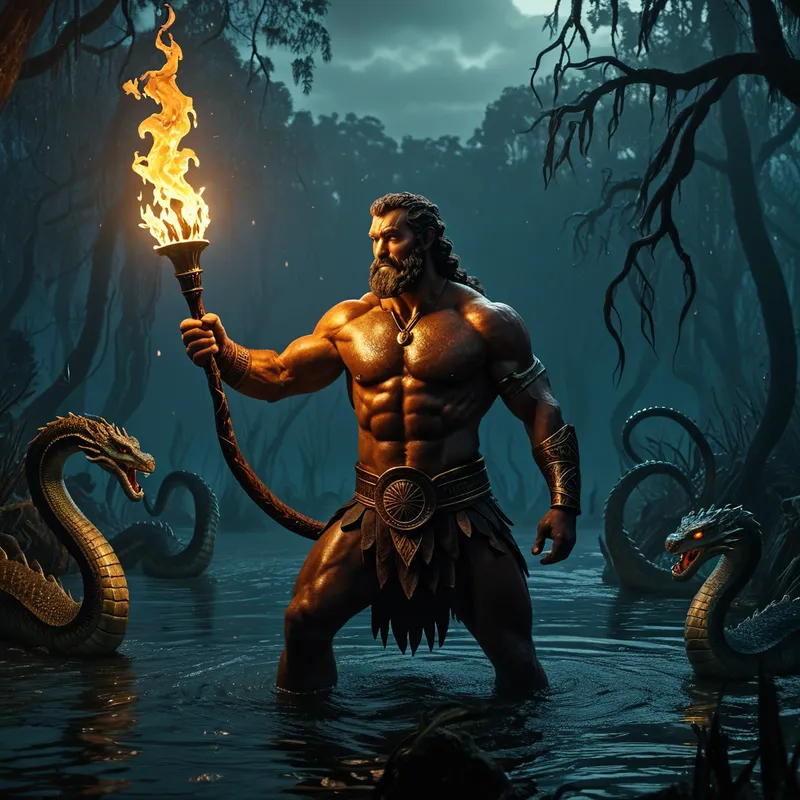
And so the journey began, a geography of terror and wonder. First, the lion of Nemea, whose golden hide turned aside all bronze and iron. Hercules strangled it with his own arms, and from then on wore its pelt, a second skin of invulnerability and shame. Then the Lernaean [Hydra](/myths/hydra “Myth from Greek culture.”/) in its toxic swamp; for each head he crushed, two more hissed to life. He learned to cauterize the necks with fire, and buried the one immortal head under a stone.
He pursued the Ceryneian Hind for a year, a chase of sublime patience. He captured the Erymanthian Boar by driving it into deep snow. He cleansed the Augean Stables not by shovel, but by diverting two rivers through them in a single day, a labor of intellect over brute force.
[The world](/myths/the-world “Myth from Tarot culture.”/) itself became his arena. He drove away the Stymphalian Birds with bronze rattles. He wrestled the Cretan Bull into submission. He tamed the Mares of Diomedes, feeding them their own master. For the belt of the Amazon Queen Hippolyta, he faced not just a warrior, but the treachery of Hera’s whispers that sparked a battle.
His path then descended into the realm of death. He journeyed to the far west to steal the cattle of the monster Geryon, slaying the giant and his two-headed hound. He ventured into [the underworld](/myths/the-underworld “Myth from Greek culture.”/) itself, confronting [Hades](/myths/hades “Myth from Greek culture.”/) to drag the three-headed guard dog, Cerberus, up to the sunlight, a living trophy. His final labor was the most delicate: to retrieve the golden apples from the garden of the [Hesperides](/myths/hesperides “Myth from Greek culture.”/), which required outwitting the titan Atlas who bore the heavens.
When the twelfth labor was done, Hercules stood before Eurystheus for the last time. The blood was not washed away—such stains are eternal—but it was redeemed. The man who had been a cursed murderer was now a purified hero, his strength tempered by suffering, his rage channeled into purpose. The labors were complete, but the man was forever changed.
Cultural Origins & Context
The myth of [Heracles](/myths/heracles “Myth from Greek culture.”/)—the Greek name for the figure the Romans called Hercules—is not a single, frozen story, but a living tapestry woven over centuries. Its threads are found in the epic poetry of [Homer](/myths/homer “Myth from Greek culture.”/) and Hesiod, elaborated in the tragedies of Sophocles and Euripides, and celebrated in local cults across the Greek world. He was a pan-Hellenic hero, claimed by no single city but revered by all.
His labors functioned as a foundational narrative of endurance and civilization. Storytellers, or rhapsodes, would recite his feats at festivals, using them to map the known (and unknown) world—from the wilds of [the Peloponnese](/myths/the-peloponnese “Myth from Greek culture.”/) to the mystical far west. The labors served a societal function: they dramatized the struggle to push back chaos ([the Nemean Lion](/myths/the-nemean-lion “Myth from Greek culture.”/), [the Hydra](/myths/the-hydra “Myth from Greek culture.”/)), to master nature (the Cretan Bull, [the Erymanthian Boar](/myths/the-erymanthian-boar “Myth from Greek culture.”/)), and to venture into the ultimate unknown (the [Underworld](/myths/underworld “Myth from Greek culture.”/)). Hercules was the ultimate culture hero, making the world safer for human order through his brutal, divinely mandated trials.
Symbolic Architecture
At its core, the myth is a profound [blueprint](/symbols/blueprint “Symbol: A blueprint represents the foundational plan or design for something, often symbolizing potential, structure, and the mapping of one’s inner self or future.”/) for the [integration](/symbols/integration “Symbol: The process of unifying disparate parts of the self or experience into a cohesive whole, often representing psychological wholeness or resolution of internal conflict.”/) of the [shadow](/symbols/shadow “Symbol: The ‘shadow’ embodies the unconscious, repressed aspects of the self and often represents fears or hidden emotions.”/). Hercules is not a pristine [hero](/symbols/hero “Symbol: A hero embodies strength, courage, and the ability to overcome significant challenges.”/); he begins fractured, his divine [strength](/symbols/strength “Symbol: ‘Strength’ symbolizes resilience, courage, and the ability to overcome challenges.”/) married to a mortal [psyche](/myths/psyche “Myth from Greek culture.”/) shattered by its own unconscious, destructive potential. The madness sent by Hera is the [eruption](/symbols/eruption “Symbol: A sudden, violent release of pent-up energy or emotion from beneath the surface, often representing transformation or crisis.”/) of the unintegrated [shadow](/symbols/shadow “Symbol: The ‘shadow’ embodies the unconscious, repressed aspects of the self and often represents fears or hidden emotions.”/)—the repressed rage, [jealousy](/symbols/jealousy “Symbol: A complex emotion signaling perceived threat to valued relationships or status, often revealing insecurities and unmet needs.”/), and instinctual force—that, when denied, turns and destroys what one holds most dear.
The Labors are not punishments, but prescriptions. They are the ego, under the guidance of the Self (the Oracle/Apollo), consciously engaging with the contents of the unconscious, one terrifying complex at a time.
Each [beast](/symbols/beast “Symbol: The beast often represents primal instincts, fears, and the shadow self in dreams. It symbolizes the untamed aspects of one’s personality that may need acknowledgment or integration.”/) represents a specific [aspect](/symbols/aspect “Symbol: A distinct feature, quality, or perspective of something, often representing a partial view of a larger whole.”/) of the inner [wilderness](/symbols/wilderness “Symbol: Wilderness often symbolizes the untamed aspects of the self and the unconscious mind, representing a space for personal exploration and discovery.”/). The Nemean [Lion](/symbols/lion “Symbol: The lion symbolizes strength, courage, and authority, often representing one’s inner power or identity.”/) is invulnerable pride, which must be confronted directly and internalized (its [skin](/symbols/skin “Symbol: Skin symbolizes the boundary between the self and the world, representing identity, protection, and vulnerability.”/) becomes his [armor](/symbols/armor “Symbol: Armor represents psychological protection, emotional defense, and the persona presented to the world. It symbolizes both safety and the barriers that separate us from vulnerability.”/)). The [Hydra](/symbols/hydra “Symbol: A multi-headed serpent from Greek mythology that regenerates two heads when one is cut off, symbolizing persistent, multiplying challenges.”/) is the [problem](/symbols/problem “Symbol: Dreams featuring a ‘problem’ often symbolize internal conflicts or challenging situations that require resolution and self-reflection.”/) of [regression](/symbols/regression “Symbol: A psychological or spiritual return to earlier states of being, often involving revisiting past patterns, memories, or developmental stages for insight or healing.”/)—cutting off one [symptom](/symbols/symptom “Symbol: A physical or emotional sign indicating an underlying imbalance, distress, or message from the unconscious mind.”/) (a head) only creates two more—requiring the transformative fire of [consciousness](/symbols/consciousness “Symbol: Consciousness represents the state of awareness and perception, encompassing thoughts, feelings, and experiences.”/) to heal. Cleaning [the Augean Stables](/myths/the-augean-stables “Myth from Greek culture.”/) symbolizes the monumental, often inglorious [task](/symbols/task “Symbol: A task represents responsibilities, duties, or challenges one faces.”/) of cleansing a lifetime of accumulated psychic filth and neglected instincts. Bringing [Cerberus](/symbols/cerberus “Symbol: The three-headed hound guarding the underworld’s entrance, symbolizing boundaries, protection, and the unconscious mind’s threshold.”/) from the [underworld](/symbols/underworld “Symbol: A symbolic journey into the unconscious, representing exploration of hidden aspects of self, transformation, or confronting repressed material.”/) is the ultimate act of shadow retrieval: confronting and making conscious the primal, guarding [energy](/symbols/energy “Symbol: Energy symbolizes vitality, motivation, and the drive that fuels actions and ambitions.”/) of our own deepest fears.
The Dreamer’s Resonance
When this myth stirs in the modern dreamer, it announces a season of immense psychological ordeal. To dream of an endless, impossible task assigned by a foolish or petty authority figure is to feel the weight of the Labors. The somatic feeling is one of profound burden, of muscles straining against a destiny that feels both cruel and necessary.
Dreams of battling multi-headed creatures, chasing elusive goals, or cleaning overwhelming messes are the psyche’s way of staging its own Labors. The dreamer is not Hercules the demigod, but the human ego tasked with its own heroic journey. The feeling upon waking is often exhaustion laced with a strange, grim determination. The psyche is signaling that a foundational purification is underway, a confrontation with a long-avoided “beast” that guards a crucial part of the dreamer’s own power and wholeness.

Alchemical Translation
The alchemical process mirrored in the Twelve Labors is the opus contra naturam—the work against nature, or more precisely, the work of transforming base nature into gold. Hercules’s initial state is the [nigredo](/myths/nigredo “Myth from Alchemical culture.”/), the blackening: the murderous guilt and utter despair. The command from the Oracle is the first stirring of [the Self](/myths/the-self “Myth from Jungian culture.”/), initiating the arduous process.
Each labor is a stage of this alchemical transmutation. The confrontations with beasts (the [solutio](/myths/solutio “Myth from Alchemical culture.”/), dissolution in the swamp, the coagulatio, solidifying the task) break down the old, brute identity. The labors of capture and retrieval (the hind, the apples) involve the sublimatio, a lifting of consciousness to a higher, more refined level. Cleansing the stables is the ablutio, the great washing.
The ultimate goal is not the approval of Eurystheus, but the creation of the lapis philosophorum—the philosopher’s stone. For Hercules, this is his apotheosis, his ascent to Olympus as an immortal. For the modern individual, it is the achievement of individuation: the hard-won state where one’s immense inner power (the strength of Zeus) is no longer at war with one’s human condition (the mortality of Alcmene), but is integrated, purposeful, and finally, at peace. The hero’s journey ends where the sage’s begins.
Associated Symbols
Explore related symbols from the CaleaDream lexicon: