The Twelve Labors of Heracles Myth Meaning & Symbolism
A demigod's epic quest for redemption, facing monstrous beasts and impossible tasks to purify a crime born of divine madness and mortal frailty.
The Tale of The Twelve Labors of Heracles
Hear now the story of a man who was more, and less, than a man. His name was [Heracles](/myths/heracles “Myth from Greek culture.”/), son of Zeus and the mortal Alcmene, and from his first breath, the scent of divine fire and mortal ash clung to him. His strength was the earthquake and the [thunderclap](/myths/thunderclap “Myth from Various culture.”/) given flesh. Yet this gift was his curse, for the gaze of Hera, ever-vengeful for her husband’s infidelity, fell upon him like a shroud. In a fit of madness she sent, the hero’s mighty hands, which could strangle serpents in his cradle, turned against his own. He saw not his beloved wife and children, but monstrous shapes, and in a crimson haze, he destroyed his world.
Awakening to the horror, the blood of his kin still upon him, Heracles was a soul in ruins. The oracle at Delphi spoke his penance: he must enter the service of his weaker cousin, Eurystheus, and perform ten labors—a number that would swell to twelve through trickery and refusal. This was no glorious quest, but a sentence of atonement, a descent into [the world](/myths/the-world “Myth from Tarot culture.”/)’s darkest edges to cleanse a stain upon the soul.
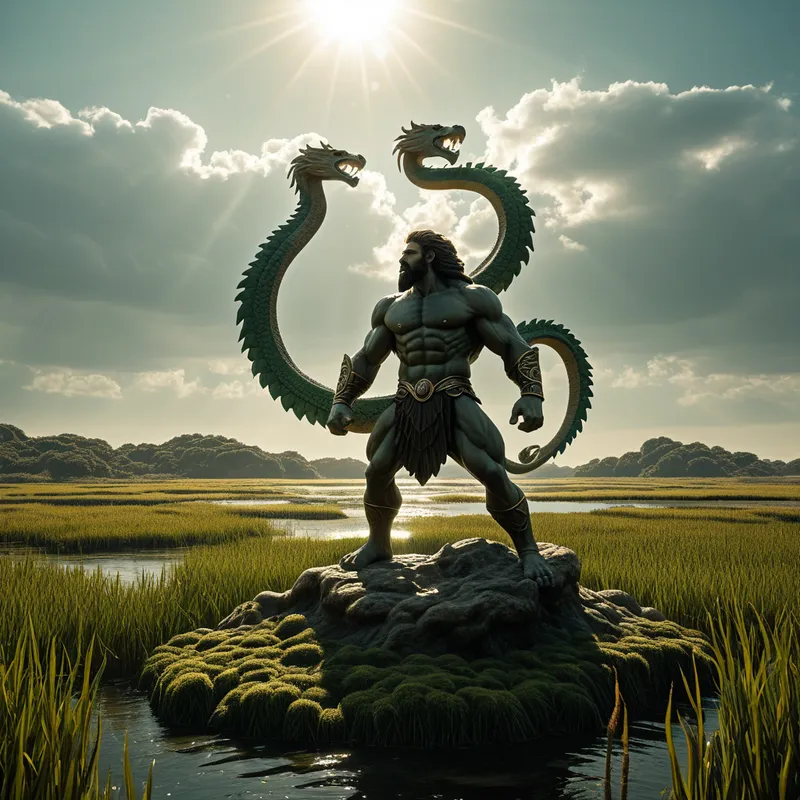
His journey began in the sun-baked hills of Nemea, where he faced a lion with a hide impervious to bronze or iron. Heracles entered its cave, a tomb of bones and stench, and when his weapons failed, his hands became his tools. He choked the life from the beast, and from its pelt, he fashioned his second skin. Next came the Lernaean [Hydra](/myths/hydra “Myth from Greek culture.”/), rising from the poisonous swamps, its breath a miasma. For every head he clubbed away, two more hissed into being. With fire and cunning, he seared the necks, burying [the immortal](/myths/the-immortal “Myth from Taoist culture.”/) head beneath a stone. He dipped his arrows in the beast’s gall, poisoning his own victories.
He chased the Ceryneian Hind for a year, a pursuit of elusive grace, capturing it without harm. He faced the Erymanthian Boar, driving it into deep snow to subdue it. He cleansed the Augean Stables in a day, not with a shovel, but by diverting two rivers—a labor of intellect over brute force. He routed the Stymphalian Birds with a thunderous clatter, scattering them from their misty lake.
His path then led beyond the known world. To the west, to capture the mad Cretan Bull. To the north, to seize the Mares of Diomedes, feeding the king who bred them to his own beasts. To the land of the Amazons, for the girdle of their queen—a task of diplomacy and sudden, brutal conflict. To the far west again, to steal the red cattle of the monster Geryon, a being of triple threat.
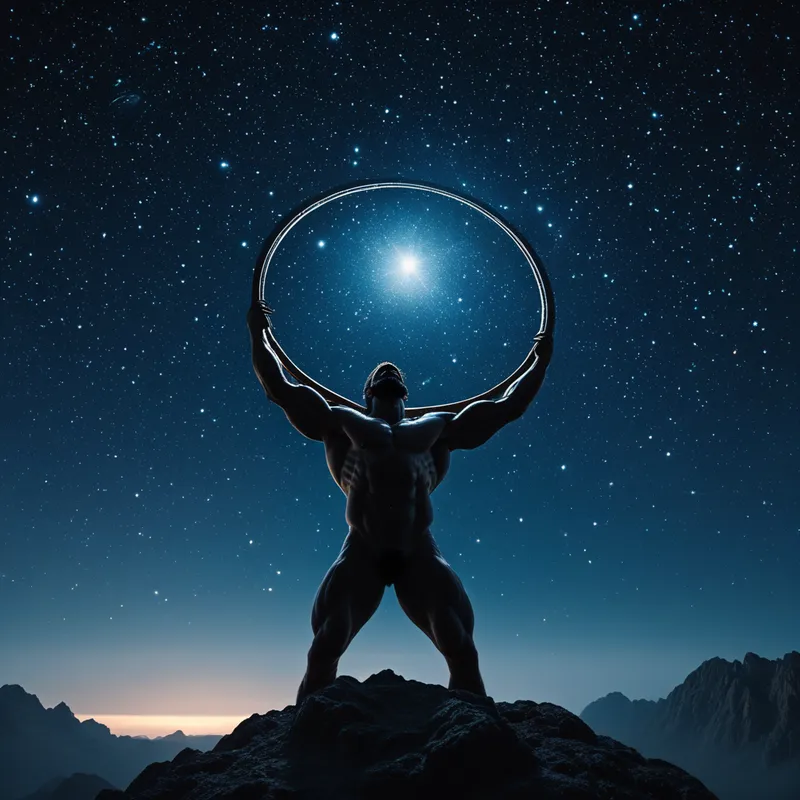
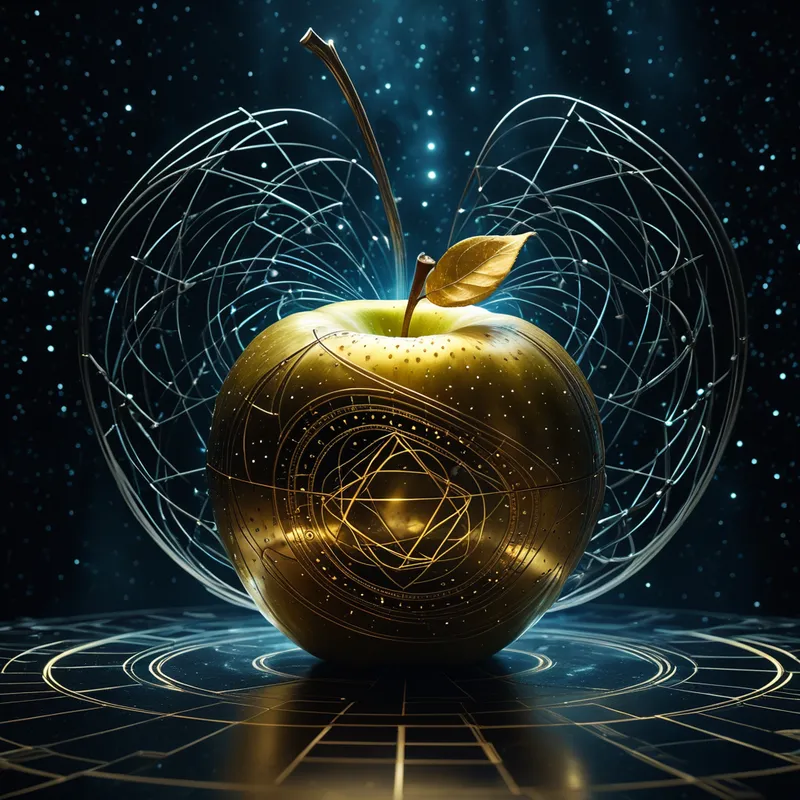
The final labors were journeys into the absolute. He was sent to the garden of the [Hesperides](/myths/hesperides “Myth from Greek culture.”/) to fetch the golden apples of immortality. Lost, he sought out Atlas, who bore the weight of the heavens. Heracles took the cosmic burden upon his own shoulders so the Titan could retrieve the fruit—a moment of ultimate strain under the silent, starry vault. And for his final task, the most impossible: a descent. Not across land, but down into the sunless realm of [Hades](/myths/hades “Myth from Greek culture.”/) himself, to chain and drag the three-headed hound, Cerberus, up to the world of light. He walked into the land of the dead and returned, a living man leading the icon of death on a leash.
When the twelfth labor was done, presented to a cowering Eurystheus, Heracles stood, labors complete, yet forever changed. The blood-guilt was washed clean, not by [water](/myths/water “Myth from Chinese culture.”/), but by ordeal. The hero who had entered service a broken murderer emerged a purified, though eternally burdened, legend.
Cultural Origins & Context
The myth of Heracles is not a single, frozen story but a living tapestry woven over centuries, from the Bronze Age through the classical period of Greece. His figure likely amalgamates older, local heroes and perhaps even pre-Greek divinities of strength. The canonical cycle of the Twelve Labors was standardized relatively late, notably in the works of poets like Peisander and later systematized by mythographers.
This was a story told in epic recitations, painted on pottery, and sculpted on temple metopes. It functioned on multiple societal levels. For the city-state, Heracles was the ultimate civilizing force, the hero who cleared the land of primordial monsters (the Lion, Boar, Birds) and chaotic beings (Hydra, Geryon), making the world safe for human order and agriculture. For the individual, he modeled the Greek ideal of arete—excellence and virtue achieved through immense struggle (ponos). His servitude to a lesser man also reinforced cultural values of obeying divine will and the necessity of ritual purification for miasma (pollution), a crucial concept in Greek religion. He was both a Panhellenic hero, claimed by all Greeks, and a personal protector, invoked for strength and deliverance from hardship.
Symbolic Architecture
The Labors are not a random checklist of [monster](/symbols/monster “Symbol: Monsters in dreams often symbolize fears, anxieties, or challenges that feel overwhelming.”/)-slaying. They are a precise symbolic curriculum for the fractured [psyche](/myths/psyche “Myth from Greek culture.”/). Heracles, in his madness, embodies the [Shadow](/symbols/shadow “Symbol: The ‘shadow’ embodies the unconscious, repressed aspects of the self and often represents fears or hidden emotions.”/) unleashed—the divine power turned destructively [inward](/symbols/inward “Symbol: A journey toward self-awareness, introspection, and the exploration of one’s inner world, thoughts, and unconscious mind.”/) upon the “[family](/symbols/family “Symbol: The symbol of ‘family’ represents foundational relationships and emotional connections that shape an individual’s identity and personal development.”/)” of [the self](/myths/the-self “Myth from Jungian culture.”/). The labors are the conscious ego’s arduous project to reintegrate that shadowy power.
The [sequence](/symbols/sequence “Symbol: The symbol of ‘sequence’ often signifies the order of events and the progression towards a desired outcome or goal.”/) maps a profound inner [journey](/symbols/journey “Symbol: A journey in dreams typically signifies adventure, growth, or a significant life transition.”/). The initial labors ([Lion](/symbols/lion “Symbol: The lion symbolizes strength, courage, and authority, often representing one’s inner power or identity.”/), [Hydra](/symbols/hydra “Symbol: A multi-headed serpent from Greek mythology that regenerates two heads when one is cut off, symbolizing persistent, multiplying challenges.”/)) are confrontations with the raw, untamed animal [nature](/symbols/nature “Symbol: Nature symbolizes growth, connectivity, and the primal forces of existence.”/) and the multiplying, toxic patterns of the unconscious (the [Hydra](/symbols/hydra “Symbol: A multi-headed serpent from Greek mythology that regenerates two heads when one is cut off, symbolizing persistent, multiplying challenges.”/)‘s heads). The middle labors often involve capture, containment, and cleansing (Hind, Boar, Stables)—the management of powerful instincts and the clearing of psychic filth.
The hero does not merely kill the beast; he must wear its skin, use its poison, redirect its rivers. The shadow, once faced, must be integrated, its power harnessed.
The later labors push beyond the personal into the transpersonal. Journeys to the edges of the map (Cretan [Bull](/symbols/bull “Symbol: The bull often symbolizes strength, power, and determination in many cultures.”/), Geryon) represent confronting archetypal, collective energies of rage and greed. The final three are alchemical: retrieving the Golden Apples (the [fruit](/symbols/fruit “Symbol: Fruit symbolizes abundance, nourishment, and the fruits of one’s labor in dreams.”/) of immortality, the Self) requires bearing the [weight](/symbols/weight “Symbol: Weight symbolizes burdens, responsibilities, and emotional loads one carries in life.”/) of the [cosmos](/symbols/cosmos “Symbol: The entire universe as an ordered, harmonious system, often representing the totality of existence, spiritual connection, and the unknown.”/) (the burden of [consciousness](/symbols/consciousness “Symbol: Consciousness represents the state of awareness and perception, encompassing thoughts, feelings, and experiences.”/)). The descent to capture [Cerberus](/symbols/cerberus “Symbol: The three-headed hound guarding the underworld’s entrance, symbolizing boundaries, protection, and the unconscious mind’s threshold.”/) is the ultimate [integration](/symbols/integration “Symbol: The process of unifying disparate parts of the self or experience into a cohesive whole, often representing psychological wholeness or resolution of internal conflict.”/)—facing the [guardian](/symbols/guardian “Symbol: A protector figure representing safety, authority, and guidance, often embodying parental, societal, or spiritual oversight.”/) of [death](/symbols/death “Symbol: Symbolizes transformation, endings, and new beginnings; often associated with fear of the unknown.”/) itself and bringing a [piece](/symbols/piece “Symbol: A ‘piece’ in dreams often symbolizes a fragment of the self or a situation that requires integration, reflection, or understanding.”/) of that profound [mystery](/symbols/mystery “Symbol: An enigmatic, unresolved element that invites curiosity and exploration, often representing the unknown or hidden aspects of existence.”/) back into the light of [life](/symbols/life “Symbol: The symbol of ‘Life’ represents a journey of growth, interconnectedness, and existential meaning, encompassing both the joys and challenges that define human experience.”/).
The Dreamer’s Resonance
When this myth stirs in the modern dreamer, it signals a profound phase of shadow-work. To dream of being tasked with impossible, Herculean labors is to feel the weight of an internal sentence—a deep-seated sense of guilt, shame, or a need to atone for some real or perceived transgression against one’s own values or relationships.
The specific “beast” that appears is diagnostic. A dream of a multi-headed problem that only grows when attacked points to a Hydra-like emotional pattern or addiction. A dream of cleaning an Augean stable speaks to a felt need for a massive, cathartic purge of accumulated psychic or life “waste.” A dream of holding up a crushing weight mirrors the somatic experience of burnout or carrying a responsibility that feels cosmic in scale. These dreams are not fantasies of escape, but somatic blueprints for a necessary, grueling process of purification and reclamation of one’s own power from the clutches of a seemingly inferior or tyrannical inner “Eurystheus” (the critical, cowardly super-ego).
Alchemical Translation
The myth of the Labors is a master map for the Jungian process of individuation. Heracles begins in a state of identification with his divine strength (inflation), which, unintegrated, leads to catastrophic shadow [projection](/myths/projection “Myth from Alchemical culture.”/) and madness (the murder of his family). The sentence of the labors is [the ego](/myths/the-ego “Myth from Jungian culture.”/)‘s acceptance of the need for drastic, disciplined work.
Each labor is an act of psychic transmutation. [The Nemean Lion](/myths/the-nemean-lion “Myth from Greek culture.”/)’s skin is the integration of raw, undifferentiated strength into a protective identity. The poisoning of his arrows with Hydra venom signifies the sobering knowledge that one’s own power, once integrated, becomes a permanent, double-edged tool. Cleaning [the Augean Stables](/myths/the-augean-stables “Myth from Greek culture.”/) by redirecting rivers is the shift from laborious, piecemeal ego-effort to aligning with the greater flow of the unconscious (the rivers) to affect wholesale change.
Individuation is not a victory parade, but a sentence of sacred service to the Self. We do not choose our labors; they are dictated by the oracle of our deepest wounds.
The apex is the journey to the Hesperides and Hades. To gain the golden apple (the symbol of the wholeness of the Self), the hero must first carry the weight of the world—the full burden of conscious awareness. Finally, he must descend, consciously, into his own [underworld](/myths/underworld “Myth from Greek culture.”/) (the unconscious, the repressed, the realm of death-anxiety) and bring back Cerberus—not to destroy it, but to present it. This is the ultimate alchemy: to acknowledge, chain, and present the terrifying guardian of our deepest fears to the daylight world of the ego. The labors end not with Heracles becoming a god, but with him becoming a complete human—a being who has consciously carried the cosmos, walked with death, and purified his own chaos. For the modern individual, the myth insists that redemption and wholeness are not given, but forged in the grueling, specific, and sacred tasks our own psyche demands.
Associated Symbols
Explore related symbols from the CaleaDream lexicon: