The Tungus Flood Myth Meaning & Symbolism
A Siberian myth where a hero, guided by a divine figure, navigates a world-destroying flood to restore balance between humanity and the spirit world.
The Tale of The Tungus Flood Myth
Listen. The world was not always as it is. Once, the great Upper World and our Middle World breathed together, one lung. The people remembered. They spoke with respect to the spirits of the birch and the bear, they offered fat to the fire, they listened to the whispers of the wind. But a forgetting crept in, cold and slow as winter ice. Laughter at sacred things. Broken taboos. The offerings grew thin, the prayers hollow. The great balance, held taut like a bowstring, began to tremble.
The spirits of the Upper World, the Khargi, turned their faces away. The master of the waters grew heavy with sorrow and rage. No rain fell, yet the rivers began to swell from a deep, groaning place within the Under World. The sky darkened not with clouds, but with the shadow of withheld grace.
Then, the groaning broke. It began as a rumble in the bones of the earth, a cracking of the world’s spine. Water, not from the sky but from the very heart of the land, erupted. It was a flood of forgetting, a deluge of consequence. It swallowed the valleys, devoured the forests where the people hunted, crushed the birch-bark tents. The cries of people were lost in the roar of the rising tide. The Middle World was drowning, being washed clean of its insolence.
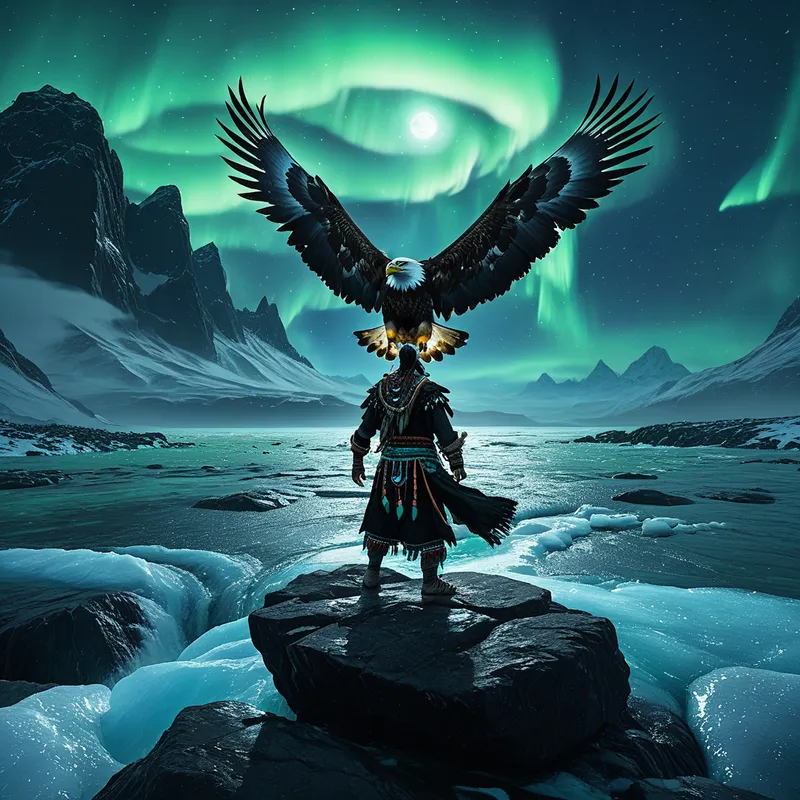
But in one high place, a man remained. He was not the strongest hunter, nor the eldest chief. He was one who still listened. In the terror, he heard a different sound—a mighty beating of wings against the torrential wind. A great Khargi, an eagle of immense size and luminous eyes, descended through the storm. It did not speak with a human tongue, but its gaze was a command, its presence a thread of hope.
“Climb,” the gaze said. The man, his heart a drum of fear and awe, scrambled onto the eagle’s vast back. With a cry that split the chaos, the eagle surged upward. Below, the world vanished into a churning, grey abyss. They flew until the air grew thin and cold, until the flood was a distant, terrible mirror below. The eagle brought him to the highest peak, a tooth of stone piercing the belly of the clouds—a place belonging neither to the drowned Middle World nor yet to the Upper World, but a threshold between.
There, upon the rock, the eagle gave its instruction. It was a task of impossible simplicity and profound cost. To mend the broken world, the man had to become a bridge. He had to remember what his people had forgotten and offer it back, not with words, but with the very substance of his being. The eagle watched, a silent judge of the cosmic scales. The man, alone on the peak with the abyss around him, began the work. He did not fight the water. He addressed it. He called out to the spirits of mountain and sky with the old, true names. He made an offering of his own history, his own pride, casting it into the void. For seven nights, he stood between the worlds, a conduit of apology and remembrance.
And the waters listened. The furious churning began to slow, to soften. The flood, having consumed its purpose, began to recede, sinking back into the earth from whence it came. It left behind a world scraped raw, silent, and glistening—a world newborn, waiting for a new song. The eagle, its task complete, gave a final, piercing look to the man, now forever changed, and vanished into the clearing sky. The hero descended to the mud and the silence, to begin the long work of teaching the song of remembrance to the survivors, so the balance would never again break.
Cultural Origins & Context
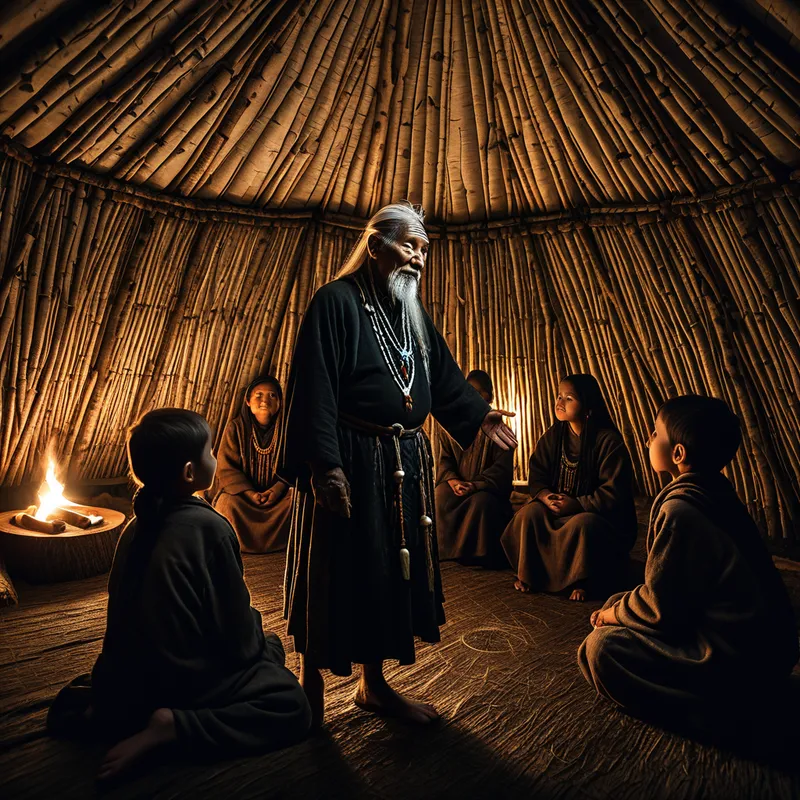
This narrative belongs to the Evenki and related Tungusic peoples, hunters and reindeer herders whose world is the vast Siberian taiga. Here, survival is a continuous dialogue with an animate, sentient environment. The myth was not mere entertainment; it was a vital ritual technology, transmitted by shamans (Saman) and elders around winter fires. Its function was prophylactic and pedagogical. It encoded the core law of existence: reciprocity. The flood is the direct, cosmological consequence of ecological and spiritual negligence. The story served as a societal compass, reinforcing taboos, prescribing respectful conduct towards game animals and natural resources, and outlining the shaman’s crucial role as mediator during crises that threaten the entire human-spirit ecosystem.
Symbolic Architecture
The flood is not a [punishment](/symbols/punishment “Symbol: A dream symbol representing consequences for actions, often tied to guilt, societal rules, or internal moral conflicts.”/), but a necessary, if catastrophic, recalibration. It represents the unconscious, in its most primordial and overwhelming form, rising up to obliterate a conscious [attitude](/symbols/attitude “Symbol: Attitude symbolizes one’s mental state, perception, and posture towards life, influencing emotions and actions significantly.”/) that has become too rigid, too arrogant, or too forgetful.
The flood is the psyche’s ultimate reset, the terrifying yet necessary return of the repressed contents of the collective soul.
The Khargi [eagle](/symbols/eagle “Symbol: The eagle is a symbol of power, freedom, and transcendence, often representing a person’s aspirations and higher self.”/) is the archetypal guide, the [symbol](/symbols/symbol “Symbol: A symbol can represent an idea, concept, or belief, serving as a powerful tool for communication and understanding.”/) of a transcendent function or higher [consciousness](/symbols/consciousness “Symbol: Consciousness represents the state of awareness and perception, encompassing thoughts, feelings, and experiences.”/) that appears when the ego is utterly overwhelmed. It does not save the [hero](/symbols/hero “Symbol: A hero embodies strength, courage, and the ability to overcome significant challenges.”/) from the process; it guides him through it, to the lonely [summit](/symbols/summit “Symbol: The highest point of a mountain, representing achievement, perspective, and the culmination of effort.”/) of [insight](/symbols/insight “Symbol: A sudden, deep understanding of a complex situation or truth, often arriving unexpectedly and illuminating hidden connections.”/). The high peak is the pivotal [moment](/symbols/moment “Symbol: The symbol of a ‘moment’ embodies the significance of transient experiences that encapsulate emotional depth or pivotal transformations in life.”/) of liminality—the [hero](/symbols/hero “Symbol: A hero embodies strength, courage, and the ability to overcome significant challenges.”/) is neither who he was, nor yet who he will become. His offering is the core of the myth’s [alchemy](/symbols/alchemy “Symbol: A transformative process of purification and creation, often symbolizing personal or spiritual evolution through difficult stages.”/): the sacrifice of the old, inflated ego (the people’s forgetfulness now made personal) to restore [connection](/symbols/connection “Symbol: Connection symbolizes relationships, communication, and bonds among individuals.”/) to the Self, the transpersonal center.

The Dreamer’s Resonance
When this myth stirs in modern dreams, it seldom appears as a literal Siberian landscape. It manifests as dreams of overwhelming floods in city streets, of tsunamis crashing through one’s home, or of being trapped as waters rise inexorably. The somatic feeling is one of profound helplessness and panic. Psychologically, this signals that a long-ignored inner tension—perhaps a repressed emotion, a stifled life-direction, or a compromised value—has reached a critical mass. The ego-structure is being flooded by contents from the unconscious it can no longer contain. The dream is the psyche initiating its own corrective deluge. The question posed is not “how do I stop this?” but “what, in my life, has become so unbalanced that it requires this total dissolution?” The appearance of a guiding animal or figure in such a dream is the first hint of the Khargi—the emerging symbol of the reconciling perspective.

Alchemical Translation
For the individual, the Tungus Flood maps the journey of individuation through catastrophic crisis. The “forgetting” is our identification with a persona that has severed ties with the instinctual and spiritual ground of being. The ensuing flood is the neurosis, depression, or life-crisis that shatters this false alignment.
The hero’s flight is not an escape, but the agonizing ascent to a viewpoint from which the disaster can be seen as a process, not just a pain.
The alchemical work occurs on the “peak.” This is the conscious, often lonely, engagement with the conflict. It is the act of journaling through the depression, of finally speaking the truth in therapy, of sitting in meditation with the rage or grief instead of numbing it. The “offering” is the voluntary surrender of the attitude that caused the crisis—the pride, the fear, the need for control. This is the sacrificium intellectus, the sacrifice of the old way of knowing. The receding waters signify the gradual integration of the unconscious material. One is left in a “new world”—a psychic landscape that feels raw and unfamiliar, but authentic. The responsibility then is to “sing the new song,” to live from this more integrated, humble, and connected place.
Associated Symbols
Explore related symbols from the CaleaDream lexicon:
- Flood — The overwhelming return of the unconscious, a necessary dissolution of an outworn conscious attitude to allow for rebirth and rebalancing.
- Water — The primal, formless substance of the unconscious itself, capable of both sustaining life and enacting transformative, cleansing destruction.
- Hero — The individual ego called to undertake a perilous mediation between the human realm and the overwhelming forces of the transpersonal psyche.
- Journey — The archetypal path from a state of brokenness, through a perilous threshold, to a new state of wholeness and responsibility.
- Sacrifice — The essential act of offering up a part of the ego’s claim to sovereignty to restore connection with the greater Self and the cosmic order.
- Mountain — The symbol of transcendence, perspective, and the lonely, elevated place where the crucial inner work of mediation and offering occurs.
- Bird — Specifically the eagle, representing the spirit, higher consciousness, and the guiding force that appears when earthly resources are exhausted.
- Spirit — The pervasive, animate intelligence of the world, which must be acknowledged and engaged with respectfully to maintain cosmic and psychic balance.
- Earth — The Middle World, the realm of manifest reality and human life, which suffers the consequences of spiritual neglect and is reborn through the ordeal.
- Rebirth — The inevitable outcome of the flood’s cleansing action; the emergence of a new, more conscious and connected mode of being from the waters of dissolution.
- Shadow — The repressed collective guilt, arrogance, and forgetfulness of the people, which builds until it erupts as the catastrophic flood from the Under World.
- Ritual — The prescribed, respectful actions and remembrances that maintain the connection between worlds, the neglect of which triggers the mythic catastrophe.