The Trumpets of Jericho Myth Meaning & Symbolism
A besieged city's walls crumble not by force, but by the ritual blast of sacred trumpets, heralding a new order from the ruins of the old.
The Tale of The Trumpets of Jericho
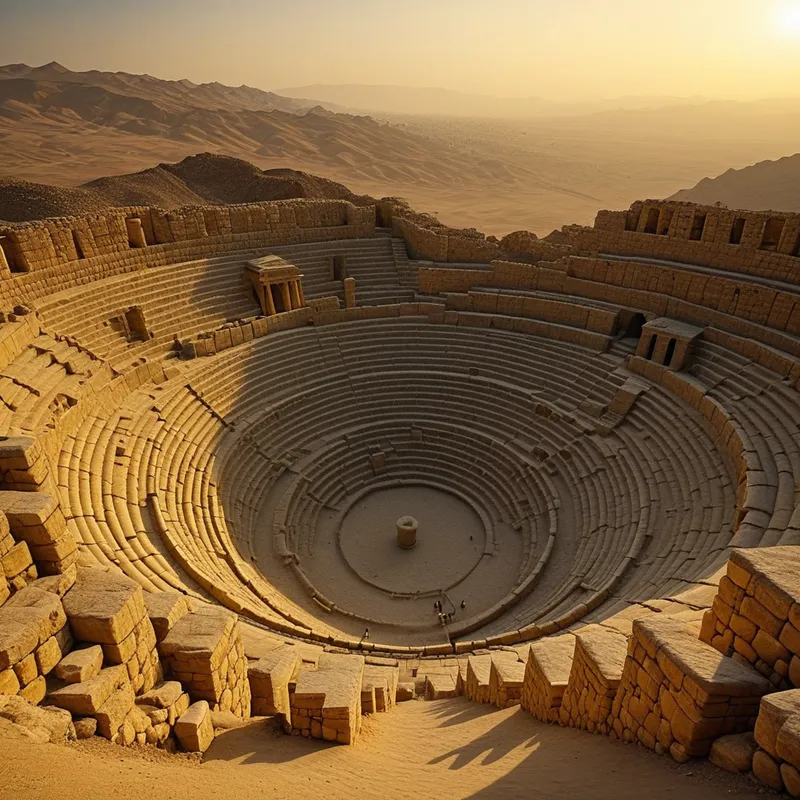
The land was a clenched fist of stone and heat, a promise unfulfilled. Before the host of Israel, the city of [Jericho](/myths/jericho “Myth from Biblical culture.”/) sat, a closed circle of defiance. Its walls were not mere walls; they were [the horizon](/myths/the-horizon “Myth from Various culture.”/) itself, a seamless, towering barrier that said No to [the sky](/myths/the-sky “Myth from Persian culture.”/), No to the future, No to the promise carried in the hearts of the wanderers.
For forty years they had carried that promise through [the wilderness](/myths/the-wilderness “Myth from Biblical culture.”/), a people shaped not by kings but by a covenant with the unseen. Their leader now was Joshua, a man who walked with the weight of a nation on his shoulders and a strange command in his ears. The strategy was not one of siegecraft, but of sacred theater. The might of men, their swords and rams, were to remain sheathed.
For six days, as the sun beat down and the eyes of the city watched from the ramparts in confusion and dread, the army of Israel marched. Not in assault, but in a silent, solemn procession. At their head walked the priests, bearing the Ark of the Covenant, and with them, seven priests blowing upon seven trumpets made from the horns of rams. The only sound was the shuffle of feet in the dust and the stark, bleating cry of the shofar. They circled the city once, a noose of sound and silence, and returned to their camp. They did this for six days, and the tension coiled like a serpent in [the desert](/myths/the-desert “Myth from Biblical culture.”/) air.
On the seventh day, they rose with the dawn. This day, the circle would be drawn not once, but seven times. The sound of the trumpets was constant now, a relentless, plaintive wail that scraped against the stones. The army marched in utter silence, a river of focused intent flowing around the unyielding rock. On the seventh circuit, as the priests raised the horns for a final, culminating blast, Joshua’s voice tore through the ritual stillness: “Shout! For YHWH has given you the city!”
And they shouted. A roar erupted from thousands of throats—a roar of release, of pent-up faith, of a people claiming a destiny held only in trust. It was not a battle cry of rage, but a proclamation of fulfillment. In that moment, as the human sound met the sacred trumpet blast, the impossible happened.
The very foundations of [the world](/myths/the-world “Myth from Tarot culture.”/) seemed to shudder. The seamless walls, which had stood for generations as a testament to human power and fear, did not crack. They dissolved. From the base upward, the stones lost their bond. The mighty ramparts leaned, groaned, and fell in upon themselves in a great, rolling cloud of dust and thunder, save for one section where a thread of scarlet faith had been hung. The city was laid open, not to an army, but to a new reality. [The way](/myths/the-way “Myth from Taoist culture.”/) forward was no longer barred by stone, but paved with rubble and revelation.
Cultural Origins & Context
This narrative is found in the Book of Joshua, a text that sits at the fraught intersection of history, theology, and national identity. For ancient Israel, emerging from the wilderness experience, the story of Jericho served a profound sociological function. It was a foundational myth of origin, explaining not just how they came to possess the land, but by what right.
The tale was likely preserved and told within priestly and prophetic circles, emphasizing a central, radical tenet of Israelite theology: victory and security are not ultimately products of military superiority or human ingenuity, but of fidelity to the covenant. The ritualistic, non-violent (in its method) conquest framed their identity as a people set apart, whose true weapon was obedience and whose true strength was divine sanction. It transformed a military campaign into a liturgical act, cementing in the cultural memory that the land was a gift, not merely a prize taken by force.
Symbolic Architecture
At its core, the myth presents a powerful archetypal [drama](/symbols/drama “Symbol: Drama signifies narratives, emotional expression, and the exploration of human experiences.”/) of collapse and [emergence](/symbols/emergence “Symbol: A process of coming into being, rising from obscurity, or breaking through a barrier, often representing birth, transformation, or revelation.”/). Jericho’s walls represent more than a [military](/symbols/military “Symbol: The military symbolizes discipline, authority, and often the need for structure or control in one’s life.”/) [obstacle](/symbols/obstacle “Symbol: Obstacles in dreams often represent challenges or hindrances in waking life that intercept personal progress and growth. They can symbolize fears, doubts, or external pressures.”/); they are the [psyche](/myths/psyche “Myth from Greek culture.”/)’s ultimate [defense](/symbols/defense “Symbol: A protective mechanism or barrier against perceived threats, representing boundaries, security, and resistance to external or internal challenges.”/) mechanisms—the rigid, fortified structures of ego, dogma, and entrenched [identity](/symbols/identity “Symbol: Identity represents the sense of self, encompassing personal beliefs, cultural background, and social roles.”/) that seem impregnable. They are the “old order,” the calcified patterns of thought, [behavior](/symbols/behavior “Symbol: Behavior encompasses the actions and reactions of individuals, often as a response to various stimuli or contexts.”/), and belief that must fall for new [life](/symbols/life “Symbol: The symbol of ‘Life’ represents a journey of growth, interconnectedness, and existential meaning, encompassing both the joys and challenges that define human experience.”/) to enter.
The walls we build for security become the prisons that define our limitation. Their collapse is not a catastrophe, but the precondition for wholeness.
The trumpets, the shofarot, are instruments of sacred sound. In the Hebraic worldview, sound is creative and destructive—it is the medium of divine command (“Let there be light”). The blast of the [shofar](/symbols/shofar “Symbol: A ram’s horn trumpet used in Jewish rituals, symbolizing divine calls, repentance, and spiritual awakening.”/) is a call to awakening, to judgment, to the breaking of [stasis](/symbols/stasis “Symbol: A state of inactivity, equilibrium, or suspension where no change or progress occurs, often representing psychological or existential paralysis.”/). It represents the penetrating, vibrational [truth](/symbols/truth “Symbol: Truth represents authenticity, honesty, and the quest for knowledge beyond mere appearances.”/)—the [insight](/symbols/insight “Symbol: A sudden, deep understanding of a complex situation or truth, often arriving unexpectedly and illuminating hidden connections.”/), the archetypal call, or the [inner voice](/symbols/inner-voice “Symbol: A spiritual or subconscious guide representing intuition, conscience, or higher self, often seen as a connection to divine wisdom or ancestral knowledge.”/)—that resonates at the precise [frequency](/symbols/frequency “Symbol: In dreams, frequency often represents rhythm, cycles, patterns, or the rate of occurrence of events, thoughts, or emotions.”/) to shatter psychic rigidity. The silent marching army signifies the focused, patient containment of will and [energy](/symbols/energy “Symbol: Energy symbolizes vitality, motivation, and the drive that fuels actions and ambitions.”/), directed not outwardly in aggression, but inwardly in preparation.
The seven-day [ritual](/symbols/ritual “Symbol: Rituals signify structured, meaningful actions carried out regularly, reflecting cultural beliefs and emotional needs.”/) underscores the necessity of process. Transformation is not instantaneous; it requires the repetitive, disciplined circling of the [problem](/symbols/problem “Symbol: Dreams featuring a ‘problem’ often symbolize internal conflicts or challenging situations that require resolution and self-reflection.”/), the gradual [application](/symbols/application “Symbol: An application symbolizes engagement, integration of knowledge, or the pursuit of goals, often representing self-improvement and personal development.”/) of pressure (the sound) against the [resistance](/symbols/resistance “Symbol: An object or tool representing opposition, struggle, or the act of pushing back against external forces or internal changes.”/), until the final, cumulative release.

The Dreamer’s Resonance
When this myth stirs in the modern unconscious, it often manifests in dreams of profound structural failure. One may dream of the walls of their own home cracking, of a familiar building collapsing, or of a formidable, smooth barrier that simply vanishes. There is rarely violence in these dreams, but rather a sense of awe, inevitability, and sudden exposure.
Somatically, the dreamer may be experiencing a deep, involuntary loosening—a release of chronic muscular armoring, a sigh held for years finally exhaled. Psychologically, this signals a moment where a long-held, defensive identity—perhaps built around perfectionism, emotional isolation, or a rigid worldview—has reached its expiration. [The ego](/myths/the-ego “Myth from Jungian culture.”/)’s defenses, once necessary for survival, have become obstructive to growth. The dream is an announcement from [the Self](/myths/the-self “Myth from Jungian culture.”/): the siege is over. The costly, exhausting project of maintaining the wall is no longer required. A core, outdated structure of the personality is being decommissioned, not through a violent battle, but through the resonant truth of one’s own becoming.
Alchemical Translation
The alchemical journey of individuation is mirrored perfectly in the Jericho operation. [The first stage](/myths/the-first-stage “Myth from Alchemical culture.”/), circulatio, is the silent marching—the patient, often frustrating work of circling one’s core complex, observing it from all angles in therapy, reflection, or creative expression. The ego learns to contain its impulse to attack directly.
The trumpet blast is the moment of illuminatio—the brilliant, disruptive insight that comes from the Self (the archetypal Anthropos or divine command). This is not an intellectual idea, but a numinous, vibrational knowing that strikes at the root of the complex. It is the realization that dissolves the problem by revealing its fundamental unreality or outdatedness.
The triumph is not in the destruction of the wall, but in the realization that you are not, and never were, the wall’s keeper.
Finally, the shout of the people represents coniunctio—the integration. It is the conscious ego’s full-throated assent to the transformation. It is the release of the held breath, the alignment of one’s personal will with the transpersonal process. The wall falls inward, not outward; the old structure is recycled into the rubble from which the new city of the Self can be built. The once-impregnable barrier becomes the foundation stones of a more authentic, less defended existence. The individual moves from a psychology of siege to a psychology of dwelling, having learned that true security lies not in fortification, but in faithful engagement with the profound and often unsettling process of being called into one’s own [promised land](/myths/promised-land “Myth from Biblical culture.”/).
Associated Symbols
Explore related symbols from the CaleaDream lexicon: