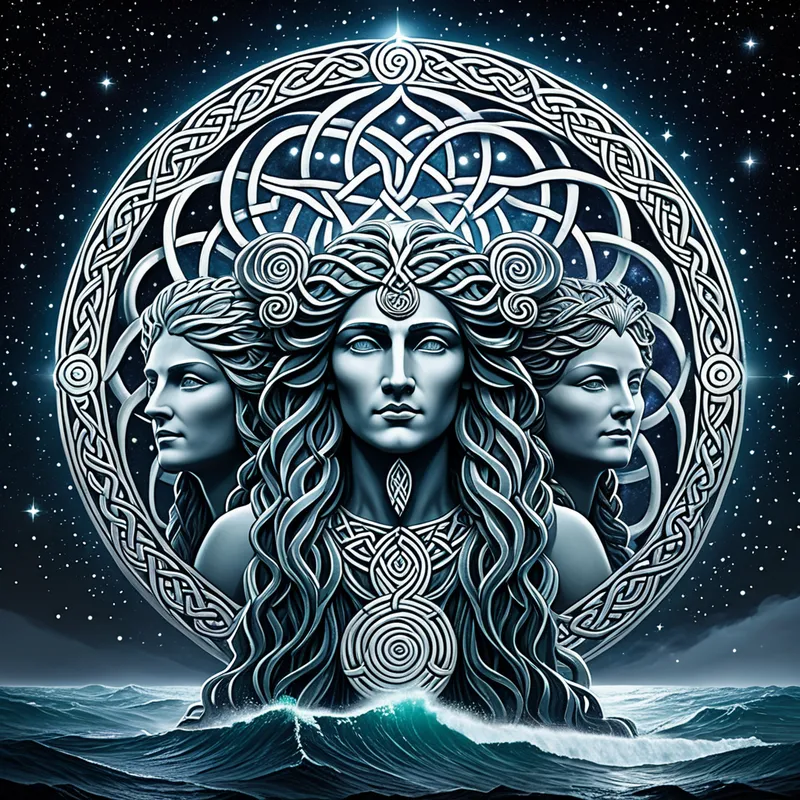
The Triskelion Myth Meaning & Symbolism
A tale of three warring siblings, embodying Land, Sea, and Sky, whose conflict births the sacred spiral of motion, balance, and eternal becoming.
The Tale of The Triskelion
In the time before time, when [the world](/myths/the-world “Myth from Tarot culture.”/) was a raw and singing [thing](/myths/thing “Myth from Norse culture.”/), there were three. They were not born, but emerged—from the first thought, the first breath, the first pulse. They were siblings, and their names were the first truths: Talamh, Muir, and Nem.
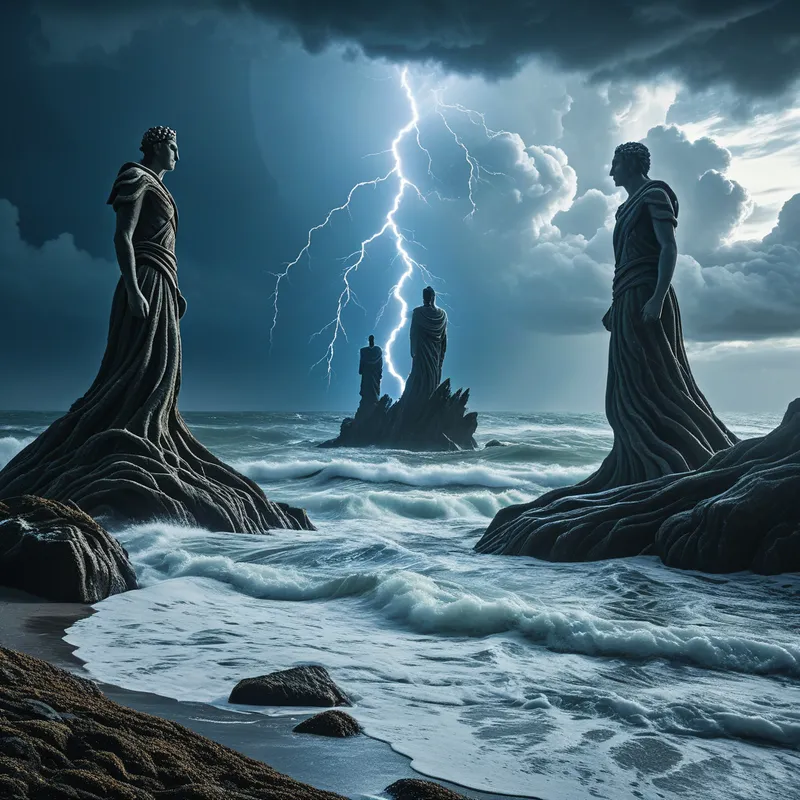
Talamh was strength and stillness. Her feet were roots that drank from the dark heart of the world, and her hair was forests. Muir was change and depth. His body was the tide, his voice the crash and whisper of waves against the unborn shore. Nem was vision and fury. Her thoughts were the winds, her laughter lightning, her tears the soft rain.
For an age, they danced in [the void](/myths/the-void “Myth from Buddhist culture.”/), their forms mingling in a gentle chaos. But a longing grew in each—a desire not for dominion, but for expression. Talamh yearned to be solid, to hold fast. Muir craved to flow, to embrace. Nem burned to soar, to see all. And so they began to pull. Talamh pulled inward, toward core and center. Muir pulled outward, toward horizon and depth. Nem pulled upward, toward height and expanse.
What was a dance became a strain. The gentle chaos hardened into conflict. Talamh’s roots sought to bind Muir’s tides. Muir’s waves sought to erode Talamh’s cliffs. Nem’s storms sought to scatter both. The world groaned in their strife, a terrible, silent scream of elements refusing communion. It was the war of Is against Is-Not, of definition against infinity. They were tearing the world asunder in their need to be.
Then, from the torment of their pulling, a sound arose. Not from any of them, but from the space between them. A low, resonant hum, the note of tension itself. It vibrated in the roots, the waters, the winds. It was a pain so profound it became a threshold.
In that moment, they did not cease their pull. Instead, they listened. And in listening, they felt it—not the pull against the other, but the pull from the other. Talamh felt Muir’s flow not as an attack, but as a caress that shaped her. Muir felt Nem’s winds not as a scatterer, but as a breath that gave him direction. Nem felt Talamh’s solidity not as a prison, but as a place from which to leap.
The terrible, linear pulling softened, bent, and began to turn. Their fierce, opposing forces began to spiral around the central hum, the note of their tension. Talamh’s solidity became [the anchor](/myths/the-anchor “Myth from Christian culture.”/) point. Muir’s fluidity became the coursing path. Nem’s expansiveness became the driving force. They did not become one. They became three-in-motion, a dynamic wheel where each force defined and was defined by the others.
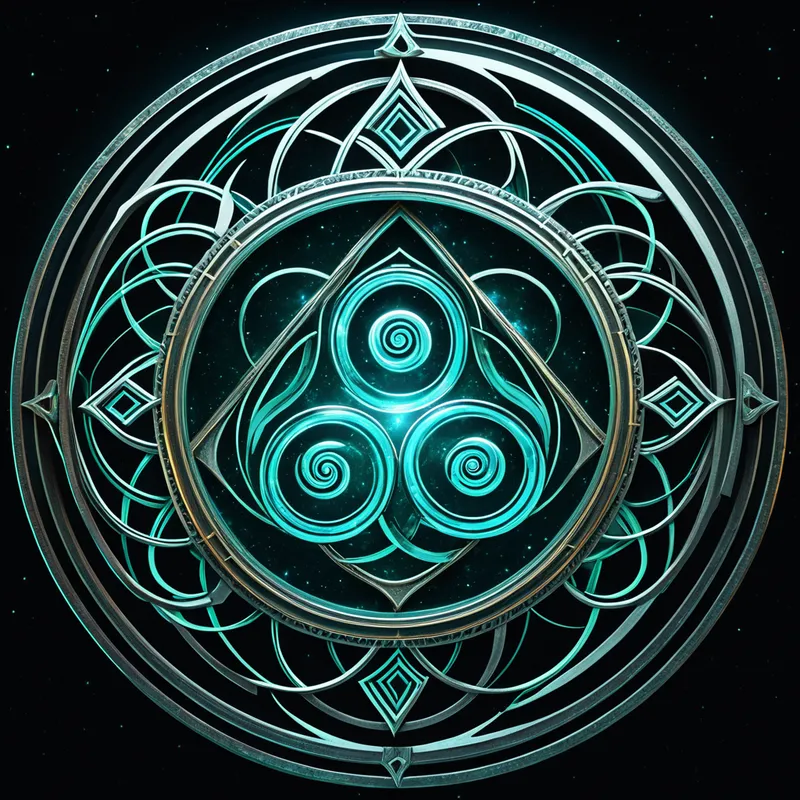
Where their strife had been, a pattern burned itself into the fabric of things: three legs, bent and running, forever chasing each other’s tails around a sacred center. The first [Triskelion](/myths/triskelion “Myth from Celtic culture.”/). It was not a peace, but a vibrant, eternal truce written in the language of motion. The war was over. The dance had truly begun.
Cultural Origins & Context
The tale of the Triskelion, as a narrative, is not found inscribed on ancient stones or in medieval manuscripts. The Celts, particularly the pre-Christian Gauls and Britons, transmitted their deepest cosmological understandings through an oral tradition of immense sophistication. Knowledge was encoded in bardic poetry, genealogical recitations, and legal triads—formats designed for memorization. The Triskelion symbol itself, however, is ubiquitous. Found on La Tène metalwork, on Neolithic passage tombs like Newgrange (which later cultures reused), and on Celtic coinage, it was a visual mantra.
This myth, therefore, is a reconstruction—a “story behind the symbol” woven from the philosophical principles evident in Celtic law, social structure, and their profound triadic view of the world. Society was often divided into three functions (Druids, Warriors, Producers). The cosmos was seen as three-layered (Land, Sea, Sky, or This World, [the Otherworld](/myths/the-otherworld “Myth from Celtic culture.”/), and the Upper World). Deities often appeared in triple forms, like the Matres or the threefold Morrígan. The myth of Talamh, Muir, and Nem gives narrative flesh to this bone-deep understanding that reality is not a binary of opposites, but a dynamic triad in motion. It was a story told not to explain origins, but to teach a mode of being—how to hold tension without breaking, how to find direction in conflict.
Symbolic Architecture
At its [heart](/symbols/heart “Symbol: The heart symbolizes love, emotion, and the core of one’s existence, representing deep connections with others and self.”/), the Triskelion myth is a map of [consciousness](/symbols/consciousness “Symbol: Consciousness represents the state of awareness and perception, encompassing thoughts, feelings, and experiences.”/) moving from a state of identification to a state of [relationship](/symbols/relationship “Symbol: A representation of connections we have with others in our lives, often reflecting our emotional state.”/). The three siblings represent primal aspects of [the self](/myths/the-self “Myth from Jungian culture.”/) that, in their undifferentiated state, are in chaotic potential. The conflict arises from the necessary, yet agonizing, process of individuation—each [aspect](/symbols/aspect “Symbol: A distinct feature, quality, or perspective of something, often representing a partial view of a larger whole.”/) seeking its own sovereign [expression](/symbols/expression “Symbol: Expression represents the act of conveying thoughts, emotions, and individuality, emphasizing personal communication and creativity.”/).
The center is not a place of rest, but the vibrating point of tension where all forces are held in relationship. Wholeness is not the end of motion, but its perpetual source.
Talamh symbolizes the somatic, earthly self: the [body](/symbols/body “Symbol: The body in dreams often symbolizes the dreamer’s self-identity, personal health, and the relationship they have with their physical existence.”/), instincts, and the unconscious. Muir is the emotional, feeling self: the [realm](/symbols/realm “Symbol: The symbol of ‘Realm’ often signifies the boundaries of one’s consciousness, experiences, or emotional states, suggesting aspects of reality that are either explored or ignored.”/) of relationship, fluidity, and the tidal [psyche](/myths/psyche “Myth from Greek culture.”/). Nem is the mental, spiritual self: intellect, [vision](/symbols/vision “Symbol: Vision reflects perception, insight, and clarity — often signifying the ability to foresee or understand deeper truths.”/), and aspiration. The myth teaches that psychic illness—the “groaning of the world”—occurs when these three declare independence and wage war. The [body](/symbols/body “Symbol: The body in dreams often symbolizes the dreamer’s self-identity, personal health, and the relationship they have with their physical existence.”/) ignores feeling and [spirit](/symbols/spirit “Symbol: Spirit symbolizes the essence of life, vitality, and the spiritual journey of the individual.”/), the feelings overwhelm the mind and neglect the [body](/symbols/body “Symbol: The body in dreams often symbolizes the dreamer’s self-identity, personal health, and the relationship they have with their physical existence.”/), the spirit disdains the earthly and the emotional.
The [resolution](/symbols/resolution “Symbol: In arts and music, resolution refers to the movement from dissonance to consonance, creating a sense of completion, release, or finality in a composition.”/) is not a victory, but a [transmutation](/symbols/transmutation “Symbol: A profound, alchemical process of fundamental change where one substance or state transforms into another, often representing spiritual evolution or personal metamorphosis.”/) of [linear](/symbols/linear “Symbol: Represents order, predictability, and a direct, step-by-step progression. It symbolizes a clear path from cause to effect.”/) conflict into circular dynamism. The sacred center that appears is the [emergent property](/symbols/emergent-property “Symbol: A complex phenomenon arising from simpler interactions, where the whole becomes greater than the sum of its parts.”/) of the relationship itself—the observing Ego, or the Self in Jungian terms, which is not a commander but the still point around which the aspects revolve. The Triskelion, therefore, is the [symbol](/symbols/symbol “Symbol: A symbol can represent an idea, concept, or belief, serving as a powerful tool for communication and understanding.”/) of a psyche that has learned to contain its own opposites by setting them in [motion](/symbols/motion “Symbol: Represents change, progress, or the flow of life energy. Often signifies transition, personal growth, or the passage of time.”/) toward a common [purpose](/symbols/purpose “Symbol: Purpose signifies direction, meaning, and intention in life, often reflecting personal ambitions and core values.”/): the evolution of consciousness.
The Dreamer’s Resonance
When the Triskelion pattern emerges in modern dreams—as three spinning wheels, three figures locked in a turning dance, or a relentless triple rhythm—it signals a critical phase of inner realignment. The dreamer is likely experiencing a somatic, emotional, and intellectual crisis simultaneously. The body feels one pull (toward rest, security), the heart another (toward a relationship or a change), and the mind a third (toward a goal or idea).
The dream is not presenting a problem to be solved by choosing one aspect over the others. Rather, it is presenting the geometry of the solution. The feeling is often one of immense, tearing pressure—the “hum” in the myth. This is the tension of growth. The dream invites the dreamer to stop trying to stop the conflict and instead to listen to its pattern. To ask: How is my need for security (Talamh) being shaped by my deep feelings (Muir), which are in turn given direction by my vision (Nem)? The dream points toward the necessity of finding the center point within the storm, the core of identity that can hold these warring pulls without being shattered by them, allowing them to become a propulsive force rather than a destructive one.
Alchemical Translation
The alchemical process mirrored in the Triskelion myth is the opus contra naturam—the work against nature, which is really the work of refining raw nature into conscious spirit. The initial state (massa confusa) is the undifferentiated sibling-dance. The [separatio](/myths/separatio “Myth from Alchemical culture.”/) is the painful, necessary war where each element asserts its distinct nature. This stage feels like madness, fragmentation, and irreconcilable conflict.
The goal of the work is not to arrive, but to acquire the momentum of becoming. The philosopher’s stone is not a static object, but a perfected motion.
The crucial alchemical stage is the coniunctio oppositorum—[the conjunction](/myths/the-conjunction “Myth from Alchemical culture.”/) of opposites. Here, the myth offers its genius. The conjunction is not a static fusion into a bland unity. It is a dynamic, spinning union where the opposites are not annihilated but orchestrated. The fixed (Salt/Talamh), the fluid ([Mercury](/myths/mercury “Myth from Roman culture.”/)/Muir), and the volatile ([Sulfur](/myths/sulfur “Myth from Alchemical culture.”/)/Nem) are bound in a rotating, reciprocal relationship. The sacred center that hums into being is the [lapis philosophorum](/myths/lapis-philosophorum “Myth from Alchemical culture.”/), [the Philosopher’s Stone](/myths/the-philosophers-stone “Myth from Alchemical culture.”/)—which in psychological terms is the integrated Self.
For the modern individual, this translates to the process of individuation. We are not tasked with eliminating our contradictions—our need for both security and freedom, for both connection and solitude, for both tradition and innovation. We are tasked with building a psyche strong enough and flexible enough to contain these contradictions in a state of creative tension. We must learn to be the still eye of the Triskelion, the non-anxious presence that allows our own elemental natures to find their orbit, transforming inner civil war into the sacred spiral that drives us forward, whole at last.
Associated Symbols
Explore related symbols from the CaleaDream lexicon: