The Triple Goddess (Maiden Myth Meaning & Symbolism
The first face of the Triple Goddess, the Maiden embodies the archetype of potential, independence, and the sacred, untamed spark of new beginnings.
The Tale of The Triple Goddess (Maiden
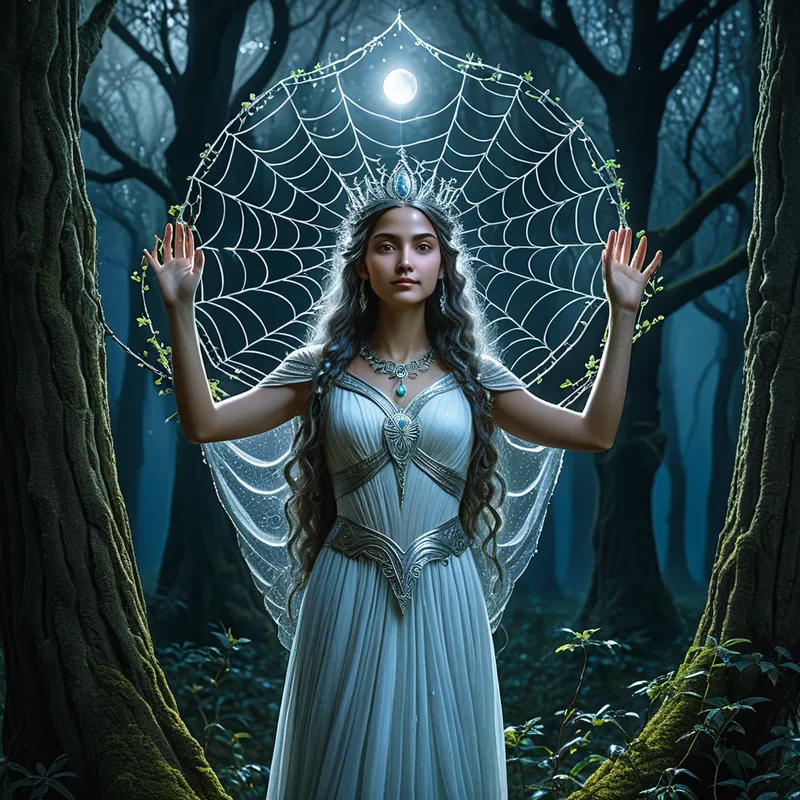
Listen. Before the world knew its own name, in the time when light was a secret held in the womb of darkness, there was a grove. Not a grove of mere trees, but of Numen, where every leaf whispered a prophecy and every root dreamed of the sky. And in the heart of this grove, she awoke.
She was not born; she became. One moment, the silence of the grove was absolute. The next, a silver sigh parted the air, and she stood—a figure of moonlight given form. She was the Maiden. Her hair was the cascade of a waterfall seen by starlight. Her eyes held the untouched clarity of a mountain spring, reflecting not the world, but its pure possibility. She wore a simple shift, white as the inside of a birch bark, and on her brow rested a delicate circlet of crescent moons, points upward, catching a light that had no source.
For a time beyond counting, she knew only the grove. She danced with shadows that became foxes. She sang to the buds, and they unfurled their first, tender green. She drank from the spring that welled up from the stone, and its water tasted of beginnings. This was her whole world: perfect, enclosed, innocent. The great Mother was the grove itself, the soft soil beneath her feet, the enveloping branches. The wise Crone was the deep, patient silence between the roots. They were her context, her entirety.
But a restlessness, sweet and sharp as the first berry of summer, began to stir within her. The songs she sang started to have questions in their melody. The path that wound through the oaks beckoned not as a circle, but as a line leading out. One evening, as the moon—her moon—hung pregnant and low, she stood at the grove’s edge. Here, the protective energy of the Mother thinned. The air smelled different: of distant rain, of cold stone, of open space.
A figure appeared on the path, not quite solid, woven from mist and memory. It was the Psychopomp, the caller-forth. It held no form she could name—sometimes a stag with antlers like bare branches, sometimes a man with eyes of shifting constellations. It spoke without sound. The branch must grow beyond the tree. The stream must find the sea. You are the question that seeks its own answer.
Terror, crystalline and bright, flashed through her. To leave was to break a sacred wholeness. To stay was to remain a dream forever dreaming itself. She looked back at the sleeping grove, at the familiar, loving presence of the Mother and the knowing silence of the Crone. She felt their blessing, not as a chain, but as a released breath. They were not leaving her; they were waiting within her, to be discovered in new forms.
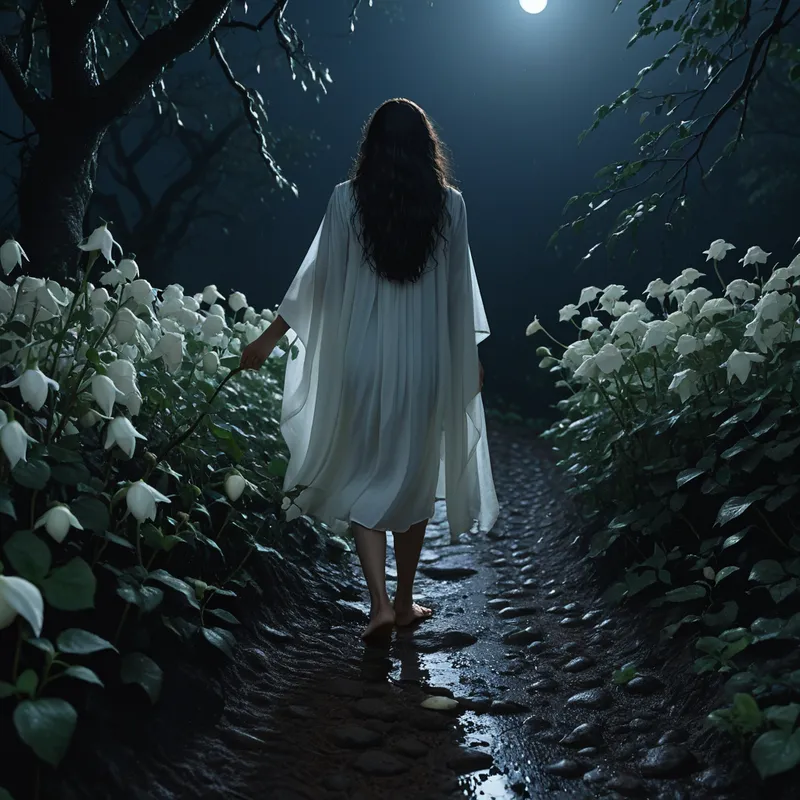
With a resolve that felt both like breaking and becoming, the Maiden took the first step. As her foot touched the earth beyond the grove’s boundary, her simple white shift was caught by a wild rose. A thorn pricked her finger. A single drop of blood, crimson and shocking against her pallor, fell onto the pale moonflowers at her feet. They glowed brighter. This was her pact, her first sacrifice of innocence: the acknowledgment of her own separate, vulnerable, and potent life.
She did not look back again. The path stretched before her into the unknown twilight. The crescent moons on her brow shone with their own captured light, a lantern now, not just a crown. She walked, and with every step, the world began to whisper its secrets to her, for she was no longer just of the grove. She was its emissary, the sacred spark set loose upon the winding road of experience. Her story, the first movement in an eternal triad, had truly begun.
Cultural Origins & Context
The archetype of the Triple Goddess, with the Maiden as its inaugural phase, is a profound example of a trans-cultural, universal pattern. It is not the property of a single pantheon but a psychic structure that has found expression in countless forms across time and geography. We see her in the Greek Artemis, forever young, roaming the wilds with her nymphs. We recognize her in the Norse Freya, who, while also a figure of maturity, carries the Maiden’s independent and magical spirit. She is present in the Dhumavati, the goddess who embodies the void of potential before creation.
This myth was never contained in a single sacred text. It was passed down through the oral traditions of wise women and storytellers, encoded in seasonal rituals celebrating the waxing moon and the spring equinox. Its societal function was multifaceted. For the community, it mapped the human life cycle onto the cosmos, providing a sacred template for the transitions of youth, especially for girls approaching womanhood. For the individual, it offered a container for the powerful, often terrifying, energies of awakening selfhood—the pull between the safety of the familial “grove” and the call of one’s own destiny.
Symbolic Architecture
The Maiden is not merely a young woman. She is the archetypal embodiment of becoming. She symbolizes the pure potential of the psyche before it is shaped by complex personal and cultural complexes. Her grove represents the unconscious unity of childhood, where the individual psyche is undifferentiated from the parental and environmental matrix (the Mother and Crone as surrounding presences).
The Maiden’s journey is the soul’s first declaration of independence, a necessary betrayal of the primal whole for the sake of conscious individuality.
The pivotal moment of stepping beyond the grove is the archetypal “call to adventure,” the rupture that initiates all psychological growth. The thorn-prick and the drop of blood are crucial symbols. They shatter the illusion of inviolable innocence and introduce the reality of embodiment, vulnerability, and life—the price of entering the realm of experience. The blood is both a sacrifice and a potent seal, marking her passage from a state of passive being to active becoming. Her crescent moons, now a lantern, signify that the inner light of potential must become an outward-guiding consciousness.
The Dreamer’s Resonance
When the pattern of the Maiden myth stirs in modern dreams, it often manifests at thresholds. You may dream of standing before a door you’ve never opened, at the edge of a forest looking out onto a plain, or holding a key whose lock you cannot find. The somatic feeling is one of anticipatory tension—a flutter in the solar plexus, a quickening of the pulse. Psychologically, this indicates a process where a long-held identity or a comfortable, enclosed phase of life (a job, a relationship, a self-concept) is becoming too small. The “grove” has become a cage.
Dreams of lost virginity in a non-literal sense, of shedding a white garment that gets dirty or torn, or of finding a new, unexplored path during a nightly walk all speak to this archetype’s activation. The psyche is rehearsing the separation from an old container. There is often grief here—for the lost innocence, the simple certainty—but beneath it thrums an undeniable current of excitement and raw potential. The dreamer is encountering their own inner Psychopomp, the part of the Self that knows it is time to grow.

Alchemical Translation
The alchemical process mirrored in the Maiden’s myth is Separatio—the essential first operation where a substance is divided from its original, homogenous mass. In the work of individuation, this is the conscious differentiation of the ego from the unconscious. We cannot become who we are meant to be while remaining fused with the internalized parents, the tribal expectations, or the unexamined patterns that form our psychic “grove.”
The thorn’s prick is the gift of consciousness; it is the point where the soul wakes up to its own existence as a separate, feeling entity.
The modern individual undergoes this alchemy when they finally heed a call that feels uniquely their own, despite external pressures to conform or remain safe. It is the artist leaving the secure career to paint. It is the individual setting a boundary that defines their separateness from a family system. It is the act of claiming a belief, an identity, or a path that is authentically one’s own, even in the face of the inner critic that sounds like the grove’s comforting, yet limiting, whispers.
This is not a rejection of the Mother or Crone, but the beginning of their integration on a higher level. By courageously stepping onto her own path, the modern Maiden does not lose her connection to source or wisdom; she begins the process of discovering them within herself. She transmutes inherited life into chosen life. The potential energy of the innocent spark becomes the kinetic energy of a soul in motion, embarking on the long and winding road toward the fullness of the Self.
Associated Symbols
Explore related symbols from the CaleaDream lexicon: