The Tree of Zaqqum Myth Meaning & Symbolism
A cursed tree in hell, bearing fruit like demonic heads, embodying the ultimate consequence of a soul's denial and the alchemy of confronting one's own shadow.
The Tale of The Tree of Zaqqum
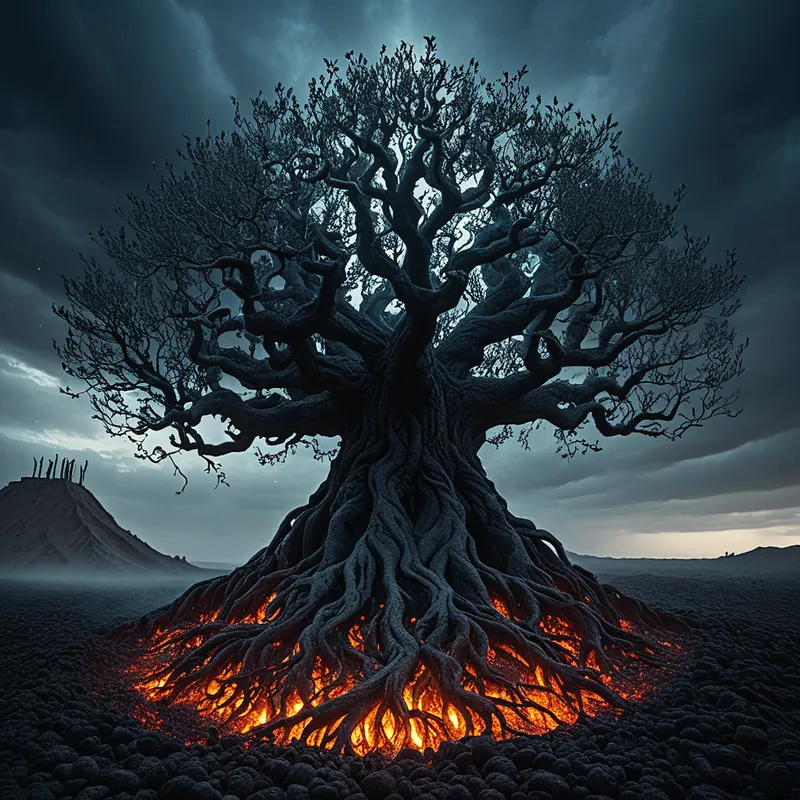
Hear now of the tree that grows where no tree should. Not in the gentle soil of the garden, watered by sweet rain, but in the very heart of the scorching pit, in the core of Jahannam.
Its roots are not of earth, but of fire. They plunge deep into the bed of coals, drinking not water but the essence of wrath. From this impossible ground, the trunk of Zaqqum heaves upward, a monstrous column of blackened, twisted matter, like the petrified sinews of a forgotten titan. Its bark is cracked and oozing, not sap, but a bitterness that scalds the air.
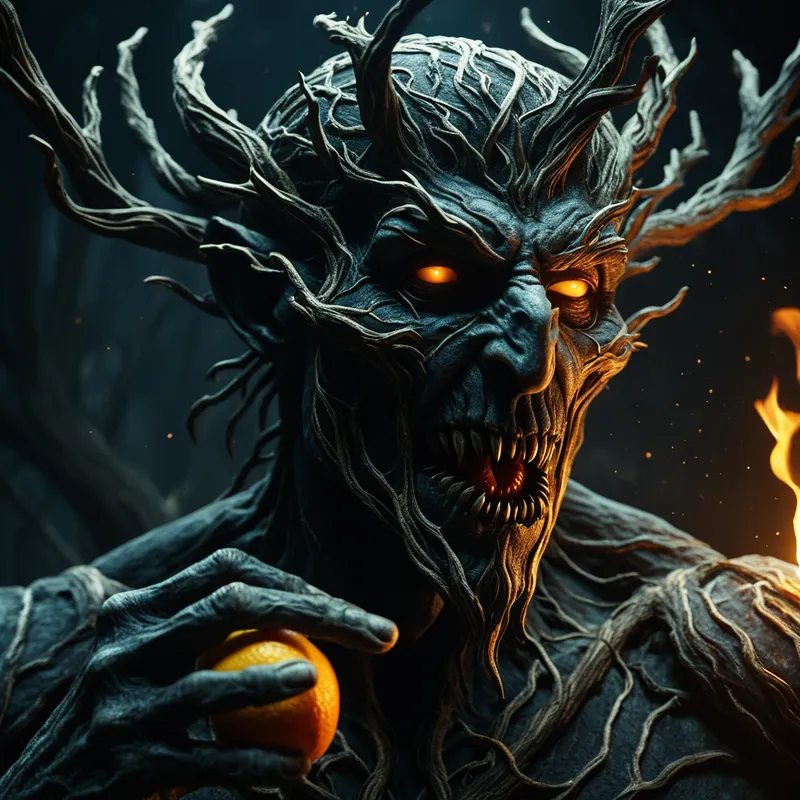
And upon its branches—oh, its branches—hang its fruit. Do not think of apples or dates. These are the heads of Shayateen. They bulge from the stems, grotesque and alive, with eyes that see nothing but the torment they promise and mouths locked in silent, eternal screams. To touch one is to feel the heat of a furnace; to consume one is the final, irrevocable sentence.
For this is the food of the condemned. When the inhabitants of the Fire cry out in their anguish, their hunger a new layer of torture, they are driven to this tree. Their hands, against their will, reach for the boiling fruit. They must eat. And as they swallow the substance of the heads of demons, it churns in their bellies like molten brass, a perpetual, internal inferno. It does not nourish; it perpetuates. It does not satiate; it ignites a deeper, more personal flame. This is the sustenance of the one who, in the realm of light and choice, nourished only the arrogance of the self, who fed upon illusion and called it truth. Now, in the realm of absolute consequence, the tree offers the only harvest such a soil can yield: the embodied, undeniable fruit of one’s own choices.
Cultural Origins & Context
The myth of Zaqqum is firmly rooted in the Qur’an, appearing in several Surahs (As-Saffat 37:62-68, Ad-Dukhan 44:43-46, Al-Waqi’ah 56:52-55). It is not a folktale but a central component of Islamic eschatology—the theology of the end times, judgment, and the afterlife. Its primary function is moral and pedagogical, serving as a powerful, visceral deterrent and a stark reminder of the cosmic scales of justice.
Passed down through revelation and then explicated by scholars and storytellers, the image of Zaqqum operated on multiple levels within the classical Islamic worldview. For the everyday believer, it was a terrifyingly concrete symbol of the consequences of persistent disbelief (kufr) and transgression. In theological discourse, it underscored the principle of divine justice (al-‘Adl), where the punishment is not arbitrary but a direct, symbolic manifestation of the inner state of the soul. The tree exists as an ontological necessity within the landscape of Hell, a perfect mirror to the Tree of Immortality in Jannah, representing the ultimate polarities of spiritual nourishment and corruption.
Symbolic Architecture
Zaqqum is the ultimate [symbol](/symbols/symbol “Symbol: A symbol can represent an idea, concept, or belief, serving as a powerful tool for communication and understanding.”/) of the embodied consequence. It is not merely a [punishment](/symbols/punishment “Symbol: A dream symbol representing consequences for actions, often tied to guilt, societal rules, or internal moral conflicts.”/) imposed from without, but the externalization and fruition of an internal [condition](/symbols/condition “Symbol: Condition reflects the state of being, often focusing on physical, emotional, or situational aspects of life.”/). The [tree](/symbols/tree “Symbol: In dreams, the tree often symbolizes growth, stability, and the interconnectedness of life.”/) represents the full, terrifying [maturation](/symbols/maturation “Symbol: The process of developing toward a more advanced, complete, or effective state, often involving growth, learning, and integration of experiences.”/) of a [soul](/symbols/soul “Symbol: The soul represents the essence of a person, encompassing their spirit, identity, and connection to the universe.”/)’s choices when they are rooted in arrogance, denial of [truth](/symbols/truth “Symbol: Truth represents authenticity, honesty, and the quest for knowledge beyond mere appearances.”/), and the feeding of the egoistic self.
The shadow, when utterly refused, does not disappear. It grows in the dark until it becomes the only landscape you can inhabit.
Its [fruit](/symbols/fruit “Symbol: Fruit symbolizes abundance, nourishment, and the fruits of one’s labor in dreams.”/), explicitly described as “like the heads of devils,” symbolizes the consummation of evil. To eat it is to internalize one’s own demonic potential, to be forced to digest the very essence of the corruption one cultivated. The molten [brass](/symbols/brass “Symbol: A durable alloy of copper and zinc, symbolizing resilience, tradition, and a blend of strength with warmth. Often associated with craftsmanship and ceremonial objects.”/) in the belly represents truth in its most unbearable, corrosive form—a truth that was rejected in [life](/symbols/life “Symbol: The symbol of ‘Life’ represents a journey of growth, interconnectedness, and existential meaning, encompassing both the joys and challenges that define human experience.”/) now becoming the inescapable, burning [reality](/symbols/reality “Symbol: Reality signifies the state of existence and perception, often reflecting one’s understanding of truth and life experiences.”/) of one’s existence. Psychologically, Zaqqum is the [shadow](/symbols/shadow “Symbol: The ‘shadow’ embodies the unconscious, repressed aspects of the self and often represents fears or hidden emotions.”/) made utterly concrete and inescapable. It is the sum total of repressed [guilt](/symbols/guilt “Symbol: A painful emotional state arising from a perceived violation of moral or social standards, often tied to actions or inactions.”/), pride, and rage, now grown into a permanent, environmental fact.
The Dreamer’s Resonance
When the pattern of Zaqqum emerges in modern dreams, it rarely appears as a literal tree of hellfire. Its resonance is more subtle, more intimate. The dreamer may find themselves in a barren internal landscape—a vast, empty parking lot at night, or a house with rooms that are inexplicably scorched. They may encounter a beloved tree in their garden that has suddenly turned black and brittle, or feel an intense, irrational hunger that can only be sated by something repulsive and bitter.
Somatically, this dream pattern often accompanies periods of profound psychological reckoning. It speaks to the soul’s confrontation with the “bitter fruit” of its own actions, choices, or denied aspects. The process is one of somatic guilt—a guilt not just thought, but felt in the gut as a churning, burning discomfort. The dream is the psyche’s way of forcing a feeding. It insists that the dreamer must finally “eat” and acknowledge what they have spent a lifetime trying to avoid: their own capacity for harm, their hidden arrogance, their foundational denials. The agony in the dream is the agony of integration beginning at the most visceral level.
Alchemical Translation
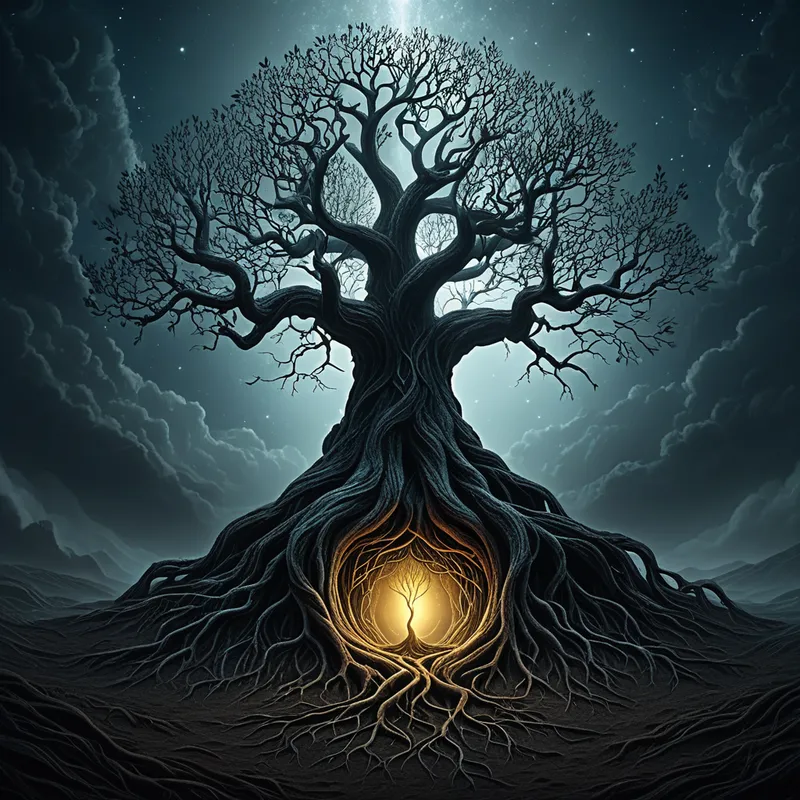
The journey from being a soul threatened by Zaqqum to one who understands its meaning is the alchemical process of nigredo—the blackening, the descent into the prima materia of the shadow. In the individuation process, Zaqqum represents the necessary, dreadful stage where one must voluntarily enter one’s own inner hell and confront what grows there.
The fire of Jahannam and the philosopher’s stone are kindled from the same secret: the unbearable heat of unvarnished self-confrontation.
The alchemical work is not to cut the tree down—for it is rooted in the very core of one’s being—but to transmute its fruit. This begins with the courageous act of “eating” in conscious, waking life: acknowledging one’s faults, digesting past mistakes, and feeling the scorching shame without turning away. The molten brass in the belly must be endured until, through the heat of conscious attention and remorse, it begins to cool and reform. The heads of the Shayateen, symbols of autonomous, destructive complexes, must be recognized as parts of the self, not external monsters. In this fierce embrace, the tree’s nature begins to shift. Its roots, once drinking only wrath, may tap into a deeper, older fire—the purifying fire of transformation. The fruit of demonic heads can, through the agony of acceptance, become the bitter medicine that initiates healing. The tree ceases to be only a symbol of damnation and becomes the crucible of the soul’s redemption. One does not escape Zaqqum; one must, in a profound sense, become its gardener, tending to the dark soil of the self until something new can eventually, painfully, take root beside it.
Associated Symbols
Explore related symbols from the CaleaDream lexicon:
- Tree — The fundamental archetype of growth, connection, and sustenance, here inverted into its shadow aspect: a growth of consequence, a connection to damnation, and sustenance that is pure torment.
- Fire — Represents both divine wrath and the purifying, transformative agony of confronting absolute truth; the element that fuels Zaqqum’s existence and the internal state of those who consume its fruit.
- Fruit-Laden Tree — The archetype of abundance and nourishment is horrifically subverted; the fruit is abundant but inedible, a perversion of life-giving harvest into a cycle of perpetual suffering.
- Shadow — The psychological core of the myth; Zaqqum is the externalized, fully-realized collective shadow of the damned, representing everything rejected and denied now made inescapably real.
- Eerie Black Tree — Captures the specific aesthetic and emotional resonance of Zaqqum: a tree that is inherently wrong, ominous, and radiating a palpable sense of dread and unnatural growth.
- Gnarled Tree — Symbolizes the twisted, hardened nature of a soul or a pattern of being that has grown without light or grace, becoming a monument to its own distortion.
- Root — Speaks to the foundational source of Zaqqum’s power; its roots are in the fiery bed of consequence, drawing sustenance from the deepest, most rejected layers of action and being.
- Sacrifice — Inverted in this context; not a voluntary offering for a higher good, but the forced, eternal sacrifice of one’s comfort and peace to the monstrous harvest of one’s own choices.
- Bone — Symbolizes the underlying, rigid structure of truth that remains when all else is burned away; the unchanging reality of cause and effect that Zaqqum embodies.
- Dream — The medium through which the modern psyche encounters the Zaqqum pattern, translating the cosmic eschatological symbol into intimate, personal landscapes of confrontation and dread.
- Guilt — The emotional and spiritual substance of Zaqqum’s fruit; the internal experience of having consumed one’s own wrongdoing, now churning as an eternal, burning reality.
- Islamic Mosque — Provides the cultural and theological framework from which the symbol emerges; a place of guidance and submission whose opposite pole is the autonomous defiance that Zaqqum represents.