
The Tortoise and the Hare Korean Myth Meaning & Symbolism
A celestial race where the hare's arrogance is undone by the tortoise's ancient wisdom, revealing the hidden power of slow, deliberate endurance.
The Tale of The Tortoise and the Hare Korean
Listen, and let the mists of Han-guk part. In the time when mountains were young and rivers sang their first songs, there lived a hare. Not a simple creature of the field, but a being of celestial vanity, whose fur was the white of winter’s first snow and whose speed was a blur of lightning on the hillside. He knew no rival. The wind itself grew weary trying to catch his shadow.
And there was the tortoise. His shell was a map of centuries, etched with the slow dance of lichen and the patient memory of stone. He moved with the rhythm of the earth’s own turning, a creature of deep mud and cool, shaded pools. Where the hare saw only finish lines, the tortoise knew the path itself.
The hare, in his boundless pride, would mock the tortoise’s pilgrimage. “Old rock!” he would cry, leaping over the tortoise’s broad back. “Does the sun set before you cross your own shadow?” The forest creatures would titter, but the tortoise merely blinked an eye that held the depth of a well. He spoke not in retort, but in invitation, his voice the sound of stone grinding upon stone. “Let us race,” he said. “From this ridge to the distant peak where the Pansori tree blooms.”
Laughter erupted, sharp as cracking ice. The hare nearly split his sides with it. A race? It was an absurdity, a joke. He agreed in an instant, already tasting the sweet nectar of victory and the admiration of all.
At dawn, they began. The hare was gone—a streak of white, a laugh echoing down the valley. The tortoise placed one heavy, deliberate foot before the other. The earth accepted his weight. He did not hurry. He felt the cool dew on the ferns, the shift of pebbles underfoot, the slow breath of the forest.
The hare, halfway to the peak, glanced back. The tortoise was a speck, a barely moving dot of darkness in the green. Victory was assured. The sun was warm. “Why rush?” thought the hare. “I have time enough for a nap and still win with my eyes closed.” He curled in a soft patch of clover and slept, dreams full of applause.
And the tortoise walked. He passed the sleeping hare, a monument to haste now stilled. He did not gloat. He did not pause. His pace was immutable, a law of nature. Step. Breath. Step.
The hare awoke to a sinking sun. With a jolt of panic, he exploded into motion, a bolt of terror aimed at the peak. His lungs burned, his heart hammered. He crested the final rise, expecting to see the empty finish.
But there, already nestled by the gnarled roots of the ancient tree, was the tortoise. A single, perfect bloom had fallen onto his shell. The tortoise was not smiling, for his face did not bend that way. But in his ancient eyes was a quiet, complete knowing. The hare stood, panting, his glorious speed rendered meaningless, his pride turned to ash in his mouth. The race was not to the swift, but to the sure. The mountain had borne witness, and the lesson was written in the slow, unyielding turning of the world.

Cultural Origins & Context
This story is not merely a fable but a foundational narrative deeply woven into the Korean ethos, found in collections like the Sui-geon. It was a story told by mothers at hearthsides and by scholars in Seowon, serving multiple layers of social function. In the rigid, hierarchical structure of Joseon society, it was a subtle critique of aristocratic arrogance (Gaman) and a validation of the Confucian virtues of steadfastness (In-nae) and diligence.
The hare, often associated with cleverness and even lunar symbolism in other tales, here embodies the peril of unchecked talent and the illusion of shortcuts. The tortoise, a symbol of longevity, the cosmos (its shell representing the dome of heaven), and unwavering resolve, embodies the Korean cultural ideal of Heung, a quiet, tenacious spirit that overcomes adversity not through flashy strength, but through unbreakable will. The myth was a psychological anchor, teaching that true achievement is a marathon measured in generations, not a sprint measured in moments.
Symbolic Architecture
At its [heart](/symbols/heart “Symbol: The heart symbolizes love, emotion, and the core of one’s existence, representing deep connections with others and self.”/), this myth is a masterclass in the [psychology](/symbols/psychology “Symbol: Psychology in dreams often represents the exploration of the self, the subconscious mind, and emotional conflicts.”/) of time and [consciousness](/symbols/consciousness “Symbol: Consciousness represents the state of awareness and perception, encompassing thoughts, feelings, and experiences.”/). The hare represents the Ego, identified with its own brilliance and speed, living in [linear](/symbols/linear “Symbol: Represents order, predictability, and a direct, step-by-step progression. It symbolizes a clear path from cause to effect.”/), urgent time. It is pure potential, but potential dissipated through arrogance and a lack of self-containment. The nap is not just laziness; it is the ego’s inevitable collapse when fueled only by its own hype, a psychic burnout.
The [tortoise](/symbols/tortoise “Symbol: Tortoises symbolize wisdom, longevity, and the importance of patience in achieving goals.”/) symbolizes the Self, in the Jungian sense. Its [shell](/symbols/shell “Symbol: Shells are often seen as symbols of protection, transition, and the journey of personal growth.”/) is the protective, containing [boundary](/symbols/boundary “Symbol: A conceptual or physical limit defining separation, protection, or identity between entities, spaces, or states of being.”/) of the psyche, its slow [pace](/symbols/pace “Symbol: The rhythm or speed of movement, thought, or life, reflecting internal tempo, urgency, or harmony with one’s environment.”/) the deliberate [movement](/symbols/movement “Symbol: Movement symbolizes change, progress, and the dynamics of personal growth, reflecting an individual’s desire or need to transform their circumstances.”/) of individuation. It operates in Kairos—the right time, the opportune [moment](/symbols/moment “Symbol: The symbol of a ‘moment’ embodies the significance of transient experiences that encapsulate emotional depth or pivotal transformations in life.”/)—rather than [Chronos](/symbols/chronos “Symbol: Ancient Greek personification of time as a destructive, all-devouring force, representing inevitable change, decay, and the cyclical nature of existence.”/).
The victory of the tortoise is not an accident of the hare’s failure, but the inevitable triumph of being over seeming, of essence over appearance.
The racecourse itself is the [path](/symbols/path “Symbol: The ‘path’ symbolizes a journey, choices, and the direction one’s life is taking, often representing individual growth and exploration.”/) of [life](/symbols/life “Symbol: The symbol of ‘Life’ represents a journey of growth, interconnectedness, and existential meaning, encompassing both the joys and challenges that define human experience.”/), and the blooming [tree](/symbols/tree “Symbol: In dreams, the tree often symbolizes growth, stability, and the interconnectedness of life.”/) at the peak is the integrated psyche, wholeness. The hare runs on the [path](/symbols/path “Symbol: The ‘path’ symbolizes a journey, choices, and the direction one’s life is taking, often representing individual growth and exploration.”/) but is not in [relationship](/symbols/relationship “Symbol: A representation of connections we have with others in our lives, often reflecting our emotional state.”/) with it. The tortoise becomes the [path](/symbols/path “Symbol: The ‘path’ symbolizes a journey, choices, and the direction one’s life is taking, often representing individual growth and exploration.”/); its [journey](/symbols/journey “Symbol: A journey in dreams typically signifies adventure, growth, or a significant life transition.”/) is its [destination](/symbols/destination “Symbol: Signifies goals, aspirations, and the journey one is on in life.”/). The myth dismantles the heroic [archetype](/symbols/archetype “Symbol: A universal, primordial pattern or prototype in the collective unconscious that shapes human experience, behavior, and creative expression.”/) of sheer force, replacing it with the sagely archetype of imperturbable [presence](/symbols/presence “Symbol: Presence in dreams often signifies awareness or acknowledgment of something significant in one’s life.”/).
The Dreamer’s Resonance
When this myth surfaces in modern dreams, it signals a critical juncture in the dreamer’s relationship with time, effort, and self-worth. Dreaming of being the frantic, exhausted hare often accompanies waking life burnout, anxiety-driven rushing, or a feeling that one’s innate talents are being squandered or are insufficient. The somatic feeling is one of breathless panic, a heart racing to nowhere.
Dreaming of the tortoise, or observing its steady progress, suggests the unconscious is advocating for a profound slowing down. It may appear during periods of recovery, deep introspection, or when a long, patient project is nearing completion. The feeling is one of deep, solid calm, a grounding. To dream of being the tortoise is to experience the Self’s unshakable rhythm breaking through the ego’s frantic narrative. The “nap” of the hare in a dream might manifest as unexpected illness, forced pauses, or projects falling apart—the psyche’s way of enforcing the rest the conscious mind refuses to take.
Alchemical Translation
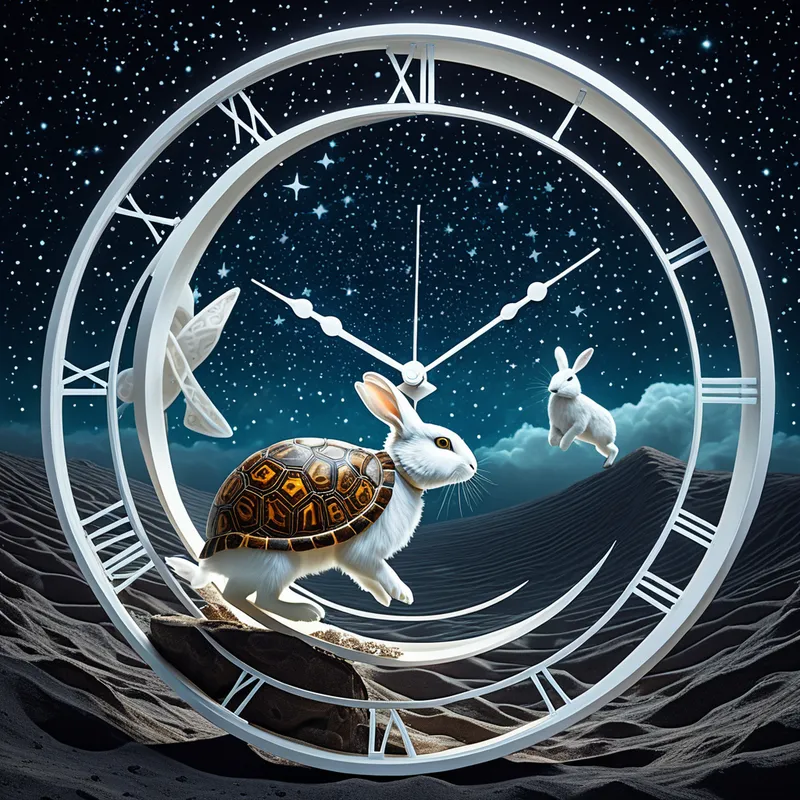
The alchemical process modeled here is the Nigredo transformed into the Albedo through the steadfast heat of the Vessel. The hare’s initial boast is the inflation of the prima materia—raw, flashy potential. His humiliation at the finish line is the necessary mortificatio, the death of the ego’s illusion of specialness and separateness.
The tortoise embodies the Vessel and the Athanor (the slow-burning furnace). Its unwavering pace is the Opus, the daily, unglamorous work of integration. It does not fight the hare; it out-endures him. It transmutes the leaden weight of time into the gold of wisdom.
The true alchemy is not in winning the race, but in becoming the being for whom the race is irrelevant. The prize is not the bloom, but the nature of the shell that receives it.
For the modern individual, the myth calls for a sacred skepticism of haste. It asks us to identify where we are the hare, leveraging cleverness to avoid depth, and where we might cultivate the tortoise—the part of us that can commit to a pace so slow it feels like stillness, yet which carries us further than any frantic sprint ever could. The integration is the moment we no longer see hare and tortoise as adversaries, but as two necessary rhythms within a single psyche: the spark of inspiration (hare) must be married to the enduring will to manifest (tortoise). Only then does the journey to the peak become a pilgrimage of the whole being.
Associated Symbols
Explore related symbols from the CaleaDream lexicon:
- Tortoise — The embodied archetype of the Self, representing containment, ancient wisdom, and the slow, unstoppable momentum of psychic wholeness.
- Tortoise Shell — The protective boundary of the psyche and a map of cosmic order, symbolizing the structure necessary for inner growth and resilience.
- Journey — The path of individuation itself, where the manner of travel is more important than the speed, emphasizing process over destination.
- Mountain — The archetypal symbol of the ultimate goal, transcendence, and the arduous but rewarding ascent toward self-realization.
- Forest — The realm of the natural psyche, the unconscious where the race takes place, filled with both distractions (the hare’s nap) and sustaining life.
- Pride — The hubris of the conscious ego, the initial fuel that sets the conflict in motion and must be humbled for growth to occur.
- Time — The central antagonist and ally, perceived as a linear race by the hare and as a cyclical, embodied experience by the tortoise.
- Dream — The hare’s nap as a metaphor for the necessary descent into unconsciousness, where the conscious plan is disrupted by deeper rhythms.
- Root — The tortoise’s connection to the earth, symbolizing groundedness, stability, and drawing sustenance from the deep, unseen layers of the self.
- Order — The cosmic and psychic principle embodied by the tortoise’s inevitable victory, suggesting a deeper law that rewards consistency over chaos.
- Shadow — The hare’s arrogance and subsequent shame represent the rejected aspects of the psyche that must be acknowledged and integrated.
- Rebirth — The hare’s defeat is not an end, but the potential for a new beginning, a chance to rebuild an identity not based on speed alone.