The Tiger as Mountain God Myth Meaning & Symbolism
A Korean myth where a powerful tiger, through sacrifice and transformation, becomes the sacred guardian spirit of the mountain.
The Tale of The Tiger as Mountain God
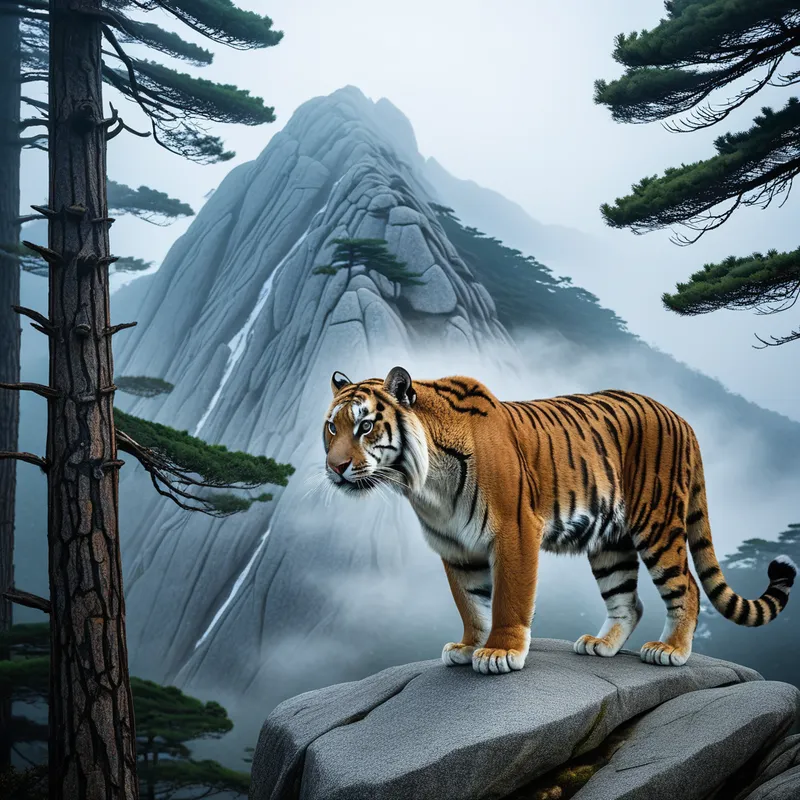
Listen, and hear the tale whispered by the wind through the sonamu and carried on the cold streams that birth themselves from stone. In the age when mountains were young gods and every valley held a breath, there lived a Tiger. He was not merely a beast of tooth and claw, but the very essence of the wild mountain—its untamed heart, its silent, watching rage. His roar shook the snow from the peaks, and his passage was the thunder of falling rock.
For generations, the people of the foothills lived in terror of him. He was Sansin and demon both—the absolute sovereign of the vertical world. He took their livestock, and sometimes, in the deep hunger of winter, he took their kin. They prayed to the mountain, offering rice and fruit, begging the stone and the forest for mercy from its furious king.
One bitter winter, a famine gripped the land. The deer grew thin and scarce. The Tiger’s great ribs pressed against his striped hide, and a fire of hunger, hotter than any sun, burned in his belly. Driven by this primal need, he descended to the very edge of the village, where the last thread of smoke rose from a solitary hut. Inside, an old Mudang lived alone. She had no fear, for she had spoken to the spirits of stream and stone all her life.
The Tiger burst through the frail door, his amber eyes coals in the gloom. The old woman did not scream. She looked into those eyes and saw not just hunger, but a deep, lonely sovereignty—a king starving in his own vast kingdom. “Great Lord of the Mountain,” she said, her voice steady as an ancient root. “You rule all you see, yet you are empty. You take, but you are not given to. What kind of god are you?”
Her words struck the Tiger like a physical blow. They echoed a truth his animal mind had never shaped: his power was absolute, yet it was sterile. It inspired only fear, not reverence. It commanded flight, not devotion. In that moment of shattered certainty, the hunter’s instinct died. The fire in his belly cooled to an ache of a different kind—a longing for a place not just feared, but honored.
Without a sound, he turned and vanished back into the forest. The famine deepened. The Tiger, weakened by hunger and this new, bewildering sorrow, came upon a wild boar—a final meal. But as he fought the fierce creature, he was mortally wounded. His life’s blood, the essence of his mountain power, began to seep into the frozen earth.
Crawling to a high cliff overlooking the village, he prepared to die. But as his vision faded, he saw the people below, more frail than ever. He saw the old Mudang pointing toward his perch. And in a final, defiant act of will, the Tiger did not let his spirit scatter to the winds. Instead, he poured it—all his strength, his territorial fury, his lonely majesty—into the mountain. His body became stone, his stripes the ridges and shadowed valleys, his breath the perpetual mist. He did not leave his kingdom; he became its eternal soul.
The next morning, the villagers found the mountain changed. It felt watchful, but protective. Where there was terror, there was now a profound awe. They built a small Sansingak at the spot where he had transformed. And when they prayed, they no longer prayed for mercy from the mountain god, but for the blessing of the Mountain God—the Tiger who had sacrificed his solitary, predatory form to become their sacred, sovereign guardian.
Cultural Origins & Context
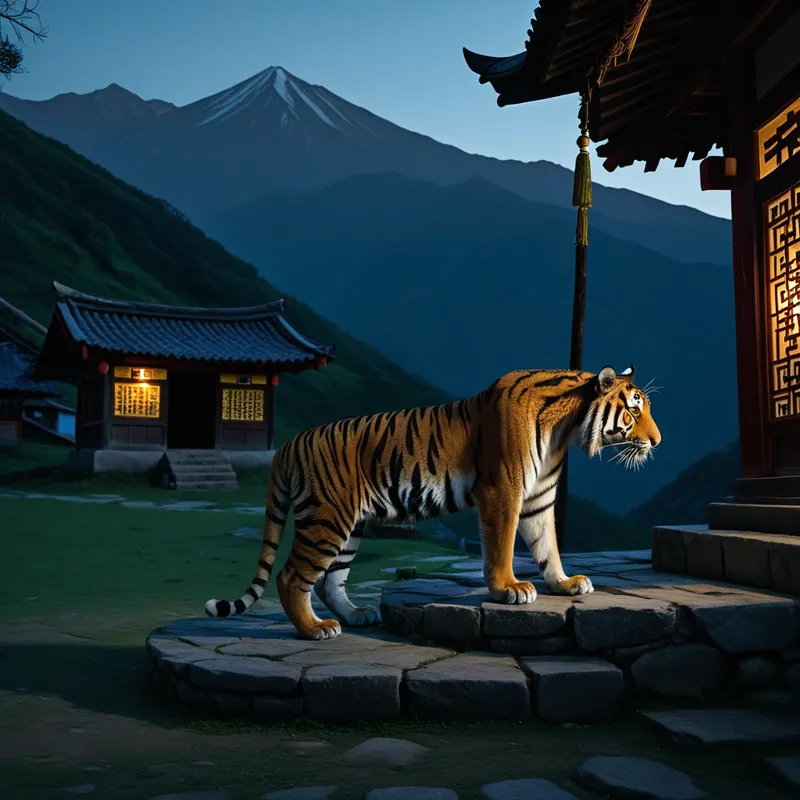
This myth is a cornerstone of Korea’s deep-seated San-shin belief, a tradition predating the arrival of organized Buddhism and Confucianism. It was not a story confined to a single text, but a living narrative passed down orally by shamans (Mudang), villagers, and hermits who lived in intimate dialogue with the mountainous landscape. Its primary function was explanatory and integrative. It explained the palpable, awe-inspiring, and often dangerous presence of the mountains that dominate the Korean peninsula. More importantly, it provided a framework for humans to relate to that wild power.
The myth served as a psychic treaty between human civilization (the village in the foothills) and the untamed, unconscious wild (the mountain). By transforming the Tiger from a predatory threat into a divine guardian, the story ritualizes the process of moving from a relationship of fear and projection to one of respect and symbolic exchange. The Sansingak shrines, often featuring paintings or statues of a seated, benevolent old man with a tiger by his side, are the physical manifestation of this myth. The tiger is the mountain’s potent, animal spirit, now allied with and tempered by a wiser, humanized aspect (the old man), representing the successful integration of nature’s raw power into the cultural order.
Symbolic Architecture
At its core, this myth is about the [alchemy](/symbols/alchemy “Symbol: A transformative process of purification and creation, often symbolizing personal or spiritual evolution through difficult stages.”/) of sovereignty. The [Tiger](/symbols/tiger “Symbol: The tiger symbolizes power, courage, and primal instincts, often representing untamed energy and aggression.”/) begins as the archetypal [Shadow](/symbols/shadow “Symbol: The ‘shadow’ embodies the unconscious, repressed aspects of the self and often represents fears or hidden emotions.”/)—the feared, autonomous force of [nature](/symbols/nature “Symbol: Nature symbolizes growth, connectivity, and the primal forces of existence.”/) that exists outside the [village](/symbols/village “Symbol: Symbolizes community, connection, and a reflection of one’s roots or origins.”/) walls, the [human](/symbols/human “Symbol: The symbol of a human represents individuality, complexity of emotions, and social relationships.”/) ego’s domain. He is pure, unreflected instinct and power.
The journey from predator to protector is the soul’s journey from autonomy to authentic authority.
The Tiger’s [hunger](/symbols/hunger “Symbol: A primal bodily sensation symbolizing unmet needs, desires, or emotional voids. It represents craving for fulfillment beyond physical nourishment.”/) represents not just physical need, but the spiritual [poverty](/symbols/poverty “Symbol: A state of lacking material resources or essential needs, often symbolizing feelings of inadequacy, vulnerability, or spiritual emptiness in dreams.”/) of power exercised in [isolation](/symbols/isolation “Symbol: A state of physical or emotional separation from others, often representing a need for introspection or signaling distress.”/). His confrontation with the Mudang is the critical [moment](/symbols/moment “Symbol: The symbol of a ‘moment’ embodies the significance of transient experiences that encapsulate emotional depth or pivotal transformations in life.”/) of recognition. The human [consciousness](/symbols/consciousness “Symbol: Consciousness represents the state of awareness and perception, encompassing thoughts, feelings, and experiences.”/) (the Mudang) holds up a mirror to the raw psyche (the Tiger), asking it to account for the quality of its rule. This shatters the Tiger’s identification with mere instinct and introduces the possibility of [relationship](/symbols/relationship “Symbol: A representation of connections we have with others in our lives, often reflecting our emotional state.”/).
The mortal wound and subsequent transformation are the pivotal symbols. The Tiger does not simply die; he performs a conscious act of psychic sacrifice. He surrenders his isolated, predatory form—the egoic identification with raw power—and invests his essence into a greater, enduring [structure](/symbols/structure “Symbol: Structure in dreams often symbolizes stability, organization, and the framework of one’s life, reflecting how one perceives their environment and personal life.”/): the [Mountain](/symbols/mountain “Symbol: Mountains often symbolize challenges, aspirations, and the journey toward self-discovery and enlightenment.”/) itself, a [symbol](/symbols/symbol “Symbol: A symbol can represent an idea, concept, or belief, serving as a powerful tool for communication and understanding.”/) of the enduring Self. He becomes the [spirit](/symbols/spirit “Symbol: Spirit symbolizes the essence of life, vitality, and the spiritual journey of the individual.”/) of the place, the genius loci. This transforms his power from something that takes (preys upon) to something that is (provides a [foundation](/symbols/foundation “Symbol: A foundation symbolizes the underlying support systems, values, and beliefs that shape one’s life, serving as the bedrock for growth and development.”/), a context, a sacred [boundary](/symbols/boundary “Symbol: A conceptual or physical limit defining separation, protection, or identity between entities, spaces, or states of being.”/)).

The Dreamer’s Resonance
When this myth stirs in the modern dreamer, it often signals a profound confrontation with one’s own inner “Tiger”—the aspect of the psyche that feels fiercely autonomous, powerful, perhaps rageful or isolated in its strength. Dreaming of a powerful, threatening tiger can indicate a raw, untamed instinct or talent that the conscious ego fears and rejects.
The dream may progress to scenes of the tiger wounded, or of the dreamer facing the tiger without weapons. This mirrors the Tiger’s meeting with the Mudang: it is the moment the ego stops trying to slay or flee from this powerful inner force and instead turns to face it, to see it. The somatic experience can be one of trembling awe, a mix of terror and profound respect.
A dream of a tiger transforming into a landscape, or of a mountain that feels alive and watchful, signals the successful, ongoing process of integration. The raw power is no longer a separate beast to be managed, but is becoming the very ground of one’s being—a source of inner authority and resilience. The dreamer may wake with a sense of solemn strength, a feeling of having made a sacred pact with a deeper part of themselves.
Alchemical Translation
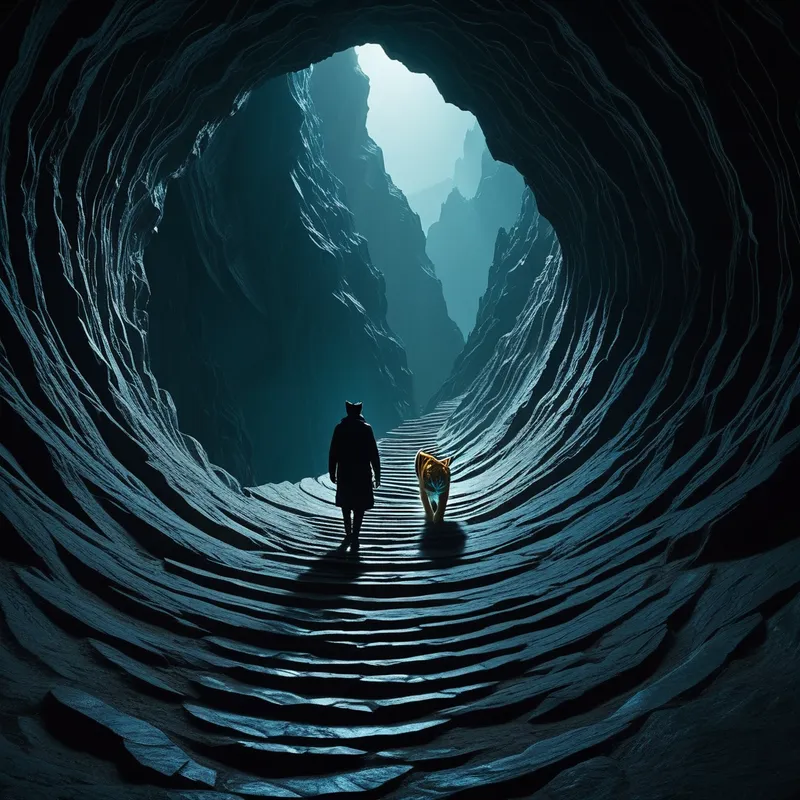
For the individual, the myth of the Tiger as Mountain God maps the arduous path of Individuation, specifically the integration of the Shadow and the realization of the Self. We all harbor an inner Tiger: a reservoir of instinctual energy, primal emotion, and autonomous will that often feels at odds with our civilized persona.
The first stage is projection: we experience this power as an external threat—a boss who enrages us, a circumstance that feels predatory, an addiction that stalks us. The “village” of our conscious identity feels besieged.
The turning point is the confrontation and recognition, often precipitated by a crisis (the famine, the wound). This is the painful but necessary moment when we must cease projecting and instead own this power. We must ask our inner Tiger, “What kind of ruler are you?” This involves acknowledging our own capacity for rage, our will to power, our primal needs, without immediately condemning them.
The sacrifice is not of the power itself, but of the form in which we hold it—the isolated, ego-centric identification with it.
The final, alchemical stage is transmutation through sacrifice. We do not kill the Tiger (repression), nor do we let it run wild (possession). We sacrifice its old, isolated form. We allow that fierce, instinctual energy to be wounded by the realities of relationship and responsibility, and in that vulnerable state, we consciously choose to let it become something greater. We let our raw ambition become stewardship. We let our fierce protectiveness become grounded wisdom. We let our solitary strength become the foundational, sacred mountain upon which a more complete life can be built. The Tiger does not disappear; it becomes the God of the Mountain—the integrated, sovereign Self.
Associated Symbols
Explore related symbols from the CaleaDream lexicon:
- Tiger — The raw, instinctual power of the psyche, autonomous and fearsome, representing the untamed Shadow that must be integrated to achieve true sovereignty.
- Mountain — The enduring, foundational structure of the Self; the sacred domain where transformation occurs, symbolizing stability, challenge, and spiritual ascent.
- Sacrifice — The pivotal act of surrendering an old, isolated form of power or identity so that its essence can be transmuted into a greater, more integrated state of being.
- Mountain Temple — The sacred inner space, the Sansingak of the soul, where a conscious relationship with one’s instinctual and spiritual power is maintained through reverence and ritual.
- Shadow — The repressed, wild, and often feared aspect of the personality, embodied by the predatory tiger, which holds immense energy necessary for wholeness.
- Mountain Path — The arduous, winding journey of individuation, leading from the village of the ego up to the summit where one confronts and integrates the powerful forces within.
- Mountain Peak — The moment of culmination and transformation, where the perspective shifts from isolated struggle to a sovereign view of one’s entire psychic landscape.
- God — The archetype of ultimate authority and wholeness, achieved when the Tiger’s raw power is successfully integrated into the enduring structure of the Mountain (Self).
- Ritual — The conscious, repeated practice—like prayer at a shrine—that formalizes the relationship between the human ego and the vast, instinctual power of the deeper psyche.
- Sovereignty — The mature state of rulership that emerges not from domination, but from the sacred integration of wild power (Tiger) with enduring structure (Mountain).