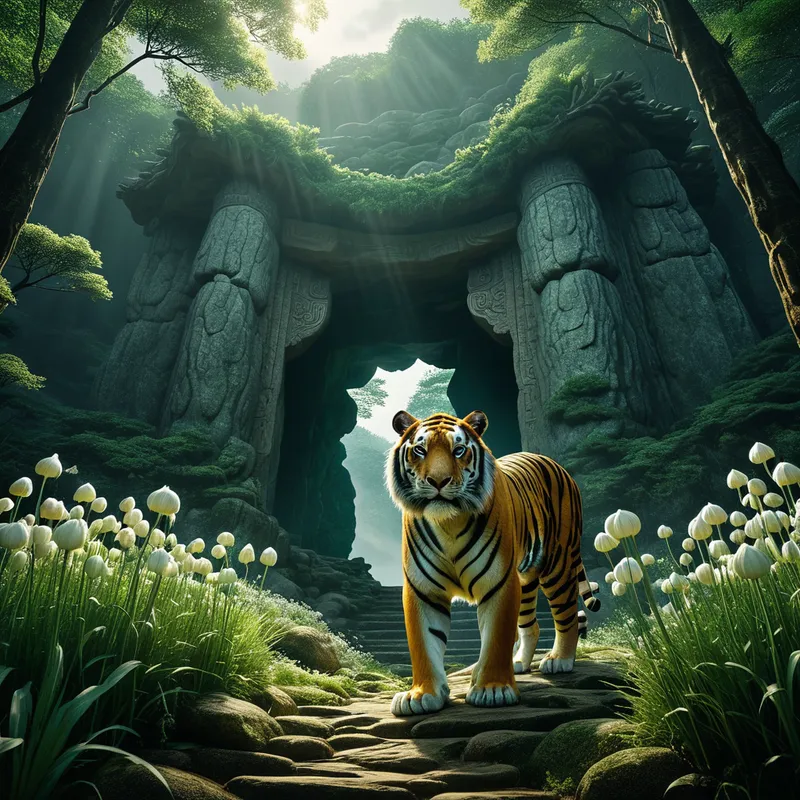
The Tiger and the Bear Myth Meaning & Symbolism
A primal bear endures a dark trial of patience and will to become human, founding a lineage, while the impatient tiger remains forever in the wild.
The Tale of The Tiger and the Bear
In the time before time, when the world was raw and the mountains whispered secrets to the clouds, there lived a great and lonely god-king. His name was Hwanung, son of the Lord of Heaven. He descended from the celestial realm to the peak of Mount Taebaek, and there he established his sacred city, ruling over the winds, the rain, and the clouds. He brought with him the laws of heaven and the arts of civilization, yet his heart yearned for a people to govern, for a lineage to carry his divine wisdom into the earth.
Below his luminous city, in the deep, shadowed valleys where the ancient pines stood guard, two powerful souls watched him with desperate longing. One was a Tiger, massive and striped with the darkness of the forest, his muscles coiled like river currents. The other was a Bear, solemn and immense, her eyes holding the patience of stone. Both creatures, in their wild hearts, burned with a singular desire: to shed their beastly forms and become human, to dwell in the light of Hwanung’s grace.
They climbed the sacred mountain and prostrated themselves before the divine king. Their plea was a raw, wordless cry that echoed in the stillness. Hwanung, moved by their profound yearning, looked upon them. He took twenty-one cloves of garlic and a bundle of sacred mugwort. “Your wish is not impossible,” he intoned, his voice like distant thunder. “Take these. Enter that dark cave and consume only this for one hundred days. Endure the darkness, the hunger, the solitude. If your resolve holds, you will be transformed.”
The Tiger and the Bear took the offerings and entered the cavern’s maw. The darkness was absolute, a velvet pressure against their fur. The pungent scent of garlic filled the space, a sharp, living smell that became their world. Days turned into a slow river of shadow. The Tiger’s mighty spirit, born for the open chase and the flash of conquest, could not bear the stillness. The hunger was a fire in his belly, but the confinement was a cage for his soul. The silence drove him mad. With a roar of frustration that shook the cave walls, he burst forth into the forest light, forever forsaking the trial, forever remaining a creature of magnificent, untamed instinct.
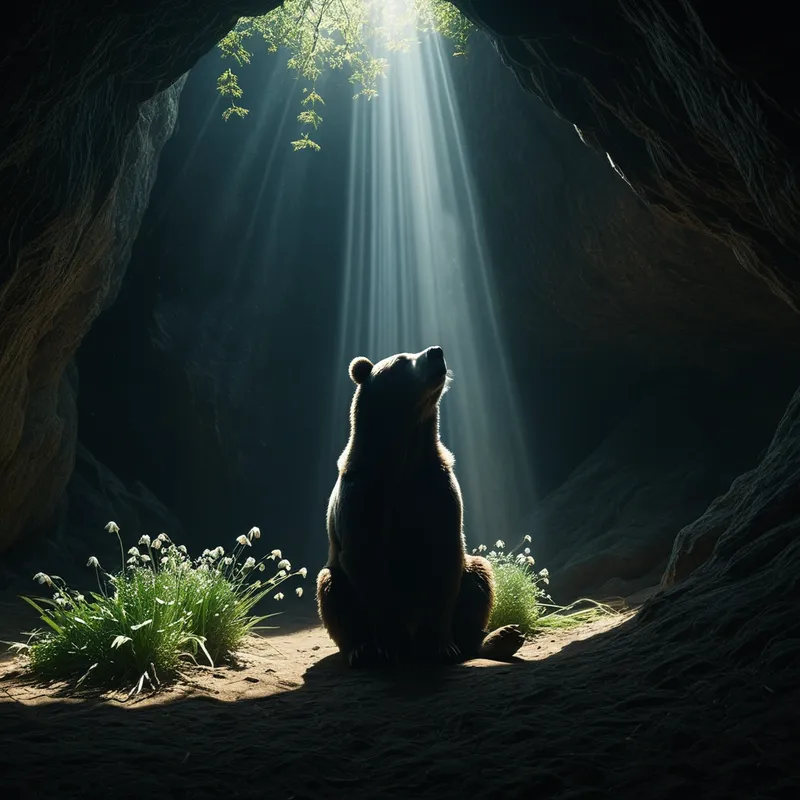
But the Bear remained. She settled into the earth of the cave. She let the darkness become her mantle. She consumed the bitter garlic and the sharp mugwort, not as food, but as a sacrament. She endured the gnawing void, the whispers of doubt, the crushing weight of time. She did not count the days; she became the days. Her animal consciousness began to dissolve in the long vigil, her fierce will tempered into pure, unwavering being. She held the vision of humanity within her like a single, unwavering star in the black sky of the cave.
On the hundredth day, a tremor passed through the mountain. The darkness in the cave softened, not from an external light, but from a light growing within. Where the great Bear had lain, now knelt a woman. Her form was human, radiant with the strength of the earth and the stillness of her ordeal. She stepped out into the sunlight, the first of her kind, and wept with a joy as deep as the roots of the world. Hwanung named her Ungnyeo. He took her as his wife, and from their union was born a son, Dangun Wanggeom, who would establish the great kingdom of Gojoseon and begin the long dawn of a people.
Cultural Origins & Context
This foundational myth is recorded in the Samguk Yusa (Memorabilia of the Three Kingdoms), a collection of legends, histories, and folklore compiled by the Buddhist monk Iryeon in the 13th century. Its origins are far older, rooted in the shamanic and totemic traditions of ancient tribal societies on the Korean peninsula. The tale served as a divine charter, a mythic explanation for the origin of the Korean people and their ruling lineage, directly linking them to the heavenly realm through Ungnyeo and Hwanung.
It functioned as more than a simple etiological story. It was a narrative of cultural identity, distinguishing the settled, agricultural, and civilized society (born from the enduring Bear) from the wild, unpredictable forces of the untamed frontier (represented by the impatient Tiger). The myth was likely told by shamans and storytellers, performed in rituals that connected the community to its sacred geography—Mount Taebaek—and to the primal, transformative powers of endurance and ritual purification symbolized by the cave, the garlic, and the mugwort.
Symbolic Architecture
At its [heart](/symbols/heart “Symbol: The heart symbolizes love, emotion, and the core of one’s existence, representing deep connections with others and self.”/), the myth presents a profound map of transformation, contrasting two fundamental responses to the call of the [spirit](/symbols/spirit “Symbol: Spirit symbolizes the essence of life, vitality, and the spiritual journey of the individual.”/). The [Tiger](/symbols/tiger “Symbol: The tiger symbolizes power, courage, and primal instincts, often representing untamed energy and aggression.”/) and the Bear are not mere animals but archetypal forces within the psyche and the cultural [landscape](/symbols/landscape “Symbol: Landscapes in dreams are powerful symbols representing the dreamer’s emotional state, personal journey, and the broader context of life situations.”/).
The Tiger represents raw, untamed instinct, magnificent power without discipline, and the impulsive will that cannot endure containment. It is the [aspect](/symbols/aspect “Symbol: A distinct feature, quality, or perspective of something, often representing a partial view of a larger whole.”/) of the psyche that seeks immediate gratification, revolts against limitation, and remains in a state of potent but chaotic potential. Its failure is not one of weakness, but of a [nature](/symbols/nature “Symbol: Nature symbolizes growth, connectivity, and the primal forces of existence.”/) incompatible with the specific [alchemy](/symbols/alchemy “Symbol: A transformative process of purification and creation, often symbolizing personal or spiritual evolution through difficult stages.”/) required for this form of becoming.
The Bear, however, embodies [the principle](/symbols/the-principle “Symbol: A fundamental truth, law, or doctrine that serves as a foundation for a system of belief, behavior, or reasoning, often representing moral or ethical standards.”/) of enduring containment. The cave is the ultimate [vessel](/symbols/vessel “Symbol: A container or structure that holds, transports, or protects something essential, representing the self, emotions, or life journey.”/) of transformation—the [womb](/symbols/womb “Symbol: A symbol of origin, potential, and profound transformation, representing the beginning of life’s journey and the unconscious source of creation.”/), the [ritual](/symbols/ritual “Symbol: Rituals signify structured, meaningful actions carried out regularly, reflecting cultural beliefs and emotional needs.”/) [chamber](/symbols/chamber “Symbol: A private, enclosed space representing the inner self, hidden aspects, or a specific stage in life’s journey.”/), the [crucible](/symbols/crucible “Symbol: A vessel for intense transformation through heat and pressure, symbolizing spiritual purification, testing, and alchemical change.”/) of the [soul](/symbols/soul “Symbol: The soul represents the essence of a person, encompassing their spirit, identity, and connection to the universe.”/).
To become human is not to add something, but to willingly submit to a sacred limitation until the old form can no longer hold the new consciousness.
The twenty-one cloves of [garlic](/symbols/garlic “Symbol: Garlic symbolizes protection, purification, and transformation, often representing both healing and social boundaries.”/) and mugwort are not a nutritional test, but a ritual diet. They are purifying, protective agents that alter [consciousness](/symbols/consciousness “Symbol: Consciousness represents the state of awareness and perception, encompassing thoughts, feelings, and experiences.”/) and separate the initiate from the ordinary world of foraging and hunting. The hundred days signify a complete cycle of [death](/symbols/death “Symbol: Symbolizes transformation, endings, and new beginnings; often associated with fear of the unknown.”/) and [gestation](/symbols/gestation “Symbol: A period of development and preparation before a significant birth or emergence, symbolizing potential, transformation, and the journey toward manifestation.”/). The Bear’s triumph is the triumph of the feminine principle of receptive holding, the mater ([mother](/symbols/mother “Symbol: The symbol of ‘Mother’ represents nurturing, protection, and the foundational aspect of one’s emotional being, often associated with comfort and unconditional love.”/)/matter) who contains the seed of spirit until it is ready to be born in a new shape. Ungnyeo is the [archetype](/symbols/archetype “Symbol: A universal, primordial pattern or prototype in the collective unconscious that shapes human experience, behavior, and creative expression.”/) of the one who bears the process, literally and psychically.
The Dreamer’s Resonance
When this myth stirs in the modern dreamer, it often manifests as a profound confrontation with a necessary but daunting period of incubation. Dreaming of being in a dark cave, a confined space, or undergoing a strict, purifying regimen points directly to the Bear’s trial. The somatic feeling is one of pressure, containment, and a deep, instinctual hunger—not just for food, but for release, for meaning, for a breakthrough.
The presence of a tiger in such dreams may symbolize the part of the self that is restless, prideful, and desperate to escape the process. It is the voice that says, “This is taking too long,” or “I am not meant for this darkness.” The dream may present a literal choice at a threshold: to flee into familiar but unchanging landscapes (the forest of the Tiger) or to turn back into the darkness to see the ordeal through. This is the psyche’s enactment of a crucial developmental stage—the nekyia, or night sea journey—where one must hold still in the unconscious to be fundamentally remade.

Alchemical Translation
For the individual on the path of individuation, the myth models the essential process of psychic transmutation. The call from Hwanung is the call of the Self, the central, organizing archetype of the psyche, inviting the ego-consciousness to a higher integration.
The first step is the descent into the cave—the voluntary engagement with the unconscious (the shadow, the complexes, the unlived life). This is an act of supreme courage. The ego, like the Tiger, initially balks; it wants to solve, to act, to remain in control. The alchemical work begins when the ego learns to emulate the Bear: to contain the conflict, to sit with the tension of opposites, to endure the “garlic and mugwort” of analysis, introspection, or painful life circumstances without fleeing into distraction or old patterns.
The hundred days in the cave is the opus, the long, patient work of allowing the conscious and unconscious to commune until a tertium non datur—a third, transcendent thing—is born.
The birth of Ungnyeo is the emergence of a new psychological attitude, one that integrates the enduring, grounded strength of the instinctual world (the Bear) with the divine spark of consciousness and culture (Hwanung). The resulting child, Dangun, is the nascent Self, the founding of a new, more authentic inner kingdom. The Tiger is not destroyed or vilified; it remains a vital part of the psychic ecology, the necessary wildness that borders and defines the civilized center, a reminder of the power that was sacrificed for, and thus sanctifies, the transformation.
Associated Symbols
Explore related symbols from the CaleaDream lexicon:
- Bear — The central archetype of endurance, maternal containment, and the willingness to undergo a dark incubation to achieve a higher state of being.
- Tiger — The archetype of magnificent, untamed instinct and impulsive power that refuses the containment necessary for this specific alchemical transformation.
- Cave — The primal womb, the ritual crucible, and the psychological vessel where the old self is dissolved in darkness so the new self can gestate.
- Garlic — The purifying and protective agent of the ritual diet, symbolizing the bitter but necessary sustenance that separates the initiate from ordinary life.
- Mountain — The sacred axis mundi where heaven and earth meet, representing the lofty goal of transformation and the arduous climb toward spiritual attainment.
- Transformation — The core process of the myth, the alchemical change from a beast-state of pure instinct to a human-state of integrated spirit and culture.
- Darkness — Not evil, but the fertile, necessary ground of potential, the void in which the seed of new consciousness must be patiently held.
- Light — The emergent consciousness born from enduring the darkness, represented by Ungnyeo stepping from the cave and the divine lineage she founds.
- Patience — The supreme virtue enacted by the Bear, the active, willful endurance of tension over time that is the engine of true metamorphosis.
- Hunger — The primal drive, here transmuted from a physical need into a spiritual craving, the motivating force that must be endured and redirected.