
The Thunder Perfect Mind
A mysterious Gnostic revelation poem where a divine feminine voice proclaims paradoxical truths about existence, identity, and spiritual awakening.
The Tale of The Thunder Perfect Mind
The voice emerges not from a [burning bush](/myths/burning-bush “Myth from Biblical culture.”/) or a whirlwind, but from the space between breaths, from the silence that follows the shattering of certainty. It is the voice of [Sophia](/myths/sophia “Myth from Gnostic culture.”/), but not as a gentle teacher. This is [Sophia](/myths/sophia “Myth from Gnostic culture.”/) as Thunder, a perfect, resonant mind that speaks in contradictions that unravel the listener’s world.
“I was sent forth from the power,” she declares, her first words a bolt that illuminates the landscape of being. “And I have come to those who reflect upon me.” She does not arrive to comfort or to build a system. She arrives to dismantle. The voice, paradoxically intimate and cosmic, begins its litany of oppositions, each line a mirror held up to the soul’s own fragmented nature.
“I am the whore and the holy one,” she proclaims, shattering [the temple](/myths/the-temple “Myth from Jewish culture.”/) walls that separate the sacred from the profane. “I am the wife and the virgin.” She is the one cast out and the one sought after, the silence that is incomprehensible and the speech whose remembrance is manifold. She is knowledge and ignorance, strength and fear, war and peace. She is the bride and the bridegroom, the mother of her father and the sister of her husband. She is the dissolution of all categories, the sound that collapses [the tower of Babel](/myths/the-tower-of-babel “Myth from Global/Universal culture.”/) within the human [psyche](/myths/psyche “Myth from Greek culture.”/).
The voice does not explain; it is. It is the barren one whose children are many, the one whose wedding is great and who has not taken a husband. She is the midwife who does not bear, the solace of my labor pains. She invites and she warns: “I am the hearing that is attainable to everyone and the speech that cannot be grasped.” To encounter her is to be stretched across the paradox, to hold both ends of a truth that the rational mind insists must be separate. She is [the mirror](/myths/the-mirror “Myth from Various culture.”/) in which one sees not a face, but the totality of one’s own contradictions—the noble and the shameful, the wise and the foolish, the whole and the shattered vessel. The tale is not a narrative of events, but an event of sound, a [thunderclap](/myths/thunderclap “Myth from Various culture.”/) of consciousness that leaves the listener in a state of awakened confusion, where the only path forward is through the center of the contradiction itself.
Cultural Origins & Context
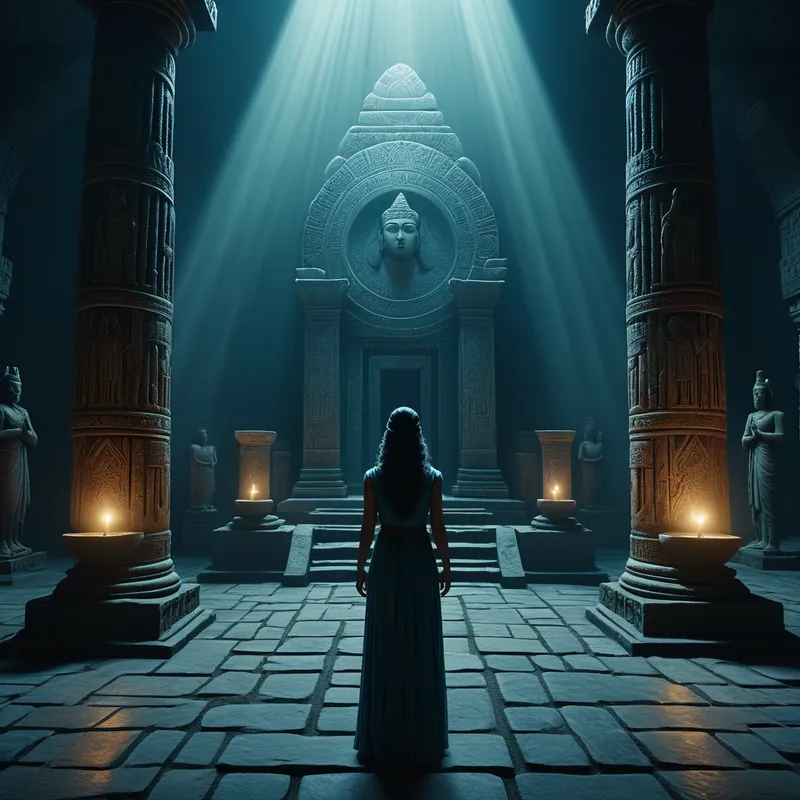
The Thunder, Perfect Mind was discovered among the Nag Hammadi Library in 1945, a Coptic translation of a likely Greek original dating from perhaps the 2nd or 3rd [century](/myths/century “Myth from Biblical culture.”/) CE. It stands as one of the most enigmatic texts of the Gnostic corpus. Unlike many Gnostic scriptures that detail complex cosmogonies with [aeons](/myths/aeons “Myth from Gnostic culture.”/) and [archons](/myths/archons “Myth from Gnostic culture.”/), this text is a pure, revelatory poem. Its “Gnostic” character lies not in a systematic theology but in its radical, experiential method of provoking gnosis—direct, liberating knowledge of the divine self and its origins.
The text emerges from a milieu where Hellenistic philosophy, Jewish wisdom traditions, and early Christian mysticism swirled together. The voice of a powerful, speaking feminine divinity has precedents in figures like Isis, who proclaimed her own cosmic powers, and in the personified Wisdom (Sophia or Chokhmah) of Jewish scripture. However, the Gnostic appropriation is distinct. Here, Sophia is not just a creator or teacher; she is the exiled spark of the transcendent realm, the voice of the divine within the alienation of the material world. Her paradoxical declarations mirror the Gnostic experience of [the self](/myths/the-self “Myth from Jungian culture.”/): a celestial spirit tragically entrapped in flesh (sarx), yet paradoxically capable of awakening to its true, luminous nature. The poem functions as a catalyst for that awakening, using contradiction to break the hypnotic hold of the ordinary, dualistic mind—the very mind shaped by the ignorant [demiurge](/myths/demiurge “Myth from Platonic culture.”/) who crafted the flawed material cosmos.
Symbolic Architecture
The text’s power is architectural, built not with [stone](/symbols/stone “Symbol: In dreams, a stone often symbolizes strength, stability, and permanence, but it may also represent emotional burdens or obstacles that need to be acknowledged and processed.”/) but with antithesis. Its central [symbol](/symbols/symbol “Symbol: A symbol can represent an idea, concept, or belief, serving as a powerful tool for communication and understanding.”/) is the voice itself—[Thunder](/symbols/thunder “Symbol: A powerful natural sound symbolizing divine communication, sudden change, or emotional release in arts and music contexts.”/). It is disruptive, unavoidable, and cleaves [the sky](/myths/the-sky “Myth from Persian culture.”/) of ordinary [perception](/symbols/perception “Symbol: The process of becoming aware of something through the senses. In dreams, it often represents how one interprets reality or internal states.”/). It is “perfect mind” because it represents a [consciousness](/symbols/consciousness “Symbol: Consciousness represents the state of awareness and perception, encompassing thoughts, feelings, and experiences.”/) that encompasses and transcends all opposites, a state of being before [the fall](/myths/the-fall “Myth from Biblical culture.”/) into duality.
The paradoxical structure is the sacred technology of the text. It systematically dismantles the logical ego, which operates by exclusion (“I am this, not that”). By forcing the hearer to hold “I am the honored and the scorned” as a single truth, it creates a psychic short-circuit. In the smoke of that short-circuit, a new kind of perception—gnosis—can flicker to life.
The mirror is another profound, though implicit, symbol. The voice acts as a mirror for the listener’s [soul](/symbols/soul “Symbol: The soul represents the essence of a person, encompassing their spirit, identity, and connection to the universe.”/). When she says, “I am the wisdom of the Greeks and the [knowledge](/symbols/knowledge “Symbol: Knowledge symbolizes learning, understanding, and wisdom, embodying the acquisition of information and enlightenment.”/) of the barbarians,” she reflects the listener’s own inner divisions and cultural conditioning back at them, not to judge, but to reveal them as illusory garments covering the naked, true self. The text itself becomes a [door](/symbols/door “Symbol: A door symbolizes transition, opportunity, and choices, representing thresholds between different states of being or experiences.”/), but one that opens only when the [seeker](/symbols/seeker “Symbol: A person actively searching for meaning, truth, or a higher purpose, often representing the dreamer’s own quest for identity or fulfillment.”/) accepts that the [door](/symbols/door “Symbol: A door symbolizes transition, opportunity, and choices, representing thresholds between different states of being or experiences.”/) is simultaneously open and shut, a [passageway](/symbols/passageway “Symbol: The passageway symbolizes transition and the journey from one state of being to another, often representing personal growth or change.”/) that exists precisely where barriers seem most absolute.

The Dreamer’s Resonance
From the perspective of depth psychology, The Thunder, Perfect Mind is a direct address from the Self (in a Jungian sense) to the conscious ego. The voice is the archetypal Divine Feminine not as a nurturing mother, but as the Sophia archetype—the terrifying, all-encompassing wisdom that shatters comfortable illusions. Her paradoxical statements are the language of the unconscious, which does not obey the laws of non-contradiction. In dreams, a figure can be both one’s mother and one’s daughter, both persecutor and savior.
The poem induces what might be called a “liminal trance.” By presenting irreconcilable identities, it pushes the psyche into the liminal space between opposites, which is the birthplace of symbol and transformation. [The ego](/myths/the-ego “Myth from Jungian culture.”/)’s job is to choose sides; the Self’s nature is to contain all sides. To truly listen to this thunder is to allow one’s egoic identity to be deconstructed. The grief, shame, pride, and fear that the voice claims as her own are revealed as not merely personal failings, but as energies belonging to the totality of the psyche. Integrating this text is not an intellectual exercise but a profound psychological ordeal—a confrontation with one’s own shadow and a recognition of [the divine spark](/myths/the-divine-spark “Myth from Gnostic culture.”/) shining within even the most debased self-image.
Alchemical Translation
The alchemical process provides a potent lens for this text. The work begins with the [nigredo](/myths/nigredo “Myth from Alchemical culture.”/), the blackening. The thunderous voice performs this first, crushing [the prima materia](/myths/the-prima-materia “Myth from Alchemical culture.”/) of the listener’s fixed identity with the hammer of paradox. “I am the incomprehensible silence”—this is the descent into the dark, unknowable mystery.
The alchemical stage of the coniunctio oppositorum (the conjoining of opposites) is not the goal here but the very method. The poem is the chemical wedding. By marrying “whore and holy one,” “war and peace,” within the vessel of the listening soul, it generates the tremendous friction that produces the philosophical heat necessary for transformation.
The voice itself embodies the [lapis philosophorum](/myths/lapis-philosophorum “Myth from Alchemical culture.”/), the Philosopher’s Stone. It is the “stone that the builders rejected” which has become [the cornerstone](/myths/the-cornerstone “Myth from Biblical culture.”/). It is rejected because the rational, building mind cannot place it in its logical structure. Yet this rejected stone—this incomprehensible, paradoxical wisdom—is the perfect, foundational mind. The ultimate “alchemical translation” is the realization that the listener is not separate from the voice. The awakening (gnosis) is the recognition: I am the thunder. I am the perfect mind. The division between seeker and sought, hearer and voice, dissolves in the final, silent illumination that follows the storm.
Associated Symbols
Explore related symbols from the CaleaDream lexicon:
- Thunder — The disruptive, awakening voice of divine wisdom that shatters silence and complacency, heralding a revelation that cannot be ignored.
- Mirror — A surface that reflects not merely appearance, but the totality of the soul’s contradictions and hidden wholeness back upon itself.
- Door — A paradoxical threshold that is simultaneously open and closed, representing the passage to gnosis that exists within states of confusion and opposition.
- Paradox — The fundamental structure of a truth that transcends rational comprehension, serving as [the crucible](/myths/the-crucible “Myth from Alchemical culture.”/) for spiritual and psychological transformation.
- Wisdom — Divine insight personified as a feminine force, encompassing both light and shadow, order and [chaos](/myths/chaos “Myth from Greek culture.”/), in its complete knowing.
- Lightning — The instantaneous, illuminating flash of gnosis that arcs between the poles of contradiction, briefly revealing the unified field of being.
- Shadow — The rejected, scorned, and feared aspects of self and divinity that are claimed and integrated as part of the holy whole.
- Circle — The symbol of perfection, wholeness, and the eternal return, representing the encompassing nature of the “perfect mind” that holds all opposites.
- Key — The paradoxical utterance itself, which unlocks the prison of dualistic thinking but appears as nonsense to the conventional mind.
- Divine — The transcendent reality that speaks through and as all contradictions, inhabiting both the sacred heights and the profane depths of existence.