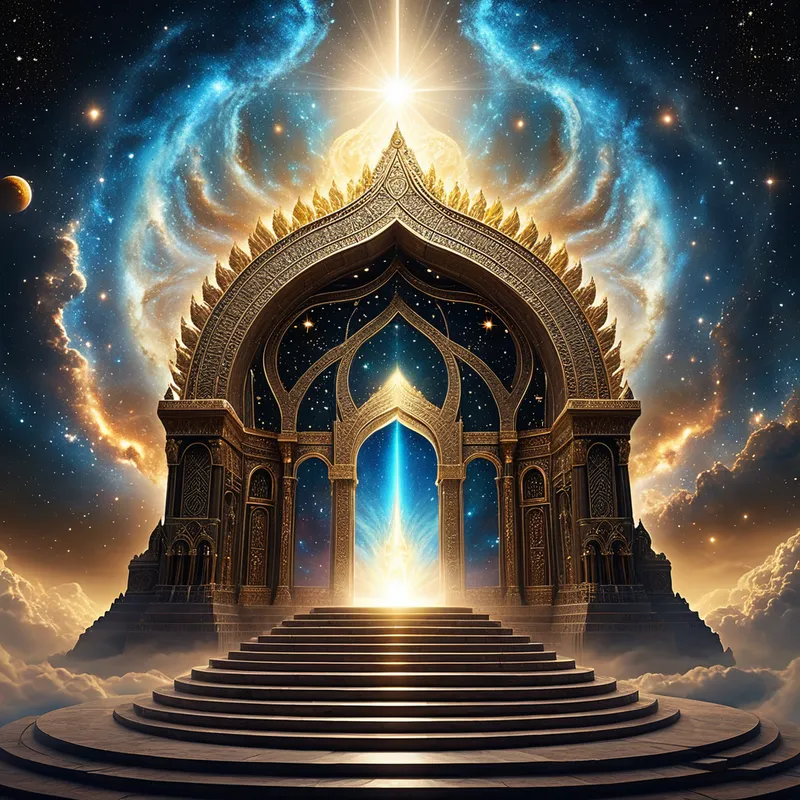
The Throne of God Kursi Myth Meaning & Symbolism
A vision of the divine Throne encompassing all creation, a symbol of ultimate sovereignty, mercy, and the sacred order that holds the cosmos together.
The Tale of The Throne of God Kursi
Listen, and let your heart be still. Before time was measured, before the first breath was drawn from the clay of Adam, there existed a Reality so vast, so complete, that all of creation is but a whisper within its chamber. This is the tale not of a beginning, but of an eternal Presence. The Presence of the Allah, the Most Merciful, the King of Kings.
And the King has a Throne.
Do not imagine gold or jewels, though all riches are but dust before it. The Kursi is the expanse of the heavens and the earth. It is not a chair, but the very stage of existence. Picture, if you can, the seven heavens and the seven earths. They are layered, one upon the other, like delicate plates of crystal and emerald. Now, place them within a vast ring. This ring is the Kursi. And the Kursi itself? It is but a footstool, lost in the desert of immensity that is the Arsh, the Supreme Throne.
The air around the Kursi hums with a frequency of pure awe. It is borne, not by pillars of stone, but by angels whose size shatters mortal understanding. Among them are the Hamalat al-Arsh. Their forms are of light upon light, and the strain of upholding this cosmic weight causes sweat like pearls to form upon their brows, forming rivers of light in the celestial realms.
Upon this Throne is seated the command of all things. From it flows the decree that spins galaxies into being and commands the rain to fall upon a single leaf. It is the source of the Lawh al-Mahfuz, from which the Pen writes all that was and will be. The conflict here is not of battle, but of scale—the human soul, a flickering candle, gazing up at this supernova of sovereignty. The rising action is the soul’s own expansion in recognition. The resolution is never conquest, but submission—Islam—to the order that emanates from this ultimate seat. To know of the Kursi is to feel the cosmos held, ordered, and infinitely cherished within a mercy as vast as the Throne itself.
Cultural Origins & Context
The mythos of the Kursi is not a folktale passed down by bards, but a sacred cosmology revealed within the Quran and elaborated upon in the Hadith. Its primary source is the famed <abbr title=“The “Verse of the Throne” from the Quran’s second chapter, Surah Al-Baqarah”>Ayat al-Kursi (2:255), recited daily by millions of Muslims worldwide. This verse is considered a pinnacle of theological and spiritual expression, describing God’s eternal, living, self-sustaining sovereignty.
The transmission was through revelation to the Prophet Muhammad and then through scholarly and mystical interpretation across centuries. Ulama and Sufis alike pondered its depths. For the orthodox, it established the framework of Tawhid—God’s complete otherness and absolute authority over creation. For mystics like Ibn Arabi, it became a map of the cosmos and the soul. Its societal function was multifaceted: as a theological anchor, a protective incantation (Ayat al-Kursi is often recited for safety), and a meditative tool to humble the ego and expand the heart towards the divine.
Symbolic Architecture
The Kursi is the ultimate [symbol](/symbols/symbol “Symbol: A symbol can represent an idea, concept, or belief, serving as a powerful tool for communication and understanding.”/) of cosmic order and containment. It represents the [vessel](/symbols/vessel “Symbol: A container or structure that holds, transports, or protects something essential, representing the self, emotions, or life journey.”/) that holds the multiplicity of creation within the unifying principle of divine will.
The Throne is not where God is located; it is the symbol that God is the location of all things.
Psychologically, it represents the Self—the innermost, transcendent core of the [personality](/symbols/personality “Symbol: Personality in dreams often symbolizes the traits and characteristics of the dreamer, reflecting how they perceive themselves and how they believe they are perceived by others.”/) around which the ego and other complexes orbit. The ego is like one of the heavens within the Kursi: important, structured, but contained within a much greater [reality](/symbols/reality “Symbol: Reality signifies the state of existence and perception, often reflecting one’s understanding of truth and life experiences.”/). The struggle of the “[hero](/symbols/hero “Symbol: A hero embodies strength, courage, and the ability to overcome significant challenges.”/)” in this myth is the ego’s struggle to comprehend its own smallness within this vast psychic [architecture](/symbols/architecture “Symbol: Architecture in dreams often signifies structure, stability, and the framing of personal identity or life’s journey.”/), and in doing so, to find its proper, humble, and secure place.
The angels symbolize the archetypal forces or psychic structures that “hold up” this inner order—principles of morality, [consciousness](/symbols/consciousness “Symbol: Consciousness represents the state of awareness and perception, encompassing thoughts, feelings, and experiences.”/), and the natural laws of the psyche. Their sweat signifies the tremendous [effort](/symbols/effort “Symbol: Effort signifies the physical, mental, and emotional energy invested toward achieving goals and personal growth.”/) required to maintain [psychic wholeness](/symbols/psychic-wholeness “Symbol: A state of complete integration between conscious and unconscious aspects of the psyche, representing spiritual unity and self-realization.”/) and integrity against the entropic forces of [chaos](/symbols/chaos “Symbol: In Arts & Music, chaos represents raw creative potential, uncontrolled expression, and the breakdown of order to forge new artistic forms.”/) and [fragmentation](/symbols/fragmentation “Symbol: The experience of breaking apart, losing cohesion, or being separated into pieces. Often represents disintegration of self, relationships, or reality.”/).
The Dreamer’s Resonance
When the Throne of the Kursi appears in modern dreams, it rarely manifests as a literal chair. Instead, one might dream of a vast, impossibly complex administrative center where all fate is decided, a monolithic and serene geometric form in space, or a feeling of being utterly held and witnessed by a benevolent, impersonal authority that fills the entire sky.
This dream signals a profound somatic and psychological process: the confrontation with the archetype of order. The dreamer is likely undergoing a crisis where their personal sense of control (the ego) is being overwhelmed. The psyche is presenting the image of a higher, transpersonal order to which they must submit to find peace. It is an invitation to stop trying to hold the universe together through personal will alone, and to trust in a larger, intelligent pattern. The awe and terror in the dream are the ego’s death throes; the profound peace that can follow is the birth of a relationship with the Self.
Alchemical Translation
The individuation process modeled here is not one of slaying dragons, but of sacred submission. The alchemical opus is the gradual realization that the ego is not the ruler, but a citizen within a divine kingdom.
The first stage (nigredo) is the crushing realization of one’s own limits, the “dust” feeling before the immensity of the Kursi. The conflict (mortificatio) is the ego’s rebellion against this truth. The turning point is the recitation of the “Ayat al-Kursi”—not as a verse, but as an inner act of acknowledging a sovereignty greater than one’s own will.
The gold is not achieved by conquering the Throne, but by discovering that your true essence has always been seated within its dominion.
The subsequent stages (albedo, citrinitas, rubedo) involve the purification and re-orientation of the personality around this new center. Personal desires and fears are seen as the “seven earths” contained within a greater structure. Life’s events are seen as inscriptions from the Lawh al-Mahfuz of the soul’s destiny. The final “transmutation” is a state of Islam—an integrated psyche where the ego willingly serves the directives of the Self, finding in that service its ultimate freedom and purpose. The individual becomes a conscious participant in the order they once only feared.
Associated Symbols
Explore related symbols from the CaleaDream lexicon:
- Throne — The central symbol of divine authority, sovereignty, and the ultimate seat of order from which all creation is governed and sustained.
- Sky — Represents the limitless, transcendent realm of the divine, the canvas upon which the reality of the Throne is conceptually projected.
- Order — The essential principle emanating from the Throne, the cosmic and psychic law that structures chaos into a harmonious, meaningful whole.
- Circle — Symbolizes the encompassing, infinite, and perfect nature of the divine sovereignty represented by the Kursi and the Arsh.
- Light — The primary substance of the divine realm, from which the Throne and its bearers are fashioned, representing knowledge, purity, and revelation.
- Temple — The microcosmic reflection of the Throne in the human world; a sacred space designed to evoke the order and presence of the divine seat.
- Spirit — The non-material essence that connects the human soul to the reality of the Throne, facilitating awe, submission, and recognition.
- Destiny — The content inscribed by divine command, flowing from the authority of the Throne, representing the pre-ordained path of all creation.
- God — The absolute, singular sovereign who is inseparable from the Throne, which is the symbol of His majestic authority and encompassing knowledge.
- Moon — A symbol of reflected light and measured time, governing cycles within the stable order established by the eternal, unchanging Throne.