The Threshold Myth Meaning & Symbolism
A myth of a traveler at a liminal gate, facing a guardian who offers a choice between a known world and an unknowable, transformative journey.
The Tale of The Threshold
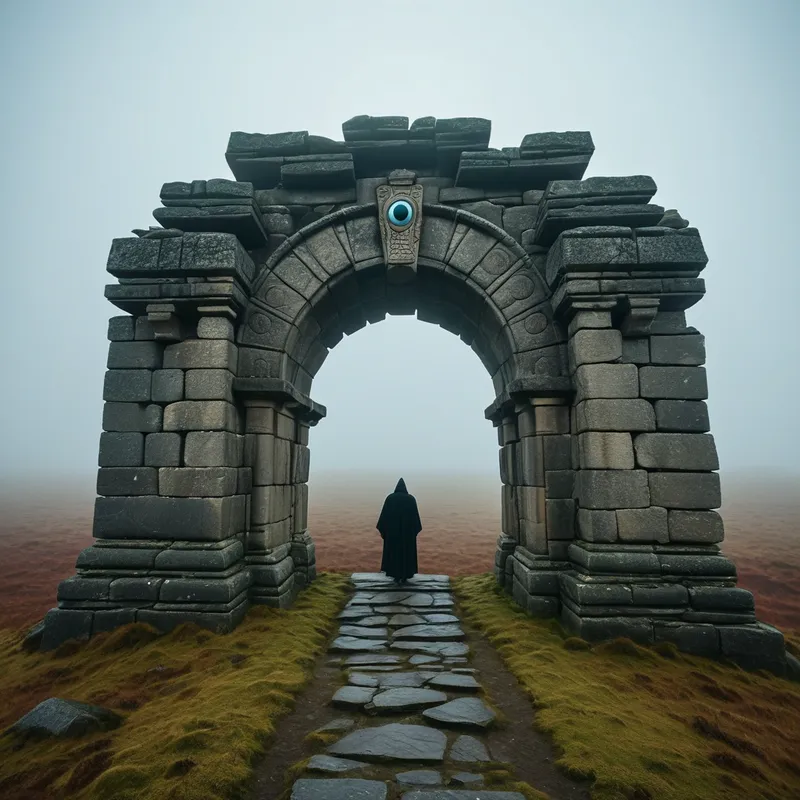
Listen, and let the mist of the old world gather. In a time when the map of the world was drawn in stories and the borders between realms were thin as a sigh, there was a place known only as The Moor of Mists. It was a land of whispering grasses and stones that remembered the footsteps of giants. And at its heart stood the Gate of Two Ways.
No one knew who built it. It was simply there, older than the oldest oak, a great arch of stone so worn by wind and rain it seemed less carved than grown from the bones of the earth. It led to no road anyone could see. On one side lay the familiar world of village, hearth, and field. On the other side, visible only through the arch, swirled a perpetual, gentle mist, shot through with the gold of a hidden sun and the silver of a veiled moon.
To this place came a traveler. Not a king or a warrior, but one weary of the same paths, whose soul itched with a quiet, persistent hunger. Let us call them The Wayfarer. As they approached the Gate, the air grew still and thick. The sounds of the moor—the wind, the distant cry of a curlew—fell away into a profound silence.
And then, the Guardian was there. They did not appear from the mist, but rather coalesced from the very substance of the threshold itself. Their form was shifting—sometimes an old man with eyes like deep wells, sometimes a woman with hair like flowing water, sometimes a figure of pure, featureless light. Their voice was not a sound, but a vibration felt in the marrow.
“You stand at the Sill of Becoming,” the Guardian intoned. “One step back is the world you know, with all its comforts and its certain sorrows. Its path is clear to its end. One step forward is the Uncharted. Its beginning is this mist. Its end is not for me to see. You may not return the person who enters. What is forged in the mist cannot be unmade. Choose.”
The Wayfarer’s heart hammered against their ribs. They looked back at the fading path that led to home, to love, to a life measured and known. They looked forward into the luminous, swallowing unknown. Fear was a cold stone in their gut. Yet, beneath it, that old hunger stirred—a pull deeper than fear.
They did not speak. Words had fled. With a breath that felt like their first and their last, the Wayfarer took the single, irrevocable step through the arch.
The stone of the threshold was not cold, but warm, like living skin. As they passed the midpoint, a sensation like a spiderweb breaking brushed their face. The world behind them did not vanish, but its sounds became the faintest of echoes, a memory of a dream. Before them, the mist did not part, but changed. It was no longer a barrier, but a medium, alive with potential shapes and half-heard songs. The path was not revealed. Instead, the Wayfarer understood, with a shock of terrifying clarity, that they would now have to become the path.
And the tale ends there, for the old tellers. What happened in the mist is not for the story. The story is the choice. The myth is the threshold itself.
Cultural Origins & Context
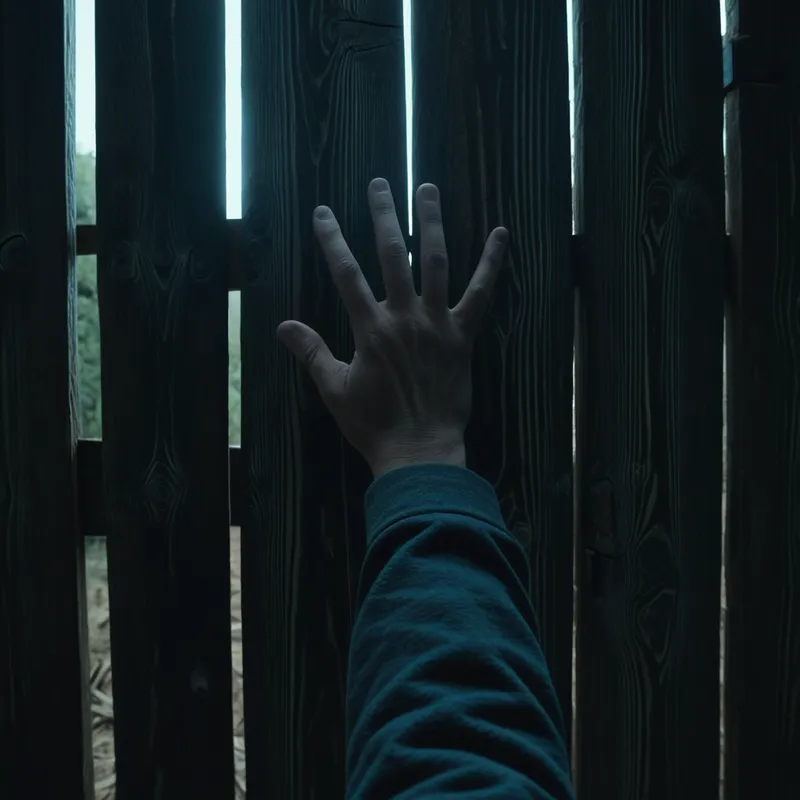
The myth of The Threshold is a foundational etiological tale found across countless folk traditions, from Celtic sidhe lore to Slavic stories of forest spirits guarding crossroads. It was not the property of priests or kings, but of the people. It was told by hearthsides, in fields during harvest, and to children on the cusp of adulthood. Its tellers were grandmothers, wandering bards, and wise folk who understood the land’s subtle geographies.
Its societal function was multifaceted. Practically, it served as a warning and a teaching story for those approaching literal thresholds: adolescents, those leaving home, the newly married, the dying. It ritualized the danger and necessity of change. More profoundly, it gave a shape to the universal human experience of existential choice. In a world governed by fate and the will of gods, this myth carved out a sacred space for individual agency. The Guardian does not command or judge; they merely present the terms. The power—and the burden—rests entirely with the human soul.
Symbolic Architecture
The myth’s power lies in its stark, elegant symbolism. The Wayfarer is the ego-consciousness, the part of us that navigates the known world and feels the call of something more. The Moor of Mists is the psyche’s borderland, where conscious reality blurs into the unconscious.
The Guardian is not an obstacle, but the embodiment of the choice itself—the psychic tension that must be fully faced before transformation can begin.
The Guardian represents the Self, or the deep, orchestrating intelligence of the psyche. It is neutral, presenting reality without illusion. Its shifting form shows it is beyond personal identity; it is the voice of the soul’s own destiny. The crucial symbol is the Gate. It is not a door to be unlocked, but an arch to be passed through. This signifies that true transformation is not about acquiring something new, but about transitioning from one state of being to another. The “spiderweb” sensation is the breaking of an old psychic structure, a subtle but permanent sundering.
The Dreamer’s Resonance
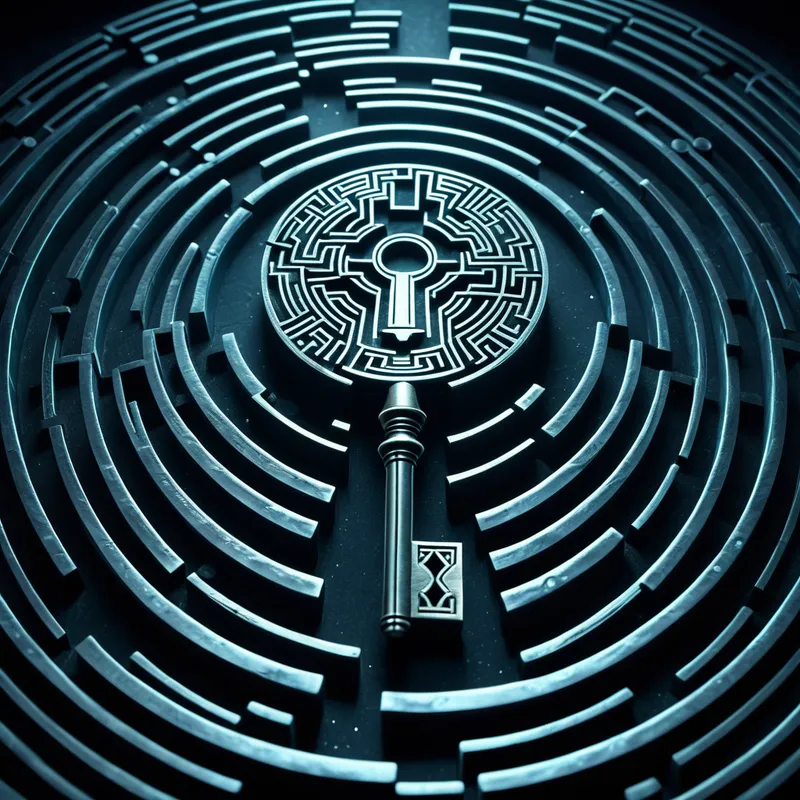
When this myth activates in the modern dreamer, it rarely appears as a stone arch on a moor. Its imagery is translated into the psyche’s contemporary lexicon. One dreams of standing before a career-changing decision, symbolized by two elevators, one familiar and one leading to unknown floors. One hesitates at the door of a therapy office, or at the literal doorstep of a new home. The dream may feature a bridge over a dark chasm, a fork in a road that wasn’t there before, or a phone ringing with a call that will change everything.
The somatic experience is key: the profound silence, the hammering heart, the weight in the limbs. This is the body registering the gravity of a psychic turning point. The dream is not forecasting an external event, but announcing that the psyche has reached a critical mass. The unconscious is presenting the dreamer with their own internal Guardian and Gate. To ignore such a dream is to feel a lingering stagnation, a “soul-itch.” To engage with it is to enter a process where the old self-concept begins to dissolve in the “mist” of the unconscious.

Alchemical Translation
In the alchemy of the soul, this myth models the first, most vital operation: separatio and the journey toward individuation. The known world behind the Gate represents the persona and the conscious ego’s territory—valuable, but incomplete. The mist represents the unconscious, teeming with unlived life, shadow material, and the seeds of the future Self.
The step through the arch is the active, willing descent into the unconscious—not as a tourist, but as a pilgrim seeking their own wholeness.
The modern individual’s “threshold” is any moment where one must choose between the security of a known, but limiting, identity and the terrifying freedom of psychological growth. This could be leaving a toxic relationship, changing a lifelong belief, or finally confronting a buried trauma. The Guardian’s warning—“You may not return the person who enters”—is the core truth of psychotherapy, spiritual awakening, or any deep creative endeavor. The process changes you. The old certainties burn away in the mist.
The triumph of the myth is not a victory over a monster, but the courage to embrace the process of becoming unknown to oneself. By stepping into the mist, the Wayfarer agrees to co-create their destiny with the unconscious. They move from being a subject of fate to a participant in their own genesis. In our lives, this alchemical translation means having the courage to dwell in the uncomfortable, fertile liminality between who we were and who we are becoming, trusting that the path will form under the footfall of our own authentic choices.
Associated Symbols
Explore related symbols from the CaleaDream lexicon: