The Thousand-Eyed Argus Myth Meaning & Symbolism
Zeus hides his lover Io, Hera sets the thousand-eyed Argus to guard her, and Hermes' lullaby brings a fatal, transformative sleep.
The Tale of The Thousand-Eyed Argus
Hear now the tale of a gaze that was a prison, and a song that was a key. It begins, as so many do, in the golden halls of Olympus, where the air is thick with the scent of ambrosia and the heavier scent of deceit. Zeus, the cloud-gatherer, whose desires shape the world, had cast his eye upon Io, a maiden of such beauty she seemed a shaft of moonlight given form. Fearing the wrath of his queen, he wrapped the world in a dark, rolling mist to hide his transgression.
But Hera sits upon a throne woven from suspicion. She descended from the heights, sweeping the manufactured fog aside with a wave of her hand. There stood Zeus, and beside him—not Io, but a heifer of such stunning white purity it hurt to look upon. The god’s transformation was swift, but the lie was transparent. Hera’s smile was colder than the north wind. “What a magnificent creature,” she said, her voice honeyed with malice. “A gift fit for a queen. I shall take her.”
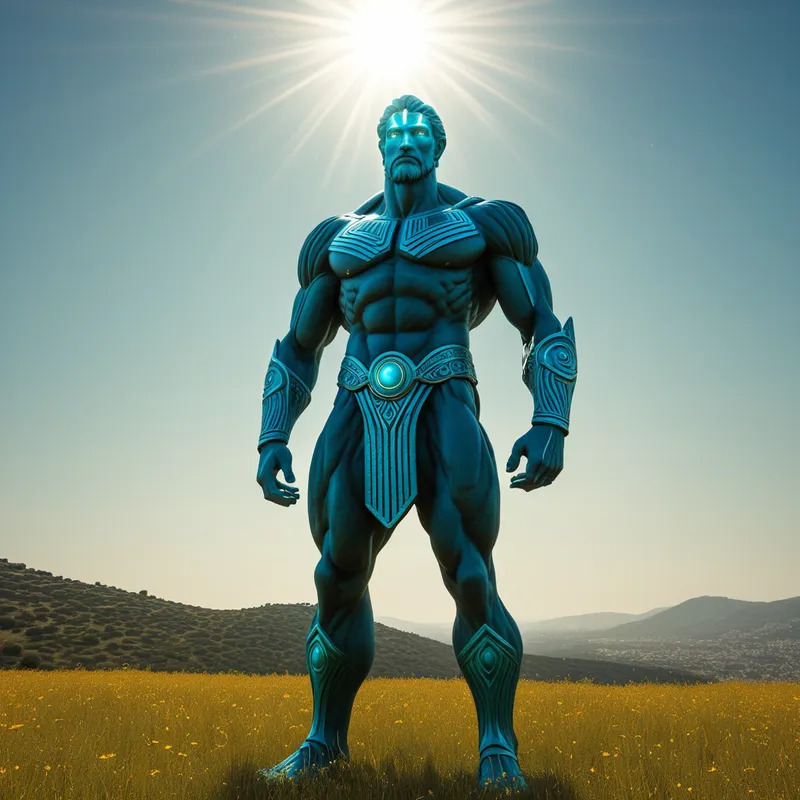
Trapped by his own ruse, Zeus could not refuse. And so Io was led away, her human mind screaming within the bovine form. But Hera was not finished. She needed a jailer no secret could escape. She summoned Argus Panoptes. He was a creature of an older order, a giant whose strength was not in his arms but in his perception. Across his entire body—his arms, his back, his very scalp—were set a thousand unblinking eyes. While some slept in shifts, others remained forever watchful, a living, breathing fortress of vigilance. Hera chained the white heifer to an ancient olive tree in a secluded grove and set Argus around her like a wall of sight.
There Io remained, under the endless, silent scrutiny. Argus never spoke. His thousand eyes were his only language, a relentless survey of every trembling muscle, every plaintive low. He saw the human terror in the beast’s gaze; he saw the god’s betrayal and the queen’s vengeance, and he simply watched. He was the perfect guardian, for he was consciousness itself, fractured into endless points of attention, allowing no thought, no memory, no hope of Io to slip into the unseen.
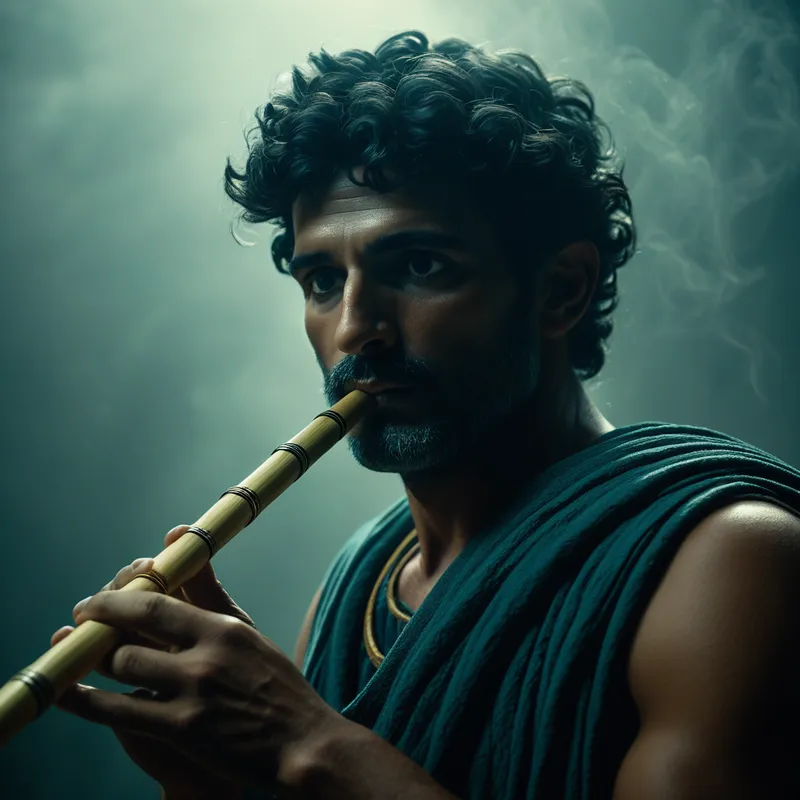
Zeus, writhing in guilt, called upon his most cunning son, Hermes, the psychopomp. “Lull the watcher to sleep,” he commanded. Hermes, the god of thresholds, descended. He shed his winged sandals and took the guise of a simple goatherd, strolling into the grove with a casual air. He sat near the immovable Argus and began to talk—of rustling reeds, of the invention of the shepherd’s pipe from a tortoise shell. Then, he drew out those very pipes and began to play.
The melody was not one of excitement, but of profound, descending peace. It was the sound of a river slowing, of leaves settling at dusk, of eyelids growing heavy after a long day’s watch. He played the song of Hypnos himself. One by one, the eyes of Argus began to dim. A pair on his ankle closed, then a cluster on his shoulder. The great giant, who had never known total rest, began to sway. Still, a few stubborn eyes remained open, fixed on Io. So Hermes wove his tale with his music, telling the story of the nymph Syrinx, who was transformed into reeds to escape pursuit—a story too close to Io’s own fate. In a final, surrendering sigh, the last eye closed. The thousand-eyed fortress fell into a complete and utter slumber. Then, with a swift, merciful motion, Hermes drew his blade and ended the watch forever.
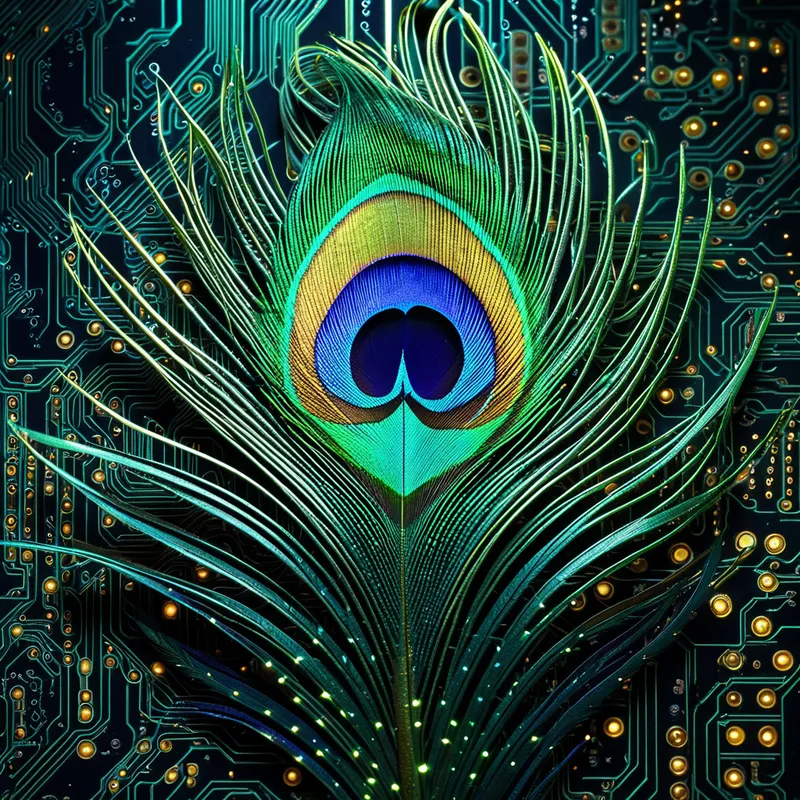
Hera, feeling the death of her servant, descended in a fury. She took the thousand eyes from the fallen giant and, with a tenderness reserved for sacred things, placed them upon the tail feathers of her favorite bird, the peacock. There they would remain forever, a shimmering, watchful constellation of her enduring mistrust. As for Io, driven mad and chased by a vengeful gadfly sent by Hera, her journey of transformation had only just begun.
Cultural Origins & Context
This haunting story comes to us primarily from the epic compendium of Hesiod, and later from the Roman poet Ovid. It was not merely a divine soap opera but a foundational narrative that explained natural phenomena (the origin of the peacock’s plumage) and explored profound cultural anxieties. In a world where the gods were capricious and the line between human, beast, and divine was fluid, the myth of Argus served as a cautionary tale about the consequences of transgression and the inescapable nature of divine justice (or jealousy).
Told by bards and woven into the fabric of Greek cosmological poetry, it functioned as an explanation for suffering that seemed arbitrary—why does a beautiful creature suffer? Why must vigilance fall to deception? It placed human-like passions into the cosmic realm, making the universe’s operations feel intimately personal and often terrifying. Argus himself may be a fragment of older, pre-Olympian mythology, a primordial giant of awareness absorbed and repurposed into the newer order’s dramas.
Symbolic Architecture
At its heart, this myth is a profound map of consciousness, its fragmentation, and its ultimate vulnerability.
Argus Panoptes is the personification of total, fragmented awareness. He is not wise, all-knowing consciousness, but paranoid, fractured attention. Each eye is a separate point of focus, unable to synthesize a whole picture. He represents the ego’s exhausting attempt to control reality through relentless surveillance—of our environment, of others, and most cruelly, of ourselves. He is the inner critic multiplied a thousandfold, the anxiety that never rests.
The watcher must sleep so the soul may awaken. Total vigilance is the enemy of transformation.
Io, trapped in her bovine form, is the instinctual, creative, or divine spark within us that has been captured and distorted by circumstance, shame, or the expectations of others (Hera’s “ownership”). She is the authentic self, forced into an alien shape and placed under constant, judgmental observation.
Hermes, the divine trickster, is the agent of the unconscious. He does not attack vigilance head-on with force, but subverts it with enchantment. His music is the language of the deep psyche—dreams, intuition, and numinous inspiration that can bypass the rigid guard of the ego. His act is not one of cruelty, but of necessary release. The death of Argus is the dissolution of a psychic structure that has become a prison.
Finally, Hera’s transference of the eyes to the peacock’s tail is the alchemical completion. Raw, paranoid vigilance is transformed into a thing of beauty, a display of integrative awareness. The peacock does not watch with those eyes; it displays them. The fragmented self, once mourned, can become the integrated self, adorned with the lessons of its own watchfulness.
The Dreamer's Resonance
When this myth stirs in the modern dreamscape, it signals a profound confrontation with the psyche’s own surveillance state. To dream of being watched by countless eyes—on walls, in the sky, or covering a figure—is to experience the somatic weight of hyper-vigilance. The dreamer is likely in a state of burnout, where the conscious mind is exhausted from monitoring threats, managing impressions, or suppressing unwanted parts of the self.
Dreaming of being Io, the trapped heifer, speaks to a feeling of being fundamentally misunderstood, caged by a role or a body that does not feel like one’s own, under the silent judgment of an internal or external authority. The dream may carry a deep sense of frustrated communication—a scream that comes out as a mute.
Conversely, to dream in the role of Hermes, playing a melody that puts watchful eyes to sleep, indicates the emergence of a reconciling force from within. It is the psyche’s innate wisdom beginning to dissolve a rigid complex through creativity, insight, or the acceptance of a paradoxical solution. The dream is a promise that the exhausting watch can end.
Alchemical Translation
The myth of Argus is a precise model for a critical phase of individuation: the dismantling of the oppressive, monolithic ego-complex to free the captive Self.
The process begins with the Captio—the capture of Io. This is any moment where our essential nature is betrayed, shamed, or forced into an inauthentic shape by internalized values (the Hera principle within). We then construct an Argus—a complex network of defensive vigilance, perfectionism, and self-monitoring to protect that wounded, hidden self and maintain the status quo.
The giant must die so that the god may be born. The death of one form of consciousness is the birth rite of another.
The Hermetic Intervention is the work of depth psychology. It is not an aggressive battle against our defenses, but a patient, cunning engagement with the unconscious. Through active imagination, dream work, or creative expression (the “music”), we speak the language of the complex itself, soothing its fears and narrating its own story back to it. We lull the tyrannical guard to sleep by acknowledging its purpose, thereby robbing it of its power.
The Slumber and Release is the moment of insight, the collapse of the old complex. It can feel like a death, a profound disorientation as a lifelong pattern of vigilance falls away. This is followed by the Transmutatio—Hera’s act. The energy that was bound up in paranoid watching is not destroyed but reclaimed. Those “eyes” become the integrated wisdom of experience, the beautiful, displayed pattern of a life examined and made whole. The peacock’s tail is the symbol of the individuated psyche: complex, glorious, and born from the sacred integration of all that was once used to imprison it.
Associated Symbols
Explore related symbols from the CaleaDream lexicon: