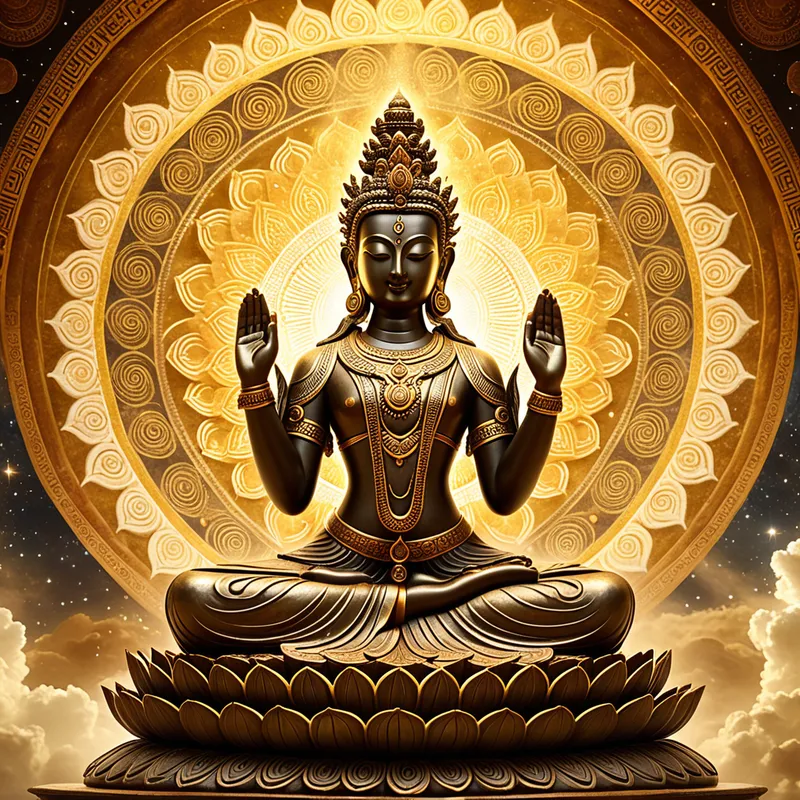
The thousand arms of Avalokite Myth Meaning & Symbolism
A bodhisattva, witnessing infinite suffering, shatters in despair. From the fragments, a thousand arms and eyes emerge, becoming an instrument of universal compassion.
The Tale of The thousand arms of Avalokite
Listen. In the time before time, when the fabric of reality was still thin with the breath of the first vow, there walked a being named Avalokiteśvara. His heart was a vast, clear lake, reflecting the sorrows and joys of every sentient thing in the ten directions. He had made a promise, a vow that shook the foundations of Samsara: “I shall not enter final bliss until every last being is freed from suffering.”
And so he listened. He heard the cry of the newborn and the sigh of the dying. He heard the grinding of tectonic plates as grief and the silent scream of stars burning out in distant galaxies. He poured his compassion like a healing rain over the worlds. Yet, one day, gazing from the Potalaka Peak upon the endless ocean of suffering, a terrible realization dawned. However many he saved, however far his mercy reached, the number of beings in anguish did not diminish. It was infinite. The weight of his own vow, the sheer, impossible scale of the pain he had sworn to alleviate, crashed upon him.
His serene form trembled. The lake of his heart, which once reflected perfectly, began to boil with a despair so profound it was cosmic. With a sound like a universe cracking, his head split apart from the agony of limitless empathy. His being could not contain the contradiction: boundless compassion meeting boundless suffering.
From the fragments of his shattered form, a light emerged. It was not the light of destruction, but of radical, desperate love. His spiritual father, the Amitābha Buddha, appeared. Seeing his spiritual child broken by the very depth of his vow, Amitābha gathered the luminous pieces. From each fragment of Avalokiteśvara’s fractured compassion, he fashioned a new arm. And in the palm of each new hand, he placed an all-seeing eye.
Where once stood a single, overwhelmed being, now stood a magnificent, awe-inspiring presence: a thousand arms fanned out like the rays of a divine sun, a thousand eyes seeing simultaneously into every hidden corner of anguish. The shattering was not an end, but a metamorphosis. The despair was alchemized into capacity. Now, he could hear every cry, see every hidden wound, and reach into every hell with a hand bearing the tools of salvation—a lotus, a book, a rosary, a vase of nectar, a gesture of fearlessness. The one who listens to the cries of the world had become the one whose embrace is the world itself.

Cultural Origins & Context
This myth originates within the Mahayana</abuddhism tradition, finding its most elaborate expressions in texts like the Kāraṇḍavyūha Sūtra. It is not a folktale but a core cosmological narrative that defines the bodhisattva ideal. The story was passed down through monastic recitation, intricate temple sculptures, and vibrant thangka paintings across Tibet, Nepal, China (where Avalokiteśvara becomes Guanyin), and Japan.
Its societal function was multifaceted. For the monastic, it was a map of the ultimate spiritual commitment, portraying the pinnacle of altruism. For the layperson, it provided a tangible, accessible figure of infinite mercy—a divine responder to whom any prayer could be directed, whose thousand eyes missed no suffering, whose thousand arms were never too busy to help. The myth served as both an awe-inspiring ideal and a profound comfort, embedding the principle of active, universal compassion into the cultural psyche.
Symbolic Architecture
The myth’s power lies in its stark depiction of a psychological and spiritual crisis of the highest order. Avalokiteśvara represents the conscious ego’s aspiration toward perfect, unconditional compassion.
The ego’s vow to heal all suffering inevitably shatters upon the rocks of the world’s, and the psyche’s, infinite complexity.
The shattering is the critical symbol. It is the failure of the unitary, heroic “I” to manage an oceanic reality. This is not a failure of character, but a necessary death of a limited mode of being. The thousand arms and eyes that emerge are the symbols of a consciousness that has decentralized itself. It is no longer a single point of awareness trying to direct everything, but a distributed, networked presence. Each arm is an autonomous capacity for action; each eye is a unique perspective. This is the psyche moving from a monarchical model of governance to an ecological one.
The objects in the hands—the lotus (purity), the sword (discernment), the mala (prayer)—signify that this distributed consciousness is not chaotic but is equipped with all the necessary “tools” or psychological functions to address any specific form of suffering it encounters.

The Dreamer’s Resonance
When this myth appears in modern dreams, it rarely manifests as a literal thousand-armed deity. Instead, one might dream of being overwhelmed by the needs of others (a parent, a caregiver, a leader), feeling their own body fragment or multiply. They may dream of having too many tasks, represented by countless hands belonging to them, or of seeing a situation from a dizzying number of angles at once—a proliferation of eyes.
This dream pattern signals a somatic and psychological process of compassion fatigue transmuting into systemic capacity. The dreamer is at the limit of their old, centralized way of caring or managing. The psyche is presenting the image of shattering not as a nightmare of disintegration, but as the prerequisite for a more complex, resilient integration. The feeling of being pulled in a thousand directions is the raw material from which a new, multi-threaded awareness wants to be born. It is the unconscious proposing a radical solution: to stop trying to be one hero, and to become instead a responsive network.

Alchemical Translation
The alchemical journey modeled here is the transmutation of empathic burnout into embodied, wise action. For the modern individual, the “vow” is any deep commitment that exposes us to the scale of suffering—in our families, communities, professions, or our own inner worlds.
The first stage is the despair of the bodhisattva: the honest confrontation with the impossibility of our task by the light of our old consciousness. This despair must be fully felt, not spiritualized away. It is the nigredo, the blackening, the necessary dissolution.
The transformation occurs not in spite of the shattering, but because of it. The center cannot hold, so it becomes the circumference.
The intervention of Amitābha represents the arrival of a transpersonal resource—what Jung called the Self. It is the guiding, integrative principle of the psyche that reassembles the fragments not back into the old, fragile form, but into a new, more complex totality.
The final stage is operating as the mandala. The individual no longer identifies as the single, struggling “I” at the center. Instead, they learn to identify with the entire field of awareness and response. They become the process itself: noticing (the thousand eyes), responding appropriately (the thousand tools), without the crippling burden of a monolithic “doer” who must own every outcome. This is individuation as a move from heroic singularity to compassionate plurality—a psyche that has made room for the world within its very structure.
Associated Symbols
Explore related symbols from the CaleaDream lexicon: