
The Thorn-Bug Myth Meaning & Symbolism
A creature of the deep sands, pierced by a sacred thorn, carries a wound that becomes the source of all life-giving water.
The Tale of The Thorn-Bug
Listen. The wind does not just carry sand; it carries memory. It carries the story from the time before the first oasis, when the world was a bowl of unbroken gold and the sun was a jealous king. In that age of thirst, the great beings of the deep earth stirred. Not gods of mountain or forest, but deities of pressure and silence, of the slow dream beneath the dunes.
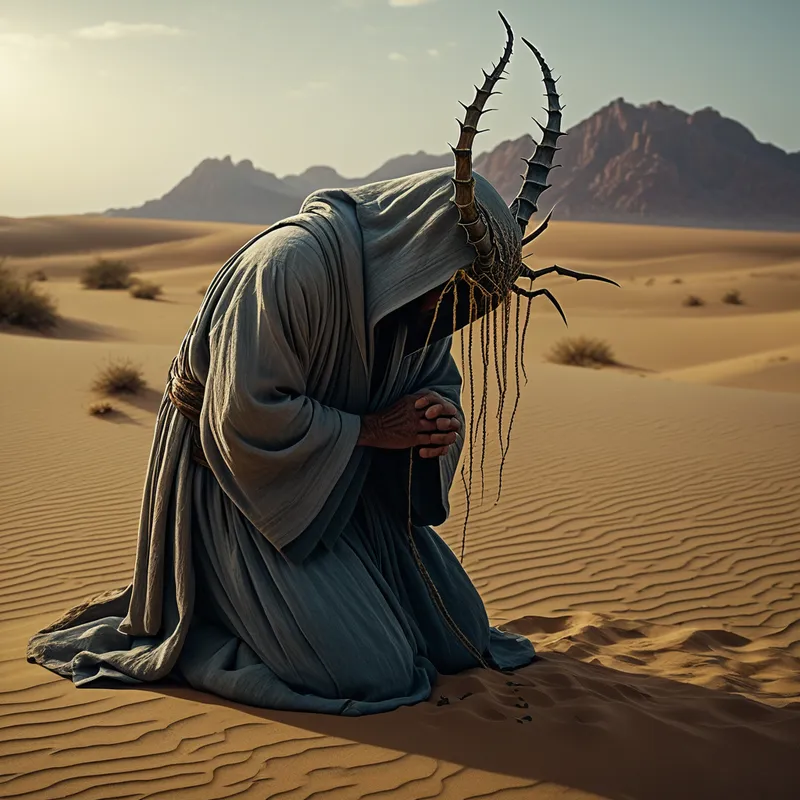
Among them was Khepri-el, not yet the Thorn-Bug. It was a vast, armored creature of living obsidian and polished flint, its legs like pillars holding up the vault of the underworld. It moved through the substrata of the desert, a continent in miniature, and its passing was the reason the dunes sighed and shifted. It knew the secret songs of stone and the slow heartbeat of the planet’s core. But it did not know the sky, or the scald of the air, or the fragile, burning need of the things that crawled upon the surface.
The conflict began not with a war, but with a falling star. A shard of the Crystal Firmament broke loose—a splinter of pure, condensed intention. It was a thorn of divine logic, meant to stitch the sky. It missed its mark. Piercing the skin of the world, it fell, a needle of furious light, and found the back of Khepri-el as the being slept in its geothermal cradle.
The impact was silent in the deep places, but catastrophic. The thorn, cold and brilliant as a captured star, lodged itself in the junction of the great being’s thorax. This was no mere injury. It was a fusion. The primordial essence of the deep earth met the absolute law of the heavens. Khepri-el awoke not to pain, but to a terrifying new awareness—a consciousness split between the dark, comforting pull of the core and the piercing, clarifying light of the cosmic order.
Driven mad by this duality, Khepri-el breached the surface. It erupted from the sand in a cataclysm of dust and shattered rock, a monstrous silhouette against the sun. The thorn in its back flared, casting sharp, painful shadows. It was an abomination to both realms: too earthly for the sky, too celestial for the earth. It began to wander, a living monument to its own impossible condition. The wound did not heal. Instead, from around the base of the celestial thorn, a thick, golden sap began to weep. It was the being’s life-essence, its deep-earth vitality, now filtered and transformed by the heavenly splinter.
Where the sap fell upon the blistering sand, a miracle occurred. The sand did not hiss and steam; it drank. And where it drank, the sand darkened, softened, and gave birth. First, a stain of moisture. Then, a trickle. Then, a seep. And finally, a clear, cool pool that reflected the very stars the thorn had come from. The Thorn-Bug, in its agony, was making wells. Each dragging step, each drop of its transformed blood, became an oasis. It did not know it was creating life. It only knew it was walking its wound across the face of the world.
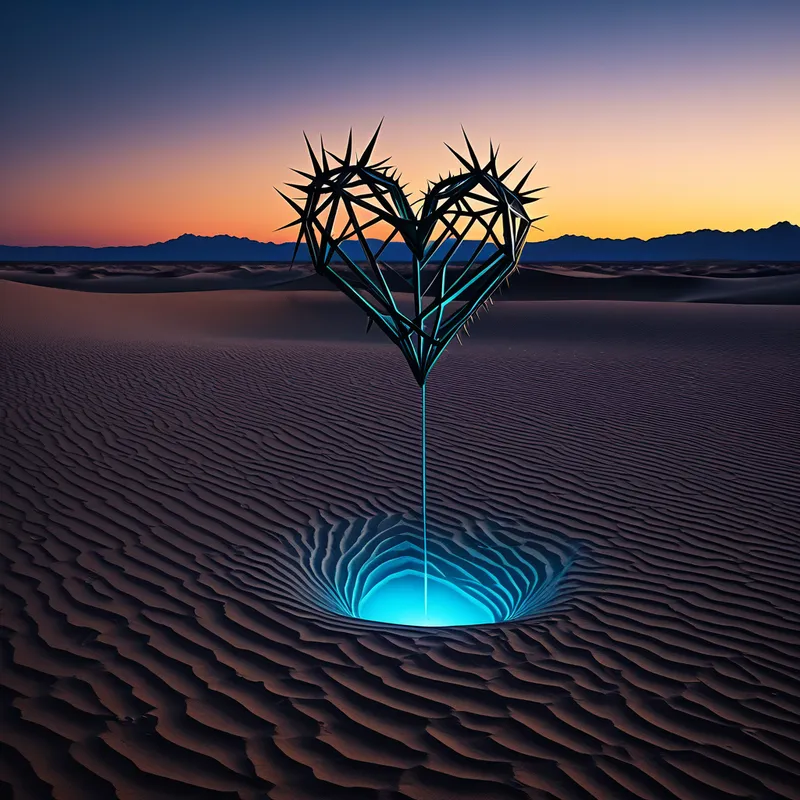
The resolution was not a removal of the thorn, but a final, willing embrace of it. The wanderings took centuries. The Thorn-Bug grew weary, its once-boundless energy now channeled entirely into the sacred leakage. It came to rest in the deepest basin, where the bones of ancient seas lay buried. There, it settled its colossal form, the thorn now glowing with a soft, internal pulse. It allowed the wound to open fully, not as a rupture, but as a gateway. The sap flowed not in drops, but in a steady, gentle stream, feeding a great underground river that would feed all the wells and oases it had ever created.
It became not a crippled creature, but the beating heart of the desert itself. The thorn was no longer a foreign object, but its core, its compass, its reason for being. The wound became the source.
Cultural Origins & Context
This myth originates from the oral traditions of the nomadic Khal’vari tribes, for whom the location of water is not merely survival, but sacred geography. The story was not told to children as a simple fable, but recited by the Miraj during the deep-night vigils at new oasis camps.
Its function was multifaceted. Primarily, it was an etiological myth, explaining the seemingly random, miraculous presence of water in a lethal landscape. But more profoundly, it served as a foundational narrative for the Khal’vari worldview. It taught that life springs not from perfection, but from a sacred wound; that the most vital resources are often born of a painful fusion of opposites (earth and sky, destiny and accident); and that the burden which seems to cripple you might be the very thing that maps the world for others. The myth sanctioned their nomadic life—they were following the literal and symbolic path of the Thorn-Bug, finding sustenance where a sacred burden had bled.
Symbolic Architecture
The Thorn-Bug is the archetype of the Wounded Source. Its symbolism is a profound blueprint of transformative suffering.
The Deep-Earth Khepri-el represents the undifferentiated Self, content in its unconscious, instinctual existence. The Celestial Thorn is the catalyzing agent of consciousness—a traumatic awakening. It is the divine accident, the psychic injury, the sudden awareness of a truth too bright to ignore, which seems to shatter the original, whole self.
The wound where heaven and earth meet is not a site of decay, but a wellspring. The Self is not fractured by the piercing insight; it is opened by it.
The weeping Golden Sap is the crucial alchemical process. It is not pure blood (instinct) nor pure light (spirit), but a new, third thing born of their interaction: conscious life-force. This represents how a personal trauma or crisis, when consciously carried and not denied, can be transmuted from mere suffering into a source of creativity, empathy, or wisdom. The Oases are the external manifestations of this inner work—the art, the relationships, the insights that nourish others, born from one’s own processed pain.

The Dreamer's Resonance
To dream of the Thorn-Bug is to dream at the frontier of a profound somatic and psychological process: the embodiment of a core wound. This is not dreaming about a past trauma, but dreaming as the archetype that transforms trauma.
Somatically, the dreamer may report sensations of pressure or a specific, localized “presence” in the body—a weight between the shoulder blades, a constriction in the chest, a palpable heat at the site of an old injury. Psychologically, they are in the stage where a deep, perhaps long-carried pain is shifting from being a passive burden to an active, if agonizing, source of potential. The dream often arrives during periods of intense introspection, therapy, or creative fermentation, where the raw material of suffering is beginning to seek a form of expression.
The dream’s landscape—the endless desert—mirrors the feeling of psychic aridity and isolation that accompanies this process. The pivotal moment in the dream is not the piercing (the original injury), but the witnessing of the sap transforming the sand. The unconscious is showing the dreamer the nascent, life-giving potential hidden within their own wound-state.
Alchemical Translation
The myth of the Thorn-Bug is a master narrative for the Individuation process. It models the journey from an unconscious, self-contained state (Khepri-el in the deep earth), through a crisis of consciousness (the piercing thorn), to the ultimate goal: becoming a conscious vessel that transforms primal energy into nourishing life for the wider psyche and world.
The modern individual’s “thorn” might be a diagnosis, a loss, a betrayal, a fundamental truth about oneself that is too sharp to ignore. The initial reaction is often the Thorn-Bug’s maddened surfacing—a feeling of being an abomination, torn between who one was and what one now knows. The alchemical work is in the wandering, the conscious carrying of this wound without seeking to prematurely pluck it out.
The thorn is not to be removed, but integrated. It becomes the axis around which the transformed self revolves.
The “golden sap” is the daily, often wearying, work of translating pain into meaning—journaling, creating, connecting, mentoring. Each act is a drop that creates an internal oasis, a pocket of self-compassion and understanding. Finally, the “settling into the basin” represents the stage where the wound is fully accepted as part of one’s identity. It is no longer a bleeding gash, but a dedicated aperture. The individual discovers that their greatest vulnerability has become their definitive source of strength and their unique contribution. They have built an internal river, an underground current of resilience and wisdom that sustains them and, by its very nature, nourishes the landscape of their relationships and community. They have become, not despite their wound, but because of it, a source.
Associated Symbols
Explore related symbols from the CaleaDream lexicon: