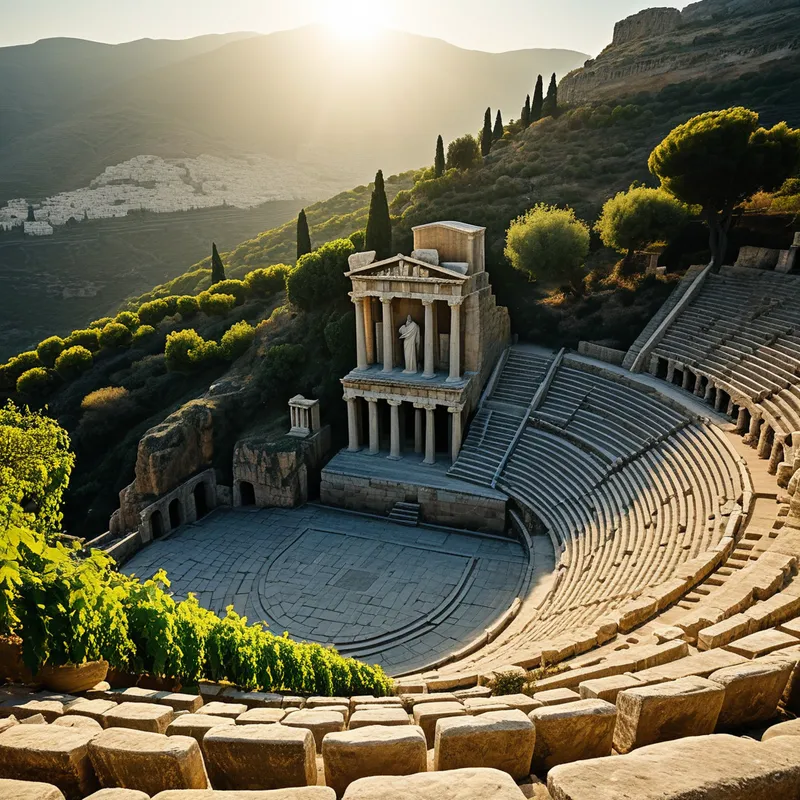
The Theater of Dionysus Myth Meaning & Symbolism
The god of wine and ecstasy establishes his sacred theater, a liminal space where the mask, the chorus, and the story dissolve the boundary between self and other.
The Tale of The Theater of Dionysus
Hear now the tale not of a hero’s conquest, but of a god’s invitation. It begins not on Olympus, but in the earthy, fragrant dark of a vineyard, and in the pounding, anxious heart of a city.
The air in Athens was thick with the smell of dust and humanity, with the unspoken fears that cling to stone and soul. Then, a new scent arrived—wild ivy, crushed grape, and the distant perfume of pine forests. He came not with thunder, but with the sound of flutes and the restless shuffle of satyrs at the city’s edge. Dionysus, the twice-born, [the stranger](/myths/the-stranger “Myth from Biblical culture.”/)-god, had returned to claim his due.
The people were wary. His worship was not of tidy altars and clear prayers, but of ecstatic cries on mountainsides, of a loss of self that was both terrifying and liberating. To honor him was to risk everything. To ignore him was a greater risk still. A plague of stillness fell upon the city, a paralysis of the spirit. The arts faltered. Joy became a memory. The civic order, so proud and rigid, began to feel like a tomb.
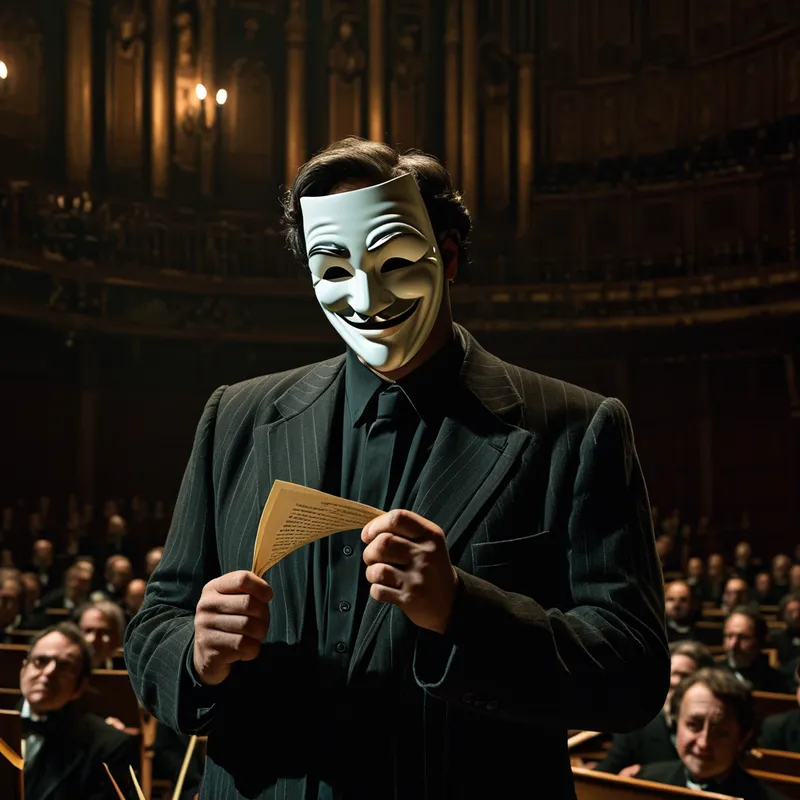
Then, the call. Not a decree, but a compulsion. From the slope of the Acropolis, a space was cleared. Not a temple, but a bowl of earth facing [the sky](/myths/the-sky “Myth from Persian culture.”/). Here, the god’s chosen—the tragoidoi—gathered. They wore the skins of goats, creatures of both wilderness and sacrifice. Their faces were not their own. They placed hollow eyes of painted wood and linen over their own, becoming another. One man stepped forward, separating from the churning, singing mass of [the chorus](/myths/the-chorus “Myth from Theater culture.”/). He was the hypokrites.
And the story unfolded. Not a hymn, but the tale of a king—[Oedipus](/myths/oedipus “Myth from Greek culture.”/), perhaps, or Creon. The actor, behind his mask, gave voice to towering pride and devastating ruin. The chorus, a single heartbeat of the community, swayed and sang of warning and lament. In the stone seats, the citizens of Athens watched. They did not see an actor; they saw the hero. They did not hear a poet; they heard fate itself whispering.
As the story reached its terrible, inevitable end, a silence heavier than any noise descended upon the theatron. Then, a collective exhalation—a sigh that was also a release. The rigid fear in their own hearts had been given a shape, a name, and a destiny upon the stage. It had been lived, and in the living, it was purged. The god’s gift was not mere entertainment. It was a sacred surgery of the soul, performed in the open air, where [the mask](/myths/the-mask “Myth from Various culture.”/) revealed more truth than the naked face ever could. The theater was born, and it was, from its first breath, a holy site of Dionysus Eleuthereus, the liberator.
Cultural Origins & Context
This was no mere myth in the storybook sense. The establishment of the [Theater of Dionysus](/myths/theater-of-dionysus “Myth from Greek culture.”/) in Athens was a historical and ritual event, crystallized into foundational myth. Its origins lie in the ancient rural festivals of Dionysus, particularly the City Dionysia. This was a massive civic and religious undertaking, where [the polis](/myths/the-polis “Myth from Greek culture.”/) paused its political and economic life for days of procession, sacrifice, and competition.
The plays of Aeschylus, Sophocles, and Euripides were performed as offerings to the god, in a theater that was part of his sanctuary. The myth of the theater’s origin served a crucial societal function: it sanctified a potentially disruptive force (ecstatic, boundary-dissolving worship) by channeling it into a structured, civic ritual. It transformed raw enthousiasmos—“the god within”—into a shared cultural mirror. The storytellers were the poets themselves, and the society was both narrator and audience, participating in its own profound psychological and spiritual reckoning.
Symbolic Architecture
At its core, the [Theater](/symbols/theater “Symbol: The theater represents the performance of life, creativity, and the exploration of one’s inner self through roles and narratives.”/) of Dionysus is a myth about container and content, [structure](/symbols/structure “Symbol: Structure in dreams often symbolizes stability, organization, and the framework of one’s life, reflecting how one perceives their environment and personal life.”/) and [chaos](/symbols/chaos “Symbol: In Arts & Music, chaos represents raw creative potential, uncontrolled expression, and the breakdown of order to forge new artistic forms.”/), the individual and the collective.
The Mask (The Prosopon): This is the central [symbol](/symbols/symbol “Symbol: A symbol can represent an idea, concept, or belief, serving as a powerful tool for communication and understanding.”/). It is not about hiding, but about revealing a [role](/symbols/role “Symbol: The concept of ‘role’ in dreams often reflects one’s identity or how individuals perceive their place within various social structures.”/). The individual ego steps aside to let an [archetype](/symbols/archetype “Symbol: A universal, primordial pattern or prototype in the collective unconscious that shapes human experience, behavior, and creative expression.”/) speak. The mask objectifies a complex [fate](/symbols/fate “Symbol: Fate represents the belief in predetermined outcomes, suggesting that some aspects of life are beyond human control.”/)—pride, [blindness](/symbols/blindness “Symbol: Represents a lack of awareness, insight, or refusal to see truth, often tied to emotional avoidance or spiritual ignorance.”/), vengeance—allowing the [audience](/symbols/audience “Symbol: An audience in a dream often symbolizes the need for validation, recognition, or the desire to perform.”/) to behold it safely, yet intimately.
The mask is the vessel that makes the invisible wound visible, allowing the community to tend to a sickness it shares but dares not name in the daylight of the agora.
The Orchestra (The Dancing Place): The circular, flat [space](/symbols/space “Symbol: Dreaming of ‘Space’ often symbolizes the vastness of potential, personal freedom, or feelings of isolation and exploration in one’s life.”/) between the stage and the seats. This was the domain of the [chorus](/symbols/chorus “Symbol: A chorus in dreams symbolizes unity, collaboration, and the harmony of diverse voices contributing to a greater whole.”/), the symbolic embodiment of the [community](/symbols/community “Symbol: Community in dreams symbolizes connection, support, and the need for belonging.”/), [nature](/symbols/nature “Symbol: Nature symbolizes growth, connectivity, and the primal forces of existence.”/), and the unconscious. They are the constant, reacting [heart](/symbols/heart “Symbol: The heart symbolizes love, emotion, and the core of one’s existence, representing deep connections with others and self.”/) of the [drama](/symbols/drama “Symbol: Drama signifies narratives, emotional expression, and the exploration of human experiences.”/), connecting the singular [hero](/symbols/hero “Symbol: A hero embodies strength, courage, and the ability to overcome significant challenges.”/)’s fate to the universal [human](/symbols/human “Symbol: The symbol of a human represents individuality, complexity of emotions, and social relationships.”/) [condition](/symbols/condition “Symbol: Condition reflects the state of being, often focusing on physical, emotional, or situational aspects of life.”/).
The Theatron (The Seeing Place) & The Skene (The [Tent](/symbols/tent “Symbol: A tent often symbolizes temporary shelter, transition, and the need for safety.”/)/Scene): This [architecture](/symbols/architecture “Symbol: Architecture in dreams often signifies structure, stability, and the framing of personal identity or life’s journey.”/) establishes the fundamental duality. The theatron is the [realm](/symbols/realm “Symbol: The symbol of ‘Realm’ often signifies the boundaries of one’s consciousness, experiences, or emotional states, suggesting aspects of reality that are either explored or ignored.”/) of [consciousness](/symbols/consciousness “Symbol: Consciousness represents the state of awareness and perception, encompassing thoughts, feelings, and experiences.”/), of ordered spectatorship. The skene represents the hidden, the backstage, the [realm](/symbols/realm “Symbol: The symbol of ‘Realm’ often signifies the boundaries of one’s consciousness, experiences, or emotional states, suggesting aspects of reality that are either explored or ignored.”/) of transformation from which masked figures emerge. The drama is the liminal space between them.
The Dreamer’s Resonance
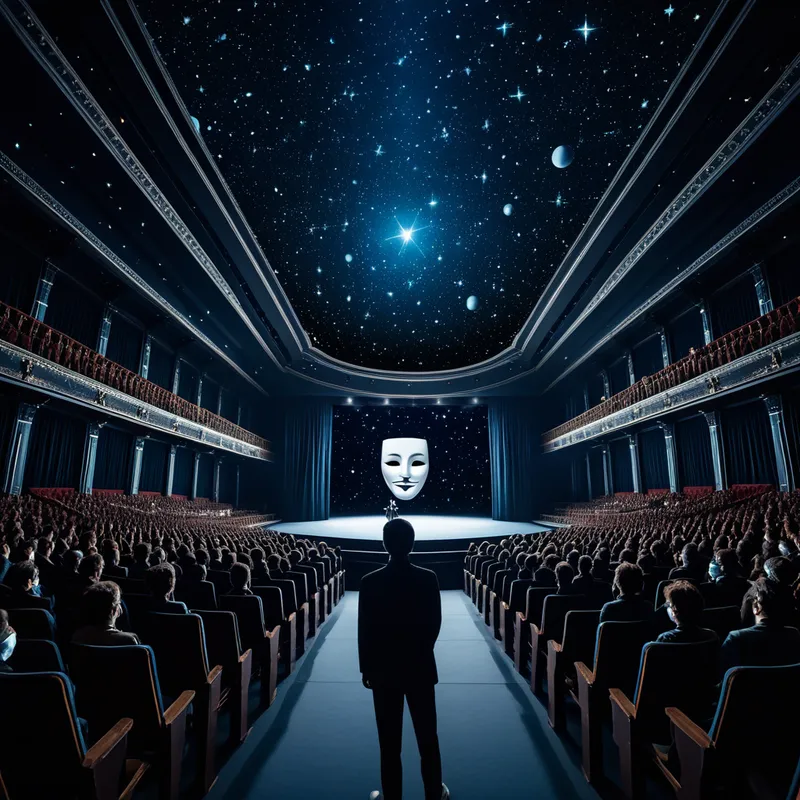
When the Theater of Dionysus appears in a modern dream, it signals a profound encounter with the shadow and [the collective unconscious](/myths/the-collective-unconscious “Myth from Jungian culture.”/). To dream of standing on that stage, mask in hand, points to a somatic and psychological process of role identification. The dreamer is being asked: what archetypal drama are you unconsciously acting out? Are you the rebellious hero, the doomed king, the mourning chorus?
Dreaming of being in the audience, watching a terrifying or cathartic play, suggests a process of [projection](/myths/projection “Myth from Alchemical culture.”/) and reclamation. The intense emotions witnessed on the dream-stage are disowned parts of [the self](/myths/the-self “Myth from Jungian culture.”/), being presented for recognition and integration. The dream is performing its own catharsis. A dream of a broken mask, or an actor refusing to wear one, often coincides with a life stage where the [persona](/myths/persona “Myth from Greek culture.”/)—the social mask—has become too constricting, and the authentic self demands to be heard, however raw.
Alchemical Translation
The myth models the alchemical process of individuation—the journey toward psychic wholeness—with stunning precision. The base material (the [prima materia](/myths/prima-materia “Myth from Alchemical culture.”/)) is the chaotic, undifferentiated inner turmoil, the “plague” of repressed emotion and fate.
- Separation (The Actor Steps Forward): [The ego](/myths/the-ego “Myth from Jungian culture.”/)-consciousness (the hypokrites) must separate from the undifferentiated mass of the unconscious (the chorus). It must dare to take on a defined role, to name the conflict. This is a courageous act of self-differentiation.
- [Nigredo](/myths/nigredo “Myth from Alchemical culture.”/) (The Tragic Mask): The donning of the tragic mask is the confrontation with [the shadow](/myths/the-shadow “Myth from Jungian culture.”/). The ego consciously engages with its darkest material—guilt, hubris, pain—in the contained vessel of the narrative. This is the blackening, the descent.
- Coniunctio (The Chorus’s Song): The drama is not a monologue. The actor is in constant dialogue with the chorus. This symbolizes the crucial dialogue between the conscious ego and the broader, wiser unconscious (the Self). The chorus comments, warns, laments, and ultimately contextualizes the individual’s suffering within a universal pattern.
- Albedo & [Rubedo](/myths/rubedo “Myth from Alchemical culture.”/) (Catharsis): The climax and resolution of the play bring the albedo and [rubedo](/myths/rubedo “Myth from Alchemical culture.”/). The purgation of pity and terror in the audience is the psychic transmutation. The leaden weight of unconscious complex is turned into the gold of conscious insight and released emotion. The mask, having served its purpose, can be laid down. The individual returns to life, not the same, but lighter, having seen the drama of their own soul played out in the sacred space between the hidden skene and the witnessing theatron.
The ultimate alchemy of the theater is this: by fully becoming another for a time, we are returned to ourselves, more wholly and truly than before. Dionysus, the dismemberer, is also the god who makes whole.
Associated Symbols
Explore related symbols from the CaleaDream lexicon: