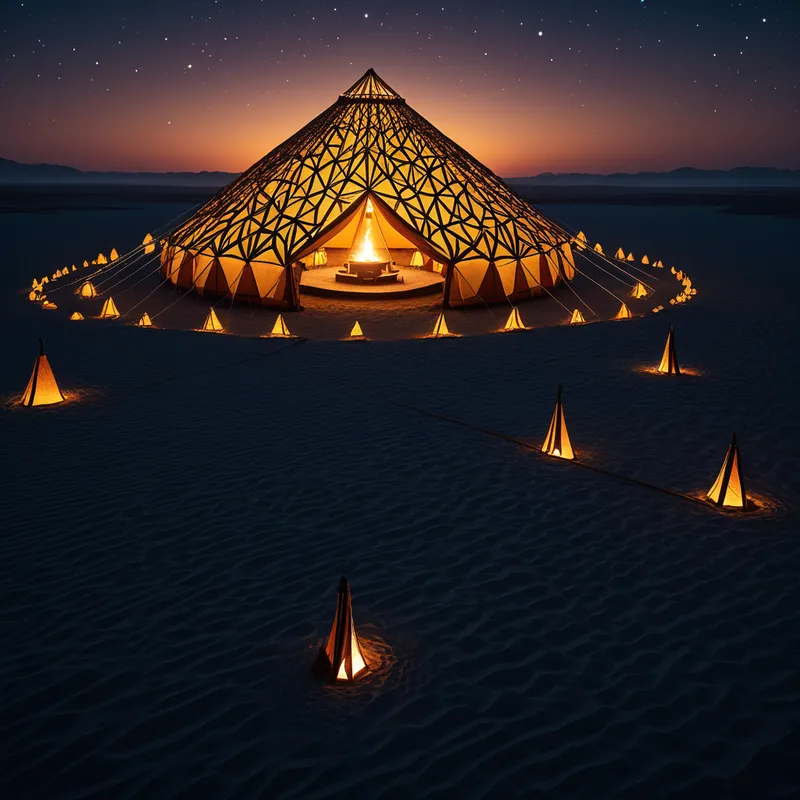
The temporary camps of the nom Myth Meaning & Symbolism
A myth of cosmic nomads who build ephemeral homes in the void, teaching that the journey itself is the only true dwelling place.
The Tale of The temporary camps of the nom
Listen. In the time before the first suns were kindled, when the Ur-Silence was the only song, there moved the Nom. They were not born of soil or star, but of the longing between them. Their world was the Vast Between, a breathless expanse where light traveled weary and alone.
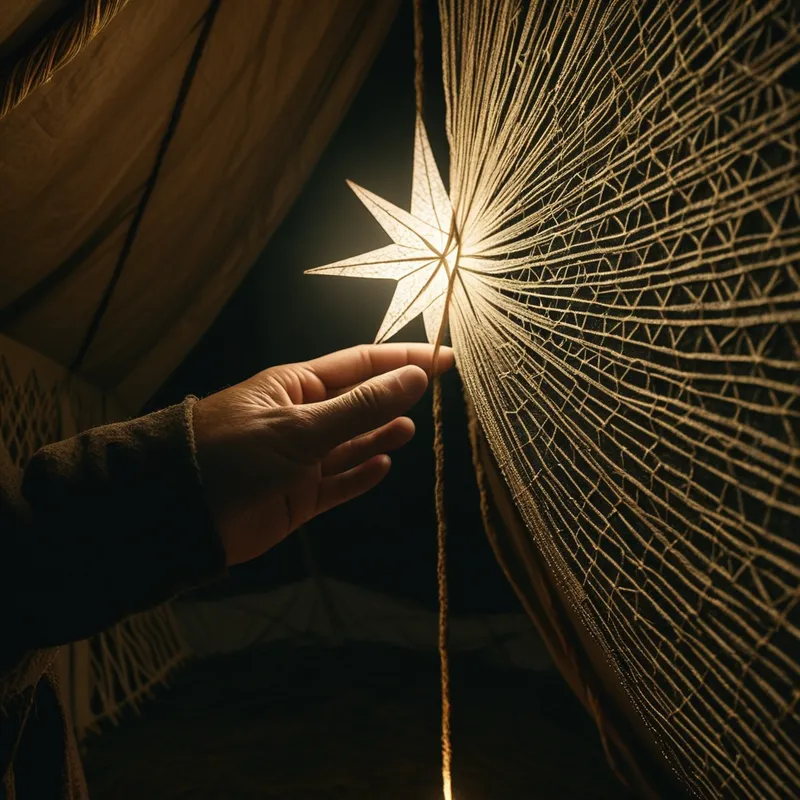
And so, the Nom learned to build. Not cities of stone, nor towers to pierce heavens, but camps. Temporary camps. From the dust of dead comets and the whispers of magnetic fields, they wove tents of impossible geometry. They sang threads of starlight into bridges, spun nebulae into canopies that held the warmth of a sun-that-was for a single, glorious cycle. Each camp was a masterpiece of ephemeral art, a heartbeat of home in the endless night.
They would arrive at a resonant point in the Vast Between, a place humming with a memory of warmth or a promise of passage. For a time—a century, a moment, a dream—the camp would flourish. Fires of contained plasma would dance in braziers, casting shifting shadows on fabric that told the stories of all their previous halts. Children would learn the songs of anchoring and release. The air would fill with the scent of ozone and something like cinnamon, the smell of temporary sanctuary.
But the Unseen Tide always came. It was not a foe, but a rhythm deeper than breath. First, it was a subtle dissonance in the camp’s harmonic hum. Then, the woven starlight in the bridges would begin to dim, not from failure, but from a gentle un-remembering. The central fire’s warmth would turn inwards, preparing for its long sleep. No command was given, no alarm raised. The Nom simply knew. The time of packing had arrived.
With rituals of profound gratitude, they would begin the unraveling. Every thread was carefully drawn back, every stone of comet-dust blessed and released to the void. They did not destroy their home; they returned it, piece by sacred piece, to the Vast Between. The final act was always the same: the eldest would stand where the heart-fire had burned, scoop a handful of the now-cold, ash-like resonance, and place it in a small, ever-growing pouch worn by the youngest. This was the only thing they carried from camp to camp—not the camp itself, but the memory of its warmth.
As the last tent-fold vanished, the Nom would stand together on the bare, resonant point. They would sing a single, low note of farewell and thanks. Then, turning as one, they would step back into the flowing darkness, the Ur-Silence welcoming them once more, their eyes already scanning the darkness for the next faint pulse, the next temporary place to call home.
Cultural Origins & Context
The myth of the Temporary Camps is a foundational narrative of the Global/Universal culture, meaning it is not tied to one geography but to a state of being. It is the story of the psyche in transition. It was never “written down” in a conventional sense but is passed through what anthropologists of myth call “mnemonic resonance”—it is recalled in moments of collective departure, during rites of passage, and in the quiet dissolution of eras. The tellers are those on the threshold: the migrant, the graduate, the retiree, the survivor of loss. Its societal function is anti-monumental; it does not teach how to build forever, but how to dwell deeply in the now of a place, relationship, or phase of life, with the full, bittersweet knowledge of its inevitable end. It sanctifies the act of leaving as much as the act of arriving.
Symbolic Architecture
The myth’s power lies in its radical redefinition of “home” and “journey.” The Nom represent the core Self in its essential state: a traveler through the landscapes of experience, identity, and time.
The camp is not a failed attempt at permanence; it is a perfect ritual of temporary belonging.
The Vast Between symbolizes the unconscious itself—the fertile, dark potential from which conscious structures (the camps) temporarily arise. The Unseen Tide is the psychic force of individuation, the inner compulsion to grow beyond any current configuration of the personality, no matter how beautiful or comfortable. The meticulous packing away is not grief, but sacred economy—the internalization of lessons, memories, and strengths so they become part of the soul’s portable treasury, the pouch of ashes carried by the “youngest” (the nascent, future self).
Psychologically, the camp is any constructed identity: “the successful professional,” “the devoted parent,” “the activist,” “the victim.” These are necessary, beautiful, functional tents we weave. The myth’s wisdom is that we must learn to weave them well, live in them fully, and—when the inner tide turns—dismantle them with reverence, not with the despair of one who has lost a fortress, but with the gratitude of one who has fully inhabited a sanctuary.
The Dreamer’s Resonance
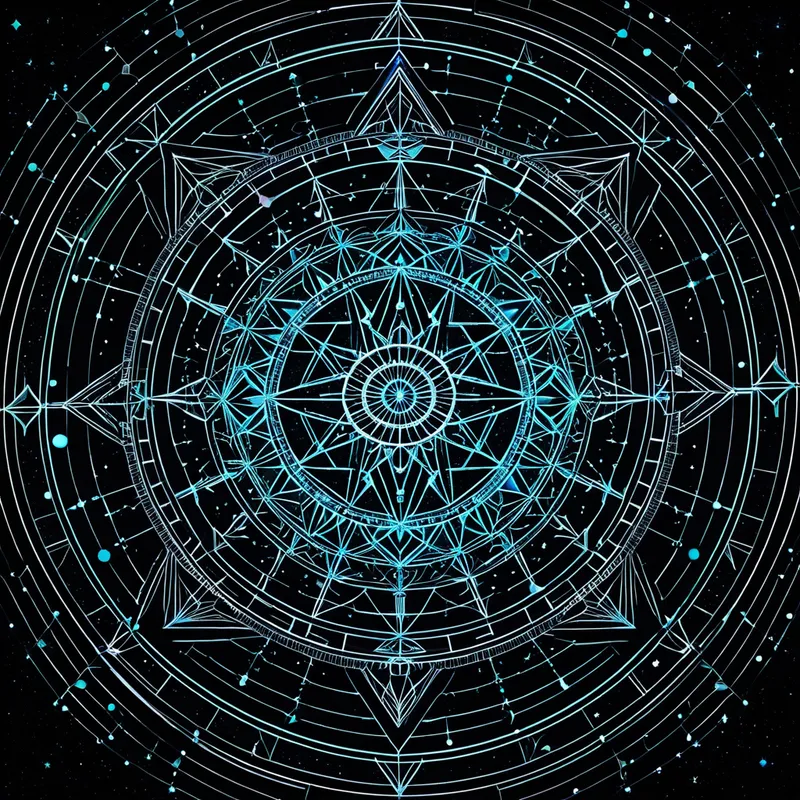
When this myth activates in the modern dreamscape, it often manifests as dreams of transient architecture: beautiful, intricate houses made of paper or light that begin to dissolve; packing suitcases with impossible, sentimental objects as a storm or tide approaches; or finding oneself in a profoundly “homey” place that one simultaneously knows is a train station or a waiting room.
Somatically, this can correlate with feelings of restless legs before sleep, a sense of lightness or rootlessness in the diaphragm, or the peculiar anxiety that arises not from threat, but from an intuitive knowing that a life chapter is concluding. The psyche is rehearsing the dismantling. It is not a nightmare of collapse, but the soul’s preparation for the Unseen Tide. The dreamer is in the process of metabolizing the truth that a current form of life—a relationship, career, self-concept—has served its purpose and its energy is now withdrawing, preparing the Self for the next journey into the Vast Between of the unknown.
Alchemical Translation
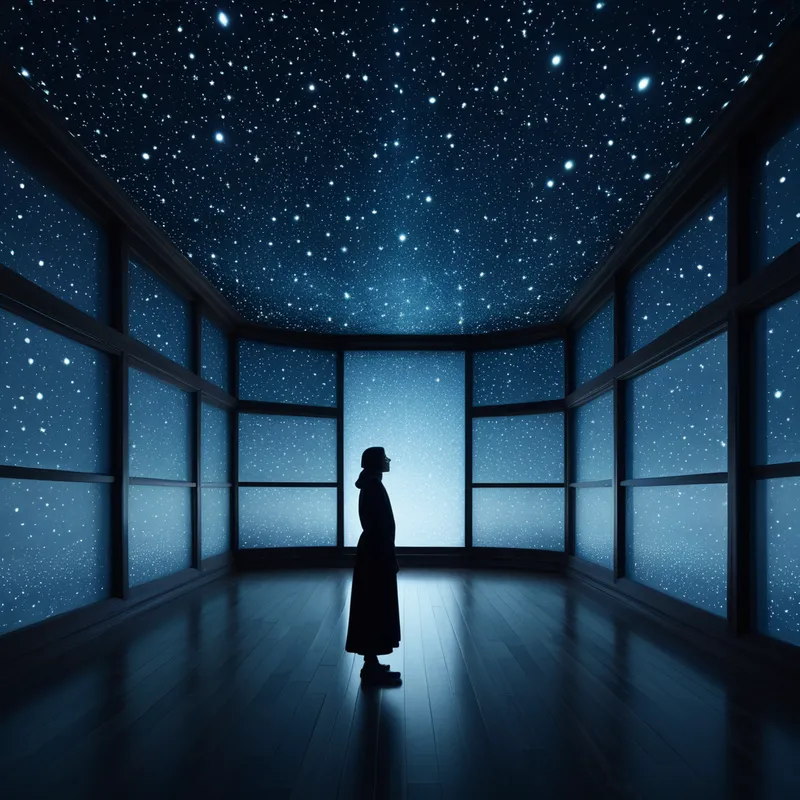
The alchemical process mirrored here is Solutio (dissolution) followed by Coagulatio (coagulation), in a perpetual, spiraling cycle. The modern individual’s path of individuation is not a linear climb to a fixed peak, but a nomadic journey of building, dwelling, dissolving, and moving on.
Individuation is the courage to become a nomad of your own soul, to cherish the temporary camp without mistaking it for the promised land.
The “triumph” of the Nom is not in finding a permanent home, but in achieving flawless skill in the art of transition. The alchemical gold they produce is not a static state of enlightenment, but resilient adaptability—the pouch of ashes that contains the essence of all past homes. For us, this translates to the practice of non-attachment to forms, coupled with deep commitment to the present moment. We learn to build our careers, relationships, and self-images with care and beauty, while holding them lightly, knowing we are the builders, the dwellers, and the packers. The ultimate psychic transmutation is the realization that the journey itself—the conscious engagement with the rhythm of building and releasing—becomes the only true, eternal dwelling. We do not escape the Vast Between; we learn to make our peace with its spaciousness, and in doing so, we become it. We become the welcoming darkness and the brave, temporary light, both the wanderer and the way.
Associated Symbols
Explore related symbols from the CaleaDream lexicon: