The Temple Myth Meaning & Symbolism
A story of a sacred center built, lost, and remembered, embodying the covenant between the divine and the human, and the indestructible longing for wholeness.
The Tale of The Temple
Listen. There is a story of a center, a fixed point in the whirl of the world.
In the beginning was the promise, carried on desert winds: a people chosen, not for dominion, but for a dwelling. The Divine, a presence that filled mountains with smoke and thunder, whispered of a desire: to rest. Not in the high heavens, but here, in the dust, among the beating hearts of a stubborn, wandering tribe.
A king arose, Solomon, whose wisdom was a quiet pool reflecting the structure of creation itself. He gathered the wealth of kingdoms: cedars from Lebanon, fragrant and towering; gold from Ophir, hammered into cherubim whose wings spanned the silence; quarried stone, cut in silence so deep not a chisel’s sound was heard at the holy site. For seven years, the mountain echoed with a sacred industry.
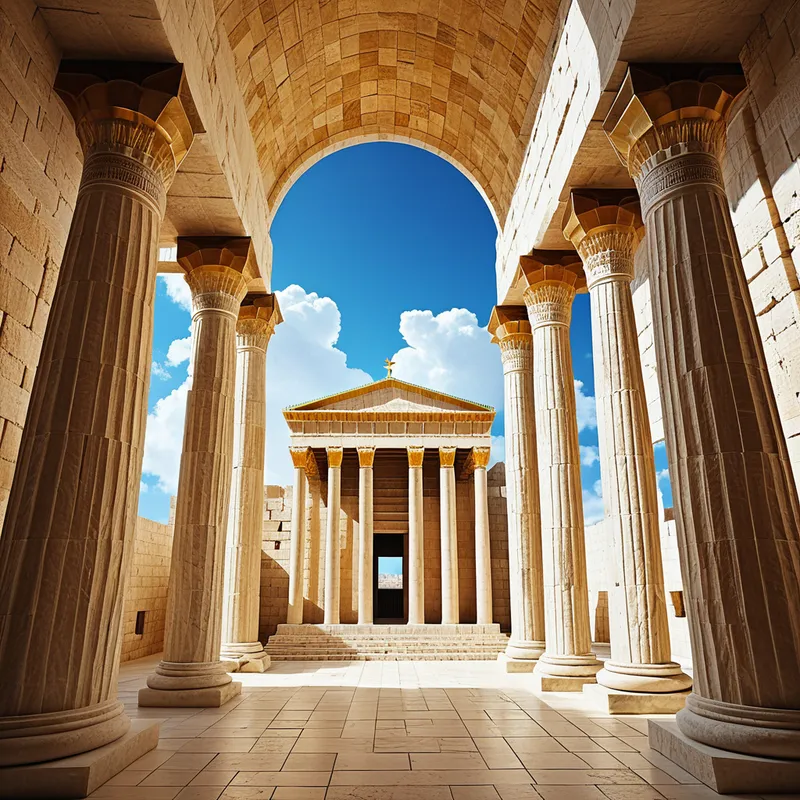
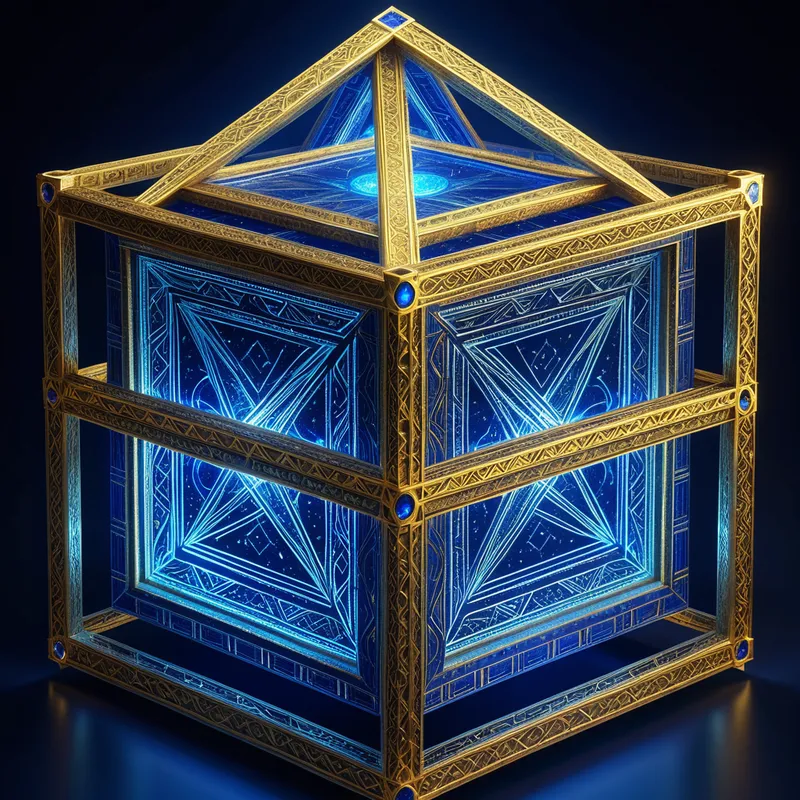
And then it stood. The House. Its outer courts bustled with the scent of offerings and the murmur of pilgrims. But within, layer by layer, the world grew still. Past the bronze sea, past the altars, through veils of blue, purple, and crimson, one entered the Holy of Holies. A perfect cube of darkness. And there, in that utter stillness, rested the Ark of the Covenant, crowned by the silent, overshadowing wings of golden cherubim.
On the day of dedication, the king finished his prayer, a vast sigh of hope and frailty. And then it came. A cloud, thick and palpable as wool, filled the House. The priests could not stand to minister, for the weight of glory, the palpable dwelling, pressed upon them. The Divine had taken up residence. The center held. Heaven and earth touched in a space no larger than a man could pace out in thirty steps.
But hearts turned. The center cannot hold if the circle is broken. Prophets cried into the growing darkness, their words like fire against the cold stone of empty ritual. The glory, it is said, departed. It lingered at the threshold, a reluctant farewell, then ascended eastward, leaving the House a beautiful shell.
Then came the thunder of empire. The crash of Babylonian hammers on sacred walls. The cedar beams became torches, the gold ran molten in the streets, and the stones of the foundation were pried loose with a terrible, final groan. The Ark vanished into legend. The people were led away, and by the rivers of a foreign land, they wept, hanging their harps on the willow branches. How could they sing the song of the center in a land of exile?
Yet, a remnant returned. With trembling hands, they laid new stones upon the old scars. A second House arose, smaller, plainer, a memory made tangible. It stood for centuries, a beacon for longing. But again, the tides of empire rose. Roman legionaries, under a flaming eagle standard, breached its walls. Fire consumed the veils, and the last echo of the sacred service was drowned by the roar of collapse and the cry of triumph. All that remained was a single, massive retaining wall, weeping with the heat of the day.
Now, the stones wait. The story whispers that from this very place, from this enduring foundation, a final, everlasting House will one day descend, woven not of stone and cedar, but of light and perfected time. And until that day, the story itself is the dwelling place.
Cultural Origins & Context
The myth of the Temple is not a single narrative but the core architectural blueprint of Jewish spiritual and national identity, woven from historical memory, prophetic vision, and liturgical longing. Its origins are in the Torah, specifically the detailed instructions for the Tabernacle, a traveling temple. This blueprint was realized historically in the First Temple (c. 957 BCE) and the Second Temple (c. 516 BCE – 70 CE).
It was passed down not by bards, but by priests recording consecration, prophets thundering warnings, psalmists composing pilgrim songs, and rabbis teaching legal and mystical interpretations after the physical Temple’s destruction. Its societal function was multifaceted: it was the political and theological center of the nation, the only place for certain sacrificial rites, and the literal axis mundi connecting the people to God. After 70 CE, the myth transformed. The study of its laws, the acts of prayer and ethical living, and the communal memory of its service became the “portable Temple,” ensuring the myth’s survival and interiorization through two millennia of diaspora.
Symbolic Architecture
The Temple is the ultimate symbol of the axis mundi. It represents the possibility of a meeting point between transcendent reality and immanent life, between the infinite and the finite container.
The Temple is not merely a building God desired, but the archetypal structure of a soul that can receive the divine.
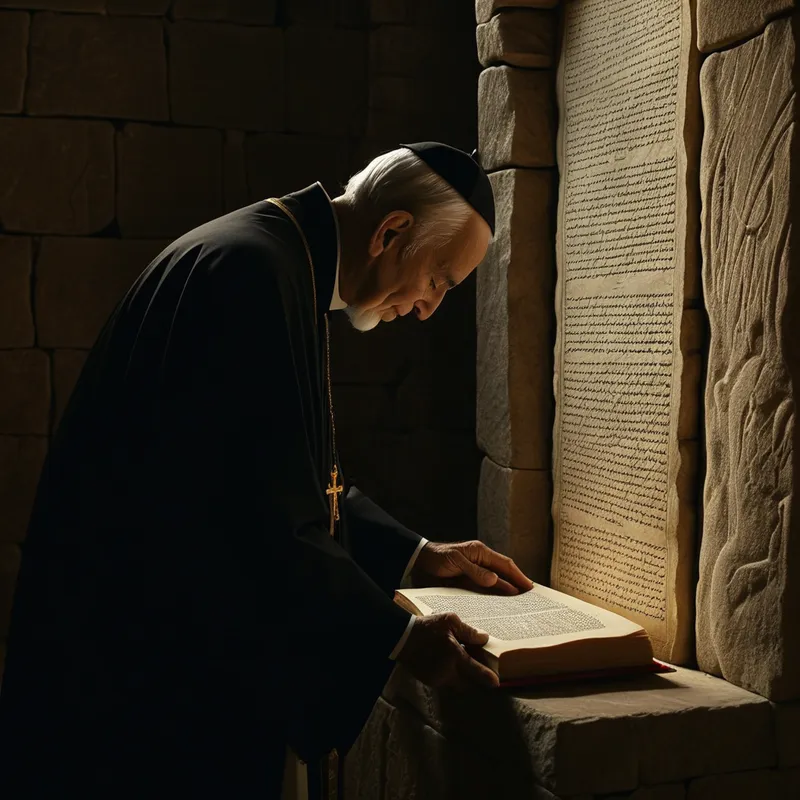
Its destruction, therefore, is not just a historical tragedy but a profound psychological truth: the experience of the sacred center collapsing within one’s own life. The vanished Ark symbolizes lost inner certainty, the core covenant with the Self that feels forgotten or buried. The Western Wall, the enduring fragment, represents the indestructible core of longing that remains even in the midst of ruin—the part of the psyche that continues to face the direction of wholeness.
The progression from portable Tabernacle to permanent Temple to spiritualized memory maps the journey of internalization. The sacred space moves from being an external, ritual location to an internal, ethical, and mystical reality—a temple of the heart.
The Dreamer’s Resonance
To dream of the Temple is to dream of one’s own inner sanctuary. Dreaming of building it suggests a conscious, arduous process of psychological integration, laying a new foundation for the Self. Dreaming of entering its inner chambers speaks to a journey into the deepest, most numinous layers of the unconscious, approaching the core of one’s being.
Dreaming of its destruction, however, is far more common. It manifests as dreams of one’s house crumbling, of sacred rooms being defiled, or of searching desperately for a lost, central room in a vast, familiar-yet-alien building. This is the somatic signature of a psyche undergoing deconstruction. An old, rigid structure of identity, belief, or adaptation is being dismantled by forces beyond the ego’s control (the “Babylonians” or “Romans” of the psyche). The dreamer is in the exile phase, feeling unmoored from their inner center. The profound grief and disorientation in such a dream is not pathological; it is the necessary mourning for a lost container, preparing the ground for a more authentic structure to emerge.
Alchemical Translation
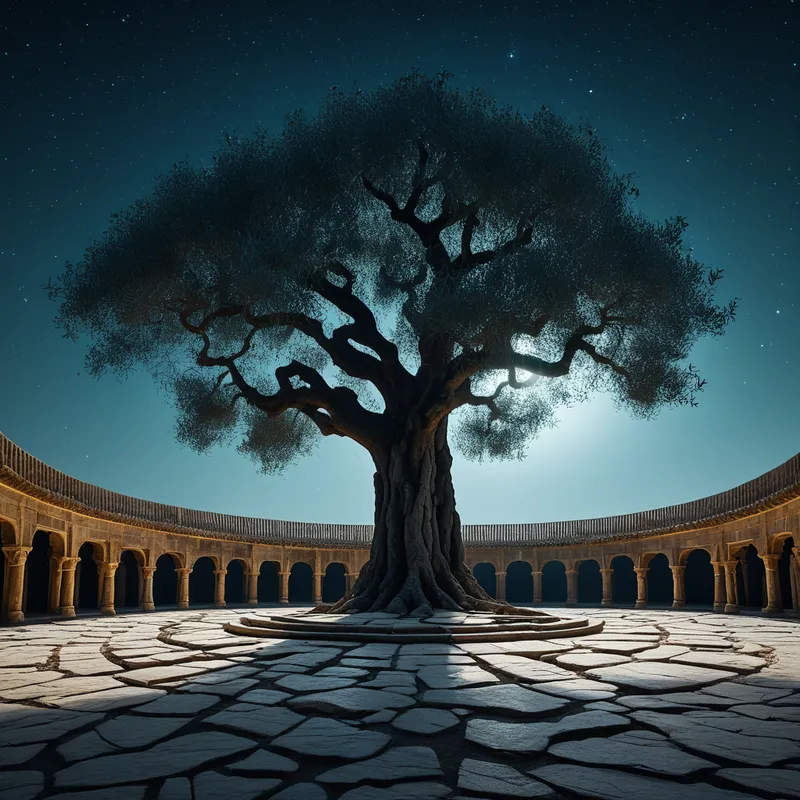
The alchemical process mirrored in the Temple myth is the opus of creating the inner temenos—a sacred, protected space for the transformation of the psyche. The raw materials—the chaotic experiences, instincts, and conflicts of life (the “cedars of Lebanon,” the “gold of Ophir”)—must be gathered and shaped in silence (the “stones cut far away”).
The first construction is the ego’s attempt to build a permanent, glorious structure for the Self. This is the Solomonic phase of wisdom and order. But this structure, being of the ego, must inevitably be destroyed—the nigredo, the blackening, the Babylonian fire. This destruction is the crucial alchemical dissolution, where identification with the outer form is burned away.
Exile is the alchemical stage of separatio; it is in the loss of the known sacred that the soul learns to carry the sacred within.
The remnant’s return to build the Second Temple represents the albedo, the whitening. It is a humbler, less glorious but more resilient structure, built not on naive grandeur but on the memory of loss. This is the conscious personality integrating the reality of suffering and impermanence.
Finally, the vision of a future Temple “not made by hands” points to the rubedo, the reddening, the culmination of individuation. This is the realization of the Self as a living, dynamic, and eternal center, no longer projected onto any external form—stone, doctrine, or institution—but experienced as the immanent and transcendent ground of one’s own being. The longing itself becomes the dwelling, and the seeker realizes they are what they sought.
Associated Symbols
Explore related symbols from the CaleaDream lexicon: