The Tao That Cannot Be Named Myth Meaning & Symbolism
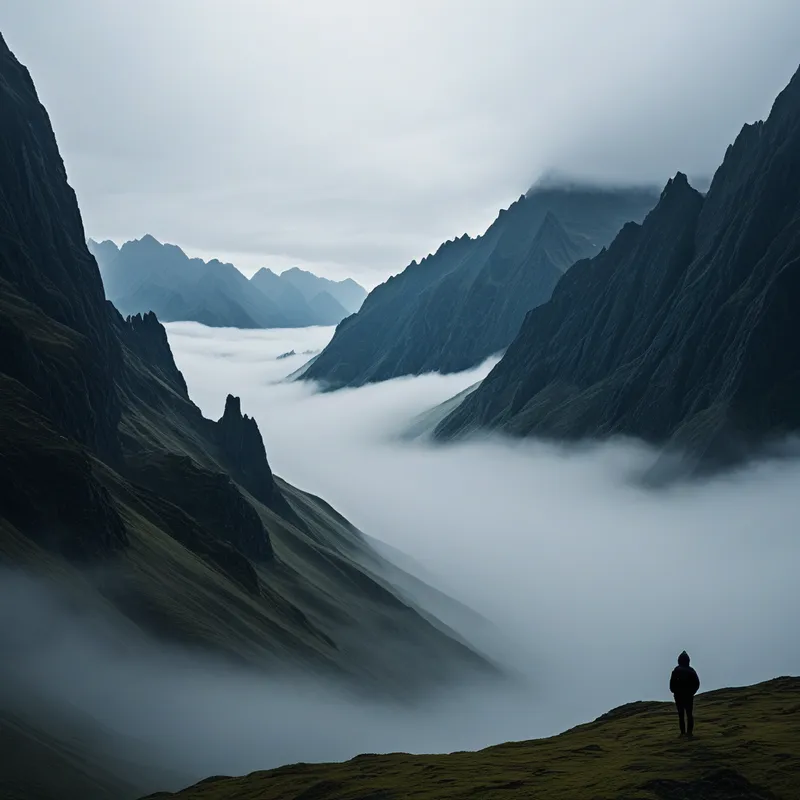
The foundational myth of the primordial, unutterable source from which all things emerge and return, beyond all description and duality.
The Tale of The Tao That Cannot Be Named
Before the first word was spoken, before the first thought took shape, there was a silence so profound it was not an absence of sound, but the womb of all possibility. In this boundless, nameless expanse, there stirred a presence that was no presence, a principle that was no principle. It was the Tao.
It had no face to behold, no voice to hear. It was not a god to be petitioned, nor a king to be obeyed. It was the deep, dark valley that cradled the unborn ten thousand things. It was the hollow of the bell before the clapper strikes. It moved, yet left no trace, like a great fish swimming in the depths of an endless, starless ocean. To speak of it was to lose it. To name it was to confine it.
The sages of antiquity, with hearts like still water, sensed its movement in the turning of the seasons. They felt its breath in the wind that wears down the mountain and its patience in the river that carves the canyon. They tried to point toward it, crafting words like clumsy fingers gesturing at the moon. “It is like water,” one would whisper, “yielding yet overcoming all.” “No,” another would murmur, “it is the uncarved block, the simplicity before form.” But each metaphor was a net cast to catch the wind, holding only the memory of the attempt.
The greatest conflict was not with a monster or a rival, but with the human mind itself—the desperate, brilliant mind that seeks to grasp, to define, to own. The mind built towers of philosophy and labyrinths of ritual, each brick a name, each corridor a doctrine, all in a frantic effort to house the homeless, to cage the uncageable. Yet the Tao remained, serene and elusive, as the source of the stream remains untouched by the river’s long journey to the sea.
The resolution came not in a victory, but in a yielding. The sage who understood laid down the tools of naming and knowing. He sat by the bank of the flowing stream and simply witnessed. He saw that the name he sought to give was already the ten thousand names of the world in constant transformation—the green shoot, the falling leaf, the rising mist, the setting sun. In the act of releasing the need to capture it, he found himself held within it. The unnameable was not a distant mystery, but the very fabric of his breath and the silent space between his thoughts. The tale ends where it began: in a wordless, all-encompassing presence that is both the journey and the destination, eternally nameless.

Cultural Origins & Context
This is not a myth of a single hero or a specific historical event, but the foundational, permeating narrative of Taoist thought, primarily crystallized in the Daodejing (or Tao Te Ching). Attributed to the sage Laozi, its verses are thought to have been composed around the 4th century BCE, a time of great social upheaval and philosophical ferment in China known as the Warring States period.
In this context of political chaos and rigid Confucian social codes, the myth of the Unnameable Tao functioned as a profound counter-narrative. It was passed down not by bards in great halls, but often secretly, from master to disciple, through poetic texts designed to confound the logical intellect and speak directly to the intuitive spirit. Its societal function was therapeutic and subversive: it offered a return to a primordial authenticity (ziran) beyond the artificial constraints of names, roles, and rigid hierarchies. It provided a cosmic framework for understanding change, conflict, and harmony, teaching alignment with the natural way rather than domination over it.
Symbolic Architecture
The myth’s core [symbol](/symbols/symbol “Symbol: A symbol can represent an idea, concept, or belief, serving as a powerful tool for communication and understanding.”/) is the act of not-naming. This is not a void of ignorance, but a supreme, conscious negation that makes authentic [perception](/symbols/perception “Symbol: The process of becoming aware of something through the senses. In dreams, it often represents how one interprets reality or internal states.”/) possible.
To name is to create a category, and every category casts a shadow of what it excludes. The Unnameable is the whole which contains all categories and their shadows.
The Tao represents the unconscious itself in its pristine, undifferentiated state—the plenum of psychic [energy](/symbols/energy “Symbol: Energy symbolizes vitality, motivation, and the drive that fuels actions and ambitions.”/) from which all complexes, archetypes, and conscious thoughts emerge. The “ten thousand things” are the contents of [consciousness](/symbols/consciousness “Symbol: Consciousness represents the state of awareness and perception, encompassing thoughts, feelings, and experiences.”/): our identities, emotions, and perceptions. The sage’s struggle is the ego’s attempt to assimilate the unconscious into itself, to make the boundless personal. The [resolution](/symbols/resolution “Symbol: In arts and music, resolution refers to the movement from dissonance to consonance, creating a sense of completion, release, or finality in a composition.”/)—the yielding—symbolizes the ego’s relinquishment of its central [authority](/symbols/authority “Symbol: A symbol representing power structures, rules, and control, often reflecting one’s relationship with societal or personal governance.”/), allowing for a conscious [relationship](/symbols/relationship “Symbol: A representation of connections we have with others in our lives, often reflecting our emotional state.”/) with the Self, the psychic totality that includes both conscious and unconscious.
The Yin aspects ([valley](/symbols/valley “Symbol: A valley often symbolizes a period of transition or a place of respite between two extremes.”/), [water](/symbols/water “Symbol: Water symbolizes the subconscious mind, emotions, and the flow of life, representing both cleansing and creation.”/), darkness) are not negative but represent the receptive, containing, and generative feminine principle necessary for creation. The myth elevates this receptive state as the highest wisdom.
The Dreamer’s Resonance
When this mythic pattern stirs in the modern psyche, it often manifests in dreams of profound emptiness, silence, or vast, featureless landscapes. One may dream of a blank page that cannot be written on, a mirror that reflects nothing, or being in a room where all labels have fallen off the objects. These are not dreams of lack, but of potential.
Somatically, this can coincide with a process of dissolution—a feeling of losing one’s familiar bearings, identity, or life narrative. The psychological process is the de-integration of the persona, the socially constructed self. The ego experiences this as a kind of death or terrifying freedom. The dream is presenting the Unnameable ground of being, asking the dreamer to endure the anxiety of the unknown without rushing to fill it with old names (old identities, solutions, narratives). It is the psyche’s way of clearing the slate, creating the inner “uncarved block” from which a more authentic existence can emerge.
Alchemical Translation
The individuation process modeled here is the alchemy of via negativa—the path of negation. It is not about acquiring new qualities, insights, or powers (the hero’s journey of accumulation), but about stripping away.
The first and greatest transmutation is the turning of seeking into being, of questioning into witnessing.
The “conflict” with the naming mind is the necessary nigredo, the dark night of the soul where all one’s previous understandings prove inadequate. The ego’s tools—analysis, judgment, ambition—turn to ash. The “yielding” of the sage is the albedo, the whitening: a purification through surrender, an acceptance of not-knowing. This creates the inner vessel, the receptive valley, capable of containing the contradictory totality of the Self.
Finally, the realization that the Unnameable is the very substance of existence is the rubedo, the reddening or culmination. The psychic energy once locked in the ego’s struggle is freed and integrated. Life is no longer lived from the small, named identity, but from a participation in the unnamed, ever-generative flow. One becomes an embodiment of ziran, acting with effortless rightness, not because one possesses the right name for things, but because one is in unobstructed dialogue with the unnamed source of all things.
Associated Symbols
Explore related symbols from the CaleaDream lexicon:
- Water — The primary metaphor for the Tao, representing yielding, adaptability, immense power through softness, and the formless that takes the shape of its container.
- Valley — Symbolizes the receptive, feminine, and empty space that gives birth to and cradles all existence, the humble low point that holds the sacred.
- Mirror — Represents the mind of the sage, which reflects reality perfectly without adding commentary, judgment, or names, remaining clear and unstained.
- Uncarved Block — The state of primordial potential and simplicity before the imposition of form, names, and distinctions; the authentic self before socialization.
- Circle — The symbol of the Tao itself: seamless, without beginning or end, containing all opposites in harmonious, cyclical movement.
- Darkness — Not evil, but the fertile, mysterious, and generative womb of all possibilities from which light and form emerge.
- Mountain — Represents the eternal, unchanging aspect of the Tao in contrast to the flowing valley, yet both are part of the same whole landscape.
- River — The manifest flow of the Tao through time and space, the constant change and journey of the ten thousand things back to the source.
- Silence — The medium and message of the Unnameable; the space between sounds where true understanding arises, beyond the noise of words.
- Name — The central object of negation in the myth; representing all conceptual knowledge, ego identity, and the limiting power of definition.