The Tao Te Ching Myth Meaning & Symbolism
A weary sage, facing the world's decay, is compelled to inscribe the ineffable Way before vanishing into the west, leaving a text of paradox and power.
The Tale of The Tao Te Ching
The world was growing loud. The clang of swords being forged echoed in the valleys, the chatter of a hundred competing philosophies filled the courts, and the hearts of men were knotted with ambition and fear. In the quiet archives of the Zhou dynasty, an old man named Lao Tzu watched the slow unraveling. His eyes, deep as still pools, had seen the patterns of rise and fall, the way desire hardens into law and law crumbles into chaos.
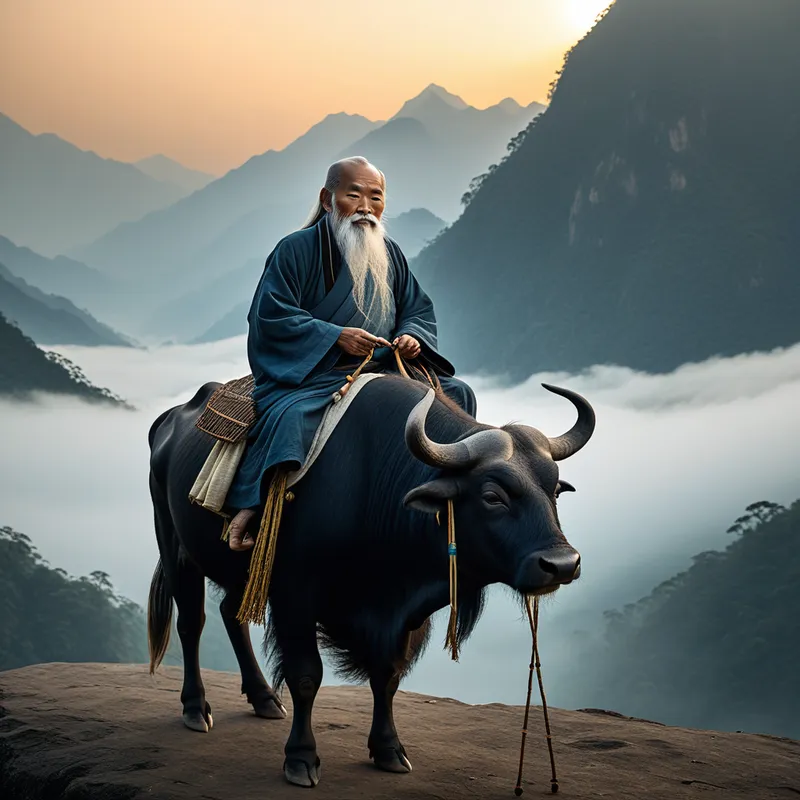
Weariness settled into his bones, a dust upon the spirit. He could smell the coming decay on the wind, a metallic tang beneath the scent of pine. So, he saddled his black water buffalo, a creature of patient strength and earth, and turned its head to the west—the direction of mystery, of sunset, of return. He sought only to disappear, to melt back into the unnamed source from which all things softly emerge.
His journey brought him to the Hangu Pass. The mountains here were stern sentinels, their peaks lost in swirling mist. The gatekeeper, Yin Xi, was no ordinary official. He was a seer, a man who recognized the aura of the profound around the humble traveler. As Lao Tzu approached, Yin Xi felt not the arrival of a man, but the passing of an era. He smelled the rain on the old man’s robes, saw the infinite patience in the buffalo’s slow blink, and heard the immense silence that traveled with them.
Yin Xi barred the way, not with force, but with a deep bow. “Master,” he said, his voice cutting through the mountain silence, “you intend to withdraw forever. I beg you, for the sake of those who will come after, leave a record of your wisdom. Compose a book. Give a name to the unnameable, a path to the pathless.”
A conflict greater than any war stirred in the pass. To speak of the Tao was to betray its nature. To write it down was to freeze the flowing river. Lao Tzu looked east, back toward the cacophony of the world, then west, into the gathering dark and silence. He felt the weight of the request—not a demand, but a plea from the human heart lost in its own noise. In that moment, the sage’s personal retreat transformed into a final, profound act of compassion for the world he was leaving.
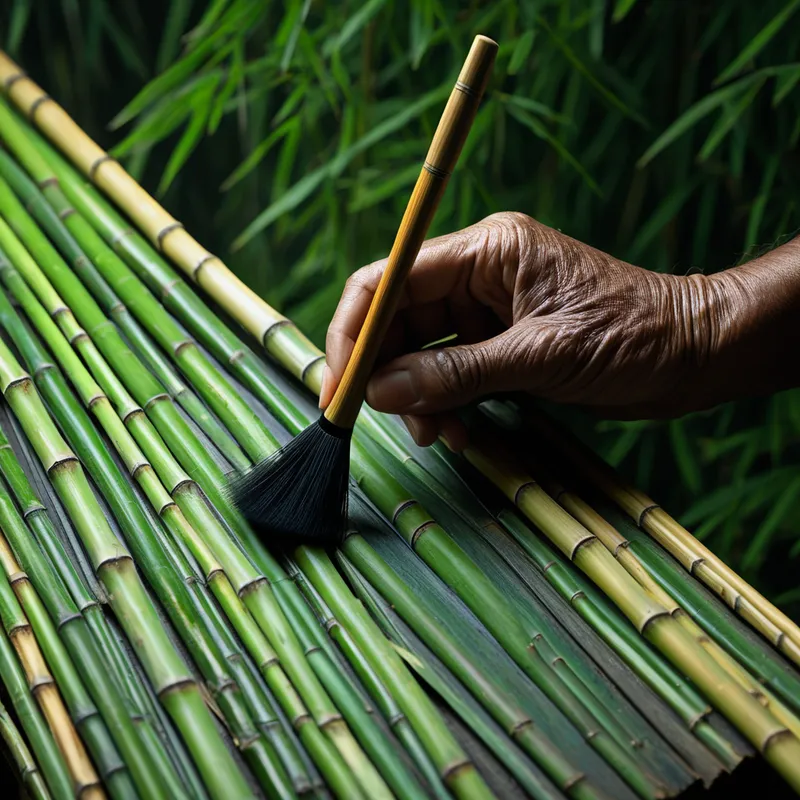
He consented. In the spare gatehouse, by the light of a single lamp that fought the deepening dusk, the old master took up the brush. The conflict resolved not in a shout, but in a whisper of ink on bamboo. For three days, he wrote. He did not argue; he described. He did not command; he suggested. He wrote of water that wears away stone by yielding, of the valley that receives all streams because it lies low, of the uncarved block that holds all potential. He wrote of the mystery that is both mother and void, of action through non-action, of strength found in softness.
When the last character was set, a stillness absolute filled the room. Lao Tzu handed the Tao Te Ching—eighty-one brief chapters—to Yin Xi. Without a word, he mounted his buffalo. He passed through the gate, the shadows of the mountains swallowing him and his beast whole. He did not depart; he simply ceased to be separate, returning to the Tao as a raindrop returns to the sea. All that remained was the text, a map drawn in paradox, pointing toward the very horizon where the mapmaker had vanished.
Cultural Origins & Context
The myth of the Tao Te Ching’s birth is inseparable from its historical ambiguity. Scholars debate the existence of Lao Tzu, placing the text’s compilation possibly in the 4th century BCE, a time known as the Warring States period—an era of brutal fragmentation and philosophical ferment. This context is crucial. The myth arises from a culture exhausted by rigid Confucian ritual and incessant warfare, yearning for a principle of order that was natural, not imposed.
The story was passed down not as verified history, but as a foundational legend, first recorded by the historian Sima Qian. Its societal function was profound: it authorized the text as a sacred relic, a direct transmission from a semi-divine sage who had achieved ultimate union with the Tao. It framed the Tao Te Ching not as a philosophical treatise to be debated, but as a testament to be contemplated, a whisper from the edge of the known world. The gatekeeper, Yin Xi, represents the mediating role of the disciple—the necessary human vessel that compels and receives transcendent wisdom, ensuring its passage into the human community.
Symbolic Architecture
The myth is a perfect symbolic vessel for the text’s core teachings. Lao Tzu is the archetype of the realized Self, the individual who has integrated consciousness with the deep, unconscious flow of life. His weariness is not despair, but a detachment from the ego’s frantic projections—the “world of ten thousand things.”
The journey to the west is the symbolic movement toward the unconscious, the unknown, the feminine (yin), and the ultimate source. It is the soul’s orientation toward death, not as an end, but as a return to origin.
The Hangu Pass is the liminal space, the threshold between the conscious world (the known kingdom) and the unconscious (the mysterious west). All transformation occurs in such borderlands. The black water buffalo symbolizes earthy, instinctual strength—the animal nature that is not conquered, but calmly mastered and ridden toward transcendence.
The central, beautiful paradox is the act of writing. To inscribe the ineffable is the ultimate human dilemma. The text itself becomes a wu wei (non-action) action—a creation that points beyond itself, a form that teaches formlessness. The sage’s disappearance is the final, necessary lesson: the teacher must vanish so the teaching can live, so the seeker does not cling to the person but to the principle.
The Dreamer’s Resonance
When this myth pattern stirs in the modern psyche, it often manifests in dreams of compelled creativity or wise departure. You may dream of an urgent need to write something down, but the pen writes in water or light. You may dream of a wise old figure at a border—a train station, an airport gate—handing you a simple, heavy object (a stone, a cup) before turning away. Or you may dream of riding a strange, calm animal through a decaying city toward open wilderness.
Somatically, this can feel like a deep fatigue with striving, a “bone-tiredness” of the persona. Psychologically, it signals a critical juncture where the conscious attitude—perhaps one of over-achievement, rigid control, or forceful intervention—has reached its limit and is beginning to break down. The psyche is preparing to yield, to listen to a deeper, quieter intelligence. The dream is an invitation to “ride the buffalo west,” to attend to the instinctual, earthy wisdom that knows how to move without force, and to prepare to articulate the new understanding that emerges from that surrender.

Alchemical Translation
The myth models the alchemical opus of individuation—the process of becoming an integrated, whole Self. The initial state is the “weariness” of the ego, identified with the conscious world’s conflicts and noise (the massa confusa). The decision to “go west” is the crucial, courageous turn inward, the beginning of the nigredo or dark night, where one confronts the shadow and the unknown.
The encounter at the pass is the confrontation with the inner guardian, the psychopomp (here, Yin Xi), who demands that the insights gleaned from the unconscious be made conscious, be given form. This is the albedo, the whitening—the distillation of pure meaning.
The writing of the text is the citrinitas, the yellowing—the translation of raw, often paradoxical, unconscious content into a communicable structure for the psyche. It is the creation of one’s own inner “teaching,” a personal philosophy forged in the depths.
Finally, the disappearance of Lao Tzu is the rubedo, the reddening, and the ultimate goal. It represents the death of the ego’s identification as the separate “author” of one’s life. The integrated Self does not stand apart, boasting of its wisdom; it operates anonymously, through the world, like water shaping the landscape without effort. The individual becomes a clear vessel for the Tao, acting with spontaneous, effortless rightness. The struggle triumphs not in a victory, but in a vanishing—a return to the source, where the personal self is transcended, and one simply is the process of life, flowing.
Associated Symbols
Explore related symbols from the CaleaDream lexicon: