The Tablet of the Fates Myth Meaning & Symbolism
The unalterable cosmic record, inscribed by the primordial Fates, that even Zeus dared not defy, embodying the ultimate law of necessity.
The Tale of The Tablet of the Fates
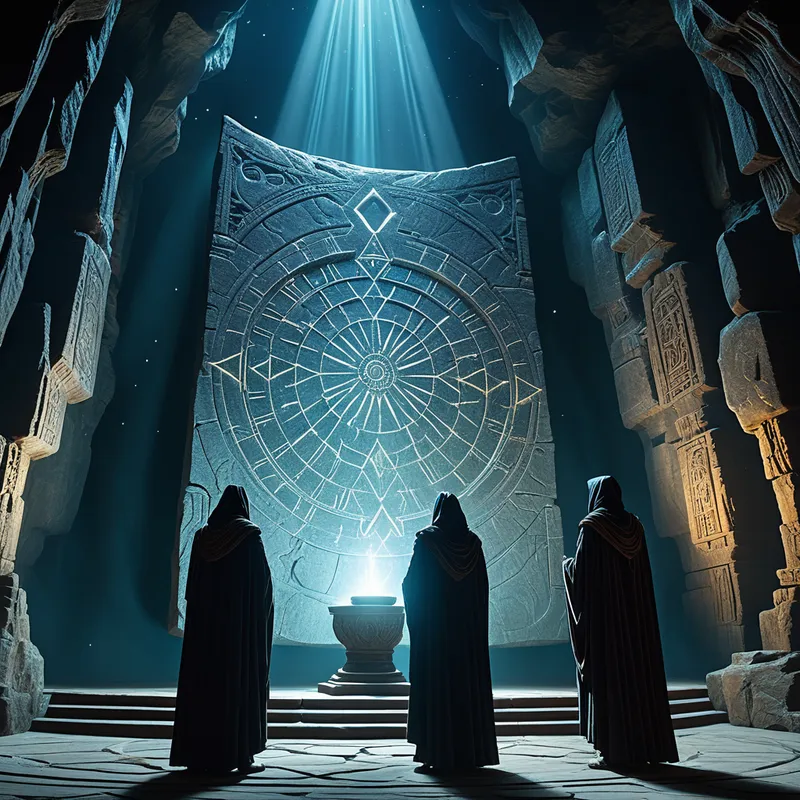
Before the first note of the lyre, before the first clash of the thunderbolt, there was the hum. A deep, resonant frequency woven into the fabric of the void, the sound of inevitability itself. In a chamber older than time, a place not of rock or cloud but of pure potential, three ancient sisters moved. They were the Moirai, daughters of primordial Nyx. Clotho, whose spindle drew the raw thread of a life from the air. Lachesis, whose rod measured its length with unerring eye. And Atropos, the eldest, the inevitable, whose shears waited.
But their work was not merely to spin and cut. Their decree required a record, a foundation upon which the cosmos itself would be built. And so, from the substance of necessity, they conjured it: The Tablet. It was not stone, nor metal, but a plane of solidified law. Upon its vast, smooth surface, Lachesis began to inscribe. Not with chisel or pen, but with the focused intent of her being. Lines of silver fire appeared, a sprawling, beautiful, terrifying script. It was the Logos of all that would be—the rise and fall of cities, the flight of an eagle, the love of a mortal, the moment of a god’s triumph, and the instant of his despair. Each destiny, from the mightiest Titan to the smallest blade of grass, was etched in an unbreakable sequence. The hum became a chorus, the music of fixed fate.
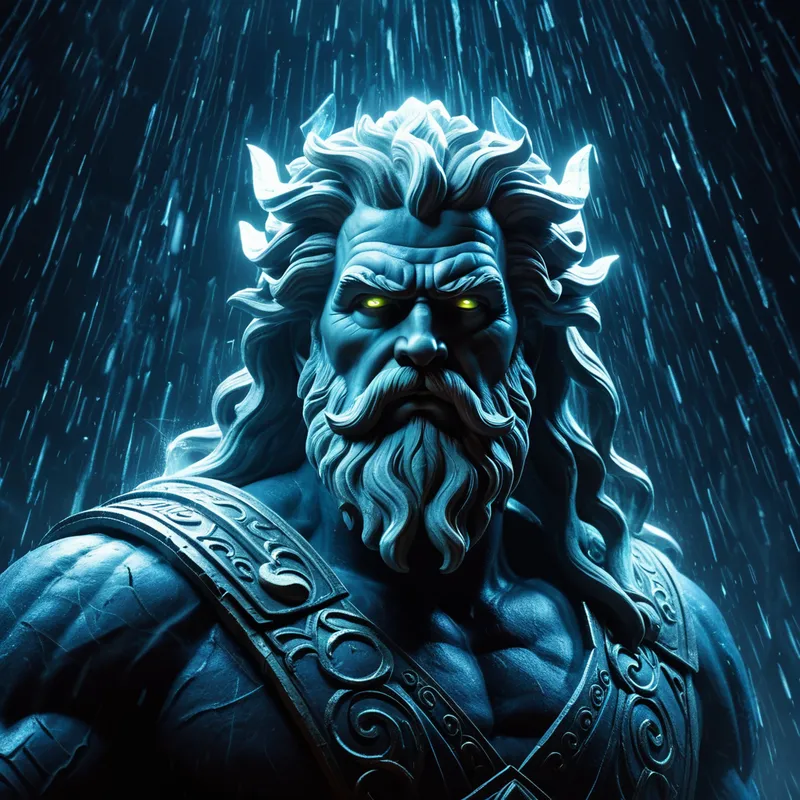
Ages passed. The Titans rose and were cast down by the thunder of the new king, Zeus. He sat upon his throne on Olympus, master of the sky, father of gods and men. His will was law, his power absolute. Or so he believed. For in his pride, a thought grew: to avert a prophecy, to save a beloved son from a foretold doom. He descended from the shining peaks, through the realms of air and earth, drawn to the source of that ancient hum.
He found the chamber. He saw the Sisters, undisturbed by his divine presence, continuing their eternal work. And he saw the Tablet. Its light was cold and absolute. He approached, his aura of storm and authority filling the space. He read the lines pertaining to his own blood, and his brow darkened like a gathering tempest. Here was a law he did not make. Here was a decree his thunder could not shatter.
“This shall not be!” his voice boomed, shaking the foundations of the chamber. He reached out, his hand crackling with the power that had bound the monster Typhon. He would erase the line, rewrite the script, assert his sovereignty over this last, silent domain.
His fingers neared the luminous surface. An inch away. A hair’s breadth. The script upon the Tablet flared, not with heat, but with a profound, inertial no. It was not a barrier, but a truth so dense his divine will could find no purchase. The power drained from his arm. The thunder died in his palm. He stood, for the first time in his eternal life, checked. Not by a superior force, but by the very architecture of reality. The three sisters did not look up. The hum continued. Zeus, the ruler of all, slowly lowered his hand. He had met the boundary of his kingdom. He turned, and in his eyes was not defeat, but a newfound, solemn understanding. Even the king must kneel before the throne of Ananke. The story was written. It would be read.
Cultural Origins & Context
The concept of the Tablet of the Fates, while not detailed in a single, canonical Homeric hymn, is a powerful synthesis of deep strands within Greek religious thought. It is an extrapolation from the well-attested and pervasive belief in the Moirai and the inescapability of Moira itself. This mythic logic finds its roots in the pre-Olympian, chthonic worldview where impersonal, ancient forces held ultimate sway.
The story would have been passed down not as a fixed scripture, but as a philosophical and theological motif within the oral tradition, elaborated by poets and tragedians to explore the limits of power. In works like Homer’s Iliad, Zeus himself weighs the fates of heroes on golden scales, an instrument of measurement, not determination. The Tablet is the logical source of those weights. Its societal function was profound: it was a mythic grounding for the concepts of natural law, justice (Dike), and balance. It answered the haunting question of the Greek mind: if the gods are capricious and powerful, what prevents utter chaos? The Tablet was that answer—an immutable cosmic order that even the gods must uphold, making the universe intelligible and, in a stern way, just.
Symbolic Architecture
The Tablet is the ultimate symbol of the Objective Psyche, the impersonal, foundational layer of reality upon which personal consciousness is built. It is not a story, but the substrate of all stories.
The Tablet of the Fates is the psyche’s first law: before desire, before will, there is pattern.
The Moirai represent the autonomous, instinctual processes of the unconscious that structure existence. Clotho is the urge toward manifestation, the birth of a complex. Lachesis is the process of its development and unfolding through time. Atropos is the necessary termination, the death without which no new life can emerge. The Tablet itself is the recorded pattern of this process—the archetypal blueprint. Zeus represents the ego, the seat of conscious will and identity, which believes itself to be the author of its own life. His confrontation with the Tablet is the inevitable, humbling moment when the ego discovers it is not the writer, but a character within a much larger, pre-existing narrative. The crisis is not about destruction, but about the correct attribution of authorship.
The Dreamer’s Resonance
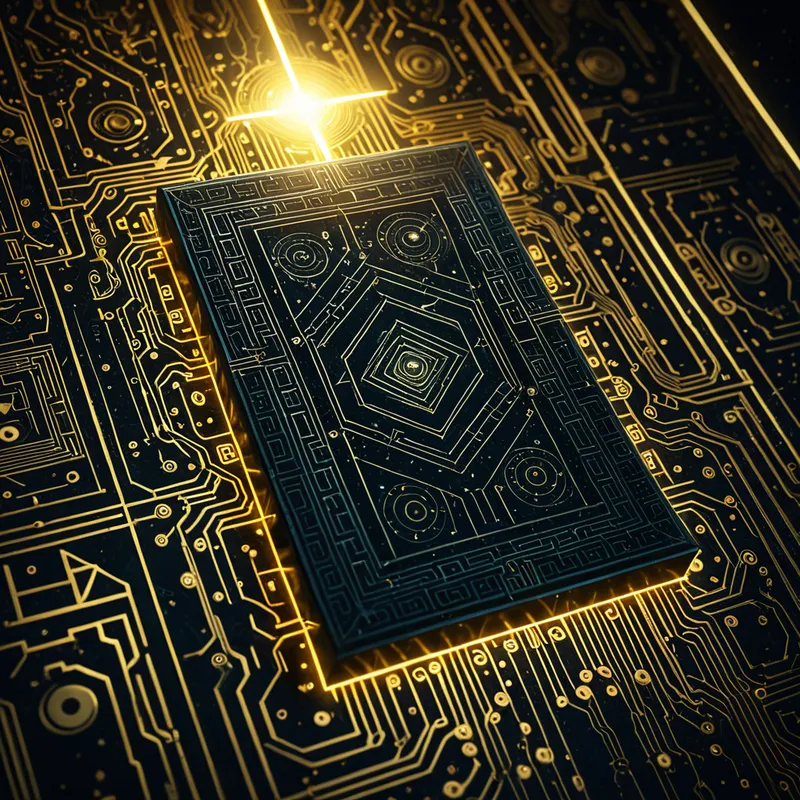
When this myth stirs in the modern soul, it rarely appears as a literal stone tablet. It manifests as the dream of an unchangeable document: a birth certificate with the wrong name, a legal contract signed in blood, a computer screen displaying a life-script you cannot edit. The somatic feeling is one of profound constraint—a tightening in the chest, a weight on the shoulders. This is the psyche signaling an encounter with a core complex or a fateful life pattern.
The dreamer may be struggling with what feels like an inborn trait, a familial destiny, or a consequence so entrenched it feels written in stone. The psychological process at work is the painful but necessary differentiation between what is truly mutable (attitudes, responses, interpretations) and what is a given of one’s existence (certain innate predispositions, historical facts, the actions of others, mortality itself). The dream invites a surrender to this distinction, not as passive resignation, but as the first step toward authentic agency within the bounds of one’s fate.

Alchemical Translation
The alchemical work modeled here is the transmutation of the relationship to necessity. The goal is not to shatter the Tablet—that is the hubris of the uninitiated ego—but to learn to read it with wisdom and to inscribe one’s conscious response upon its fixed lines.
Individuation is not the rewriting of one’s fate, but the conscious ratification of the script, bringing the light of understanding to what was once blind necessity.
Zeus’s journey is our own. First, inflation (believing we are all-powerful authors). Then, confrontation (the crushing discovery of limits). Finally, integration (the sober acceptance of the law, which paradoxically grants a new kind of sovereignty). The king who acknowledges a higher law becomes a true ruler, not a tyrant. So too, the individual who consciously acknowledges the “givens” of their life—their body, their history, their innate temperament—ceases futile rebellion and begins the work of creative adaptation. The Tablet remains, but the posture of the soul before it changes. We move from wanting to erase the text, to deciphering its meaning, and ultimately, to adding our unique signature of conscious assent in the margin. This is the sacred marriage of freedom and destiny, where one’s will aligns with the deeper pattern, and the hum of inevitability becomes the harmony of a life lived in truth.
Associated Symbols
Explore related symbols from the CaleaDream lexicon: