The Tabernacle Myth Meaning & Symbolism
The story of a people building a portable dwelling for their God in the wilderness, a blueprint for the sacred architecture of the inner world.
The Tale of The Tabernacle
[The wind](/myths/the-wind “Myth from Various culture.”/) was a constant whisper over the sands of Sinai, a breath of desolation. Beneath [the shadow](/myths/the-shadow “Myth from Jungian culture.”/) of the trembling mountain, where the voice of YHWH had carved law into stone, a people waited. They were a nation of former slaves, their spirits still echoing with the clank of chains, now adrift in a sea of dust and awe.
Then, a call descended, not in thunder, but in meticulous detail. To [Moses](/myths/moses “Myth from Biblical culture.”/), on the peak wrapped in cloud, the vision was given. It was not a city or a fortress, but a tent—a sacred tent of meeting. A dwelling to be carried. “Let them make me a sanctuary,” the voice said, “that I may dwell among them.”
And so the work began, not by royal decree, but by a stirring of hearts. The call went out: gold, silver, bronze; fine linen of blue, purple, and scarlet; acacia wood, oil, spices, and precious stones. From the treasure they had carried from Egypt, the people gave—not from obligation, but from a willing spirit, until messengers had to say, “Enough! Bring no more.”
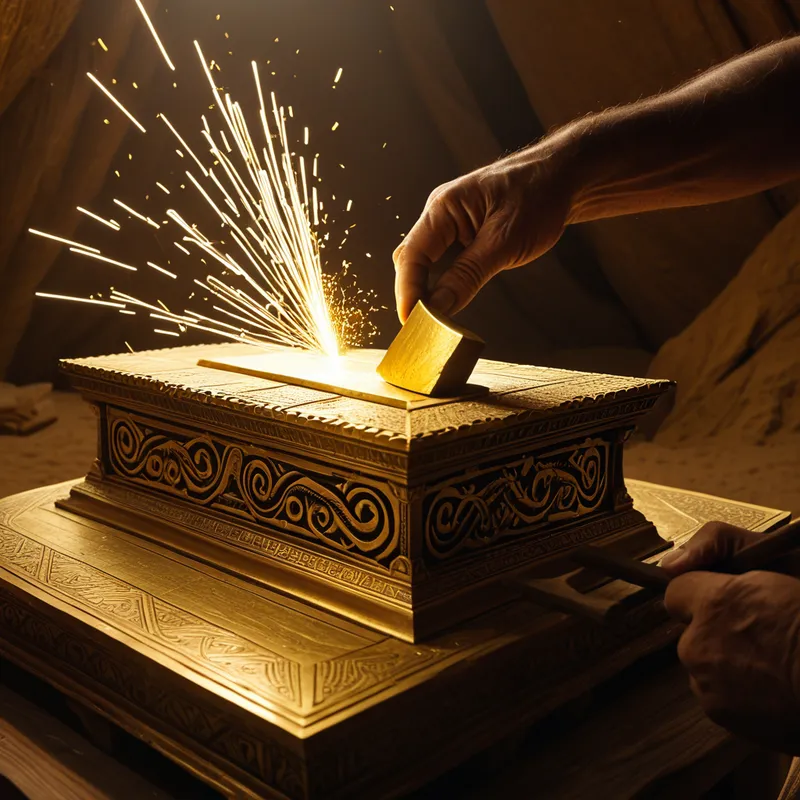
The camp transformed into a sacred workshop. Bezalel of the tribe of Judah, and Oholiab of Dan, their minds and hands filled with the spirit of God, of skill and intelligence and knowledge. They did not invent; they translated. They hammered gold into the mercy seat, where two cherubim of beaten gold faced each other, wings outstretched. They wove ten curtains of twisted linen, embroidered with cherubim, to form the very fabric of the dwelling. They cast bronze for the altar and the basin, and fashioned the seven-branched [Menorah](/myths/menorah “Myth from Judeo-Christian culture.”/) from a single talent of pure gold.
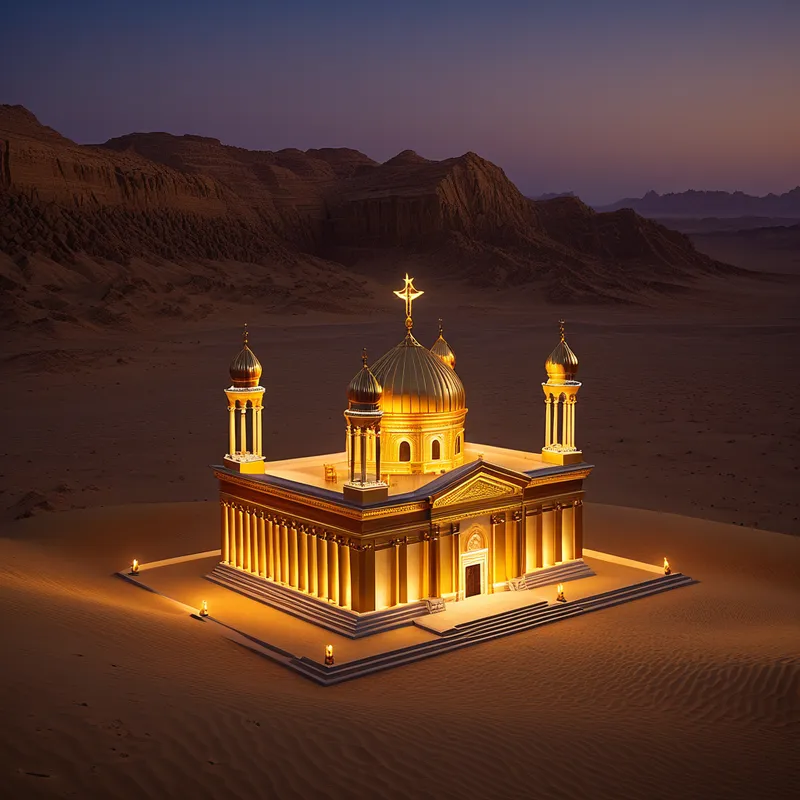
Piece by piece, the portable mountain was born. The outer court, defined by linen hangings. Within it, the bronze altar of sacrifice and the basin for washing. Then the Tent itself, divided by a magnificent veil: the Holy Place, with its table of [showbread](/myths/showbread “Myth from Biblical culture.”/), menorah, and altar of incense; and beyond [the veil](/myths/the-veil “Myth from Various culture.”/), in profound darkness, the Holy of Holies. Here, alone, rested the Ark of the Covenant, surmounted by the cherubim. The space between them was the empty throne, the place of meeting.
On the first day of the first month, the structure was raised. As the frames slotted into their silver sockets, as the curtains were hung and the veils fastened, a silence fell heavier than [the desert](/myths/the-desert “Myth from Biblical culture.”/) heat. Then, the cloud—the visible presence of the [Shekinah](/myths/shekinah “Myth from Christian culture.”/)—descended and covered the Tent of Meeting. The glory of YHWH filled the [Tabernacle](/myths/tabernacle “Myth from Biblical culture.”/). Moses could not enter. The work was complete. God now dwelled in the midst of the wandering, his presence a [pillar of cloud](/myths/pillar-of-cloud “Myth from Biblical culture.”/) by day and fire by night, guiding them through the unknown. The sanctuary moved when the cloud moved; it rested when the cloud rested. The holy was no longer fixed to a mountain peak; it journeyed with the people.
Cultural Origins & Context
This narrative is meticulously recorded in the latter chapters of the Book of Exodus and elaborated throughout Leviticus and Numbers. It is a foundational “constitution myth” for early Israel, emerging from [the crucible](/myths/the-crucible “Myth from Alchemical culture.”/) of [the Exodus](/myths/the-exodus “Myth from Abrahamic culture.”/). The people transitioning from servitude under a [Pharaoh](/myths/pharaoh “Myth from Egyptian culture.”/) who was considered a divine king to a covenant with an invisible, mobile deity required a radical reorientation of sacred space.
The story functioned as both a legal blueprint and a national epic. It was told and retold by the priestly class, the Kohanim, who were its custodians. Its societal function was multifaceted: it established ritual purity laws and a sacrificial system, it centralized worship (preventing idolatry at local shrines), and most profoundly, it answered the existential question of a nomadic people: “Where is our God?” The answer was revolutionary: He is not in a distant heaven or a conquered land, but in the precise, beautiful, and orderly space you create for Him at the very center of your community. The Tabernacle was the physical anchor of the Sinaitic Covenant, the sign that the abstract laws given on the mountain had taken up residence in the heart of the camp.
Symbolic Architecture
The Tabernacle is not merely a [tent](/symbols/tent “Symbol: A tent often symbolizes temporary shelter, transition, and the need for safety.”/); it is a cosmic map and a psychological model. Its layout is a [journey](/symbols/journey “Symbol: A journey in dreams typically signifies adventure, growth, or a significant life transition.”/) from the profane to the profoundly sacred, mirroring the [path](/symbols/path “Symbol: The ‘path’ symbolizes a journey, choices, and the direction one’s life is taking, often representing individual growth and exploration.”/) of [consciousness](/symbols/consciousness “Symbol: Consciousness represents the state of awareness and perception, encompassing thoughts, feelings, and experiences.”/).
The outer court represents the world of action and the body—the place of sacrifice (relinquishment of the old) and washing (purification).
The Holy Place symbolizes the realm of the soul and the mind—illuminated by the Menorah (conscious insight), nourished by the showbread (sustenance), and perfumed by the incense of prayer (ascent of intention).
The Holy of Holies is the irreducible core of the Self, the Self in Jungian terms. It is veiled, dark, and contains only the Ark—the covenant law at the heart of identity. The empty space above the Ark, between the cherubim, is the mysterium tremendum, the point of contact with the transcendent.
Every [material](/symbols/material “Symbol: Material signifies the tangible aspects of life, often representing physical resources, desires, and the physical world’s influence on our existence.”/) is alchemical: acacia [wood](/symbols/wood “Symbol: Wood symbolizes strength, growth, and the connection to nature and the environment.”/) (incorruptible [nature](/symbols/nature “Symbol: Nature symbolizes growth, connectivity, and the primal forces of existence.”/)) overlaid with gold (divine value); bronze (judgment) giving way to silver ([redemption](/symbols/redemption “Symbol: A theme in arts and music representing transformation from failure or sin to salvation, often through creative expression or cathartic performance.”/)) and finally to pure gold (divinity). The [structure](/symbols/structure “Symbol: Structure in dreams often symbolizes stability, organization, and the framework of one’s life, reflecting how one perceives their environment and personal life.”/) moves from the coarse and functional at its periphery to the refined and symbolic at its center.
The Dreamer’s Resonance
When this myth stirs in the modern unconscious, it often manifests in dreams of intricate construction, sacred geometry, or finding a hidden, perfectly ordered room within a chaotic house. One might dream of meticulously measuring a space, weaving a complex tapestry, or trying to assemble a fragile, golden object according to precise but forgotten instructions.
Somatically, this can correlate with a felt sense of seeking center—a need for inner order amidst life’s wilderness. The psychological process is one of sacred containment. The dreamer is attempting to build an inner structure sturdy enough to hold a newfound sense of meaning, a profound emotion, or a connection to the numinous that feels too vast or chaotic for their everyday consciousness. The conflict in the dream often revolves around getting the measurements right, finding the proper materials, or protecting the inner sanctum from profanation. This is the [psyche](/myths/psyche “Myth from Greek culture.”/)’s blueprint phase for individuation.
Alchemical Translation
The alchemy of the Tabernacle myth is the transmutation of wandering into dwelling, and chaos into a vessel for the sacred. For the modern individual, the “wilderness” is the undifferentiated psyche—a landscape of raw impulses, inherited complexes, and existential drift. The “divine command” to build is the call from [the Self](/myths/the-self “Myth from Jungian culture.”/) to create conscious structure.
The first operation is the willing offering—taking the raw materials of one’s life experience (the “gold of Egypt,” both traumatic and gifted) and dedicating them to a higher purpose, rather than being defined by them.
The second is the application of skilled spirit—developing the inner Bezalel, the focused consciousness that can patiently craft insight (the Menorah), nurture the self (the showbread), and cultivate a practice of inner attention (the incense altar).
The ultimate operation is the creation of the inner Holy of Holies: a still, dark, and profoundly private psychic space where one’s core covenant—one’s deepest values and truths—is housed. This space is not accessed constantly, but its known existence changes everything. It is the inner reference point that allows the entire personality to become portable, stable, and guided.
The cloud that fills the completed structure is the experience of indwelling wholeness, a sense of sacred presence that does not remove one from life’s journey but travels with it. The myth teaches that God, or the Self, does not descend into chaos, but into an ordered space made by human hands and a willing heart. We do not find the sacred by accident; we construct the conditions for its revelation, piece by deliberate piece, at the very center of our being.
Associated Symbols
Explore related symbols from the CaleaDream lexicon: