The Symposium from Plato Myth Meaning & Symbolism
A philosophical feast where seven Athenians, from comic to tragic, deliver speeches on love, culminating in Socrates' revelation of its divine, ascending nature.
The Tale of The Symposium from Plato
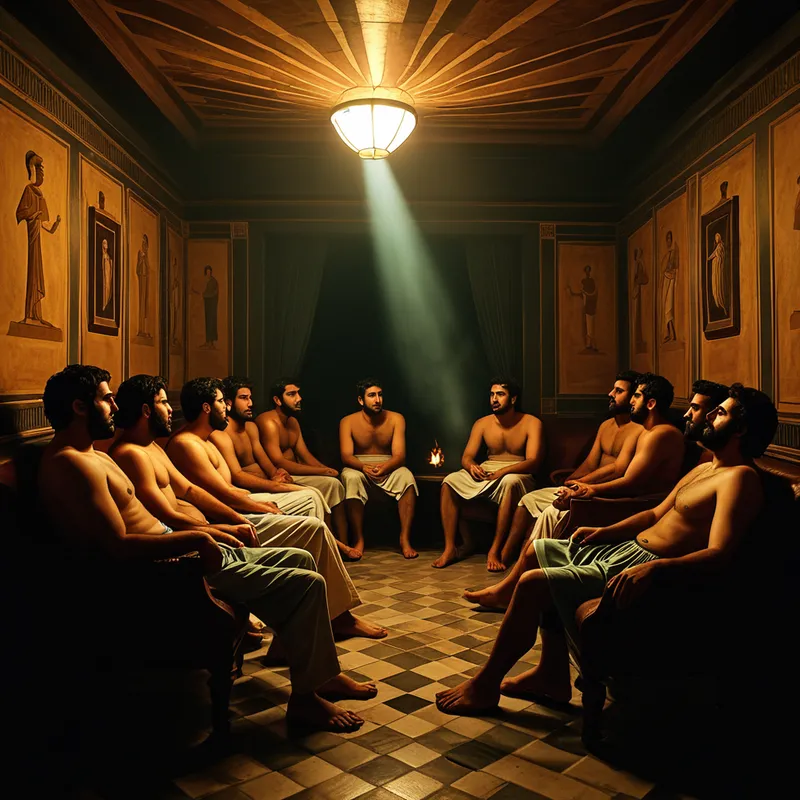
The night air in Athens was thick with the scent of crushed thyme and spilled wine, a perfume of celebration and forgetting. The house of the poet Agathon glowed like a beacon, its courtyard alive with the murmur of slaves and the soft clink of bronze. A sickness had passed through the city, a plague of victory celebrations, and the guests arrived not for a riotous feast, but for a sacred respite—a symposion.
They reclined, these men of Athens, on cushioned couches arranged along the walls. There was Eryximachus, who spoke of harmony in the body and the seasons. There was Aristophanes, his famous hiccups momentarily stilled, who would soon tell a tale of spherical beings cleft in two, forever seeking their missing half. Agathon himself, radiant in his victory garlands, would praise Love as the youngest and most beautiful of gods, shunning all that is old and harsh.
But the soul of the night was Socrates. He entered not as a conqueror, but as a man who had paused in a neighbor’s porch, lost in thought. His cloak was plain, his sandals dusty, yet his presence charged the room like a gathering storm. The agreement was made: they would speak in praise of Eros, each in turn.
The speeches flowed like the wine, each a different vintage. Phaedrus began, calling Love the oldest and greatest god, the inspirer of noble deeds. Pausanias distinguished a common, earthly love from a heavenly, intellectual one. The physician spoke of cosmic balances; the comic poet of primordial wounds and desperate, clinging unions. The host sang of a soft, youthful deity.
Then came Socrates. His voice was a low river cutting through pretty streams. He did not praise. He questioned. He dismantled Agathon’s pretty notions with the gentle, relentless precision of a sculptor finding the form within the stone. Then, he offered not his own speech, but the teaching of a wise woman from Mantineia, Diotima.
He told of Love not as a god, but as a great daimon, a spirit born of Poverty and Resource at the feast of the gods. Love was ever needy, ever seeking, the child of want and cunning. And then, Diotima’s ladder appeared in the mind’s eye of every listener. One begins, she taught, by loving a single beautiful body. But wisdom is to see that the beauty in one body is kin to the beauty in another. The soul then ascends, stepping from the love of beautiful bodies to the love of beautiful souls, then to the love of beautiful laws and institutions, then to the love of beautiful knowledge. Each rung is a letting go, a widening of vision. Until, at the summit, one beholds it: Beauty Itself, absolute, pure, unalloyed, not clothed in flesh or stone or thought, but existing eternally in its own realm. This was the true goal of all love’s yearning. The room fell into a silence deeper than sleep, vibrating with a revelation that made the wine taste like water.
The spell was broken by a clamor at the door. Alcibiades, crowned with ivy and violets, drunk and magnificent, stumbled in. He offered not a praise of Love, but a praise of Socrates—the man whose words had pierced him like a flute-player’s melody, whose ugly exterior hid a divine, sculpted interior of self-mastery. He confessed his own failed, erotic pursuit of the philosopher’s wisdom. In the gray dawn, as the revelers slept or departed, only Socrates remained, awake and unmoved, discussing tragedy and comedy with Agathon and Aristophanes before finally walking out into the morning, to the Lyceum, to begin another day.
Cultural Origins & Context
This is not a myth of Olympus, but a myth of the polis and the mind. Composed by Plato around 385-370 BCE, The Symposium is a philosophical drama set within a quintessential Athenian institution: the all-male drinking party that followed a meal. Its primary function was not mere entertainment, but paideia—the cultural and intellectual formation of the citizen. Here, politics, poetry, philosophy, and homoerotic mentorship intertwined.
The myth was passed down not by oral bards, but through the elite medium of the written dialogue, designed for circulation among educated circles. Its societal function was profound: to provide a new, transcendent telos for the powerful social force of eros (desire), which in Athenian society was primarily channeled into the pedagogical relationship between an older erastes (lover) and a younger eromenos (beloved). Plato, through Socrates and Diotima, seeks to sublimate this social energy. He redirects it from a potentially possessive, physical aim toward a shared pursuit of the Good and the Beautiful, thereby offering a spiritualized foundation for education, philosophy, and civic virtue.
Symbolic Architecture
The Symposium itself is a symbolic vessel—a krater for mixing not just wine and water, but speech and soul. Each speaker represents a partial, fragmented understanding of love, a specific rung on the ladder they have mistaken for the whole.
Love is the child of Poverty and Plenty. It is the permanent condition of the seeker—forever in need, forever resourceful in its pursuit.
Aristophanes’ halved humans symbolize the pervasive feeling of incompletion that drives human longing, a psychic wound mistaken for a literal missing half. Socrates’ ugly exterior masking divine interiority is the ultimate symbol of the deceptiveness of appearances and the principle that true value lies in the immaterial realm of the Forms. The core symbol, however, is The Ladder of Ascent. This is the map of psychic evolution. Each step requires a kenosis—an emptying. One must let go of the particular, the personal, the physical attachment, to embrace the universal, the impersonal, the abstract principle. The beautiful body is a doorway, not a destination.
The Dreamer’s Resonance
When this myth stirs in the modern dreamer, it manifests not as a literal dinner party, but as a profound somatic tension between attachment and transcendence. To dream of climbing a staircase that shifts from solid stone to pure light is to feel the pull of Diotima’s ladder. To dream of a mesmerizing yet plain-faced teacher, or of a beloved whose form keeps dissolving into a blinding light, is to confront the Socratic challenge.
The psychological process is one of sublimation—feeling the raw, magnetic pull of a desire (for a person, a status, an object) and simultaneously experiencing a call to translate that energy upward. The conflict between Alcibiades’ torment and Socrates’ serenity plays out in the dreamer’s body: a heartache that is also a homesickness for something beyond any single person. The dream may present a feast where all food turns to ash, symbolizing the ultimate insufficiency of earthly satisfactions, pointing the soul toward a nourishment of a different order.

Alchemical Translation
The alchemical process modeled here is the transmutation of libido. The base material is raw, personal, often possessive desire—the lead of human need. The symposium is the sealed vas (vessel) of reflection and discourse where this material is heated by the fire of dialectic and shared inquiry.
The goal is not to eradicate desire, but to educate it, to turn its gaze from the reflection to the source.
The separatio occurs at each rung of the ladder: distinguishing the beauty in the body from the Beauty of which the body partakes. The coniunctio is not a marriage with another person, but the soul’s ecstatic union with the Form of Beauty itself. Socrates is the archetypal Philosopher’s Stone—the unassuming vessel that contains and catalyzes the entire transformative process. His self-containment is the proof of the completed work.
For the modern individual, the alchemy is psychic individuation. It is the journey from being driven by personal complexes and attractions (eros as biological or psychological compulsion) to being guided by a transpersonal value (eros as the soul’s longing for the divine). It asks us to use every attraction, every love, every profound admiration as a starting point for an ascent—to ask not “How can I possess this?” but “What eternal quality in the realm of Forms is this pointing me toward?” The triumph is not in finding one’s missing half, but in realizing the self is already whole, and its true fulfillment is in participatory contemplation of the absolute. The feast ends, the guests depart, and the philosopher walks alone into the dawn, carrying the silent, unshakeable knowledge of the source of all beauty within.
Associated Symbols
Explore related symbols from the CaleaDream lexicon: