The Sword in the Stone - only Myth Meaning & Symbolism
A mysterious sword, embedded in an anvil upon a stone, awaits the one predestined to draw it, proving their right to rule and their unity with a higher will.
The Tale of The Sword in the Stone - only
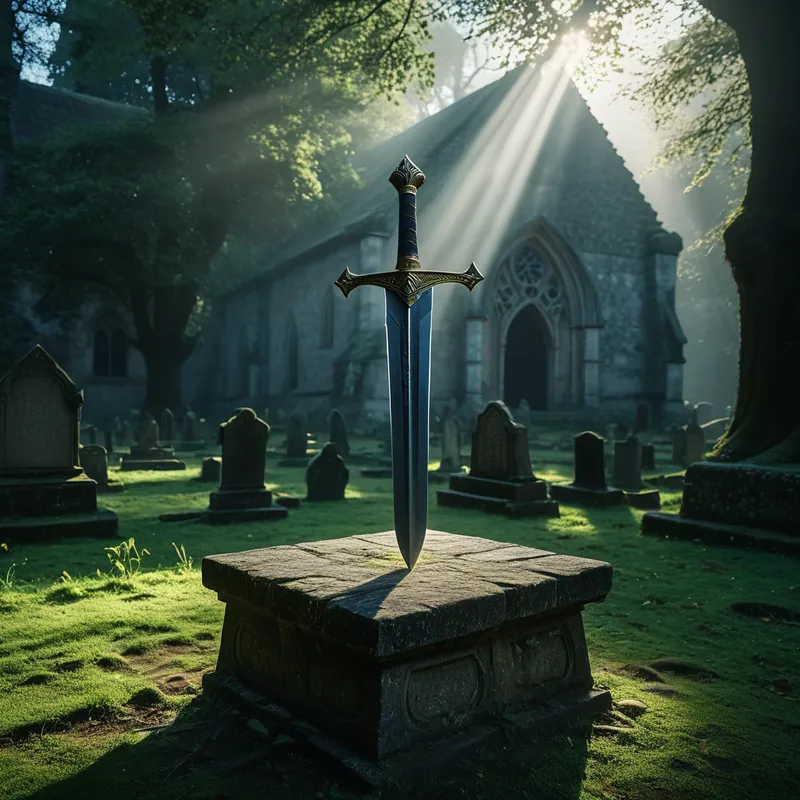
Listen, and hear a tale not of a kingdom, but of a vacancy. A throne sat empty, a land held its breath. The old king was gone, and with him, the certainty of order. In the heart of the realm, in the forgotten churchyard of London Stone, a miracle had frozen in iron and granite.
It appeared with the first frost—a great, grey stone, and upon it, an anvil of blackest iron. And through anvil and stone, a sword was driven, its blade buried to the hilt. The metal was not of this earth; it caught the sun and moon with equal fire, and letters of gold shone along its length: Whoso pulleth out this sword of this stone and anvil, is rightwise king born of all England.
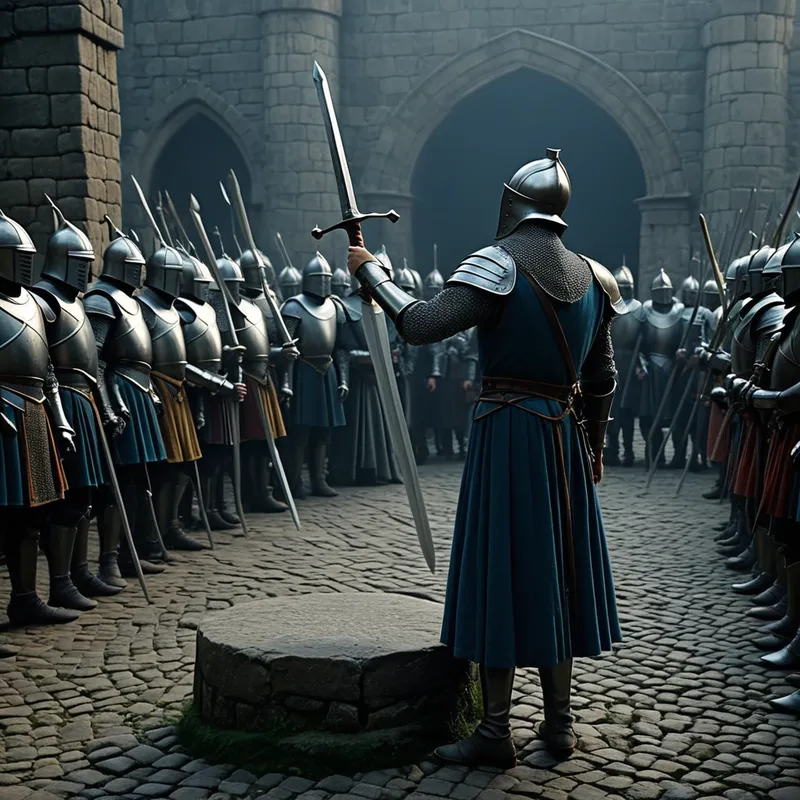
The news rang like a bell. Lords and knights, barons and champions—all whose blood ran hot with ambition—came. They arrived in polished steel, their muscles corded from a lifetime of war. They gripped the hilt, their faces set in grim determination. They heaved. They strained until veins stood out on their temples and sweat soaked their tunics. The sword did not budge. It was as if the stone had grown roots to the center of [the world](/myths/the-world “Myth from Tarot culture.”/), and the sword was the spine of the stone itself. Hope curdled into frustration, then into a bitter tradition. A tournament was proclaimed in London, a grand distraction, where men could win a crown of laurels since they could not win [the crown](/myths/the-crown “Myth from Various culture.”/) of sovereignty.
To this tournament came a forgotten boy, Arthur Pendragon, a squire to his foster-brother, Sir Kay. Duty-bound, earnest, he was invisible to the glittering throng. When Kay’s own sword was lost in the chaos of preparation, he sent Arthur to fetch a replacement. Arthur, in his haste, found the churchyard empty. There stood the stone, the anvil, the sword. Seeing no owner, thinking only of his brother’s need, he did not ponder destiny. He did not summon his strength. He simply took the hilt in his hand and pulled.
The sound was not of grating metal, but of a sigh released from [the earth](/myths/the-earth “Myth from Hindu culture.”/). The sword slid forth, smooth and silent as a key turning in a lock. He felt no resistance, only a rightness, a completion, as if his hand had been the missing piece. He carried the blade back, a simple tool for a simple task, unaware that he carried the fate of nations.
Only when the sword was thrust back into the stone to satisfy the disbelieving lords did the truth become undeniable. For Arthur, alone among all men, could draw it out again. And again. Each time, the release was effortless. The crowd’s jeers turned to murmurs, then to a hushed, awe-struck silence. The stone had not been a test of might, but a mirror of essence. The kingdom had not found its strongest man, but its rightful soul.
Cultural Origins & Context
The core archetype of the unclaimable weapon that designates a ruler is ancient and widespread, but its most crystalline form is found in the Historia Regum Britanniae by Geoffrey of Monmouth and later refined in the Le Morte d’Arthur. This was not a folk tale told around hearths, but a literary and political myth crafted in a time of fragile nationhood. It served a critical societal function: to legitimize authority not through brute force or lineage alone, but through divine providence and inherent, almost magical, right.
The “sword in the stone” narrative provided a perfect metaphor for the medieval ideal of kingship. The king was not merely a warlord; he was Rex Dei Gratia—the King by the Grace of God. His authority was embedded in a cosmic order, represented by the stone (the enduring land, [the law](/myths/the-law “Myth from Biblical culture.”/)) and the anvil (the divine forge of destiny). The story was a bulwark against chaos, asserting that true sovereignty is a sacred contract, recognized by the world itself, not seized by the most ambitious.
Symbolic Architecture
The myth is a perfect symbolic engine. The [Stone](/symbols/stone “Symbol: In dreams, a stone often symbolizes strength, stability, and permanence, but it may also represent emotional burdens or obstacles that need to be acknowledged and processed.”/) represents the immutable [foundation](/symbols/foundation “Symbol: A foundation symbolizes the underlying support systems, values, and beliefs that shape one’s life, serving as the bedrock for growth and development.”/) of [reality](/symbols/reality “Symbol: Reality signifies the state of existence and perception, often reflecting one’s understanding of truth and life experiences.”/)—the laws, traditions, and unconscious structures of the world into which we are born. The Anvil is the point of [tension](/symbols/tension “Symbol: A state of mental or emotional strain, often manifesting physically as tightness, pressure, or unease, signaling unresolved conflict or anticipation.”/) between the [human](/symbols/human “Symbol: The symbol of a human represents individuality, complexity of emotions, and social relationships.”/) will and this [foundation](/symbols/foundation “Symbol: A foundation symbolizes the underlying support systems, values, and beliefs that shape one’s life, serving as the bedrock for growth and development.”/), the place where [destiny](/symbols/destiny “Symbol: A predetermined course of events or ultimate purpose, often linked to spiritual forces or cosmic order, representing life’s inherent direction.”/) is hammered out. The Sword is sovereignty itself: the power to cut through illusion, to make decisive judgments, to defend and define a [realm](/symbols/realm “Symbol: The symbol of ‘Realm’ often signifies the boundaries of one’s consciousness, experiences, or emotional states, suggesting aspects of reality that are either explored or ignored.”/).
The sword is not pulled by strength, but by congruence. It answers not to the muscle, but to the metaphysical signature of the soul.
Arthur’s success is the key. He does not overpower the stone; he is in alignment with it. The sword is the [symbol](/symbols/symbol “Symbol: A symbol can represent an idea, concept, or belief, serving as a powerful tool for communication and understanding.”/) of the Self, and the stone is the unintegrated [psyche](/myths/psyche “Myth from Greek culture.”/). The act of drawing the sword is the [moment](/symbols/moment “Symbol: The symbol of a ‘moment’ embodies the significance of transient experiences that encapsulate emotional depth or pivotal transformations in life.”/) of psychic [integration](/symbols/integration “Symbol: The process of unifying disparate parts of the self or experience into a cohesive whole, often representing psychological wholeness or resolution of internal conflict.”/), where the individual’s conscious will (Arthur’s hand) is recognized as the legitimate agent of the deeper, transpersonal Self (the sword’s divine [purpose](/symbols/purpose “Symbol: Purpose signifies direction, meaning, and intention in life, often reflecting personal ambitions and core values.”/)). He is the only one not trying to take power, but to fulfill a need, which is the purest form of right [action](/symbols/action “Symbol: Action in dreams represents the drive for agency, motivation, and the ability to take control of situations in waking life.”/).
The Dreamer’s Resonance
When this myth stirs in the modern dreamscape, it signals a profound crossroads in the dreamer’s psychological development. To dream of [the sword in the stone](/myths/the-sword-in-the-stone “Myth from Global/Universal culture.”/) is to dream of a latent potential, a destiny, or a true vocation that feels tantalizingly close yet impossibly fixed. The dreamer often stands before it, feeling both called and inadequate.
The somatic experience in the dream is telling. Attempting to pull the sword and failing mirrors feelings of imposter syndrome, of striving with the wrong part of oneself—using [the ego](/myths/the-ego “Myth from Jungian culture.”/)’s ambition (the knight’s brute force) instead of the soul’s authenticity. The sword that will not budge represents a life role or creative power that cannot be accessed through effort alone; it requires a surrender to one’s essential nature. The dream is an invitation from the unconscious to stop trying to become sovereign, and to recognize the sovereignty that is already inherent, waiting for the correct, seemingly humble, application of [the self](/myths/the-self “Myth from Jungian culture.”/).
Alchemical Translation
The alchemical process modeled here is the Individuation journey toward inner kingship. The initial state is the unconscious nation—the psyche ruled by competing complexes (the quarreling barons), lacking a central, guiding authority.
The stone and sword represent the [prima materia](/myths/prima-materia “Myth from Alchemical culture.”/), the raw, confused material of the psyche where our greatest power lies buried. The tournament of knights symbolizes the ego’s futile attempts to solve the problem through known methods: ambition, [persona](/myths/persona “Myth from Greek culture.”/), and force.
Arthur’s action is the alchemical coniunctio, or [sacred marriage](/myths/sacred-marriage “Myth from Alchemy culture.”/). His humble, service-oriented consciousness ([the squire](/myths/the-squire “Myth from Arthurian culture.”/)) makes contact with the transcendent function (the sword). He is not seeking the philosopher’s stone; he is simply fetching a sword for his brother. This is the critical insight: the ego must engage with the Self not out of greed for power, but out of necessity and right relationship.
The crown is not placed upon the head, but grown from within it, forged in the moment the hand, the hilt, and the heart are recognized as one.
Drawing the sword is the opus, the creation of the psychic center. The once-buried power is now conscious, wieldable, and directed. For the modern individual, this translates to the moment one stops trying to force a life path and instead answers a genuine, often simple, call from the depths of one’s being. The authority that emerges is not over others, but over one’s own fragmented self—a sovereignty that brings order, purpose, and the courage to rule the inner kingdom with [justice](/myths/justice “Myth from Tarot culture.”/) and grace.
Associated Symbols
Explore related symbols from the CaleaDream lexicon: