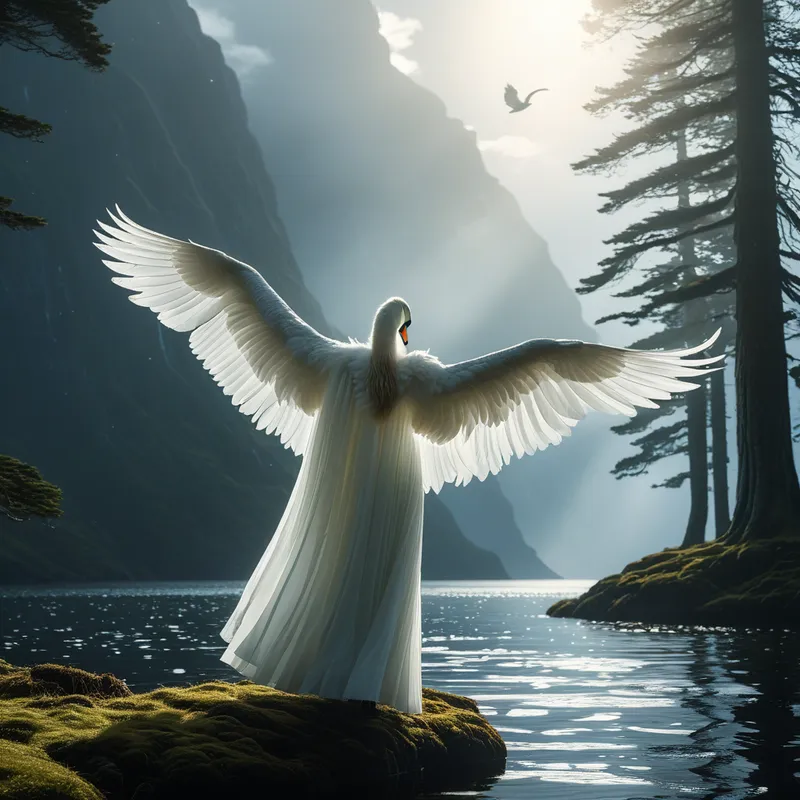
The Swan Cloak Myth Meaning & Symbolism
A man steals a swan maiden's feathered cloak, forcing her into human marriage until she rediscovers her hidden skin and reclaims her wild, free nature.
The Tale of The Swan Cloak
Listen. The wind carries a story older than the standing stones, a whisper from the time when the veil between worlds was thin as a swan’s feather. In the long, blue twilight of the north, where the fjords cut deep and the pines stand sentinel, there is a lake. Not just any lake, but a place of silvered stillness, a mirror to the sky, known to be touched by the Fae.
On such an evening, a young hunter, weary from a fruitless chase, came to its shores to drink. As he knelt, the water did not ripple. The air grew cold and thick with a scent like frost and lily. Then, from the mist curling over the far shore, they came. Three shapes, gliding with a grace that stole his breath. Not birds, but women of unearthly beauty, their skin pale as moonlight, their hair flowing like dark water. With them, upon the bank, they laid three cloaks—garments not of wool or linen, but woven from the very plumage of swans, each feather holding the light of the stars.
With laughter like ice cracking on a spring stream, they shed these skins and slipped into the lake’s embrace, becoming one with the water and the fading light. The hunter watched, his heart a drum in his chest. A longing, fierce and desperate, seized him—not for conquest, but for the beauty that was so utterly free. Driven by an impulse he could not name, he crept forward on silent feet. His hand closed on the softest thing he had ever felt, a cloak of down and flight. He hid it within his tunic and retreated into the shadows of the trees.
The twilight deepened. Two of the women emerged, shook the water from their limbs, and donned their cloaks. In an instant, they were swans again, beating powerful wings to ascend into the darkening sky. The third searched. Her movements grew frantic, her cries a sharp, lonely sound that echoed across the water. She was trapped, her wildness caged, her means of return stolen.
It was then the hunter revealed himself. In his eyes, she saw her prison. Without her cloak, she could not fly. Without her skin, she was bound to the world of men. He offered her his cloak, his home, his name. With the resignation of one who sees no path, she accepted, her eyes holding the distant look of the far horizon.
Years passed. She was a good wife, they say. She bore him children, and her touch could heal and her words could soothe. But often, she would stand at the door of their dwelling, gazing toward the lake, her spirit clearly elsewhere. The hunter, now a husband, kept the cloak hidden in a chest, beneath heavy furs and tools of iron, its memory a secret thorn in his heart.
Then came the day. The children, playing in the loft, discovered the chest. Among the mundane things, they found a bundle of breathtaking softness. Dragging it into the light, they marvelled at the white feathers, still impossibly clean and bright. Their mother, entering the room, stopped as if struck. The sight of her own skin, lost and found, washed over her like a tide. The distant look in her eyes ignited into a fierce, immediate fire.
She took the cloak from her children’s hands. She did not shout, nor weep. She wrapped it around her shoulders, and as the feathers touched her skin, a transformation began—not of pain, but of profound remembering. The form of the wife softened, blurred, and reshaped itself into the ancient, elegant lines of the swan. She looked once at her human children, her gaze holding a love that was now of a different world, and then at the man who had loved and confined her. Without a sound, she turned and walked out the door, down to the lake she had never forgotten.
At the water’s edge, she launched herself into the air. The great wings beat once, twice, and she was aloft, a streak of white against the grey sky, joining the distant, calling V of her sisters. She did not look back. The hunter, arriving breathless at the shore, held only the memory of her touch and the profound silence she left in her wake, a silence filled with the understanding of what it means to hold, and what it means to let go.
Cultural Origins & Context
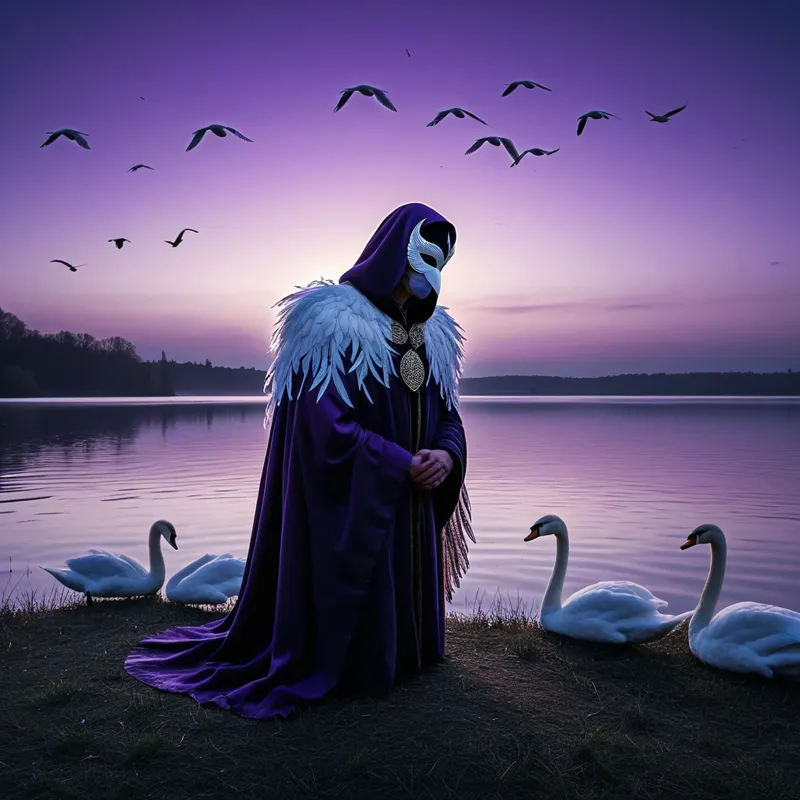
The tale of the Swan Maiden is a migratory myth, a story-shape found across the globe, from Japan to North America. Within the Celtic and Norse spheres, it finds a particular home. In Norse tradition, swans are connected to the Valkyrjur and to the Norns, beings who traverse the boundaries of fate and destiny. The swan’s seasonal migration mirrored the soul’s journey, and its purity and otherworldliness made it a fitting vessel for a being from the Álfheimr or the Celtic Tír na nÓg.
These stories were not mere entertainment. Told around hearth-fires in longhouses or at seasonal gatherings, they served as profound cultural parables. They explored the tense interface between the human community and the wild, untamable forces of nature and the supernatural. The myth codified the understanding that some forms of beauty and power are not meant to be owned, and that marriage—or any binding contract—with the otherworld carries inherent, volatile risks. It was a narrative reminder that the Fae are not humans; their logic is different, their loyalties are to their own kind and their own freedom. The story’s persistence speaks to a deep, ancestral recognition of a truth: the soul has a native shape, and to force it into another is to invite an inevitable, often heartbreaking, reckoning.
Symbolic Architecture
At its core, the Swan Cloak is the symbol of authentic being. It is the integrated self, the true nature, the soul’s unique capacity and essence. To possess one’s cloak is to be whole, autonomous, and in alignment with one’s deepest destiny.
The theft of the cloak is the central wound of the psyche: the separation from one’s own wild nature by the demands of the world.
The hunter represents the conscious ego—the part of us that seeks to capture, to name, to secure beauty, love, or inspiration. His act is not one of malice, but of a longing so intense it becomes possessive. He sees a sublime aspect of life (the anima, the soul-image) and, in his desire to make it permanent and his, he severs it from its source. The marriage that follows is the psyche’s compromised state: a life lived productively, even lovingly, but with a fundamental part of the self locked away, hidden in the shadow (the chest under mundane objects). The swan wife’s distant gaze is the symptom of this displacement—the chronic nostalgia for a home the conscious mind has forgotten.
The children, serendipitously discovering the cloak, symbolize the emergent, undomesticated contents of the unconscious. They act without the ego’s agenda, bringing what is hidden into the light. The moment of recovery is not an act of will, but an act of grace and recognition. The return to swan-form is the ultimate symbol of individuation: the reclamation of one’s essential nature after a long exile in an adopted identity.
The Dreamer’s Resonance
When this myth stirs in modern dreams, it speaks of a profound psychological process underway. To dream of finding or wearing a feathered garment suggests a nascent connection to a more authentic, intuitive, or creative self trying to emerge. There is a feeling of lightness, potential, and a forgotten grace being remembered.
Conversely, dreams of searching desperately for a lost item of clothing, especially one that is soft, white, or magical, often mirror the swan maiden’s plight. This is the somatic signature of the soul feeling trapped—in a job, a relationship, a life role that, while perhaps comfortable or respectable, does not belong to the dreamer’s fundamental nature. The anxiety in the dream is the anxiety of displacement. The body may feel heavy, grounded, and sluggish, in stark contrast to the longed-for sensation of flight and weightlessness. Such dreams are a call from the deep self, indicating that a vital aspect of the personality has been bartered for security and is now demanding its return.
Alchemical Translation
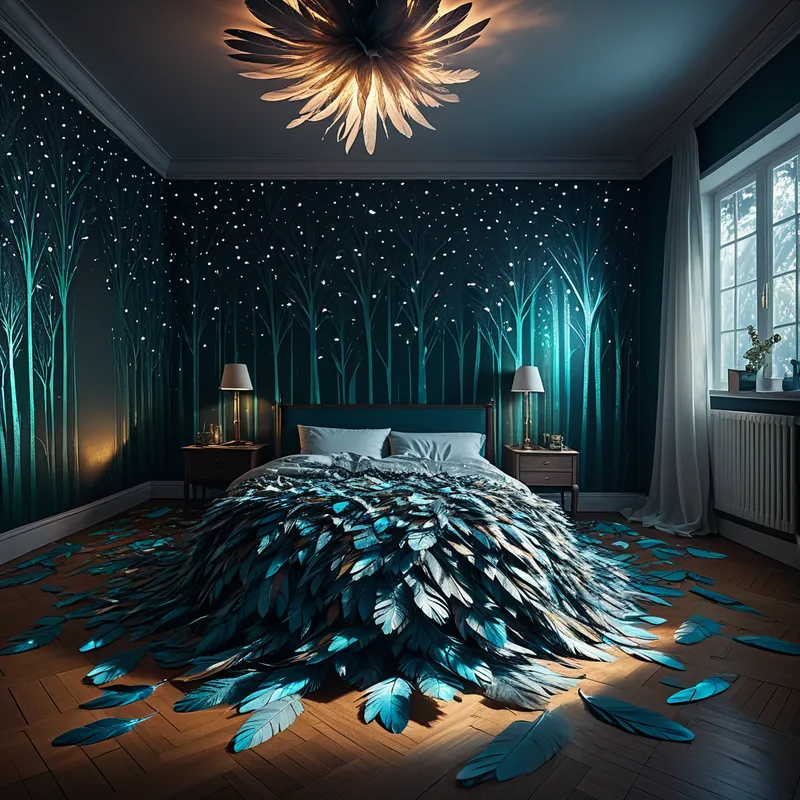
The alchemical journey mirrored in the Swan Cloak myth is the process of solve et coagula—dissolution and re-coagulation—applied to the self. The initial state (the swan free on the lake) is the prima materia, the unrefined but whole soul. The theft is the separatio, the violent splitting of spirit from matter, wildness from domestication. The long marriage represents the nigredo, the blackening—a period of often productive but melancholic struggle, where the individual operates without their full power, feeling the dull ache of incompletion.
The rediscovery of the cloak is the albedo, the whitening: the moment of illuminating insight where the ego recognizes the treasure it has hidden, even from itself.
This is not an intellectual understanding, but a visceral, transformative recognition. The final transformation and flight are the rubedo, the reddening, and the culmination of the individuation process. Here, the reclaimed self is not the same as the innocent one lost at the lake’s edge. It has been tempered by human experience—by love, by loss, by the mundane realities of life. The new wholeness incorporates that experience but is no longer defined or confined by it. The swan flies with the memory of the hearth, but her direction is once again her own. For the modern individual, the myth does not prescribe abandoning responsibility, but rather undertaking the sacred task of finding where, in the architecture of one’s life, the true cloak has been stored, and having the courage to put it on again, no matter the cost to the comfortable, furnished identity left behind. The flight is inward, toward the core of one’s own being.
Associated Symbols
Explore related symbols from the CaleaDream lexicon: