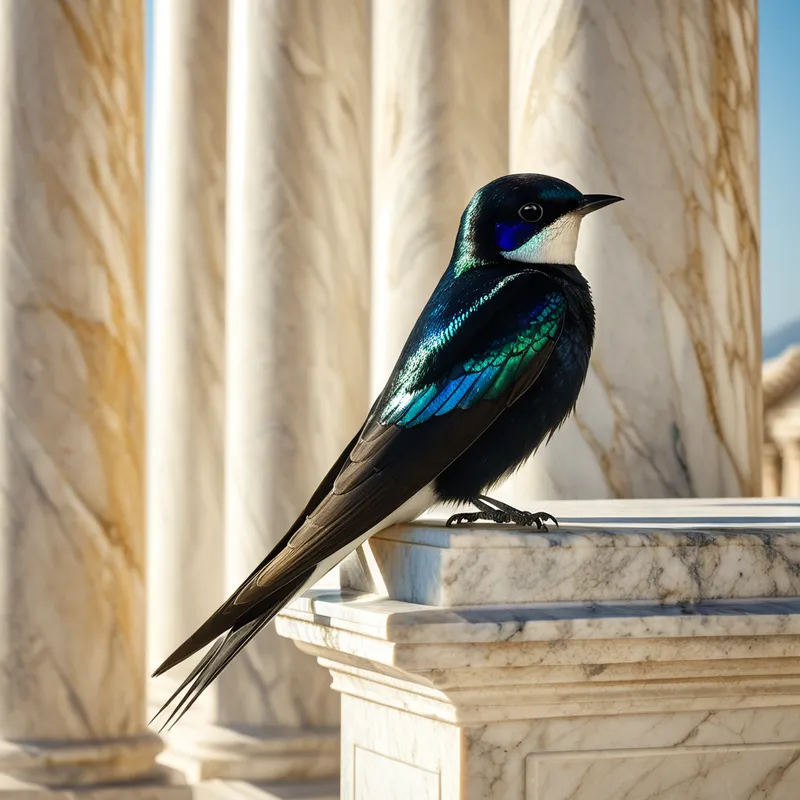
The Swallow Myth Meaning & Symbolism
A tragic tale of sisters transformed into birds, embodying grief, longing, and the eternal voice of loss carried on the wind.
The Tale of The Swallow
Hear now a story not of glory, but of a cry that pierced the heavens and was answered with feathers. It begins not with a hero, but with a king, Tereus, who fought beside the great Pandion. In gratitude, Pandion gave Tereus his daughter, Proche, to be his queen in the wild, Thracian north.
For a time, there was peace. Proche bore a son, Itys. But a deep loneliness grew in her heart, a yearning for the voice of her homeland, for her beloved younger sister, Philomela. "Husband," she pleaded, "let me see my sister, or let her come to me. Bring her here, that I might hear the music of Athens in this foreign land."
Tereus sailed to Athens and beheld Philomela. In that moment, a fire was kindled in him—not of love, but of a consuming, dark desire. He spoke honeyed lies to Pandion, swearing to protect the girl and return her swiftly. The old king, trusting in the bonds of kinship, consented.
The journey was a descent. Upon the Thracian shore, far from any watching eye, Tereus dragged Philomela into a deep, hidden grove. He committed an unspeakable violence against her. And then, fearing her voice more than any sword, he drew his blade again. "You will never tell," he hissed, and he cut out her tongue.
He imprisoned her in a high, stone hut in the woods, guarded by his men, and returned to Proche. "Philomela is dead," he declared, his face a mask of false grief. "The voyage claimed her. We mourned her at sea."
But a silenced voice finds other ways to speak. In her prison, Philomela’s hands, skilled at the loom, became her new tongue. She wove a tapestry. Not of flowers or heroes, but of her story—the ship, the grove, the crime, the mutilation—thread by bloody thread, she spelled out Tereus’s betrayal. She convinced an old servant to take this woven testimony to the queen.
Proche unrolled the fabric. She did not cry out. Her grief for a dead sister turned to ice, then to a fury colder than the Styx. She went to the festival of Dionysus, whose rites freed women to roam the wilds. In that sacred madness, she found the hut, freed her sister, and the two embraced in a silence louder than thunder.
What does rage born of utter violation demand? A payment in kind. The sisters looked upon Itys, the innocent son, the living proof of Tereus’s line. And in their shattered world, he became the symbol of the father’s crime. They killed the boy. They cooked his flesh. And at the evening feast, Proche served this terrible dish to her husband.
Tereus ate his fill. "Bring me my son," he boomed. And Philomela, the voiceless one, stepped forward. She threw the child’s severed head upon the table. Now, she spoke with action.
A roar shook the palace. Tereus, understanding the horror, seized his axe and chased the sisters through the halls, through the fields, to the very edge of the world. As his axe descended, the gods, who had watched this human tragedy unfold, finally intervened. No one was worthy of salvation, yet all were worthy of an end.
In a whirl of light and form, they were transformed. Tereus became the hoopoe, a bird armed with a sharp crest, forever chasing. Proche became the nightingale, who flies by night and sings a song of piercing, beautiful sorrow for her lost child. And Philomela, the one whose tongue was stolen, became the swallow. She cannot sing a sweet song, only a restless, chattering cry. She is forever voiceless, yet forever speaking, building her nest under the eaves of human homes, a ghost of a story that can never be fully told.

Cultural Origins & Context
This harrowing myth comes to us primarily from the Roman poet Ovid in his Metamorphoses, though he drew upon older, lost Greek sources. It is a story from the edges of the Greek world, set in wild Thrace, a land often viewed as barbaric and untamed by the Athenian imagination. This setting is crucial; it frames the narrative as a collision between civilized Athens and primal, lawless passion.
The myth functioned as a powerful aetiology—a story explaining origins. For the ancient listener, it answered the question: "Why does the nightingale sing so mournfully at night? Why does the swallow chatter and never sing? Why does the hoopoe look so warlike?" It rooted the behavior of common birds in a deep, human drama of crime and punishment. More profoundly, it was a cautionary tale about the catastrophic breakdown of the most sacred social bonds: xenia (guest-friendship), marriage, and kinship. It explored the extremes of human passion—lust, vengeance, grief—and the terrifying, ambiguous justice of the gods, who offer not healing, but a frozen, eternal reflection of the trauma in the natural world.
Symbolic Architecture
The myth’s power lies in its brutal, uncompromising symbols. It is not a story of redemption, but of indelible transformation through trauma.
Philomela, the swallow, is the archetype of the violated voice. Her tongue is cut out, the physical instrument of narrative and truth-telling destroyed. Yet her essence cannot be silenced. She weaves her testimony. The loom becomes her new voice, her creativity weaponized into evidence. Her transformation into the swallow is not an escape, but a continuation. The swallow’s sharp, incessant call is the sound of a story that can never be formed into lyrical song, only into fragmented, urgent proclamation. She nests among humans, a perpetual, haunting reminder.
The deepest trauma seeks not a song, but a pattern—a weave of evidence that says, this happened.
Proche, the nightingale, embodies the vengeance of maternal grief turned inward. Her crime is arguably more terrible, a direct infanticide born of a logic shattered by betrayal. Her beautiful, nocturnal song is the alchemy of unbearable sorrow into art, but an art forever stained by its origin. Tereus, the hoopoe, is pure, unreflective appetite and aggression—lust, violence, and wrath made feather and bone.
Together, they form a tragic triad: the perpetrator forever chasing, the mourner forever singing her loss, and the witness forever testifying in a broken language.

The Dreamer's Resonance
When this myth stirs in the modern unconscious, it rarely appears as a literal bird. Instead, one may dream of being unable to scream in a crucial moment, finding one’s mouth filled with cloth or feathers. One may dream of discovering a hidden tapestry or a coded message that reveals a devastating truth. A dream of cooking a meal with a sense of dreadful, sacred purpose points to the Proche energy—a psyche contemplating a terrible, irreversible action to balance a cosmic scale of injustice.
Somatically, this myth manifests as a tightness in the throat, a chronic cough, or a feeling that one’s words are not heard, only scattered. It is the psychology of the silenced witness struggling to articulate a truth that feels too dangerous or too painful for linear speech. The dreamer is in the process of what psychologist Carl Jung might call confronting the shadow—not just personal shadow, but the horrific shadow of collective human violation and the terrifying, amoral responses it can evoke. The psyche is weaving its own tapestry from the fragments of experience.

Alchemical Translation
The individuation process modeled here is not one of integration into wholeness, but of transmutation through irreversible catalysis. There is no going back to an innocent state. The "base metal" of a peaceful life is shattered by the lead of trauma (Tereus's crime). The alchemical vessel is the hidden grove, the prison hut—the sealed space of suffering.
Philomela’s weaving is the nigredo, the blackening. It is the conscious, agonizing work of giving form to the formless pain, of staring directly at the horror and rendering it in detail. This is not healing, but truth-making. Proche’s act is the violent, paradoxical separatio—the attempt to sever the source of the poison by destroying its fruit, a move that further binds her to the cycle.
The gods’ transformation is the mortificatio that becomes the albedo. Death of the human form, birth of the symbolic one. The psychic energy is not resolved; it is re-signed. It changes address from the personal biography to the archetypal realm.
For the modern individual, the "alchemical translation" is the movement from being a victim of a personal history to becoming a vessel for an archetypal pattern. It is the recognition that some wounds do not "heal" in a linear sense, but become the very signature of one’s voice—the chattering, restless, persistent call of the swallow. The goal is not to sing like the nightingale (turning grief into beauty), but to find the unique, fragmented, truthful pattern of one’s own testimony and to build a nest with it, close to the hearth of the human community. It is to understand that to be forever marked is not to be forever broken, but to be forever specific, a living myth in flight.
Associated Symbols
Explore related symbols from the CaleaDream lexicon: