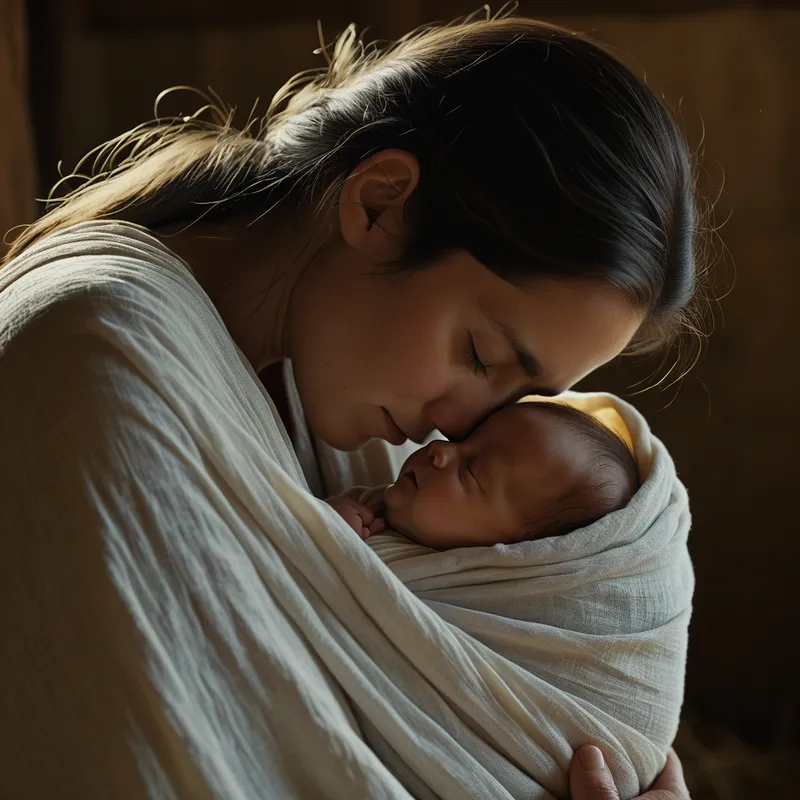
The Swaddling Clothes Myth Meaning & Symbolism
A sacred relic of the infant Christ, the swaddling clothes symbolize divine incarnation, the vessel of the soul, and the primal container of all potential.
The Tale of The Swaddling Clothes
Listen. In the time when the world was a hard shell and the sky a cold dome, a whisper began. It was a whisper not of wind, but of a promise so old the stars remembered its first syllable. It traveled down the celestial pathways, through the ranks of fiery messengers, until it settled like a seed in the heart of a land groaning under the heel of empire.
In a town whose name means "House of Bread," in a province where hope was a currency spent carefully, there was no room. Not in the inn, not in the houses of men. The only shelter was a cave, a hollow in the earth used for beasts, smelling of hay and animal breath. Here, in this most humble of temples, the Uncontainable prepared to be contained.
She was a young woman, her brow damp with the labor of all creation condensed into a single, human moment. Her pain was the pain of the world in transition. And then, a cry—not a cry of wrath or judgment, but the thin, piercing wail of a newborn. The Logos had a voice of flesh. The Infinite had finite lungs.
There was no silk, no royal purple. Only simple cloths, swaddling bands, brought for this purpose. Her hands, guided by a love as deep as the first void, moved with a ritual solemnity. She lifted the child—this tiny, vulnerable king—and began to wrap him. First one limb, then another, the linen folds embracing the squirming, sacred flesh. She bound him not to restrict, but to hold. To define the space where divinity now dwelled. To make a boundary for the boundless.
The light in the cave was not from torches alone. It seemed to pool around the manger, the feeding trough now a throne. The animals, silent witnesses, bowed their heads. The husband stood guard, a protector of the mystery. And the child, now swaddled, rested. The promise was no longer a whisper on the wind. It was here, breathing, wrapped in linen, and placed in straw. The world, in that moment, held its breath.

Cultural Origins & Context
The myth of the Swaddling Clothes finds its primary source in the Gospel of Luke (2:7, 2:12). Its power, however, extends far beyond a single verse. It became a foundational image in early Christian iconography and apocryphal tradition. The clothes themselves were believed to have been preserved as relics, with several churches in Europe claiming to possess them throughout the Middle Ages, most notably the Basilica of Santa Maria Maggiore in Rome.
This was not merely a detail of biography; it was a theological and narrative keystone. For a culture proclaiming a God who became flesh—the doctrine of the Incarnation—the specifics of that flesh mattered. The swaddling clothes were the first evidence of that humanity, the initial "container" for the divine. They were preached in sermons, depicted in nativity scenes, and pondered in monastic cells. Their societal function was to make the sublime tangible, to ground the mystery of God-among-us in the universal, human act of caring for a newborn. They bridged the chasm between the heavenly and the earthly, saying, "He was one of us, from the very first breath."
Symbolic Architecture
The swaddling clothes are an archetypal symbol of sacred containment. They represent the necessary vessel for the incarnation of spirit into matter, of the infinite into the finite.
The soul, like a newborn god, requires a binding to take form. Chaos gains meaning only when embraced by a limit.
Psychologically, the swaddling bands represent the ego in its most primal, positive function: as a necessary container for the contents of the Self. Before we can explore the vastness of who we are, we must first have a coherent "I" to do the exploring. The clothes symbolize the personal history, the body, the family, and the cultural context that initially define and hold our nascent identity. They are not the prison, but the first home.
The manger, a feeding trough, compounds this symbolism. The divine is placed not in a palace but in a place of nourishment for beasts. This speaks to the grounding of spirit in the instinctual, animal body and in the humble, mundane realities of life. The myth presents the ultimate paradox: strength in vulnerability, power in limitation, and divinity in absolute dependence.

The Dreamer's Resonance
When this myth stirs in the modern dream language, it often surfaces during times of profound vulnerability or new beginning. To dream of swaddling, or of being tightly wrapped, may point to a somatic process of integration.
The dreamer might be experiencing a "psychic birth"—a new idea, identity, or phase of life is emerging from the unconscious womb. The swaddling in the dream can reflect a felt need for protection, for a gentle but firm holding as this fragile new self comes into being. Conversely, dreaming of torn or unraveling swaddling clothes may signal a fear of falling apart, of lacking the necessary structure to contain a powerful emotional or spiritual experience. The dream may present the dreamer as the infant, in need of care, or as the parent, tasked with the solemn duty of wrapping and protecting something precious and vulnerable within themselves. The somatic resonance is often in the chest and core—a feeling of being held or, in its absence, of terrifying exposure.

Alchemical Translation
The alchemical journey modeled by this myth is not the heroic quest of the hero, but the humble, profound process of the innocent. It is the prima materia—the raw, divine spark of the Self—accepting the vessel of individual life.
The great work begins not with a sword, but with a surrender to being wrapped in the particular.
For the modern individual, the "alchemical translation" is the conscious embrace of one's own incarnation. It is the recognition that our spiritual longing must take flesh in our specific body, our personal history, our flawed relationships, and our earthly responsibilities. The "swaddling" is the act of committing to a form, of saying "yes" to the limitations that make actualization possible. The struggle is against the spirit that wishes to remain unbounded and abstract; the triumph is in the humble manger of the present moment, where the sacred is made real.
This is the core of individuation: the imago Dei must be swaddled in the fabric of our unique personality. We wrap our divine potential in the linen of our choices, our wounds, and our loves. We place it in the manger of our daily life, allowing it to be nourished by simple, earthly things. The myth teaches that transcendence is found not by escaping containment, but by sanctifying it. The goal is not to cast off the swaddling clothes, but to discover, within their gentle embrace, that they have always been holding a light that can fill the world.
Associated Symbols
Explore related symbols from the CaleaDream lexicon: