
The Styx Myth Meaning & Symbolism
The sacred river of oaths and death, a boundary between worlds where gods swear unbreakable vows and souls are ferried into the underworld.
The Tale of The Styx
Listen. Before [the world](/myths/the-world “Myth from Tarot culture.”/) was as you know it, in the deep, unformed chasms that existed before even the sun drew its first breath, there was [water](/myths/water “Myth from Chinese culture.”/). Not the life-giving sea, but a water of a different nature. A primordial water, cold and silent, born from the union of the first things: Erebus and Nyx. This was the Styx.
Her course was not through green valleys, but through the sunless gorges of [the underworld](/myths/the-underworld “Myth from Greek culture.”/), a realm of shadows and echoes. Her waters were not clear, but a black so profound it seemed a liquid void, a tear in the fabric of being. To look upon her was to feel the chill of finality, the absolute quiet that follows the last word ever spoken.
Yet, for all her terror, she was sacred. More sacred than any temple of gleaming marble. For the gods themselves, the deathless Olympians, knew one truth above all: an oath sworn by the Styx was unbreakable. It was the one chain that could bind the boundless.
When a god, in council upon high Olympus or in secret pact, needed to seal a promise with ultimate gravity, they would call upon Iris. The rainbow-winged messenger would flash down from the bright air, through the layers of the world, to the sunless land. There, from a silver ewer, she would draw the dread water. The very act of carrying it was a burden, a weight upon the soul.
Back in the divine halls, the god would pour the libation. “I swear by the black water of the Styx,” the vow would echo. And in that moment, a stillness would fall. Should the oath be broken, the punishment was not mere embarrassment or war. It was a living death. The oath-breaker would lie breathless, voiceless, and senseless for one [great year](/myths/great-year “Myth from Greek culture.”/)—nine mortal years—cut off from the nectar of life and the company of the divine. To swear by Styx was to stake your very essence.
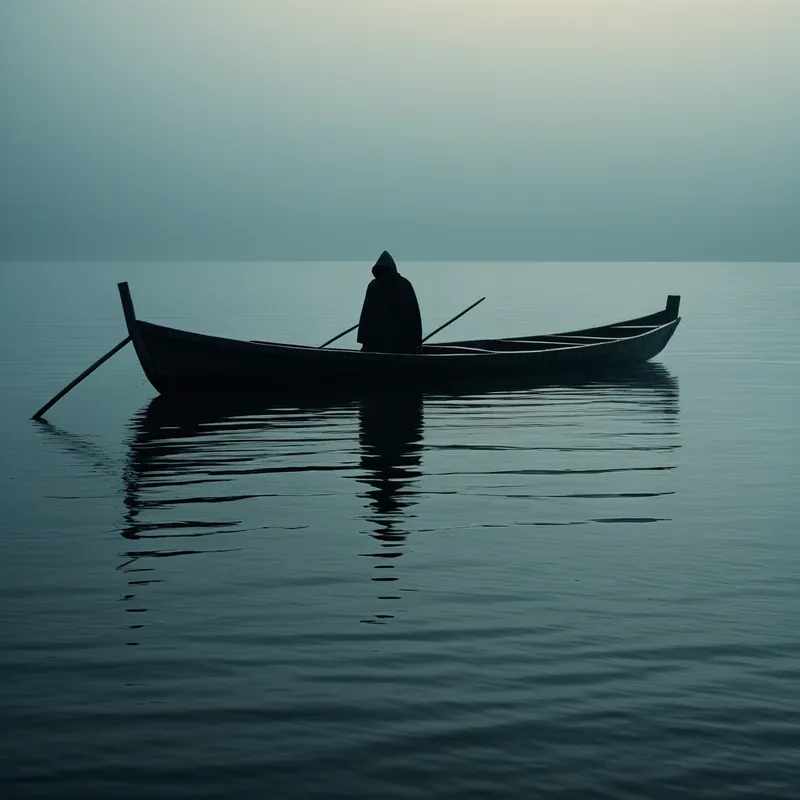
And for mortals, her name was a whisper on the final breath. She was the last boundary. After the soul left the body, it came to her banks—a desolate, crowded shore of sighs. There, the silent, aged ferryman, Charon, awaited his coin. Those who could pay were rowed across the soundless expanse. Those who could not were left to wander the misty banks for a hundred years, ghosts among ghosts. The crossing was the point of no return, the final acceptance of the story’s end. The water did not rage; it was a perfect, cold indifference, the ultimate resolver of all disputes, the final judge who asks no questions.
Cultural Origins & Context
The myth of the Styx is not a single story with a beginning, middle, and end, but a foundational element woven into the fabric of Greek religious and poetic thought. Its earliest and most authoritative sources are the epic poems of [Homer](/myths/homer “Myth from Greek culture.”/) and the Homeric Hymns, and later, the systematic theogony of Hesiod. In Hesiod’s Theogony, Styx is personified as an Oceanid, a daughter of [the Titans](/myths/the-titans “Myth from Greek culture.”/) [Oceanus](/myths/oceanus “Myth from Greek culture.”/) and [Tethys](/myths/tethys “Myth from Greek culture.”/), who was the first to side with Zeus in his war against [the Titans](/myths/the-titans “Myth from Greek culture.”/). Her reward was this solemn honor: to be the holy substance of the binding oath.
This dual nature—both a fearsome geographic feature of the [underworld](/myths/underworld “Myth from Greek culture.”/) and a personified, allied goddess—illustrates the Greek tendency to animate the forces of cosmos and [psyche](/myths/psyche “Myth from Greek culture.”/). The myth functioned on multiple societal levels. For the state, it provided the ultimate metaphysical sanction for treaties and laws. For individuals, it framed the existential journey of death, providing a concrete, albeit terrifying, geography for the afterlife. The requirement of the coin for Charon reinforced social and religious practices (the Charon’s obol), tying piety to a hoped-for peaceful transition. The Styx was thus a pillar of cosmic order, a divine instrument of [justice](/myths/justice “Myth from Tarot culture.”/), and a map for the human soul’s most daunting voyage.
Symbolic Architecture
The Styx is the archetypal [boundary](/symbols/boundary “Symbol: A conceptual or physical limit defining separation, protection, or identity between entities, spaces, or states of being.”/). It is not merely a [river](/symbols/river “Symbol: A river often symbolizes the flow of emotions, the passage of time, and life’s journey, reflecting transitions and movement in one’s life.”/) but the very concept of the liminal, the irreversible threshold. Psychologically, it represents the point of commitment so deep it alters the [structure](/symbols/structure “Symbol: Structure in dreams often symbolizes stability, organization, and the framework of one’s life, reflecting how one perceives their environment and personal life.”/) of [the self](/myths/the-self “Myth from Jungian culture.”/), and the confrontation with realities we spend our lives avoiding.
The oath sworn by the Styx is the moment the psyche binds itself to a truth, knowing the cost of betrayal is a psychic death—a numbness, a silence, an exile from one’s own vitality.
Its black, sunless waters symbolize the unconscious in its most profound [aspect](/symbols/aspect “Symbol: A distinct feature, quality, or perspective of something, often representing a partial view of a larger whole.”/): not [the personal unconscious](/myths/the-personal-unconscious “Myth from Jungian Psychology culture.”/) of repressed memories, but the collective, impersonal [depths](/symbols/depths “Symbol: Represents the subconscious, hidden emotions, or foundational aspects of the self, often linked to primal fears or profound truths.”/) where individual [identity](/symbols/identity “Symbol: Identity represents the sense of self, encompassing personal beliefs, cultural background, and social roles.”/) dissolves. To cross it is to undergo a kind of ego [death](/symbols/death “Symbol: Symbolizes transformation, endings, and new beginnings; often associated with fear of the unknown.”/). The figure of Charon is [the psychopomp](/myths/the-psychopomp “Myth from Various culture.”/), the guide who can only operate when the “coin” of conscious [acceptance](/symbols/acceptance “Symbol: The experience of being welcomed, approved, or integrated into a group or situation, often involving validation of one’s identity or actions.”/) is paid. The coin represents the willingness to acknowledge and engage with this profound transition, to pay the price of leaving an old state of being behind. Those who cannot pay are the souls trapped in denial, forever wandering the shore of a [decision](/symbols/decision “Symbol: A decision in a dream reflects the choices one faces in waking life and can symbolize the pursuit of clarity and resolution.”/) unmade, a [life](/symbols/life “Symbol: The symbol of ‘Life’ represents a journey of growth, interconnectedness, and existential meaning, encompassing both the joys and challenges that define human experience.”/) unlived, a [truth](/symbols/truth “Symbol: Truth represents authenticity, honesty, and the quest for knowledge beyond mere appearances.”/) unfaced.
The Dreamer’s Resonance
When the Styx appears in modern dreams, it rarely manifests as a classical river with a ferryman. Its presence is more subtle, more insidious. It is the dream of standing before a vast, dark body of water you must cross—a lake at night, a flooded street, an endless black ocean. There is a palpable sense of finality. You may be trying to find a boat, or you may be standing on a pier, knowing you have to swim. The water is cold, and it promises to swallow sound, light, and warmth.
Somatically, the dreamer often wakes with a chill, a feeling of dread, or a profound stillness. Psychologically, this signals a confrontation with a non-negotiable life transition: the end of a relationship, a career, an identity, or the acceptance of a mortality, either literal or metaphorical (the death of a hope, a dream). The dream asks the essential question: Are you ready to pay the fare? Do you possess the coin of conscious acceptance, or will you remain stranded on the near shore, a ghost of your former self, unable to move forward into whatever new, unknown country lies beyond? The Styx dream is an invitation—or a demand—to commit to a crossing whose outcome is unknown, trusting only in the necessity of the journey itself.

Alchemical Translation
In the alchemical process of individuation—the journey toward psychic wholeness—the Styx represents the crucial stage of [nigredo](/myths/nigredo “Myth from Alchemical culture.”/). This is the descent into the blackness, the confrontation with [the shadow](/myths/the-shadow “Myth from Jungian culture.”/), the dissolution of the [persona](/myths/persona “Myth from Greek culture.”/) we present to the world. It is a necessary, if harrowing, purification.
The alchemical oath is the vow to endure the nigredo, to stay in the black waters of the unconscious until the old, rigid structures of the ego are dissolved, making way for a new, more authentic composition.
The modern individual does not swear an oath to Zeus, but to the Self. We make promises to ourselves at the soul’s level: to heal, to create, to leave a toxic pattern, to speak a buried truth. Breaking such an oath leads to the mythical punishment: a psychic numbness, a “living death” where we go through the motions disconnected from our own vitality. The crossing of the Styx, then, is the active, courageous engagement with this nigredo. We pay Charon’s coin by surrendering our resistance, by accepting the pain and uncertainty of transformation. We are ferried not by an external god, but by an inner capacity for surrender. The far shore is not [Hades](/myths/hades “Myth from Greek culture.”/) as an end, but as a womb of potential. It is the state of having been stripped bare, where the old identity is gone and the new has not yet formed—the fertile, silent darkness from which [the philosopher’s stone](/myths/the-philosophers-stone “Myth from Alchemical culture.”/) of the integrated Self can eventually emerge. The Styx teaches that to become whole, one must first consent to be unmade.
Associated Symbols
Explore related symbols from the CaleaDream lexicon: