The Stymphalian Marshes Myth Meaning & Symbolism
Heracles' sixth labor: cleansing a poisoned marsh of monstrous, metallic birds, a myth of psychic purification and confronting the clamor of the unconscious.
The Tale of The Stymphalian Marshes
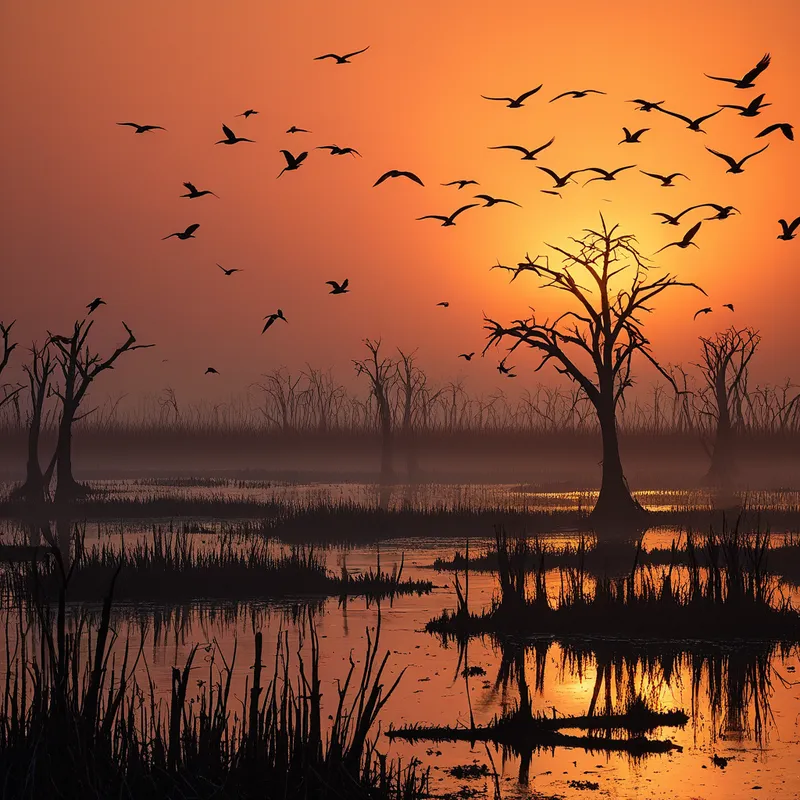
Hear now of the sixth trial, a labor not of muscle against muscle, but of spirit against a creeping, silent poison. The air itself had grown sick in the land of Stymphalia. Where once clear waters nourished the earth, there now sprawled a vast, weeping wound—a marsh, stagnant and foul. Its waters did not reflect the sky, but swallowed light, holding instead the grey, bloated visage of death. Gnarled trees, their roots drowned, reached skeletal fingers into a perpetual, clammy mist. No frog croaked here; no fish stirred in the murk. The silence was not peaceful, but a held breath, a waiting.
For this was the domain of the Stymphalian Birds. They were not creatures of feather and flesh, but nightmares given form. Their plumage was of beaten bronze, sharp enough to flay a man with a passing wing. Their beaks and talons were forged of the same deadly metal, capable of piercing armor like parchment. They did not eat grain, but the flesh of men and the fruits of the field. Their dung was a venom that blighted the land, turning soil to salt and hope to despair. And their voices… when they chose to break that terrible silence, it was a sound to shatter sanity—a metallic, shrieking clamor that echoed the grinding of gears in a god’s forgotten machine.
Into this blight walked Heracles, his shoulders already bearing the weight of five impossible labors. The stench of decay filled his nostrils; the oppressive silence pressed on his ears. He saw the vastness of the marsh, the impenetrable canopy where thousands of these metallic horrors roosted, and knew his strength, the strength that strangled the Nemean Lion, was useless here. To wade into the sucking mire was to be trapped, a feast for a descending storm of beaks and blades. For a moment, even the son of Zeus knew despair, standing at the edge of the world’s corruption.
But the gods watch, and aid comes in unexpected forms. Athena, she of the gray eyes, appeared to him not with a sword, but with a gift of sound. Into his hands she placed the krotala, great castanets of bronze forged by Hephaestus himself. They were instruments not of music, but of divine disturbance. Heracles, understanding, climbed to a high place overlooking the toxic mere. He raised the brazen clappers and brought them together.
A sound erupted that tore the world asunder. It was not mere noise, but a sonic spear, a vibration that shook the very roots of the marsh. The stagnant water rippled. The dead trees trembled. And from the dense, sickly groves erupted a chaos of shrieking metal and beating wings. The silence was obliterated as the entire flock, driven to madness by the unbearable din, clouded the sky—a storm of living blades, their bronze feathers catching the sickly light. Heracles stood firm in the tempest. As the disoriented birds wheeled and screamed above him, he raised his bow, its arrows tipped with the Hydra’s venom. One by one, with impossible precision amidst the cacophony, he shot them from the sky. Those that fled, their terror greater than their malice, winged far away, never to plague Stymphalia again. The marsh remained, but the poison in the air was gone. The dreadful clamor faded, replaced at last by the true, deep silence of a wound beginning, slowly, to heal.
Cultural Origins & Context
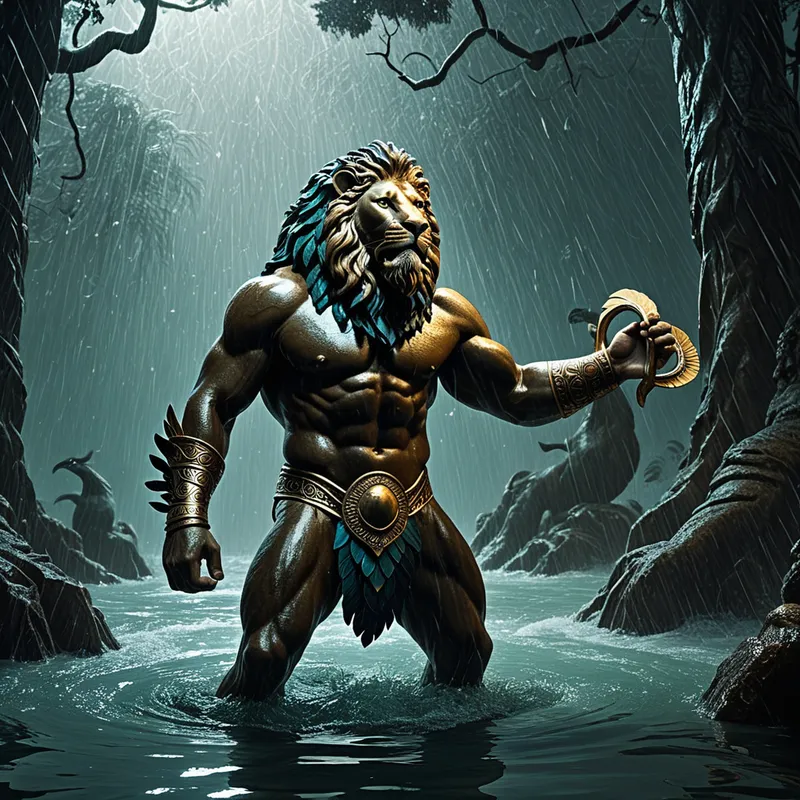
This myth comes to us primarily from the pen of Hesiod, and later, the meticulous catalog of Pausanias. It was not merely an adventure story, but a foundational narrative embedded in the Greek understanding of civilization’s fragile victory over chaos. The labors of Heracles were a cultural map of existential threats: monstrous beasts, chaotic forces, and unclean places that needed to be subdued for the ordered world, the cosmos, to exist.
The Stymphalian Marshes represented a very specific kind of threat: not a singular monster to be dueled, but an environmental sickness. It spoke to very real fears of pestilence, of wetlands that bred malaria and miasma, and of plagues of locusts or birds that could devastate crops. The myth served a societal function by providing a heroic model for confronting diffuse, systemic corruption. It was told to remind people that some evils cannot be faced head-on with brute force alone; they require cleverness, divine aid (symbolic of cultural knowledge and technology, like the krotala), and the courage to stand one’s ground in the face of overwhelming, chaotic noise.
Symbolic Architecture
The Stymphalian Marshes are a masterful portrait of a psychic condition. This is the landscape of the shadow when it is not integrated but left to fester. The marsh is the stagnant unconscious, where unresolved traumas, repressed instincts, and toxic patterns sink and putrefy, poisoning the whole psyche. The water does not flow; energy is trapped.
The Birds are the symptomatic eruptions of this stagnation. They are not coherent monsters, but a frenzied, fragmented swarm.
They represent the sharp, piercing thoughts—the anxieties, the internal criticisms, the “shoulds” and “should nots”—that arise from unresolved conflict. Their metallic nature shows how these thoughts have hardened into rigid, repetitive, and wounding patterns.
Their dung blighting the land signifies how these internal processes poison one’s creativity, relationships, and capacity for growth. The deafening clamor is the internal noise of rumination, the endless, chaotic loop of worry and self-recrimination that drowns out the inner voice of wisdom.
Heracles’s initial impotence is crucial. It symbolizes the ego’s realization that its ordinary weapons—willpower, rationalization, suppression—are useless against this swampy, diffuse malaise. The gift from Athena, the goddess of metis (cunning intelligence), represents a shift in strategy. The krotala are a tool of resonant disruption.
To cleanse the marsh, one must not fight the birds directly in their element, but must first stir the waters, agitate the system, make the hidden chaos visible and audible. The heroic act is to consciously invoke the noise to break the stagnant silence, to face the cacophony in order to dispel it.

The Dreamer’s Resonance
When this myth pattern stirs in the modern dreamer, it signals a confrontation with a psychic “marsh.” The dreamer may find themselves in a damp, decaying, or labyrinthine place—a forgotten basement, a flooded office, a misty forest path that leads nowhere. The somatic feeling is one of being slowed, stuck, weighed down by a viscous atmosphere. There is a cloying sense of pollution, of something being “off” or toxic.
The Birds manifest not as literal birds, but as a harassing, metallic chaos. They may appear as a swarm of sharp objects (keys, scissors, needles), as deafening mechanical sounds (alarms, grinding metal, static), or as a crowd of people all speaking in harsh, critical, overlapping voices. The dream ego feels besieged, unable to think clearly amidst the din. This is the psyche’s depiction of a state of anxiety, overwhelm, or being bombarded by external pressures and internal criticisms that have taken on a life of their own. The dream is presenting the problem in its mythic form: you are in the Stymphalian Marsh, and your familiar tools are not working.
Alchemical Translation
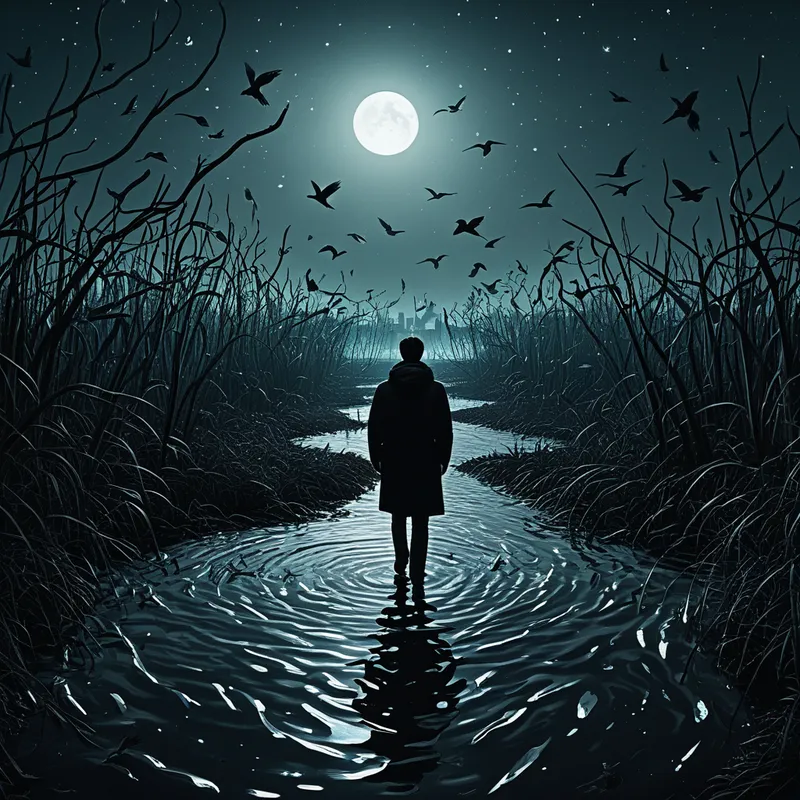
The alchemical journey modeled here is the solutio—the dissolution—followed by a fierce purification. The stagnant water of the marsh must be agitated before it can be clarified and made to flow again. For the individual on the path of individuation, this myth prescribes a counterintuitive but vital step.
One must first consciously engage with the inner noise. This is the act of picking up the krotala. In practice, it means giving structured voice to the chaos—through journaling, active imagination, or therapy—not to be defeated by it, but to call it forth from its shadowy roost.
The act of Heracles standing firm and taking precise aim represents the ego, now fortified by a new tool (conscious insight, or “Athena’s gift”), learning to discriminate within the chaos. Not every shrieking thought needs to be engaged; some are shot down with the arrow of conscious understanding (seeing the anxiety for what it is), while others are allowed to “fly away,” their power to harm dissolved once they are seen in the light of awareness. The labor is not about achieving perfect silence, but about transforming a poisonous, autonomous cacophony into a manageable environment. The marsh may remain—the unconscious is always with us—but it no longer breeds autonomous, soul-piercing horrors. The victory is the reclamation of inner space, the restoration of a silence deep enough to hear one’s own truth again.
Associated Symbols
Explore related symbols from the CaleaDream lexicon: