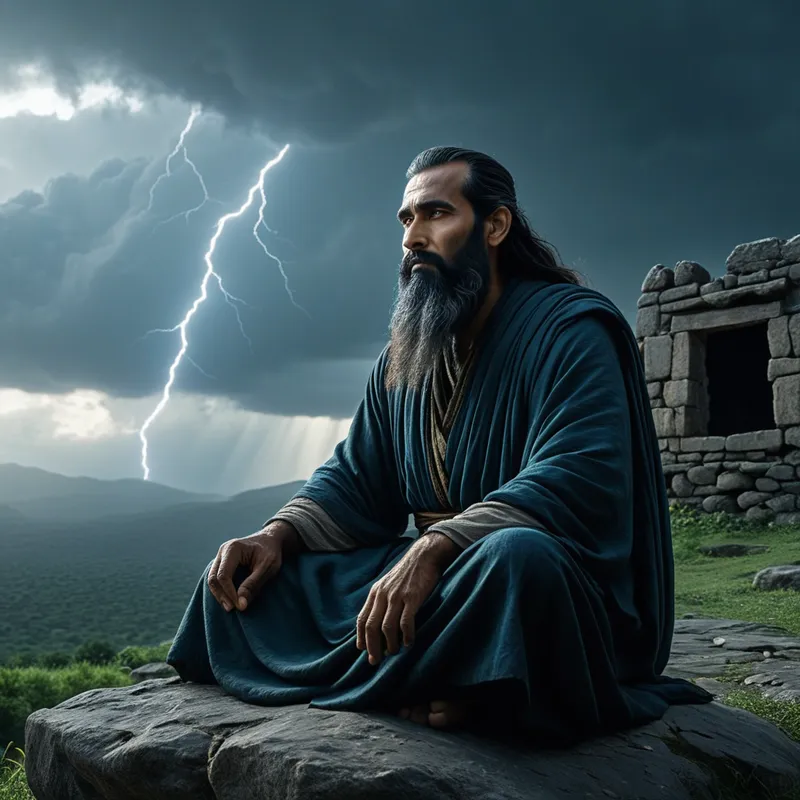
The Story of Job Ayyub Myth Meaning & Symbolism
A righteous man is stripped of everything by divine test, yet his unwavering faith leads to a miraculous restoration of health, family, and prosperity.
The Tale of The Story of Job Ayyub
Hear now the tale of Ayyub, a man whose name became a whisper on the wind, a testament etched not in stone, but in the very marrow of human endurance. In a land of verdant pastures and fattened flocks, he dwelt. Ayyub, blessed among men, a prophet whose wealth was matched only by the depth of his gratitude. His table groaned with bounty, his children were like stars around him, and his heart was a clear pool reflecting only the light of the Divine. His faith was not a garment worn on holy days, but the very air he breathed.
But in the councils of the unseen, a conversation unfolded. Iblis, the accuser, cast a sly glance at this paragon. “He is grateful only because your hand is open,” the whisper slithered. “Strip him bare, and you will see the clay of his nature crack.”
And so, the trial began. Not with a thunderclap, but with a creeping shadow. A messenger arrived, breathless—raiders from the east. The flocks, the wealth of a lifetime, were gone, scattered to the four winds. Ayyub bowed his head. “To God we belong, and to Him we return,” he murmured, the ancient formula a shield against despair. Then came the greater storm. A mighty wind, sent not by nature but by decree, shook the very foundations of his house. It fell, and from its ruins, they carried the still forms of his beloved children. The light in Ayyub’s world was extinguished, yet from the ashes of his heart rose the same whispered phrase: “To God we belong…”
Still, he remained upright. His wealth was dust, his lineage seemingly ended, but his body was yet whole, his tongue could yet praise. Seeing this, Iblis pressed further. “Touch his flesh,” came the challenge. “The temple of the spirit. Then you will hear curses.”
A foul disease descended upon Ayyub. Sores bloomed across his skin like cursed flowers, weeping and putrid. His body became a prison of agony. He was cast out from the town, from the company of men, to dwell among the refuse. Only his wife, Rahma, remained, her love a fragile raft on this sea of torment. Years piled upon years. The pain was a constant fire; his former life a fading dream. In his deepest anguish, a moment of human weakness escaped him—not a curse against God, but a plea for death, for release from the unending test.
It was then that the Divine command came, clear as a mountain spring: “Strike the ground with your foot!” With what little strength remained, Ayyub obeyed. Where his foot fell, the earth split, and a cool spring burst forth. “Wash in it,” the voice instructed, “and drink.” As the water touched his ravaged flesh, the sores closed, the pain fled like a shadow before dawn. His body was restored, stronger and more vibrant than before.
But his heart ached for more than physical healing. “My Lord,” he prayed, “You have healed me. Grant me mercy by restoring my family.” And it was granted. His wife, aged by grief, was rejuvenated. His children, not merely replaced but multiplied, returned to him. His lands flourished anew, his wealth was restored twofold. He stood again, not as a broken man made whole, but as a soul tempered in the furnace of absolute loss, now shining with a faith that had been proven, not given.

Cultural Origins & Context
The story of Ayyub is deeply woven into the fabric of the Quran and the vast corpus of Hadith and prophetic history. He is revered not as a mythical figure, but as a historical prophet (Nabi), one in a long line of messengers who preached the oneness of God. His narrative, primarily recounted in the Quranic chapter Al-Anbiya, serves a crucial didactic function within Islamic spirituality. It was passed down from the Prophet Muhammad to his companions, becoming a cornerstone lesson in sermons and teachings.
Its societal function is multifaceted. It provides a theodicy—a framework for understanding seemingly undeserved suffering within a universe governed by a merciful, all-knowing God. It models the ultimate Islamic virtue of Sabr, which is far more than passive endurance; it is an active, conscious perseverance rooted in certainty of divine wisdom. The story also emphasizes that trial is not a sign of divine displeasure, but often a mark of chosen status, a purification of the soul. It consoles the afflicted and warns the comfortable against arrogance, teaching that all blessings are a trust from God, not a permanent possession.
Symbolic Architecture
The myth of Ayyub is a masterclass in the [symbolism](/symbols/symbolism “Symbol: The use of symbols to represent ideas or qualities, often conveying deeper meanings beyond literal interpretation. In dreams, it’s the language of the unconscious.”/) of deconstruction and sacred reciprocity. Every element he loses—[wealth](/symbols/wealth “Symbol: Wealth in dreams often represents abundance, security, or inner resources, but can also symbolize burdens, anxieties, or moral/spiritual values.”/), children, [health](/symbols/health “Symbol: Health embodies well-being, vitality, and the balance between physical, mental, and spiritual states.”/), social standing—represents an attachment, an [identity](/symbols/identity “Symbol: Identity represents the sense of self, encompassing personal beliefs, cultural background, and social roles.”/) that the ego clings to. The trial is the systematic stripping away of these outer layers to reveal the core of being.
The most profound faith is not born in the palace of plenty, but in the crucible of absolute loss, where the only thing left to worship is the essence of worship itself.
His Wound is central. It is not a [punishment](/symbols/punishment “Symbol: A dream symbol representing consequences for actions, often tied to guilt, societal rules, or internal moral conflicts.”/), but the visible manifestation of the test, the point where the divine will meets mortal flesh. His [wife](/symbols/wife “Symbol: The symbol of a ‘wife’ in a dream often represents commitment, partnership, and personal relationships, reflecting one’s desires for intimacy or connection.”/), whose name signifies Rahma, represents the enduring [human](/symbols/human “Symbol: The symbol of a human represents individuality, complexity of emotions, and social relationships.”/) [connection](/symbols/connection “Symbol: Connection symbolizes relationships, communication, and bonds among individuals.”/) and [compassion](/symbols/compassion “Symbol: A deep feeling of empathy and concern for others’ suffering, often involving a desire to help or alleviate their pain.”/) that survives even when all else fails—the last thread to the world, which he must not sever. The miraculous spring is the [symbol](/symbols/symbol “Symbol: A symbol can represent an idea, concept, or belief, serving as a powerful tool for communication and understanding.”/) of grace that erupts precisely at the point of total surrender and obedient [action](/symbols/action “Symbol: Action in dreams represents the drive for agency, motivation, and the ability to take control of situations in waking life.”/) (“Strike with your foot”). It signifies that the healing power is always latent [beneath the surface](/symbols/beneath-the-surface “Symbol: A symbol of hidden depths and meanings, often exploring subconscious thoughts and feelings.”/) of our suffering, awaiting the correct, faithful [gesture](/symbols/gesture “Symbol: A non-verbal bodily movement conveying meaning, emotion, or intention, often symbolic in communication and artistic expression.”/) to release it.
Psychologically, Ayyub represents the ego-self subjected to the overwhelming forces of the Self (the total, organizing principle of the psyche, which in the myth is represented by the divine). The process is one of humiliation, not humiliation by another, but the humbling of the ego’s pretensions to control and ownership.

The Dreamer’s Resonance
When this myth stirs in the modern dreamer, it often heralds a profound somatic and psychological process of containment. One may dream of losing everything—a house crumbling, family faces fading, a body transforming into something alien and afflicted. These are not prophecies of literal disaster, but symbolic representations of a psyche undergoing a necessary, if brutal, simplification.
The somatic experience in such dreams is key: feeling the itch and ache of the sores, the crushing weight of isolation, the exhaustion that goes beyond sleep. This is the unconscious making the body a partner in the psychic ordeal. The dreamer is being asked to “sit in the ashes” of a current life structure—a career, a relationship, a self-image—that, while perhaps successful, is no longer authentic. The figure of the loyal companion (Rahma) in the dream might appear as a steadfast friend, an animal, or even an unexpected inner voice, representing the part of the psyche that must learn to tend the wound without demanding an immediate cure. The dream is an initiation into a deeper, more resilient form of patience, where the goal is not to escape suffering, but to find the self that can endure it without shattering.

Alchemical Translation
The alchemical journey of Ayyub is the opus of the soul: Solve et Coagula—dissolve and coagulate. His prosperous life represents the initial, unconscious wholeness. The descent into loss is the nigredo, the blackening, the utter dissolution of all that was familiar and valued. This is the stage of putrefaction, where the old identity rots away in the darkness of despair and physical decay.
The alchemical gold is not the return of what was lost, but the soul forged in the fire of its absence.
His unwavering prayer, even in its moment of desperate plea, is the secret fire that sustains the operation. It is the heat that prevents total disintegration into meaninglessness. The command to strike the earth is the critical turning point—the albedo, or whitening. It is the active participation of the conscious will, however weakened, in its own redemption. The spring is the aqua vitae, the divine water of life that emerges when the ego finally stops its struggle and performs the simple, prescribed action of faith.
The final restoration is not a regression, but the rubedo, the reddening, the creation of the philosophical gold. The new family and wealth are not the old ones brought back; they are new creations born from the tested soul. The modern individual undergoing this process is not seeking to get their old life back, but to become a person for whom the old attachments no longer define them. The triumph is the birth of a consciousness that has faced the abyss of meaningless suffering and found, not an answer, but a presence that transforms the abyss itself into a sacred space. The individuated Self that emerges knows its worth is inherent, not contingent on external validation or comfort.
Associated Symbols
Explore related symbols from the CaleaDream lexicon:
- Wound — The physical sores of Ayyub symbolize the visible, painful site where divine trial meets human vulnerability, representing both affliction and the potential aperture for healing grace.
- Water — The miraculous spring represents divine grace and healing that erupts from the depths of obedience and surrender, transforming a site of suffering into a source of regeneration.
- Patience — Embodied by Ayyub’s unwavering Sabr, this symbolizes the active, conscious endurance that is the heroic virtue required to contain and transform overwhelming suffering.
- Wealth — Ayyub’s lost and restored flocks symbolize the transient nature of worldly blessings and their proper role as a trust from the Divine, not a possession of the ego.
- Family — The loss and restoration of his children represent the deepest attachments of the heart, testing whether love for the gift can be surrendered while maintaining love for the Giver.
- Earth — The ground Ayyub strikes signifies the foundational, material reality that, when engaged with faithful action, can yield hidden, life-giving resources from the unconscious.
- Healing — The complete restoration of Ayyub’s body and life is the symbolic promise of psychic integration and wholeness that follows the conscious endurance of disintegration.
- Faith — The core theme of the myth, representing the unshakeable, tested connection to the Divine that survives the annihilation of every other support.
- Suffering — The central ordeal, depicted not as meaningless punishment but as a sacred, transformative fire that purifies identity and forges authentic being.
- Restoration — The myth’s resolution symbolizes the alchemical outcome where what is returned is not the old life, but a new creation born from the ashes of the old self.