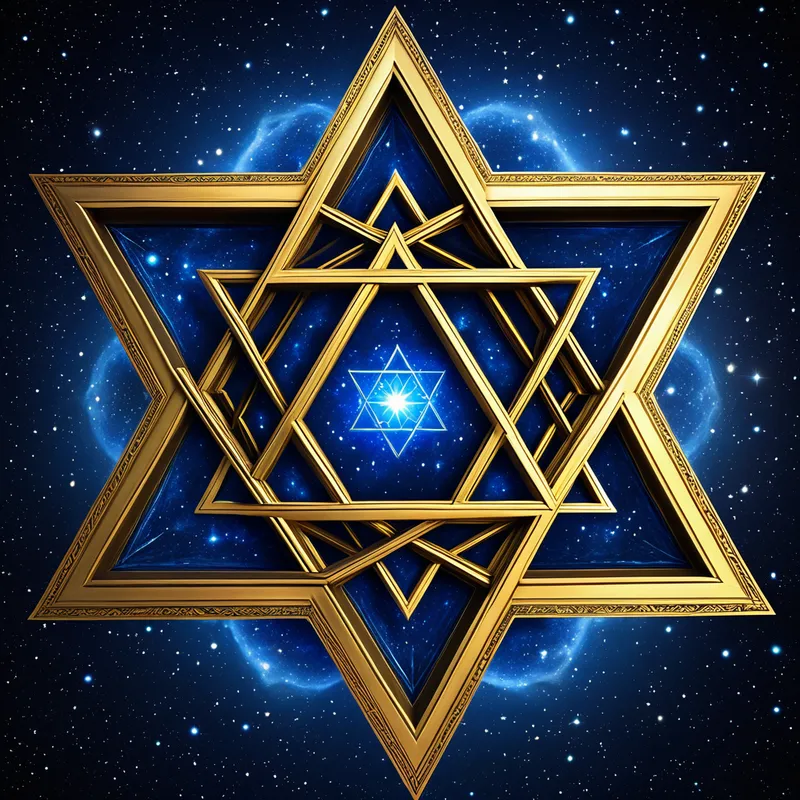
The Star of David Myth Meaning & Symbolism
The interlocking triangles of the Star of David symbolize the sacred marriage of heaven and earth, spirit and matter, and the human quest for divine integration.
The Tale of The Star of David
Before time was measured, in the silent, boundless expanse of Ein Sof, a yearning stirred. It was not a sound, but a vibration—a desire for relationship, for expression. From this unfathomable unity, a point of light flashed forth, the first letter of a divine sentence. This light descended, cascading through ten vessels of intention—the Sefirot—like water poured from a great height into fragile cups.
But the light was too pure, too potent. The vessels, unable to contain the fierce flow of the descending world, shattered. Holy sparks, fragments of the original divine radiance, were flung across the abyss, scattered and buried in the husks of the broken vessels. They fell into the lower worlds, into the very fabric of what would become matter, time, and soul. The cosmos was born from this catastrophe—a world of separation, where the divine was hidden, and wholeness was a forgotten memory.
Then came the human, a creature formed from the dust of the earth yet breathed into by the breath of the heavens. Within the human heart slept a memory of that primordial light and a profound homesickness for the source. The human looked up at the star-strewn sky and down at the solid ground, feeling the terrible rift between them. The task was whispered into the soul: Tikkun Olam, the mending of the world.
The great work began not with a sword, but with intention. The righteous ones learned to draw down. With prayer, with deed, with purified desire, they would reach upward with one hand, gathering the scattered sparks of the descending light—the light of mercy, of transcendence, of the spirit. This was the upward-pointing triangle, a funnel of aspiration pulling heaven toward earth.
Simultaneously, they reached downward with the other hand. They hallowed the physical world—the bread, the wine, the act of kindness, the struggle of the body. They lifted the holy sparks trapped in matter, elevating the hidden divinity within creation. This was the downward-pointing triangle, a vessel of embodiment, raising earth toward heaven.
When the action was true, when the heart was aligned, the two movements met. The descending stream of blessing and the ascending stream of sanctification intersected. In that moment of perfect balance, the two triangles locked into place, forming a single, stable, radiant star. It was not merely a symbol drawn in the air; it was a living architecture of reconciliation, a fleeting glimpse of the world restored. The Star was not given; it was enacted—a fleeting star of human-divine cooperation, shining in the space between breath and breath, before fading back into the work of the world, awaiting its next enactment.
Cultural Origins & Context
The symbol now known as the Magen David has a long and complex history within Jewish culture, but its deep mythological and mystical significance is rooted primarily in the medieval traditions of Kabbalah. While its use as a Jewish communal symbol proliferated later, its esoteric meaning was cultivated by Kabbalists pondering the structure of divinity and the soul's role in the cosmos.
These mystics, studying texts like the Zohar, saw in the interlocking triangles a dynamic map of reality. The mythos outlined above is not a single, canonical narrative but a distilled essence of Kabbalistic cosmology: the Shevirat HaKelim, the scattering of the sparks, and the human-driven process of Tikkun Olam. It was passed down not in public squares but in hushed study halls and through intricate diagrams, from teacher to initiated student. Its function was ontological and psychological—it provided a model for understanding a broken yet redeemable universe and placed the individual at the active center of its healing.
Symbolic Architecture
At its core, the Star of David is a symbol of dynamic synthesis, a geometric resolution of cosmic duality. It represents the end of opposition and the birth of a third, transcendent reality.
The upward triangle is the arrow of spirit seeking manifestation; the downward triangle is the chalice of matter awaiting sanctification. Where they intersect, the ordinary becomes sacred.
Psychologically, the upward triangle represents consciousness, aspiration, and the active pursuit of meaning—the ego's reach toward the Self. The downward triangle represents the unconscious, the body, the shadow, and the receptive grounding in reality. The individual, like the mythic human, often experiences these as separate or conflicting forces: spiritual yearnings versus earthly needs, mind versus body.
The completed Star symbolizes the individuated Self, where these opposites are not conquered but married. The "sparks" are our own fragmented potentials, instincts, and forgotten wholeness, scattered by the "shattering" of trauma, socialization, or simple neglect. The work of Tikkun is, therefore, also an inner work—gathering and integrating these lost parts of ourselves.
The Dreamer's Resonance
When the Star of David appears in a modern dream, it rarely arrives as a static religious symbol. It manifests as a process, a somatic puzzle the psyche is working to solve. One might dream of two separate triangles—one of ice, one of fire—floating in space, agonizingly close but not touching. This speaks to a profound inner division, perhaps between cold intellect and passionate emotion, or between spiritual ideals and physical desires.
The dreamer may find themselves in a landscape where the ground and sky are pulling apart, and they must perform a specific, ritualistic action—like placing a stone on an altar or speaking a forgotten word—to bring them back into alignment. This is the psyche enacting its own Tikkun. The feeling upon successfully "forming" the Star in a dream is often one of immense relief, balance, and quiet power—a somatic experience of inner conflict resolving into a stable, energized structure.
Alchemical Translation
The myth of the Star is a precise blueprint for psychic alchemy. The "base metal" of our fragmented experience is transmuted into the "gold" of wholeness through the conscious union of opposites.
The first alchemical stage, nigredo (the blackening), is mirrored in the Shevirat HaKelim—the catastrophic shattering that creates the world of separation and suffering, our personal and collective darkness. The scattering of sparks is our own projection, our disowned qualities cast out into the world and into the shadow.
Individuation is the art of drawing down the light of awareness and raising up the substance of the shadow until they kiss, forming a star in the soul's firmament.
The work of Tikkun is the subsequent alchemical stages. The upward triangle is the albedo (whitening)—the purification of spirit, the refinement of conscious intention. The downward triangle is the citrinitas (yellowing)—the illumination of the material, the discovery of meaning in the body and the earthly experience. The moment of perfect interlock, creating the stable, six-pointed Star, is the rubedo (reddening)—the culmination, the creation of the Philosopher's Stone, which in psychological terms is the fully realized, embodied Self.
For the modern individual, this means the struggle is sacred. The tension between career and family, between solitude and community, between accepting reality and striving to improve it, is not a flaw to be eliminated. It is the very friction necessary to generate the star-point of integration. We are not meant to choose one triangle over the other, but to engage in the constant, living practice of bringing them into relationship, thereby performing the most ancient magic: the mending of our own world from within.
Associated Symbols
Explore related symbols from the CaleaDream lexicon: