The Spirit Board Myth Meaning & Symbolism
A sacred artifact of communion, the Spirit Board bridges worlds, offering wisdom from the ancestors at the perilous cost of confronting the unquiet dead.
The Tale of The Spirit Board
Listen. In the time before memory, when the veil between the breath of the living and the silence of the dead was thin as morning mist, there was a longing. It was a hollow ache in the human heart, a question whispered into the night: Do you remember us?
In a village nestled in the high mountains, where the wind carried the voices of the pines, there lived a woman named Elara. She was not the chief, nor the warrior, but the listener. She heard the stories in the river’s flow and the secrets in the owl’s call. Her greatest sorrow was the silence that followed a loved one’s passing—the stories cut short, the wisdom lost to the great unknown.
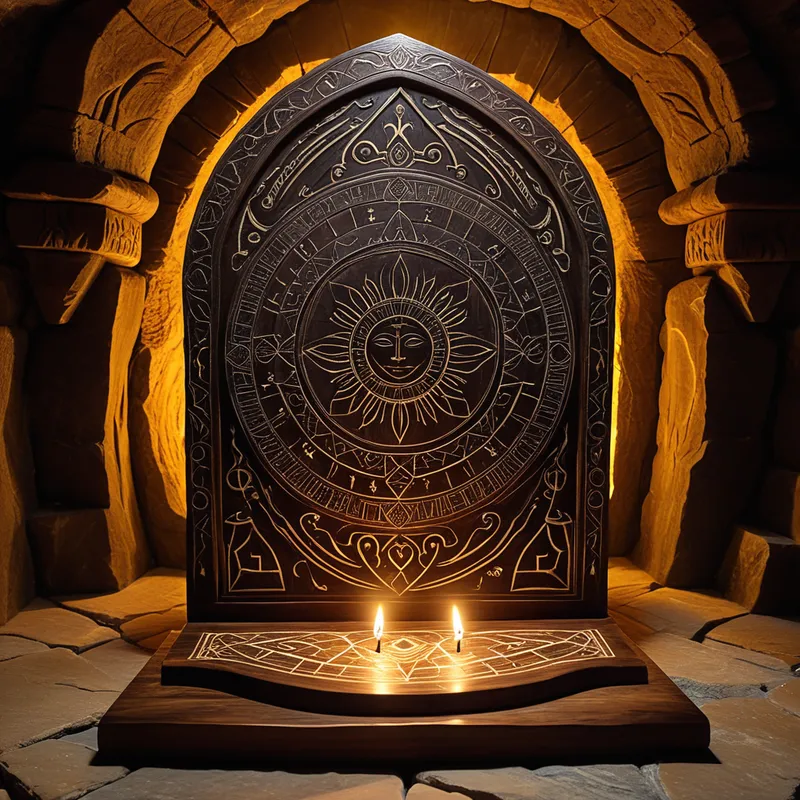
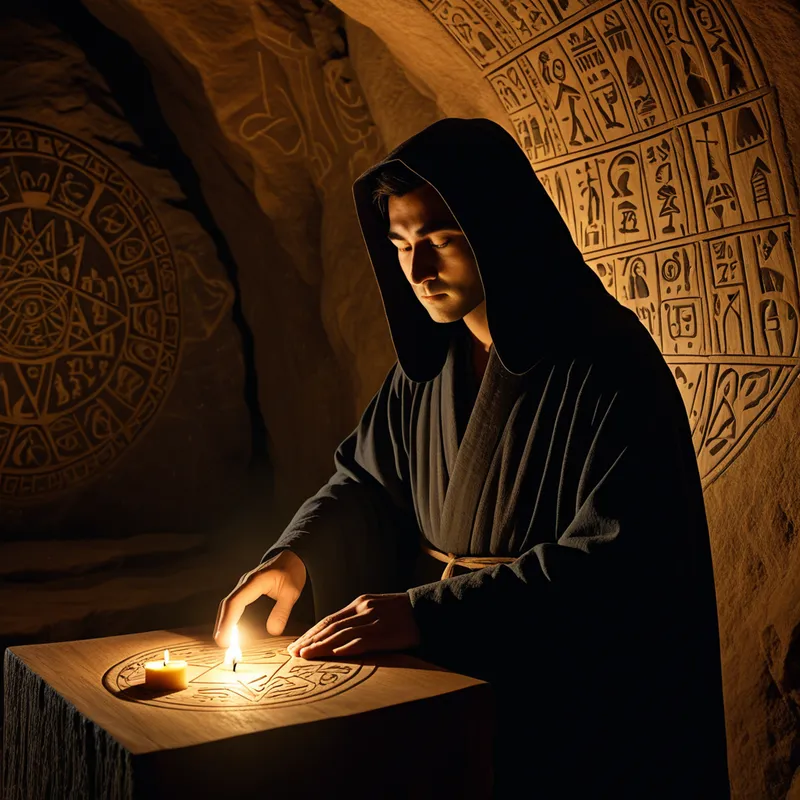
One night, under a moon so full it seemed a silver bowl, Elara was drawn to the Speaking Cave. The air was cold and still, thick with the scent of damp stone and old moss. In the deepest chamber, where moonlight never reached, her fingers found not rock, but wood—an immense, smooth slab, fallen from the cavern roof ages past. Its surface was unnaturally flat. Compelled by a force deeper than thought, she began to carve. Not pictures, but symbols: the sun, the moon, the stars, the runes of the seasons, and the letters of a forgotten tongue. She worked until her hands bled, guided by a dream-whisper she could not name.
When the last glyph was cut, she found a smaller piece of the same dark wood, shaped like a tear or a heart. She placed it upon the great board. A wind rose from within the stone itself, cold and scentless. The planchette trembled. Then, it moved.
It glided, smooth as an otter in water, from symbol to symbol. A presence filled the cave, not with sound, but with a pressure in the mind, a feeling of immense age and quiet regard. A name spelled itself out: A-R-I-A-N. Her grandmother. Questions poured from Elara’s soul, and the planchette flew, spelling warnings of a coming storm, secrets of healing herbs, and old family tales known only to the two of them. For nights, this communion was a river of light in the darkness.
But the veil, once parted, does not discriminate. Other presences gathered at the threshold—drawn by the light of attention like moths. The movement of the planchette grew jagged, frantic. The comforting pressure turned cold and grasping. It spelled not names, but curses. It promised not wisdom, but despair. The very air grew heavy with a malicious chill. Elara realized the board was not a door she could close; it was a gateway she had opened, and now things stirred in the shadows of the other side, hungry for the warmth of a living soul.
Her final question was not spoken aloud, but screamed within her heart: How do I protect my people? The planchette shuddered, fighting against a new, willful force. Slowly, laboriously, it spelled out a final message from her grandmother’s fading spirit: B-R-E-A-K T-H-E C-I-R-C-L-E. S-E-A-L T-H-E W-O-O-D W-I-T-H F-I-R-E.
With tears cutting tracks through the dust on her face, Elara built a pyre at the cave’s mouth. She placed the board and the planchette upon it. As the flames took hold, a chorus of whispers—some grateful, some wrathful—rose on the smoke and vanished into the starry sky. The board blackened, cracked, and was consumed. All that remained was the knowledge: communion is possible, but every bridge runs two ways.
Cultural Origins & Context
The myth of the Spirit Board is not the property of a single tribe or epoch, but a recurring motif in the folklore of “Various” cultures—a testament to a universal human preoccupation. We find its echoes in the bone-casting rituals of Siberian shamans, the alphabetized wine vessel (fuji) ceremonies of Tang Dynasty China, and the talking boards used in 19th-century American Spiritualist parlors. Its transmission is oral and practical, passed down not as a rigid scripture, but as a cautionary procedural, often from a seasoned elder to an initiate.
Its societal function is dual and paradoxical. Primarily, it serves as a powerful cautionary tale, establishing a sacred protocol around the profound human desire to contact the departed. It legitimizes the grief and the curiosity while strictly delineating the dangers, teaching that the realm of the dead is not a library to be casually browsed. Secondarily, for the trained few (the shamans, the mediums, the listeners like Elara), the myth provides a foundational narrative for their role. It frames them as the boundary-keepers, the ones who navigate the perilous interface between worlds, armed with ritual and respect, to retrieve healing wisdom or deliver messages of closure for the community.
Symbolic Architecture
At its core, the Spirit Board is a profound symbol of the psychic threshold. The board itself represents the structured, known world of consciousness—marked with the alphabet, numbers, and symbols of human understanding. The planchette is the focused point of attention, the ego, or the seeking self.
The board is the map of the known; the planchette is the traveler who ventures into the unmapped.
The movement of the planchette by an “unseen hand” symbolizes the autonomous activity of the unconscious. The initial, wise guidance represents communication with the ancestral layer of the unconscious—the source of innate wisdom, instinct, and cultural memory. This is the positive aspect of the Senex. However, the subsequent invasion by hostile forces embodies the eruption of the personal shadow and the psychic chthonic forces. The myth brilliantly illustrates that when we open a channel to the deep psyche, we cannot selectively invite only the comforting truths; we must be prepared to face the repressed, the traumatic, and the chaotic.
The Dreamer’s Resonance
When this mythic pattern activates in the modern dreamer, it often manifests as dreams of attempting to use a communication device that becomes uncontrollable. The dreamer may be texting, typing, or using a phone, only to have alien, threatening, or nonsensical messages flood back. The somatic experience is one of creeping dread, a chill at the nape of the neck, and a feeling of being watched or invaded.
Psychologically, this signals a critical phase of engagement with unconscious content. The dreamer is, like Elara, actively seeking answers—perhaps through therapy, journaling, or a life crisis that forces introspection. The initial positive contact reflects the emergence of valuable insights or forgotten memories (the helpful ancestor). The subsequent “hijacking” of the board signifies the inevitable confrontation with shadow material: repressed anger, childhood wounds, or shameful desires that now demand acknowledgment. The dream is a snapshot of the psyche’s warning: the process of self-discovery is not a gentle conversation; it is a negotiation with powerful, sometimes disruptive, autonomous complexes.
Alchemical Translation
The myth of the Spirit Board is a precise allegory for the individuation process. The seeker’s initial desire represents the nigredo—the darkening, the felt sense of something missing, the call to depth. Creating/using the board is the act of constructing a temenos (a sacred space), a ritualized framework (like active imagination or disciplined introspection) to safely engage the unconscious.
The fire that destroys the board is not an end, but the alchemical fire of transformation that severs identification.
The communion with the wise ancestor symbolizes the valuable guidance of the Self, offering direction. The ensuing struggle with hostile forces is the crucial stage of confrontation with the shadow. Here, the ego is overwhelmed by what it has repressed. The myth’s resolution provides the alchemical key: Elara does not defeat the shadows through force, nor does she succumb. She acts on the final wisdom received and destroys the literal tool of possession. Psychically, this translates to the necessary dissolution of the ego’s rigid identification with either the helpful spirit (inflation) or the hostile one (possession).
By “breaking the circle” and applying the purifying fire, the conscious mind severs the compulsive, literal connection, allowing the contents to be integrated rather than obeyed or feared. The board is burned, but the knowledge remains. The modern individual completes this cycle not by ceasing inner work, but by moving from a state of being controlled by unconscious contents to one of relating to them consciously, having passed through the perilous but essential gateway the myth so vividly maps.
Associated Symbols
Explore related symbols from the CaleaDream lexicon: