
The Spirit Bear Myth Meaning & Symbolism
A hunter's encounter with a sacred white bear becomes a journey of spiritual exchange, teaching that true power lies in reverence, not possession.
The Tale of The Spirit Bear
Listen, and let the wind carry you to the time when the ice sang and the stars were close enough to touch. In that age, there lived a hunter named Kajak. His hands were strong, his eyes sharp as the winter sun on ice. He provided for his people, but a hollow wind whistled through his spirit. He hunted to conquer, to prove his strength against the great white silence of the world.
One long night, when the Aurora danced a furious green, the elders spoke in hushed tones of Tornarsuk, the Spirit Bear. Not merely a bear of flesh and blood, but a walking mountain of ice and soul, a guardian of the balance between the human world and the Inua. To see it was an omen. To hunt it was a madness only the most prideful or desperate would dare.
Driven by a fire that was not warmth but hunger—a hunger for a fame that would outlast the glaciers—Kajak set out alone. For days and nights, he followed a trail that was not of prints, but of a deepening silence, a cold that seeped into the bone. The very air grew thin with presence. Then, in a cathedral of blue ice pillars, he saw it.
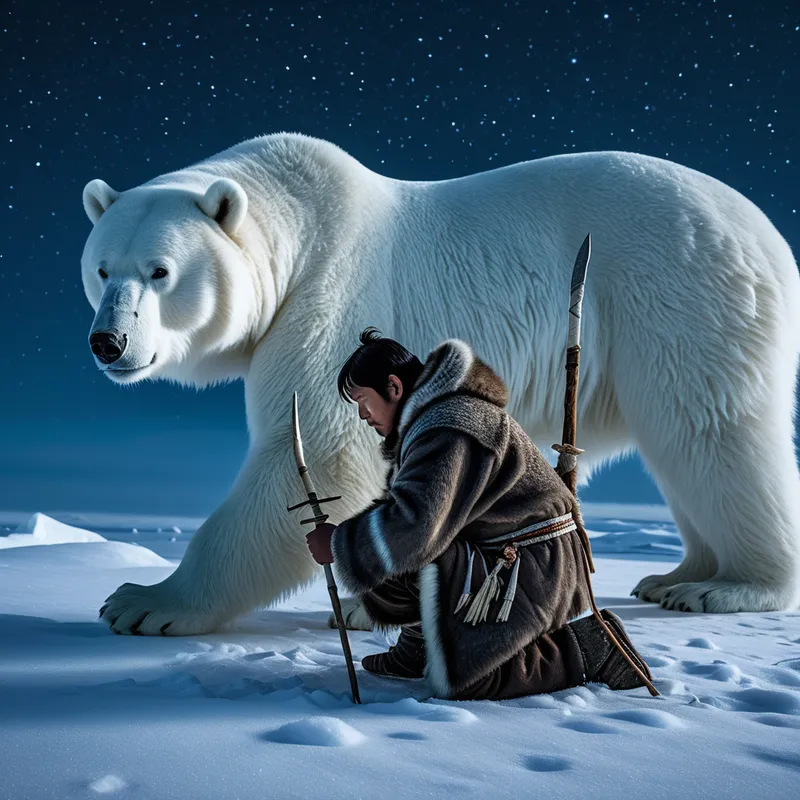
The Spirit Bear was not simply white; it was the colour of moonlight on new snow, of the heart of a glacier. Its eyes were not the eyes of a beast, but pools of dark, knowing water, holding the patience of the permafrost. It did not roar. It regarded him, and in that gaze, Kajak felt his own pride laid bare, small and brittle as a bird bone.
He raised his spear, his arm trembling not from cold, but from a terror he had never known—the terror of being truly seen. As he poised to throw, the bear did not charge. It lowered its great head and let out a sigh that seemed to carry the weight of all winters. In that moment, the hunter’s certainty shattered like ice. The spear felt like a lie in his hand.
Kajak did not cast it. Instead, his arm fell. He knelt in the snow, not in submission, but in recognition. He laid his spear—his identity, his weapon—at the bear’s massive paws. He spoke no words, for words had fled. The bear approached. The world held its breath. It nudged the spear with its muzzle, then turned its gaze back to Kajak. A understanding passed between them, wordless and complete.
Then, the Spirit Bear turned and walked into a veil of blowing snow. When it cleared, the bear was gone. Where it had stood, Kajak found not a trophy, but a single, perfect white bear claw. When he touched it, a vision flooded him: the endless journey of the bear across the ice, the interconnectedness of all life, the sacredness of the hunt as an exchange, not a theft. He returned to his people a different man. He spoke little of what happened, but he hunted with a new reverence, teaching that to take a life was to enter a covenant, and that the greatest strength is found in humility before the spirit of the other.
Cultural Origins & Context
The stories of the Spirit Bear, or concepts akin to Tornarsuk, are woven into the oral traditions of various Inuit and Yup’ik groups. These narratives were not mere entertainment; they were the foundational texts of an animistic worldview. Told by elders and storytellers (unikkaatuat) during the long winter months, their function was pedagogical and existential.
In a world where survival was a daily negotiation with immense, sentient forces—the sea, the ice, the weather, the animals—these myths mapped the proper relationships that ensured balance. The Spirit Bear, as a supreme animal inua, represented the ultimate “other,” a being of pure power and autonomy. The myth served as a crucial societal check against human hubris. It taught that animals give themselves to the worthy hunter, and that disrespect or greed could cause them to withdraw, leading to famine. The story was a living law, reinforcing ethics of respect, gratitude, and the recognition of a shared consciousness between human and non-human persons.
Symbolic Architecture
At its core, the myth is a masterclass in the [psychology](/symbols/psychology “Symbol: Psychology in dreams often represents the exploration of the self, the subconscious mind, and emotional conflicts.”/) of encounter with the numinous—the wholly other. The [Spirit](/symbols/spirit “Symbol: Spirit symbolizes the essence of life, vitality, and the spiritual journey of the individual.”/) Bear is the ultimate [Shadow](/symbols/shadow “Symbol: The ‘shadow’ embodies the unconscious, repressed aspects of the self and often represents fears or hidden emotions.”/) and Self [archetype](/symbols/archetype “Symbol: A universal, primordial pattern or prototype in the collective unconscious that shapes human experience, behavior, and creative expression.”/) combined. It is everything the hunter is not: immense, patient, spiritually integrated, and utterly beyond [human](/symbols/human “Symbol: The symbol of a human represents individuality, complexity of emotions, and social relationships.”/) control.
The confrontation with the sacred is not a battle to be won, but a mirror to be faced. In the bear’s gaze, the hunter sees not a monster, but the reflection of his own untamed soul.
The hunter’s initial [quest](/symbols/quest “Symbol: A quest symbolizes a journey or search for purpose, fulfillment, or knowledge, often representing life’s challenges and adventures.”/) is driven by the [Hero](/symbols/hero “Symbol: A hero embodies strength, courage, and the ability to overcome significant challenges.”/)’s [inflation](/symbols/inflation “Symbol: A dream symbol representing feelings of diminishing value, loss of control, or expansion beyond sustainable limits in one’s life or psyche.”/), a desire to conquer the greatest [symbol](/symbols/symbol “Symbol: A symbol can represent an idea, concept, or belief, serving as a powerful tool for communication and understanding.”/) of wild power to aggrandize the self. The [Journey](/symbols/journey “Symbol: A journey in dreams typically signifies adventure, growth, or a significant life transition.”/) onto the ice is a descent into the unconscious. The pivotal [moment](/symbols/moment “Symbol: The symbol of a ‘moment’ embodies the significance of transient experiences that encapsulate emotional depth or pivotal transformations in life.”/)—the lowering of the [spear](/symbols/spear “Symbol: The spear often symbolizes power, aggression, and the drive to protect or conquer.”/)—is the critical ego [death](/symbols/death “Symbol: Symbolizes transformation, endings, and new beginnings; often associated with fear of the unknown.”/). The [weapon](/symbols/weapon “Symbol: A weapon in dreams often symbolizes power, aggression, and the need for protection or defense.”/) symbolizes his arrogant, separating will. To lay it down is to surrender the [persona](/symbols/persona “Symbol: The social mask or outward identity one presents to the world, often concealing the true self.”/) of the conquering [hero](/symbols/hero “Symbol: A hero embodies strength, courage, and the ability to overcome significant challenges.”/).
The white [Bear Claw](/symbols/bear-claw “Symbol: A bear claw signifies strength, protection, and the primal instincts that drive human behavior.”/) left behind is a token of the new [covenant](/symbols/covenant “Symbol: A binding agreement or sacred promise between parties, often carrying deep moral, spiritual, or social obligations and consequences.”/). It is not a [trophy](/symbols/trophy “Symbol: The trophy symbolizes achievement, recognition, and the reward for perseverance in competitive endeavors.”/) of domination, but a talisman of [relationship](/symbols/relationship “Symbol: A representation of connections we have with others in our lives, often reflecting our emotional state.”/) and earned wisdom. It signifies that true power (Ruler) is granted only after the humility of the [Orphan](/symbols/orphan “Symbol: Represents spiritual abandonment, primal vulnerability, and the quest for belonging beyond biological ties. Often signifies a soul’s journey toward self-reliance.”/) is accepted.
The Dreamer’s Resonance
When this myth pattern erupts in modern dreams, it often signals a profound crisis of identity. The dreamer may be a high achiever, a “hunter” in their field, who finds their success feeling empty, a “hollow wind.” The Spirit Bear appears as an overwhelming force—a looming deadline that feels sentient, a rival whose competence shames us, or a literal dream image of a majestic, terrifying bear.
The somatic experience is key: the trembling, the crushing weight of being seen, the freezing cold. This is the nervous system confronting a truth too large for the ego to process. The dream is orchestrating a necessary humiliation. The psyche is forcing a confrontation with an autonomous complex—a bundle of energy (power, instinct, wildness) that the conscious personality has either arrogantly tried to control or has completely neglected.
The resolution in the dream, if it follows the myth, is not a violent struggle but a surrender. The dream-ego gives up its weapon (its defense, its title, its rigid plan). This surrender is not defeat, but the beginning of dialogue with a deeper layer of the self. Upon waking, one might feel a strange relief amidst the anxiety, as if a burdensome performance has been cancelled.
Alchemical Translation
The myth perfectly models the alchemical nigredo and albedo, the blackening and whitening, of individuation.
- The Call (Projection): The inflated ego, identified solely with the persona of the provider or conqueror, projects its own missing wholeness onto an external object of desire (the Bear as trophy). This is the unreflective life.
- The Descent (Nigredo): The journey onto the ice is the conscious entry into the unconscious. The familiar world falls away. The ego begins to blacken, to feel its own poverty and isolation in the face of the immense psyche.
- The Confrontation (Mortificatio): The standoff is the ego’s ultimate test. The impulse to attack is the ego’s last attempt to assimilate the unconscious by force. The failure of this impulse—the trembling arm—is the mortification, the death of the old, heroic attitude.
- The Surrender (Solutio): Kneeling and laying down the spear is the dissolution. The ego lets go of its separating will and is dissolved in the waters of the unconscious (the bear’s knowing gaze). This is not annihilation, but melting into a larger context.
- The Return (Albedo & Coniunctio): The gift of the white claw is the albedo—the whitening, the dawn of a new consciousness. It is a symbol of the coniunctio, the lasting connection forged between the ego and the Self (the Spirit Bear). The hunter returns, not with a carcass, but with a living symbol integrated into his being. He now rules his life not from ego, but from a connection to the transpersonal ground of being.
Individuation is not about becoming a giant. It is about learning to kneel before the giants within, and receiving, in that posture of respect, a fragment of their stature.
The modern individual’s “Spirit Bear” is any inner or outer reality that is too powerful, too sacred, or too other to be controlled. It may be a creative force that resists manipulation, a grief that cannot be solved, or a talent that demands humility. The myth teaches that our wholeness depends not on slaying or possessing these forces, but on recognizing their sovereignty, surrendering our weapons of control, and entering into a respectful, transformative relationship with them.
Associated Symbols
Explore related symbols from the CaleaDream lexicon:
- Bear — The primal embodiment of instinctual power, hibernation (introspection), and ferocious protection, representing the autonomous force of the unconscious self.
- Journey — The necessary passage from the known world of the ego into the unknown wilderness of the psyche, where transformation becomes possible.
- Sacrifice — The voluntary surrender of the ego’s prized weapon (pride, control) as the essential price for receiving spiritual wisdom and power.
- Shadow — The Spirit Bear initially represents the feared and projected “other,” the repository of all the power and wildness the conscious personality has disowned.
- Spirit Guide — In its final aspect, the Bear becomes a tutelary spirit, offering wisdom and protection after the hunter passes the test of humility.
- Mountain — Symbolizing the immense, enduring, and daunting presence of the transpersonal Self, which the ego must learn to approach, not conquer.
- Mirror — The bear’s gaze acts as a perfect mirror, reflecting back not the hunter’s persona, but his true, unadorned spiritual state.
- Gift — The bear claw is the ultimate gift, bestowed not for taking, but for surrendering; it represents wisdom earned through right relationship.
- Death — The symbolic death of the old, arrogant ego-identity, which must perish for a more authentic self to be born.
- Light — The inner luminescence of the Spirit Bear and the dawn of new understanding (albedo) that follows the dark night of the ego’s surrender.
- Ruler — The archetype achieved at the end of the process: sovereignty founded not on domination, but on wise stewardship born of humility and connection.