The Sphinx Myth Meaning & Symbolism
A monstrous riddler guards Thebes until a hero solves her enigma, revealing a terrible truth about fate and self-knowledge.
The Tale of The Sphinx
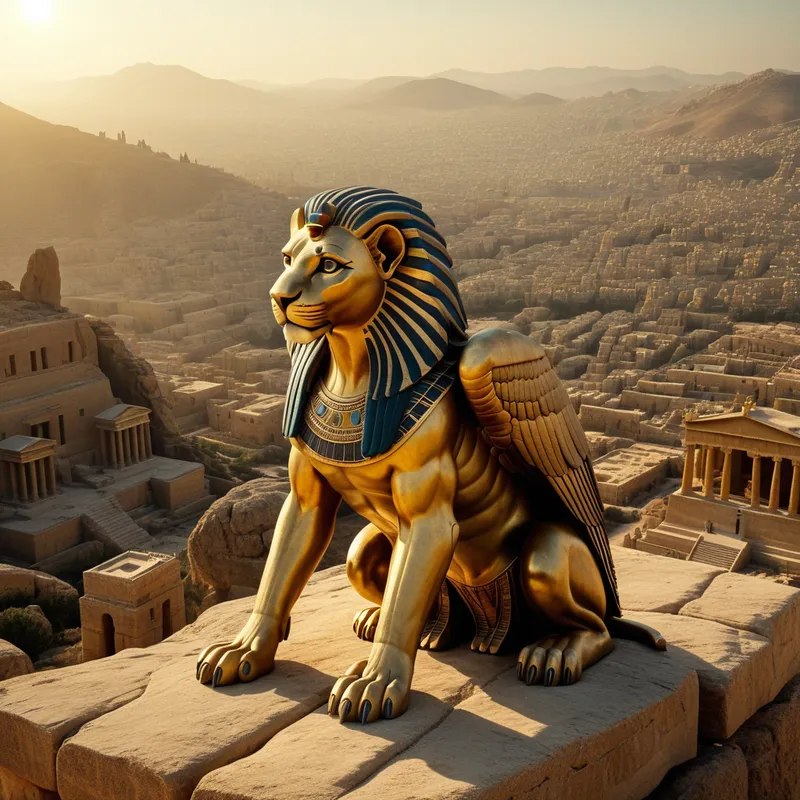
Hark, and listen to the tale spun on the dry, sorrowful winds of Thebes. A curse lay upon the land, thick as the dust on the road to Delphi. The people whispered of a monster sent by the gods—or perhaps by the wrathful Eris herself. She was the Sphinx, a creature of terrible beauty and sharper wit. With the body of a lion, mighty and tawny, the great wings of an eagle that blotted out the sun, and the face of a woman, cold and pitiless as a marble statue, she took her perch on the sacred mountain of Phikion.
Her method was not mere slaughter, but a cruel, elegant game. She would descend upon travelers, her shadow chilling the blood, and pose her riddle—a single, deceptively simple question that held the weight of life and death. None who failed could escape her claws and fangs. The bones of princes and shepherds alike whitened the rocks below her aerie. Thebes was paralyzed, cut off from the world, mourning its sons, ruled by a king, Creon, who was helpless before this winged terror. He offered a desperate prize: the kingdom itself, and the hand of the widowed queen, Jocasta, to any man who could break the curse.
Then came a stranger, a man with a limp in his soul and a prophecy dogging his steps. His name was Oedipus. He had fled his home in Corinth, fearing an oracle that said he would kill his father and marry his mother. On the road to Thebes, in a dusty pass, he had slain an arrogant old man in a chariot—a deed that sat uneasily in his heart. Now, driven and clever, he ascended the path to face the monster.
The air grew thin and cold. There she was, coiled on her rock, her eyes holding the wisdom of ages and the emptiness of the abyss. She did not roar; she spoke, her voice like the rustle of ancient parchment. “Tell me,” she said, the words hanging in the still air. “What creature walks on four legs in the morning, two legs at noon, and three legs in the evening?”
Oedipus did not hesitate. The answer came to him not as a shout, but as a quiet, dreadful certainty. “Man,” he declared. “For he crawls on all fours as an infant in the morning of his life, walks upright on two legs in the noon of his adulthood, and uses a staff as a third leg in the evening of his old age.”
A profound silence fell. The Sphinx did not snarl or attack. She stared at him, and in her inhuman eyes flashed a terrible understanding—a recognition of a truth deeper than the riddle’s answer. With a cry that was neither of anger nor pain, but of a purpose fulfilled and a prison shattered, she hurled herself from the precipice, dashing herself upon the rocks below. The road to Thebes was open. The people hailed Oedipus as their savior, their king. He entered the city in triumph, accepted the crown, and married the queen. The monster was dead. But the true riddle, the one about the man himself, had only just begun to unfold.
Cultural Origins & Context
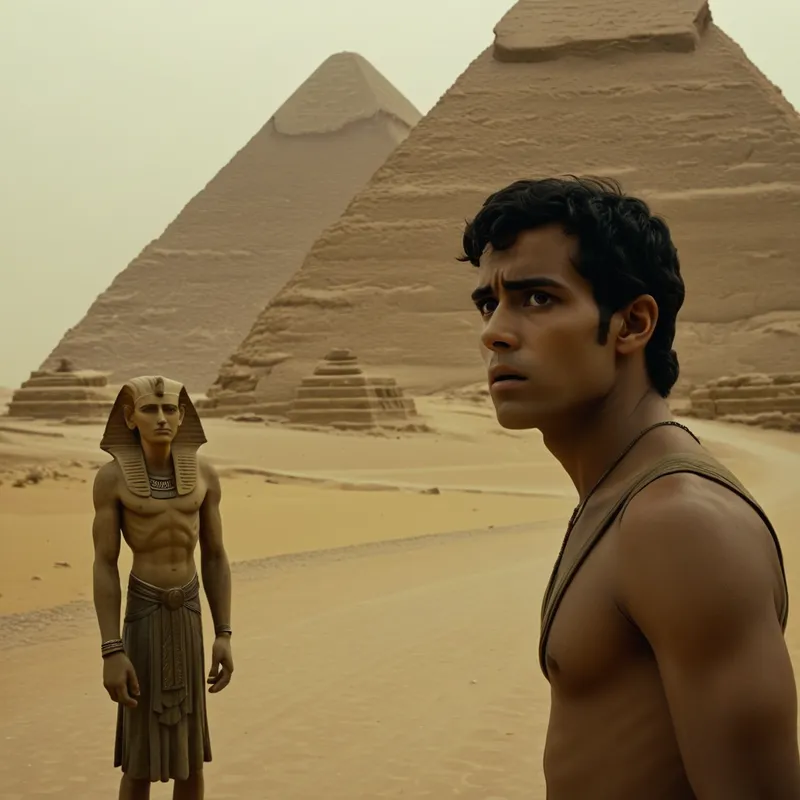
The myth of the Sphinx is woven into the fabric of the Theban Cycle, most famously in Sophocles’ tragic play, Oedipus Rex. However, her origins are likely older and more complex, hinting at a pre-Greek, possibly Near Eastern lineage. The concept of a composite, riddling guardian is found in Egyptian mythology (though the Egyptian Sphinx is typically male and silent), suggesting a cultural transmission and adaptation. In the Greek context, she was a perfect narrative device—a externalization of a divine punishment, a test of heroic metis (cunning intelligence) as crucial as physical strength.
The story was not mere entertainment; it was a foundational narrative about the limits of human knowledge and the inescapable nature of moira (fate). Told by bards and later dramatized by playwrights, it served a societal function as a cautionary tale about hubris and the dangers of incomplete self-knowledge. The Sphinx was the obstacle that defined the hero, but her defeat was not a clean victory. It set in motion the tragic revelation that true horror lies not in the monster on the mountain, but in the unrecognized truths within one’s own house and history.
Symbolic Architecture
The Sphinx is not merely a monster; she is an embodied enigma, a guardian of a threshold. She represents the ultimate question that the conscious ego must answer to proceed in its development. Her composite form—lion (instinct, raw power), wings (spirit, intellect), human head (consciousness)—symbolizes the totality of the psyche that must be integrated. She is the keeper of the shadow, but a shadow that speaks in riddles.
The Sphinx is the psyche’s own defense mechanism, posing the question that, if answered falsely, destroys the questioner, and if answered truly, destroys itself.
Her riddle is deceptively simple because its subject is the one thing the hero has not truly examined: himself. “What is man?” The answer, “Man,” is a label, a generic truth. Oedipus gives the correct answer to the literal puzzle, but he fails the symbolic test. He does not know which man. He does not know himself—his origins, his actions, his true relationship to the “father” he killed on the road or the “mother” he marries in Thebes. The Sphinx’s suicide upon hearing the correct answer is profound. It signifies that when the conscious mind (Oedipus) correctly names the nature of humanity in the abstract, the monstrous, guarding complex (the Sphinx) dissolves, making way for the next, more personal and devastating stage of revelation: confronting the individual, specific truth of one’s own life.
The Dreamer’s Resonance
When the pattern of the Sphinx arises in modern dreams, it signals a critical encounter with a psychic complex that blocks progression. The dreamer may face an impossible choice, a confusing problem at work, or a relationship dynamic that feels like a “riddle.” The somatic feeling is one of being stuck, paralyzed before a challenge that feels intellectualized yet emotionally charged.
The Sphinx in a dream is often a powerful, ambiguous feminine figure (or a situation with her qualities) that demands an answer. She represents the aspect of the unconscious that says, “You cannot pass until you understand something fundamental about your own nature.” To fight her is to fail. The dream-ego must engage its intellect and intuition to “solve” her. The resolution—her disappearance or transformation—indicates that the conscious mind has formulated a new understanding, however nascent, that allows it to bypass that particular defense of the unconscious. However, like Oedipus, the dreamer should be wary. Solving the dream-riddle often leads directly into a more personal and painful layer of psychic material—the “Thebes” of one’s own personal history and family dynamics now lies open for exploration.

Alchemical Translation
The myth models the alchemical separatio and illuminatio stages of individuation. The Sphinx represents the prima materia—the chaotic, monstrous, yet wise initial state of the unconscious. Oedipus’s journey is the ego’s attempt to confront and order this material.
The triumph over the Sphinx is not the integration of the shadow, but the acquisition of the tool—self-reflective consciousness—that makes integration possible.
By answering the riddle, Oedipus performs an act of discrimination. He separates the concept of “Man” from the beast, defining human consciousness by its phases. This is a necessary, heroic act of the differentiating ego. It wins him the kingdom (a new level of conscious responsibility and power) and the queen (a connection to the anima, the soul-image). Yet, this is the “false king” stage. The alchemical process is incomplete because the knowledge is projected outward, generic. The true coniunctio and the creation of the true “philosopher’s stone” (the integrated Self) requires the subsequent, agonizing step: applying that generic knowledge to his own specific life. He must realize he is the man who killed his father and married his mother. The monster outside was a diversion; the real transformation requires facing the monster within the familial and personal past.
Thus, the myth teaches that the first great victory of consciousness—solving the external riddle—is merely the ticket of admission to the far more difficult, intimate, and transformative work of solving the internal one. The Sphinx guards the gate to self-knowledge, and her price for passage is the willingness to see oneself, at last, without illusion.
Associated Symbols
Explore related symbols from the CaleaDream lexicon: