The Speculum Myth Meaning & Symbolism
A myth of a fractured god who must face its own reflection in a cosmic mirror, forging wholeness from the shards of its own divided nature.
The Tale of The Speculum
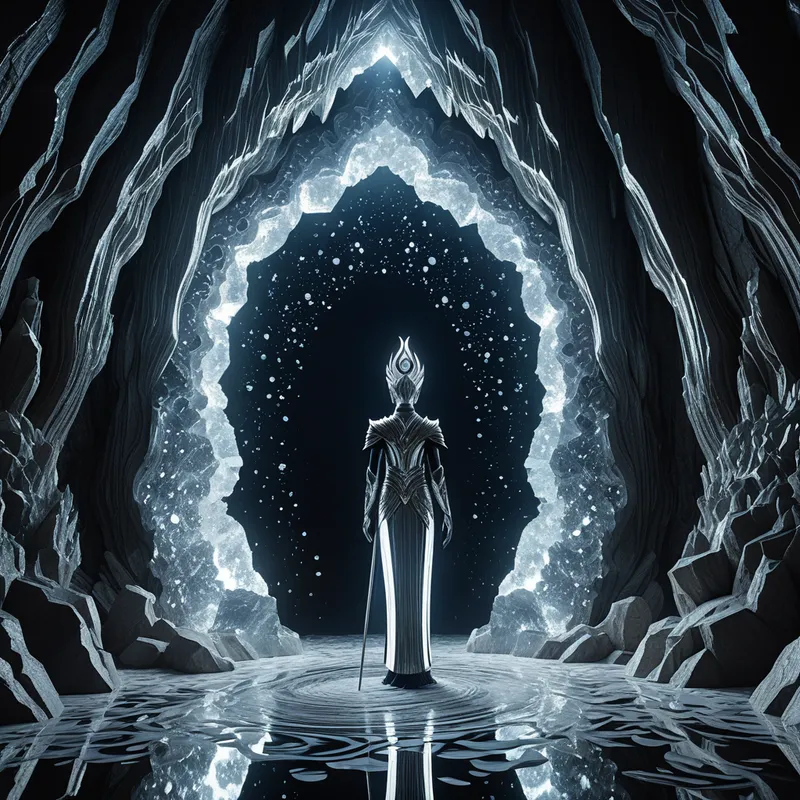
In the time before the First Conjunction, when the elements still slept in their pure, quarreling states, there existed a being known as Aurum-Lacuna. It was not a god of sun or storm, but of potential itself—a shimmering entity of unalloyed thought and unbirthed form. Aurum-Lacuna contained within its vast consciousness the blueprint for all things: the soaring spire and the crushing depth, the fierce love and the cold void. Yet this totality was a silent, static hymn. To know itself, to move from potential to being, it had to perform the one act it could not conceive: to see itself apart from itself.
And so, from the very substance of its longing, Aurum-Lacuna wept a single tear. This tear did not fall but hung suspended in the void, a droplet of pure subjective essence. The being then breathed upon it the breath of objective fire. The tear shuddered, expanded, and cooled, not into glass or water, but into a perfect, boundless disc of living mercury—the first Speculum.
Aurum-Lacuna turned its gaze upon the Speculum. But the mirror did not show a unified god. Instead, the reflective surface churned like a storm. From its depths emerged not one reflection, but ten thousand. Each was a shard of Aurum-Lacuna’s own nature, now magnified, isolated, and personified. Here was the Red King, raging with creative fury. There, the White Queen, flowing with deep intuition. Alongside them flickered the Mercurial Spirit, the stoic Salt of the Earth, and countless others—the proud, the fearful, the nurturing, the destructive. Each fragment, believing itself to be the whole, cried out in a cacophony of conflicting desires.
Horror and fascination gripped Aurum-Lacuna. The unity it sought had birthed only chaos. The fragments, through the Speculum, began to project their own realities, creating a cosmos of clashing realms. The Red King forged scorched mountains; the White Queen drowned them in silver seas. The world was a war of opposites, a direct manifestation of inner conflict externalized.
The crisis reached its zenith when the fragments, in their mutual denial, turned their power upon the Speculum itself, seeking to shatter the source of their painful differentiation. As their combined energies struck the mercurial face, the great mirror did not break. It absorbed. And in that absorption, it showed each fragment not its enemy, but its own origin. The Red King saw his fury rooted in the White Queen’s deep patience. The Mercurial Spirit saw its tricks as a dance around the steadfast Salt. Each saw, for a fleeting, eternal moment, the other not as alien, but as a lost part of its own being.
Silence fell. One by one, the fragments ceased their war. Not in surrender, but in recognition. They did not merge back into a bland soup. Instead, they turned, not to Aurum-Lacuna, but to each other. Through the mediating lens of the Speculum, they began a slow, deliberate dance—a cosmic choreography of reconciliation. The fire tempered the water, the spirit animated the salt, the proud bowed to the humble. And as they danced, their reflections in the Speculum began to change. The chaotic storm coalesced. The ten thousand images drew together, not into the single form of Aurum-Lacuna as it was, but into a new, more complex, and radiant pattern—a mandala of integrated life.
Aurum-Lacuna, the original potential, was gone. In its place stood the Anthropos Tamias, the Keeper of the Whole. It did not look into the Speculum anymore, for it had become the Speculum—a being capable of holding the multiplicity of existence in conscious, harmonious relation. The first true act of creation, the solidification of matter from spirit, could now begin, not from naive unity, but from integrated complexity.
Cultural Origins & Context
The myth of The Speculum is not a folktale of the people, but the foundational theologem of the Alchemical tradition. It was preserved not in popular song, but in the cryptic emblemata and oral teachings passed from master to adept within the sealed workshops and scriptoria. Its tellers were the practitioner-philosophers who saw in the operations of their furnaces and alembics a parallel drama of the soul.
Societally, the myth functioned as both a map and a warning. It encoded the core Alchemical maxim: Solve et Coagula—Dissolve and Coagulate. The dissolution of Aurum-Lacuna before the mirror represented the necessary breaking down of the ego’s illusion of simplicity. The coagulation into the Anthropos Tamias modeled the ultimate goal: the creation of the Philosopher's Stone, which for the Alchemist was as much an inner state of perfected consciousness as a physical substance. The myth warned that the journey to gold (wholeness) necessarily passes through the blackness of confrontation (the nigredo) and the chaos of conflicting inner forces.
Symbolic Architecture
At its heart, The Speculum is the archetypal drama of consciousness awakening to itself. Aurum-Lacuna represents the pristine, unconscious Self—full of potential but lacking definition. The act of creating the mirror is the birth of the ego, the faculty that attempts to look back at the Self and say "I am."
The mirror does not lie, but it divides. To see is to separate the seer from the seen, and in that gap, all the world—and all the psyche—is born.
The fragmented reflections are the psychic complexes, the sub-personalities, and the archetypal forces that constitute the personal and collective unconscious. The Red King and White Queen are the quintessential opposites—conscious/unconscious, logic/intuition, action/reception—whose conflict fuels both neurosis and creativity. The war of the fragments is the internal civil war every individual experiences: the critic versus the child, the persona versus the shadow.
The Speculum itself is the symbol of objective consciousness, or what Jung termed the transcendent function. It is not the ego, but the capacity to observe the ego and all other psychic contents without immediate identification. It is the space where opposites can be held in tension until a third, reconciling symbol emerges.

The Dreamer's Resonance
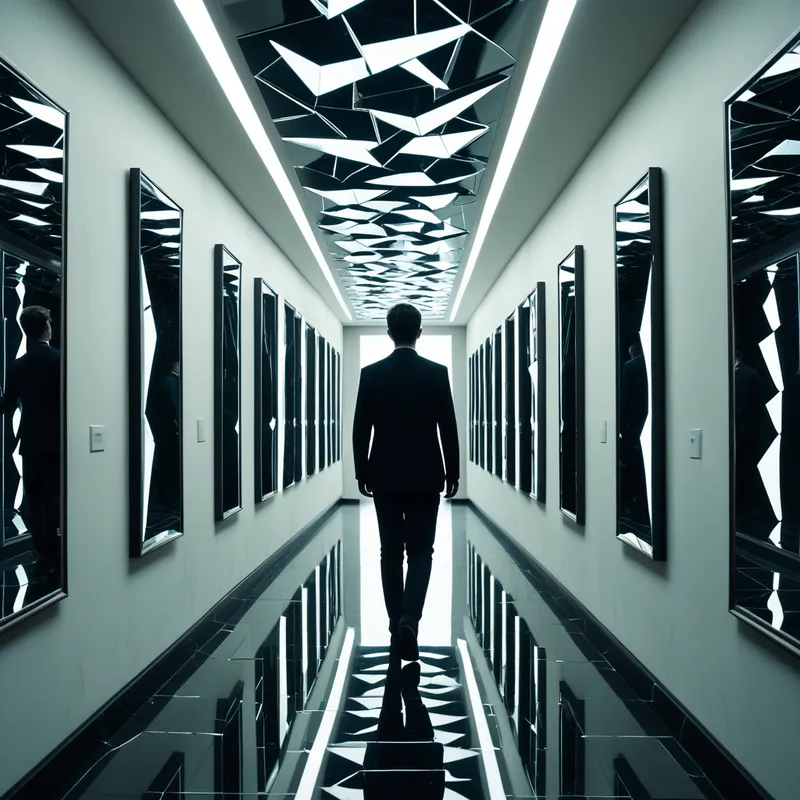
When this myth stirs in the modern unconscious, it often manifests in dreams of mirrors. Not ordinary mirrors, but strange ones: mirrors that are foggy, cracked, liquid, or that show a different version of the dreamer. To dream of anxiously avoiding a mirror suggests a refusal to engage with a burgeoning aspect of the Self. To dream of a mirror shattering often precedes, or accompanies, a painful but necessary breakdown of an old, rigid identity.
A dream of multiple reflections, each with its own will, signals the emergence of powerful complexes into awareness—perhaps a long-suppressed anger (a Red King) or a neglected creative voice (a White Queen). The somatic experience is often one of tension, anxiety in the chest or gut, a feeling of being "pulled apart." This is the psychic solve, the dissolution. The healing dream, the resolution of the mythic pattern, might involve watching the fractured images in the mirror slowly reconcile, or finding a mirror that reflects a calm, integrated, and unfamiliar-yet-known face. This marks the beginning of coagulatio.
Alchemical Translation
For the individual, the myth of The Speculum models the entire journey of individuation. We all begin as a kind of Aurum-Lacuna, a vague potential living in a state of unconscious unity with our inner world. Life—relationship, crisis, introspection—presents us with the Speculum. This is any event or insight that forces us to see our own contradictions: the loving parent who harbors secret resentment, the successful professional who feels like a fraud, the kind person who discovers a capacity for cruelty.
The goal is not to destroy the fragments, but to invite them to the council. Wholeness is not homogeneity; it is the conscious governance of a diverse inner kingdom.
The "war of the fragments" is the period of intense inner conflict, depression, or anxiety that follows such realizations. The Alchemical translation instructs us not to flee this chaos, but to approach it as the prima materia—the raw material of transformation. We must learn to be the Speculum: to observe our Red King rages and White Queen sorrows with curiosity rather than judgment. This is the practice of active imagination or mindful self-observation.
The reconciliation is not an automatic fusion, but a deliberate act of diplomacy. It means letting the inner critic speak its fears, then allowing the inner child to answer with its needs. It is finding the value in our shadow, the strength in our vulnerability. The final creation, the Anthropos Tamias, is the achieved state of the individuated person. One is no longer a battleground of unconscious forces, but a conscious vessel that can contain life’s opposites without being torn asunder. The psyche becomes a reflecting, integrating instrument—a true Speculum—turning the lead of inner conflict into the gold of authentic, resilient being.
Associated Symbols
Explore related symbols from the CaleaDream lexicon: