
The Spear of Lugh Myth Meaning & Symbolism
A tale of the radiant god Lugh, his unstoppable spear, and the sacred price of wielding ultimate power to restore cosmic order.
The Tale of The Spear of Lugh
Listen. The air is thick with the smell of damp earth and cold iron. The world is out of joint. The Fomorians, those giants of the deep and the dark, have laid a crippling tribute upon the land. The Tuatha Dé Danann are diminished, their king maimed, their hope a guttering flame. Into this twilight comes a stranger.
He arrives at the gates of Tara, and the light seems to gather around him. He names himself Lugh Lamfada, Lugh of the Long Arm. The doorkeeper challenges him: “What art do you bring? For no one enters Tara without a skill to serve the king.” Lugh lists them: he is a warrior, a poet, a harper, a champion, a historian, a physician, a cupbearer, a brazier. For each, he is told, “We have one already.” Then Lugh asks, “But do you have one who is master of all these arts?” Silence falls. The gates swing open.
He stands before the wounded king, Nuada of the Silver Hand. Lugh’s presence is a warmth in the hall’s chill. But the shadow of the Fomorian king, the terrible Balor of the Evil Eye, looms over all. Balor’s eye, when opened, brings instant death. The Tuatha Dé Danann are preparing for a final, desperate battle—the Second Battle of Mag Tuired.
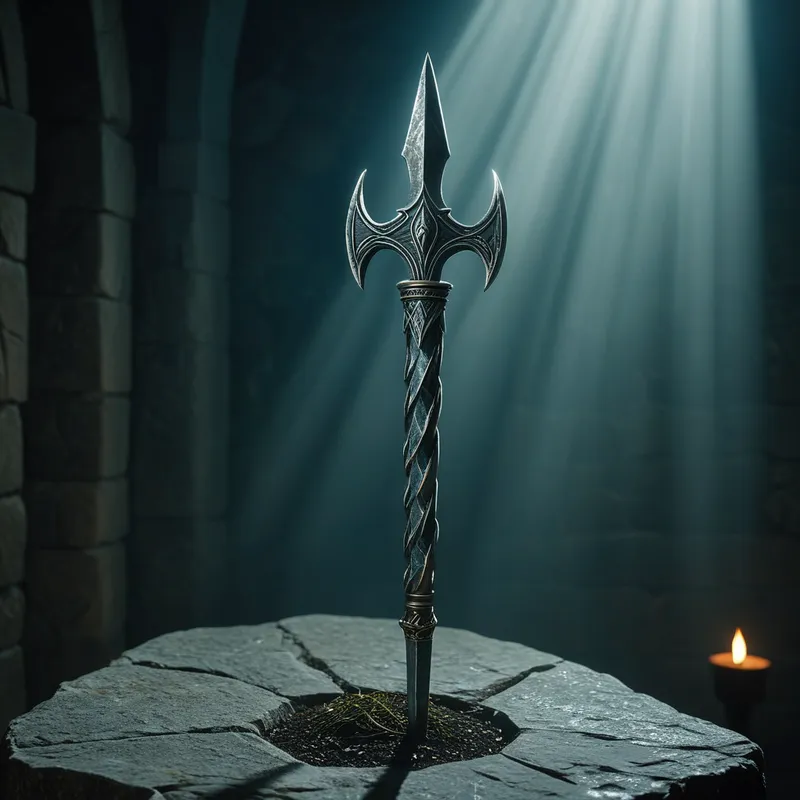
And here is Lugh’s secret, the fire he carries. He possesses the Spear of Lugh, also called Gáe Assail. It is not a simple shaft of wood and iron. Forged in the cities of the gods, it is a living thing of thirst. Its barbed head must be kept submerged in a cauldron of poppy-draught or blood, lest it scream for battle and burst into flame. It is a weapon of terrible sovereignty: it guarantees victory, but it demands a price.
The day of battle dawns grey and grim. The armies clash on the plain of Mag Tuired, a cacophony of shouts, the clash of bronze, and the cries of the dying. The tide turns against the Tuatha Dé Danann. Then Lugh rises, a sun breaking through storm clouds. He takes up his spear. It hums in his hand, a low, hungry note. He does not cast it wildly. He moves with a dancer’s precision, a poet’s intent. Where he points, the Fomorian lines break.
But the heart of the darkness remains: Balor. The giant Fomorian lumbers forward, his deadly eye lid bound shut. Lugh advances. As Balor’s eyelid is raised by his attendants, the very air curdles. Lugh does not flinch. With a shout that is both a challenge and an incantation, he hurls the Spear. It flies, a streak of vengeful light, and pierces Balor’s eye, driving the poison back into the giant’s own skull. Balor falls, and his fall shakes the earth. The Fomorians flee. The land is freed.
Yet, as the cheers rise, Lugh looks at his spear, now quiet and stained. The victory is absolute, but the instrument of it remains a thing of awful necessity. He orders it washed clean, but the memory of its thirst lingers. Order is restored, but the cost of that order—the violence, the focused, terrible will—is not forgotten. The spear is laid aside, a sacred, dangerous relic of the day the light fought the deep and won.
Cultural Origins & Context
The myth of Lugh and his spear is a cornerstone of the Irish mythological cycle, preserved primarily in the medieval text Lebor Gabála Érenn and the epic Cath Maige Tuired. It is crucial to remember that these were not static “holy books” but dynamic narratives performed by the fili, the poet-seers. In a pre-literate society, these stories were the living database of history, law, morality, and cosmic order.
The myth functioned as a foundational charter for sovereignty. Lugh, the many-skilled outsider who becomes king, models the ideal ruler: not just a brute warrior, but a master of all necessary arts (craft, law, poetry, war) required to maintain the fír flathemon, the “ruler’s truth.” His spear, one of the Four Treasures of the Tuatha Dé Danann, is the ultimate symbol of this sovereign power—a power that is both creative and destructive, protective and terrifying. It legitimizes the rule of the Tuatha Dé Danann over Ireland, framing their victory not as mere conquest but as the restoration of rightful order against chaotic, oppressive forces. The story was told to bind the community to its perceived origins, to explain the nature of just kingship, and to acknowledge that true order often has a sharp, dangerous edge.
Symbolic Architecture
At its core, the Spear of Lugh is a symbol of focused consciousness piercing the unconscious. Balor and his Fomorians represent the monolithic, undifferentiated tyranny of the unconscious—the paralyzing complexes, the archaic fears (the “evil eye” that petrifies), and the overwhelming demands that can rule a psyche or a culture.
The spear is the directed will, the sharp point of individual awareness that must confront and integrate the monstrous contents of the inner world.
Lugh himself is the archetype of the integrated Self. His title “Samildánach” (master of all arts) signifies the unification of disparate psychic functions—thinking, feeling, sensation, intuition—into a coherent whole. He is not a specialist but a synthesizer. His spear is the tool of this synthesized self. Its bloodthirstiness is not mere savagery; it symbolizes the inevitable aggression required for consciousness to define itself. To establish order, whether in the soul or society, one must “kill” the old, oppressive patterns. The spear’s need to be quenched in a cauldron speaks to the necessary cycle: focused action (spear) must be balanced by containment and reflection (cauldron), lest it burn out of control.
The Dreamer’s Resonance
When this mythic pattern stirs in the modern dreamer, it often manifests as a confrontation with a towering, paralyzing force—a monstrous boss, a suffocating relationship, or a vast, impersonal system of oppression (the Fomorians). The dreamer may feel small, ill-equipped, and hopeless.
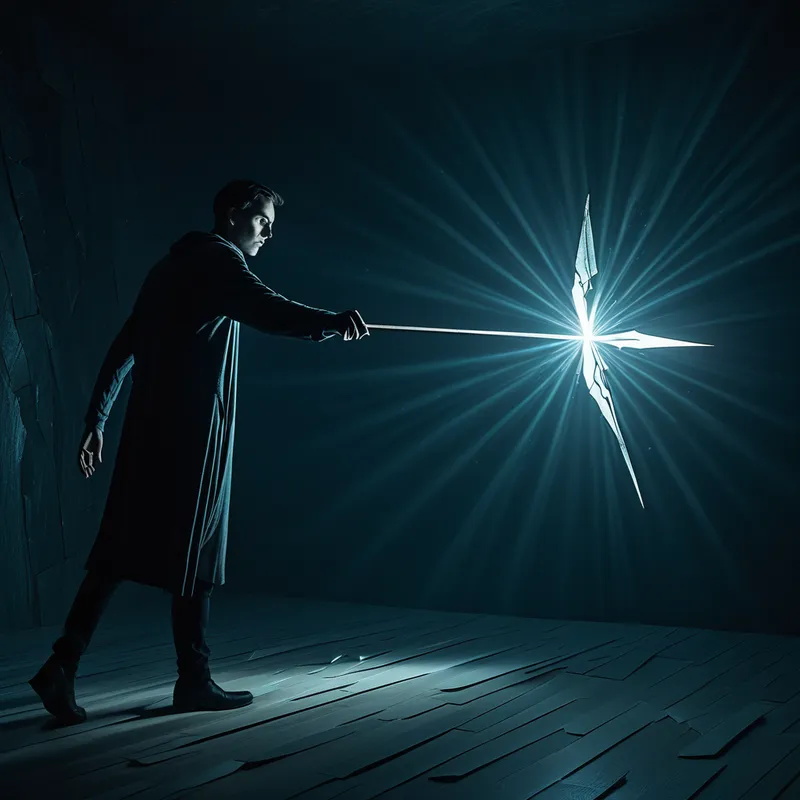
Dreaming of finding or wielding a spear, however, signals a crucial shift. It is the somatic awakening of agency. The spear in a dream is the nascent, often frightening, awareness of one’s own will and ability to fight back. The dream may involve the spear being difficult to lift (the weight of responsibility), or it may glow with an inner light (the awakening of personal power). The climactic act of hurling the spear is the psychic moment of decisive action, of finally speaking the truth, setting the boundary, or making the choice that breaks the oppressive spell. The aftermath of the dream—whether of triumph, exhaustion, or a need to cleanse the weapon—reveals how the dreamer is processing the cost of their newfound sovereignty.
Alchemical Translation
The journey of Lugh models the alchemical process of individuation. The initial state is the nigredo: the kingdom is wounded (Nuada’s silver hand), shadow forces dominate, and the psyche is in a state of tribution and depression.
Lugh’s arrival represents the emergence of the Self, the central organizing principle. His mastery of all arts is the albedo, the whitening, where disparate elements of the personality are recognized and gathered. But recognition is not enough. The confrontation with Balor is the critical rubedo, the reddening or sanguine stage. This is the fiery, often painful, engagement with the deepest shadow.
Individuation is not a peaceful meditation; it is a battle at Mag Tuired. The spear is the transcendent function, the symbol that emerges from the tension of opposites to deliver a decisive, transformative blow.
The hero does not negotiate with the evil eye; he pierces it. Psychically, this translates to the moment a lifelong complex is finally seen for what it is and consciously dismantled. The integration is not a gentle merging but a victorious, if traumatic, restructuring. Finally, the cleansing and resting of the spear signifies the citrinitas, the yellowing or integration of this experience into the ongoing life of the individual. The power is now sovereign, contained, and at the service of the whole self, not raging uncontrolled. The modern individual undergoing this process moves from being a subject of inner tyranny to becoming the rightful ruler of their own psychic realm, understanding that their wholeness carries the weight and the weapon of conscious responsibility.
Associated Symbols
Explore related symbols from the CaleaDream lexicon: