The Spear of Achilles Myth Meaning & Symbolism
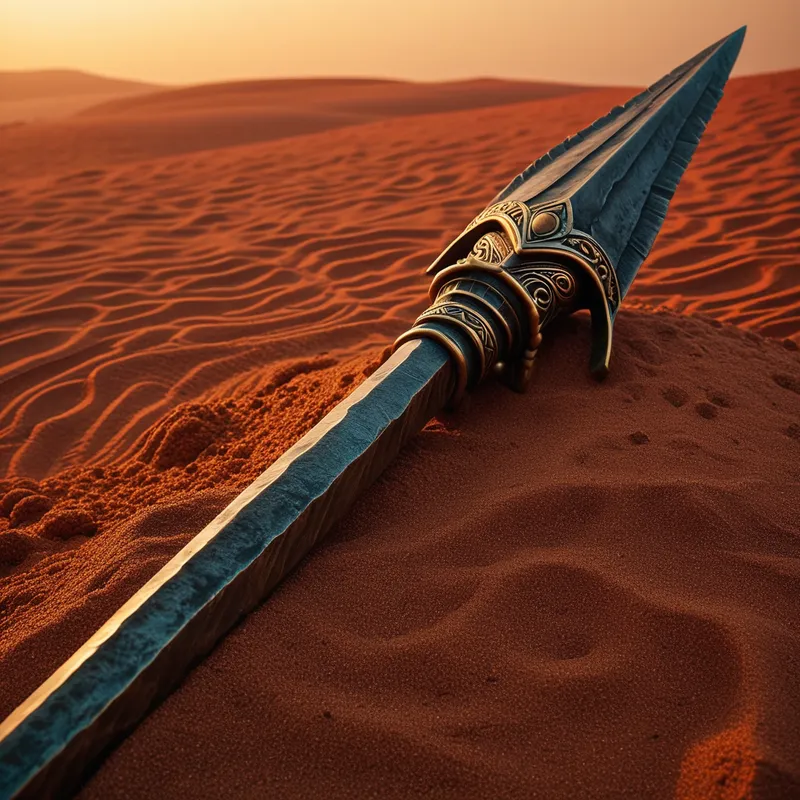
The spear, a gift from the gods, is the only weapon that can wound and heal. It embodies the paradox of the hero's destiny: his power and his fatal flaw.
The Tale of The Spear of Achilles
Hear now the tale of the ashwood spear, a story not of its thrust, but of its fate. It begins not on the plain of Troy, but in the smithy of the gods. The air there does not burn; it sings with a primordial heat. Here, [Hephaestus](/myths/hephaestus “Myth from Global/Universal culture.”/), the limping artisan, labors. Not for a king of men, but for a king of gods. The spear he forges is for Zeus, a weapon of such perfect balance and terrible point that it could decide the wars of Olympus. Its shaft is cut from an ash tree on Pelion, a tree that heard the whispers of centaurs. Its bronze point is not cast, but dreamed into being in the divine fire, cooled in the breath of the Boreads.
This spear passed from father to son, from Zeus to Peleus. And on the day of his wedding to [the sea](/myths/the-sea “Myth from Greek culture.”/)-nymph [Thetis](/myths/thetis “Myth from Greek culture.”/), the gods themselves gifted it to the mortal king. It was a dowry of destiny. When their son, Achilles, was born, the weapon waited. It leaned in the shadowed corner of his father’s hall, humming a low, almost imperceptible note—the note of a future killing.
Years later, the thousand ships of Greece are becalmed at Aulis, lost. A wrong turn has led them to the shores of Mysia, ruled by King Telephus. In the confusion and the clash, Achilles, young and blazing with untested fury, fights the Mysian king. He drives the ashwood spear home. It bites deep into Telephus’s thigh, a wound that does not kill, but corrupts. It festers, refuses to heal, a torment sent by the gods for the king’s defiance. The Greeks sail away, but the spear’s work is not done.
Months pass. A broken man arrives at the Greek camp, now finally at Troy. It is Telephus, his body wasted, his leg swollen and weeping. An oracle has spoken: “He that wounded shall also heal.” The king crawls before Achilles, not for vengeance, but for salvation. He clutches the very spear that pierced him, its bronze stained with his own dried blood. In a moment of divine irony, Achilles understands. He scrapes rust—the spear-scurf—from the weapon’s point. He sprinkles the metallic flakes onto the suppurating wound. The magic inherent in the god-forged metal, the same that caused the affliction, now undoes it. The flesh knits. The poison recedes. Telephus rises, whole. The spear has spoken its first truth: it is a threshold between destruction and restoration, a single point containing both curse and cure.
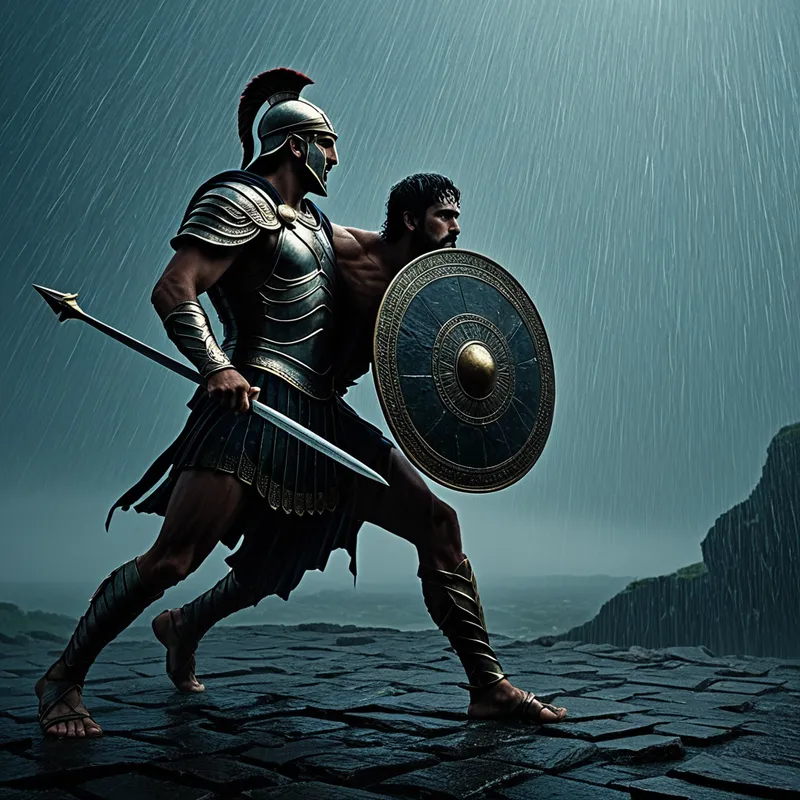
And then, silence. The spear waits again through nine long years of siege. It waits for its final, terrible purpose. When Hector slays Patroclus, the waiting ends. Achilles’s grief is a black sun. He takes up the spear, its familiar weight now an extension of his rage. On the plain before Troy, he seeks Hector. The duel is not a contest; it is an execution. The spear, guided by a fury so pure it is almost divine, finds the gap in Hector’s armor, below the collarbone. It is the killing stroke. The point that healed Telephus now drains the life from the prince of Troy. But in this act, the spear completes its circle. For by killing Hector, Achilles seals his own fate, prophesied to follow soon after his greatest enemy. The weapon that came from the gods returns its wielder to the cycle of fate, its final lesson one of inescapable reciprocity.
Cultural Origins & Context
This myth is woven into the epic tapestry of the Epic Cycle, primarily preserved in fragments and later summaries by poets and scholars like Stasinus and Apollodorus. It functioned as a crucial etiological myth, explaining the unlikely alliance of Telephus with the Greeks and his subsequent guidance of their fleet to Troy. In the oral tradition, performed by bards (rhapsodes), such episodes served as narrative glue, connecting heroes and kingdoms across the known world into a single, interconnected web of destiny.
Societally, the tale reinforced a core Greek concept: pharmakon. This word means both “poison” and “remedy.” The spear is the ultimate pharmakon. It taught that the source of the deepest wound often holds the only key to its healing, a principle applied in law, medicine, and theology. The myth also underscored the nature of heroic inheritance. A hero’s power—his armor, his weapons, his very nature—was never truly his own; it was a loan from the gods or ancestors, carrying with it a pre-written destiny and a heavy debt.
Symbolic Architecture
The [Spear](/symbols/spear “Symbol: The spear often symbolizes power, aggression, and the drive to protect or conquer.”/) of Achilles is not merely a [weapon](/symbols/weapon “Symbol: A weapon in dreams often symbolizes power, aggression, and the need for protection or defense.”/); it is a metaphysical [needle](/symbols/needle “Symbol: The needle is a powerful symbol of connection, precision, and the intricate threads of life that bind experiences and emotions.”/) stitching together the fabric of [fate](/symbols/fate “Symbol: Fate represents the belief in predetermined outcomes, suggesting that some aspects of life are beyond human control.”/), [identity](/symbols/identity “Symbol: Identity represents the sense of self, encompassing personal beliefs, cultural background, and social roles.”/), and [trauma](/symbols/trauma “Symbol: A deeply distressing or disturbing experience that overwhelms the psyche, often manifesting in dreams as unresolved emotional wounds or psychological injury.”/).
The instrument of our deepest wound is often the only key that fits the lock of our healing.
Psychologically, the spear represents inherited [destiny](/symbols/destiny “Symbol: A predetermined course of events or ultimate purpose, often linked to spiritual forces or cosmic order, representing life’s inherent direction.”/). It is passed from Zeus (the archetypal [Father](/symbols/father “Symbol: The father figure in dreams often symbolizes authority, protection, guidance, and the quest for approval or validation.”/), the ruling principle) to Peleus (the [human](/symbols/human “Symbol: The symbol of a human represents individuality, complexity of emotions, and social relationships.”/) father) to Achilles (the son). It carries not just physical potential, but the full psychological [blueprint](/symbols/blueprint “Symbol: A blueprint represents the foundational plan or design for something, often symbolizing potential, structure, and the mapping of one’s inner self or future.”/) of the “heroic” burden: glory, rage, [isolation](/symbols/isolation “Symbol: A state of physical or emotional separation from others, often representing a need for introspection or signaling distress.”/), and early [death](/symbols/death “Symbol: Symbolizes transformation, endings, and new beginnings; often associated with fear of the unknown.”/). To wield it is to accept this inheritance, for better and worse.
It symbolizes the fatal flaw (hamartia) made manifest. Achilles’s flaw is his world-shattering rage (menis). The spear is the physical extension of that rage, the means by which his inner flaw becomes outer catastrophe. Yet, in its first use, it also demonstrates that this flaw contains its own paradoxical [antidote](/symbols/antidote “Symbol: A substance or remedy that counteracts poison, illness, or harmful influences, symbolizing healing, protection, and restoration.”/). The rage that wounds must develop the [consciousness](/symbols/consciousness “Symbol: Consciousness represents the state of awareness and perception, encompassing thoughts, feelings, and experiences.”/) to heal—if only for a [moment](/symbols/moment “Symbol: The symbol of a ‘moment’ embodies the significance of transient experiences that encapsulate emotional depth or pivotal transformations in life.”/)—to fulfill its destiny.
Finally, it is the ultimate [symbol](/symbols/symbol “Symbol: A symbol can represent an idea, concept, or belief, serving as a powerful tool for communication and understanding.”/) of duality and reciprocity. It embodies the union of opposites: creation/destruction, wounding/healing, [curse](/symbols/curse “Symbol: A supernatural invocation of harm or misfortune, often representing deep-seated fears, guilt, or perceived external malevolence.”/)/gift. Its power operates on [the law](/symbols/the-law “Symbol: Represents external rules, societal order, moral boundaries, and the tension between personal freedom and collective structure.”/) of symbolic equivalence: the rust (ios) from the point is both the cause and cure of the wound. This reflects a profound understanding that in the [psyche](/myths/psyche “Myth from Greek culture.”/), the agent of trauma and the [source](/symbols/source “Symbol: The origin point of something, often representing beginnings, nourishment, or the fundamental cause behind phenomena.”/) of transformation are frequently identical.
The Dreamer’s Resonance
When the Spear of Achilles appears in a modern dream, it rarely manifests as a literal weapon. It may appear as a piercing beam of light, a relentless thought, a familial heirloom that feels charged with old anger, or a chronic pain that seems to have an intelligent, pointed source. The dreamer is likely in a process of confronting an inherited psychological pattern—a “family curse” of addiction, depression, or relational dysfunction that has been passed down.
Somatically, one might feel a sharp, localized pressure or pain during the dream, often in the thigh (the location of Telephus’s wound), symbolizing a crippling vulnerability or a supported strength that has been attacked. Psychologically, the dream signals that the dreamer has reached a point where the wounding pattern (the “spear”) is now visible and can be engaged with consciously. The dream is an invitation to “scrape the rust”—to examine the precise, granular nature of the inherited trauma. It suggests that healing will not come from avoiding the painful source, but from confronting it directly and extracting the transformative principle hidden within its toxic form.
Alchemical Translation
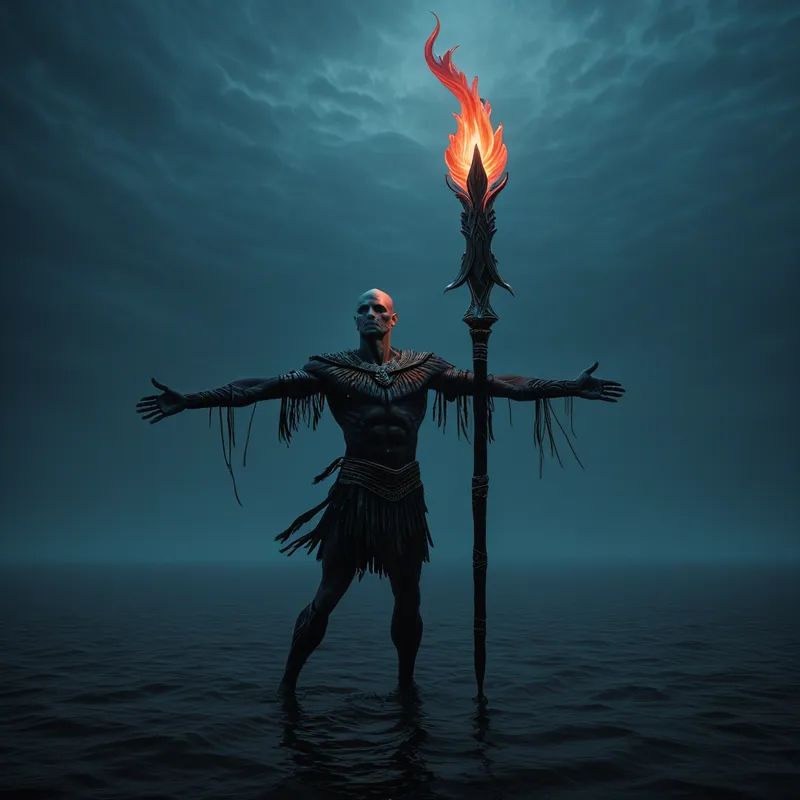
The myth of the spear models the alchemical stage of [solve et coagula](/myths/solve-et-coagula “Myth from Alchemical culture.”/)—dissolve and coagulate. The psyche must first be pierced and dissolved (the wounding) before it can be reconstituted in a new, more conscious form (the healing).
The modern individuation journey it maps is one of reclaiming the poisoned inheritance. We all receive “spears” from our forebears: genetic predispositions, cultural conditioning, familial complexes. Initially, we wield them unconsciously, wounding ourselves and others (Achilles’s rage against Telephus, then Hector). The first step in alchemical translation is the Telephus moment: the crisis where our unconscious wounding renders us helpless, forcing us to seek the source of our pain.
Individuation requires us to make medicine from our own poison, to find the healing rust on the very point that pierced us.
Healing begins when we stop using the spear to attack externally and turn it inward as an instrument of analysis. We “scrape the rust”—that is, we consciously examine the accumulated, oxidized residue of our personal and ancestral history. This rust is the [prima materia](/myths/prima-materia “Myth from Alchemical culture.”/), the base substance for transformation. Applying it to the wound is the act of integrating shadow material, of understanding how our flaw is also our unique potential.
Finally, the myth warns that full integration is fatal to the old, identified self. To truly wield the spear consciously is to accept the death of [the ego](/myths/the-ego “Myth from Jungian culture.”/) that was defined by its rage and grief (Achilles’s fate after killing Hector). The spear always returns to its source. The psychological [triumph](/myths/triumph “Myth from Roman culture.”/) is not in avoiding this fate, but in meeting it with eyes open, having used the weapon of destiny not just to destroy, but to heal, and in healing, to complete the circle of meaning that was forged in the divine fire before we were born.
Associated Symbols
Explore related symbols from the CaleaDream lexicon: