The Spartans at Thermopylae Myth Meaning & Symbolism
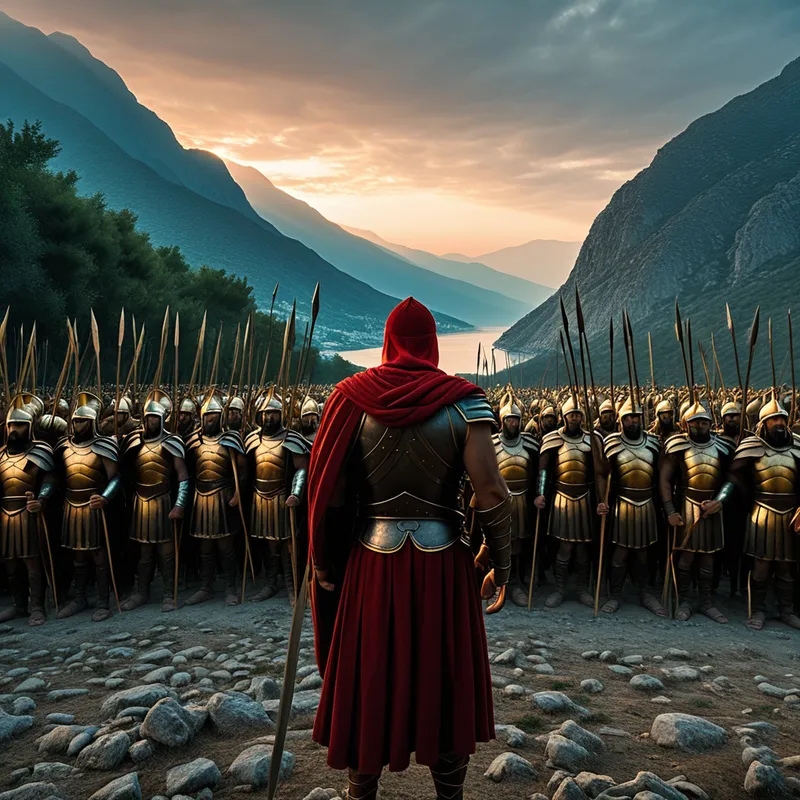
A small band of Spartans, led by King Leonidas, makes a final stand against a vast Persian army, choosing death with honor over retreat.
The Tale of The Spartans at Thermopylae
Hear now of the Hot Gates, of the place where [the earth](/myths/the-earth “Myth from Hindu culture.”/) itself conspired with men to make a legend. The year is the height of summer, 480 years before the birth of the Christian god. The air over Thermopylae is thick with the smell of salt, pine, and the iron scent of fear. From the east comes a shadow that blots out the sun—the army of Xerxes, son of Darius. It is a river of men, a flood of nations: Medes and Persians in glittering scale, Ethiopians with painted shields, Scythian horsemen whose cries are like birds of prey. They say its numbers are as the grains of sand on the shore, and its king believes himself a god walking [the earth](/myths/the-earth “Myth from Hindu culture.”/).
Against this tide stands a rock. Not just the stone of the pass, but the living rock of Sparta. Three hundred men. No, more than men—they are Spartiates, each a masterpiece of war, bred for this single purpose: to stand. At their head is Leonidas, descendant of [Heracles](/myths/heracles “Myth from Greek culture.”/). His beard is iron-grey, his eyes the color of a winter sky. He does not speak of victory. He speaks of time. Of holding the narrows so that all of Hellas can gather its strength.
For two days, they hold. The pass is a butcher’s yard. The Persian Immortals come, ten thousand strong, and break upon the Spartan wall like waves upon a cliff. The long dory finds its mark, the heavy aspis slams forward, and the line, the unbreakable line, steps, kills, and steps back. The air rings with the clash of bronze, the screams of the dying, and the deep, rhythmic chant of the Spartan paean. Xerxes, from his golden throne, watches his invincible host being rendered finite by a sliver of men.
But all walls have a weak point. A traitor, Ephialtes, hungry for gold, whispers of a mountain path that leads behind the Greek wall. The trap is sprung. When the news comes, Leonidas knows the oracle is fulfilled: either a king of Sparta must die, or the city will be destroyed. He dismisses the allies. The Thespians and Thebans choose to stay, but the core, the doomed heart, remains the Three Hundred.
On the third day, they march out, not to the defensible wall, but into the wider part of the pass. They know. They anoint their hair, as if for a festival. They sharpen their swords one last time. Leonidas is said to have told them to eat a good breakfast, for tonight they would dine in [Hades](/myths/hades “Myth from Greek culture.”/). They fight with the fury of men already dead. Spears shatter, they fight with swords. Swords break, they fight with hands and teeth. Leonidas falls. A fierce struggle erupts over his body; four times the Persians are driven back. Finally, overwhelmed by arrows, the last Spartans are buried under a mountain of missiles.
The Hot Gates are lost. But [the flood](/myths/the-flood “Myth from Biblical culture.”/) has been slowed. A story has been born. A story not of victory, but of a choice. And on a stone placed where they fell, words are carved for the ages: Go, tell the Spartans, stranger passing by, that here, obedient to their laws, we lie.
Cultural Origins & Context
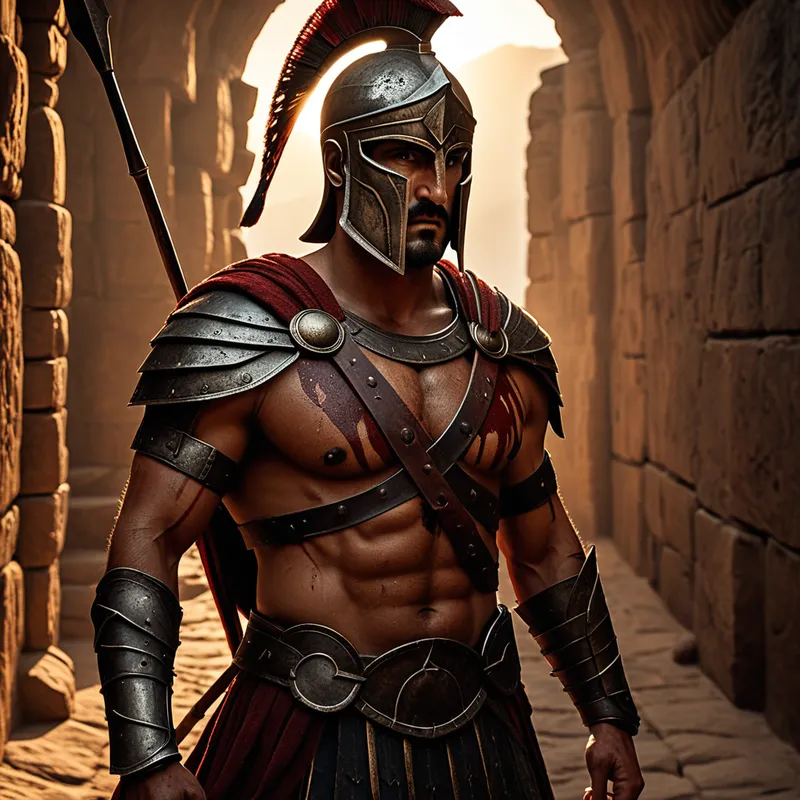
This is not a myth of the distant, god-haunted past like the tales of Agamemnon or [Odysseus](/myths/odysseus “Myth from Greek culture.”/). It is a historical event, meticulously recorded by the historian Herodotus barely two generations later. Yet, in the Spartan telling and the Greek imagination, it was mythologized instantly. It served a vital societal function: it was the foundational parable of the Spartan ideal.
In agoge, young boys were weaned on this story. It was not a tale of individual glory, but of the collective, the phalanx. The Spartan law (nomos) was supreme, greater than any king or any instinct for self-preservation. The story justified their entire harsh, insular society. To the rest of Greece, particularly the democratic Athenians who would win the naval victory at Salamis, it was a shocking, awe-inspiring testament to Greek courage—a symbol of the free man’s willingness to die for his freedom against the enslaved hordes of a tyrant. It became the ultimate “noble defeat,” a seed that would grow into the Western concept of the heroic last stand.
Symbolic Architecture
At its core, Thermopylae is a myth of conscious sacrifice. It is not a tragedy of blind [fate](/symbols/fate “Symbol: Fate represents the belief in predetermined outcomes, suggesting that some aspects of life are beyond human control.”/), like [Oedipus](/myths/oedipus “Myth from Greek culture.”/), but a deliberate, clear-eyed [choice](/symbols/choice “Symbol: The concept of choice often embodies decision-making, freedom, and the multitude of paths available in life.”/). The pass itself is the ultimate [symbol](/symbols/symbol “Symbol: A symbol can represent an idea, concept, or belief, serving as a powerful tool for communication and understanding.”/) of the liminal [space](/symbols/space “Symbol: Dreaming of ‘Space’ often symbolizes the vastness of potential, personal freedom, or feelings of isolation and exploration in one’s life.”/)—[the threshold](/myths/the-threshold “Myth from Folklore culture.”/) between [life](/symbols/life “Symbol: The symbol of ‘Life’ represents a journey of growth, interconnectedness, and existential meaning, encompassing both the joys and challenges that define human experience.”/) and [death](/symbols/death “Symbol: Symbolizes transformation, endings, and new beginnings; often associated with fear of the unknown.”/), freedom and subjugation, order and [chaos](/symbols/chaos “Symbol: In Arts & Music, chaos represents raw creative potential, uncontrolled expression, and the breakdown of order to forge new artistic forms.”/).
The hero is not the one who conquers, but the one who chooses the manner of his meeting with the inevitable.
Leonidas represents the integrated ego, the conscious [leader](/symbols/leader “Symbol: A leader signifies authority, responsibility, and guidance; representing aspirations for achievement or fear of following.”/) who accepts the [prophecy](/symbols/prophecy “Symbol: A foretelling of future events, often through divine or supernatural means, representing destiny, fate, and hidden knowledge.”/) of his own demise for a greater [purpose](/symbols/purpose “Symbol: Purpose signifies direction, meaning, and intention in life, often reflecting personal ambitions and core values.”/). The Three Hundred symbolize the trained, disciplined aspects of the [psyche](/myths/psyche “Myth from Greek culture.”/)—the values and principles one has forged through hardship (the agoge of life). The overwhelming Persian army represents the [shadow](/symbols/shadow “Symbol: The ‘shadow’ embodies the unconscious, repressed aspects of the self and often represents fears or hidden emotions.”/) in its most collective and terrifying form: the chaotic, numberless, unspeakable pressures of the outer world (tyranny, [conformity](/symbols/conformity “Symbol: The act of adjusting one’s behavior, beliefs, or appearance to match those of a group or societal norms, often involving pressure to fit in.”/), annihilation) or the inner world (formless [anxiety](/symbols/anxiety “Symbol: Anxiety in dreams reflects internal conflicts, fears of the unknown, or stress from waking life, often demonstrating the subconscious mind’s struggle for peace.”/), nihilism, the pull of [dissolution](/symbols/dissolution “Symbol: The process of breaking down, dispersing, or losing form, often representing transformation, release, or the end of a state of being.”/)).
The traitor Ephialtes is a critical, often overlooked, symbol. He represents the [betrayal](/symbols/betrayal “Symbol: A profound violation of trust in artistic or musical contexts, often representing broken creative partnerships or artistic integrity compromised.”/) from within—the weakness, the greed, the flaw in the [terrain](/symbols/terrain “Symbol: Terrain in dreams often represents the landscape of one’s life, including challenges, opportunities, and feelings about one’s current circumstances.”/) of one’s own [soul](/symbols/soul “Symbol: The soul represents the essence of a person, encompassing their spirit, identity, and connection to the universe.”/) that allows [the shadow](/myths/the-shadow “Myth from Jungian culture.”/) to circumvent our conscious defenses. No heroic stance is perfect; there is always an unguarded [path](/symbols/path “Symbol: The ‘path’ symbolizes a journey, choices, and the direction one’s life is taking, often representing individual growth and exploration.”/).
The Dreamer’s Resonance
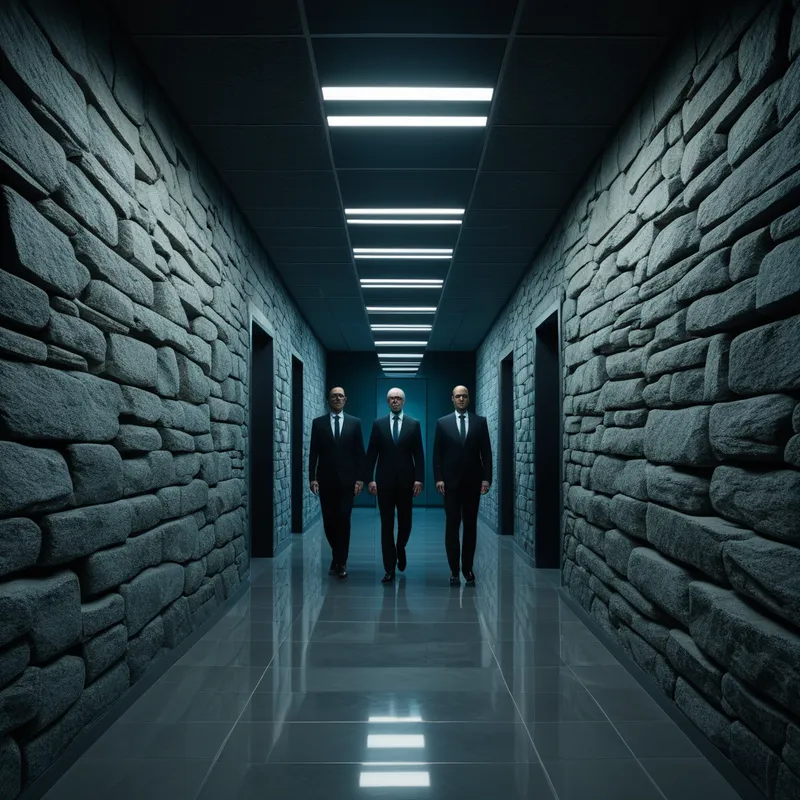
When this myth pattern arises in modern dreams, the dreamer is often at a psychological Thermopylae. The dream may manifest as holding a narrow, defensible position (a doorway, a hallway, a bridge) against an overwhelming, faceless force. There is a somatic feeling of immense pressure, of being cornered, yet also of grim determination.
This is not a dream of attack, but of containment. The psyche is attempting to hold a boundary against an inundation—be it a flood of responsibilities, a tidal wave of grief, the onslaught of external demands, or the eruption of repressed emotional material. The dreamer is the Spartan, tasked with making a stand so that other parts of [the self](/myths/the-self “Myth from Jungian culture.”/) (the “rest of Greece”) can mobilize, integrate, and survive. The exhaustion felt upon waking is the exhaustion of [the ego](/myths/the-ego “Myth from Jungian culture.”/), heroically but unsustainably, holding the line alone. The dream is a call to acknowledge the scale of the inner conflict and to ask: What is the “greater cause” for which I am sacrificing myself? Is my current position sustainable, or is it, like Leonidas’s, a destined, necessary sacrifice to buy time for a deeper transformation?
Alchemical Translation
The alchemical process mirrored here is mortificatio—the necessary death, the dissolution of a current form for the sake of a future synthesis. The Spartan stand is the ultimate act of conscious mortificatio. They do not resist their death; they consciously shape its meaning and dedicate it to a purpose beyond themselves.
For the modern individual in the process of individuation, Thermopylae models the moment when one must sacrifice a well-defended, heroic identity. Perhaps it is the identity of the perpetual warrior, the always-strong one, the inviolable wall. This identity, like the Spartan phalanx, was once a source of great strength and survival. But to move forward, it must be allowed to die a heroic death at its own “Hot Gates.”
The alchemical gold is not found in endless victory, but in the conscious, meaningful sacrifice of the very armor that once defined you.
The process involves several stages: First, recognizing the “narrow pass”—the limiting but familiar structure of your current life or identity. Second, facing the “Persian host”—the terrifying scope of change, the unknown, or the repressed shadow. Third, discovering the “Ephialtes” within—the personal weakness or betrayal that forces a crisis. Finally, making the Leonidas-choice: to consciously “die” to the old form, not in despair, but in dedication to a larger, emerging self. The “law” you obey is no longer Spartan nomos, but the deeper law of your own destiny. The result is not a military victory, but a psychic one: the transformation of a literal, physical stand into a symbolic, eternal one. The ego is sacrificed, but the meaning of the sacrifice becomes a permanent, guiding monument in the psyche’s landscape. You do not survive the battle, but your essence, your chosen stance, becomes immortal.
Associated Symbols
Explore related symbols from the CaleaDream lexicon: