The Sky Myth Meaning & Symbolism
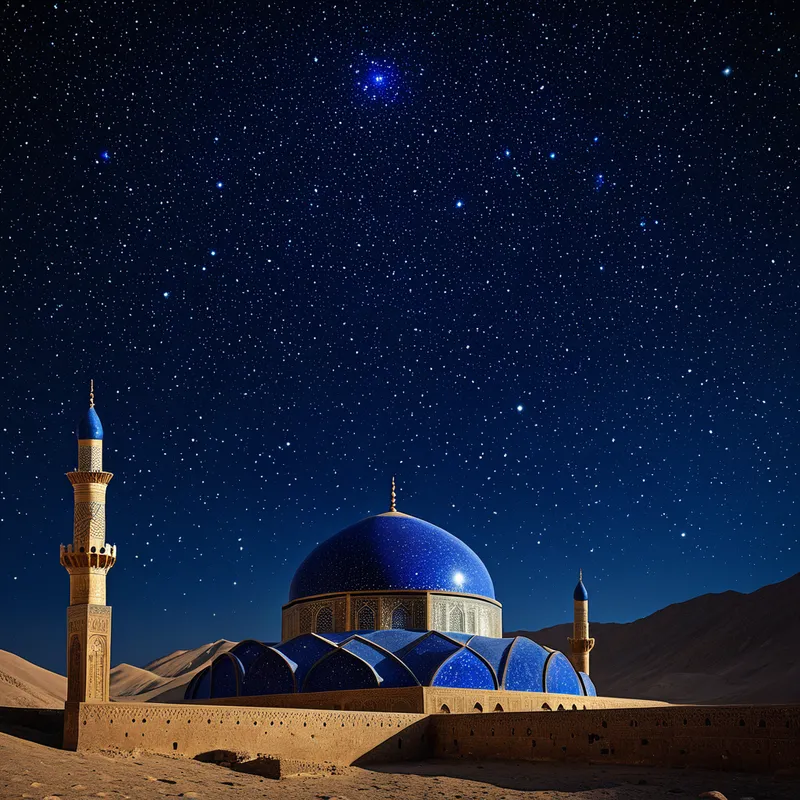
A myth of the celestial vault as a sacred boundary, forged from divine light to separate chaos from order, holding the promise of ultimate return.
The Tale of The Sky
Listen, and let your spirit ascend. In the time before time, when the world was a thought in the mind of the Boundless, there existed only the Primordial Twins: Ahura Mazda, the Lord of Wisdom, and the Angra Mainyu, the Hostile Spirit. Between them stretched the Void, a formless, seething potential.
Ahura Mazda, in his infinite wisdom, conceived of a cosmos—a place of beauty, truth, and fixed paths. He began to weave it from his own essence, from the pure, uncreated Light. But the Angra Mainyu, seeing this act of creation, was consumed by a corrosive envy. He rushed from the depths of non-being to attack, to smother the light with his own essence of darkness, noise, and lie.
A great struggle ensued, not of clashing swords, but of opposing principles: harmony against discord, song against scream. To protect his nascent creation, Ahura Mazda performed a mighty act. He took a portion of his own radiant substance, the very first and most sublime of his creations, and fashioned it into a vast, curved shield. This was not a shield of metal, but of solidified radiance, a crystalline dome of impossible hardness and perfect clarity. With a sound like the ringing of a thousand celestial bells, he raised it high.
He set this luminous vault as a boundary, a sacred limit. On one side, he contained the ordered realms he would further shape: the realm of the stars, the moon, the sun, and later, the earth. On the other side, he pushed back the Angra Mainyu and the seething, undifferentiated chaos. Thus, the Sky was born—Aneran made manifest as a firmament. It was the ultimate separator, the Vayu made visible, the barrier that made creation possible.
The Sky was not empty. Into its substance, Ahura Mazda set the fixed stars, pinpoints of his unwavering truth, and the wandering stars (planets), his agents of destiny and time. The Sky became a rotating bowl of lapis lazuli by day, a cloak of black velvet pierced by diamond fire by night. It was both a ceiling for the world and a floor for the higher heavens, a membrane between the divine and the material, forever holding back the outer darkness while allowing the nourishing light of sun and stars to pour through. It stood, and stands, as the first and greatest testament to the triumph of order over chaos, a silent, majestic promise that the light will not be extinguished.
Cultural Origins & Context
This cosmological narrative is woven from the threads of ancient Iranian, specifically Zoroastrian, thought, preserved in texts like the Avesta and later Pahlavi works. It was not a single "story" told around a fire, but the fundamental architectural principle of a worldview. Priests (Mobeds) would have conveyed this cosmology in rituals and teachings, explaining the very nature of reality.
The Sky (Asman) was the first of the seven primordial creations, followed by water, earth, plants, animals, humankind, and fire. Its societal function was profound: it provided a cosmic model for social and moral order. Just as the Sky established a lawful boundary against chaos, so too must the king (the earthly Farr) establish justice and order in the realm, and the individual must maintain order within their own mind and actions against the "chaos" of deceit, laziness, and evil thought. The sky was a constant, visible reminder of divine authority and the sacred structure of existence.
Symbolic Architecture
Psychologically, the myth of the Sky is a master metaphor for the birth of consciousness itself. The undifferentiated void represents the unconscious, a state of potential containing both creative wisdom and destructive impulses.
The first act of the psyche is not to create, but to separate. To draw a boundary between 'I' and 'Not-I,' between inner order and outer chaos.
The Sky is that boundary—the ego, the structure of consciousness that forms to contain and organize the inner world. It is the "skin" of the psyche, the necessary separation that allows for a stable identity and a coherent perception of reality. Ahura Mazda represents the organizing, transcendent function of the Self, while the Angra Mainyu symbolizes the undifferentiated, shadowy, and potentially overwhelming contents of the unconscious that threaten to engulf a nascent ego.
The stars fixed within the sky symbolize the core, unchanging truths and values that guide an individual (the archetypal patterns), while the wandering planets represent the dynamic, changing forces of fate, emotion, and impulse that move within the structure of one's life. The Sky, therefore, is not a prison, but the necessary vessel that makes conscious life and navigation possible.

The Dreamer's Resonance
When this myth stirs in the modern unconscious, it often manifests in dreams of ceilings, domes, vast open skies, or conversely, of cracking firmaments and falling heavens. To dream of gazing up at a profoundly beautiful, star-filled night sky can signal a moment of ego-transcendence, where the individual feels connected to a larger, orderly cosmos. It is the psyche reassuring itself of a higher structure.
Conversely, dreams of the sky cracking, turning a threatening color, or pressing down oppressively indicate a crisis in this psychic boundary. The dreamer may be experiencing a period where their conscious worldview (their "sky") is under assault—by trauma, overwhelming emotion, or a life transition that shatters old certainties. The Angra Mainyu of unprocessed psychic material is threatening to break through. The somatic feeling is often one of vertigo, breathlessness, or profound anxiety—the fear of psychic dissolution. Such a dream is not a prophecy of doom, but a call to the dreamer to consciously reinforce and perhaps reconstitute their "sky" on a new, more resilient level.
Alchemical Translation
The alchemical process mirrored here is the Coagulatio—the making solid, the formation of the lapis or philosopher's stone, which is a symbol of the indestructible, integrated Self. The initial struggle is the Nigredo, the chaotic confrontation with the shadow (Angra Mainyu). The raising of the Sky is the Albedo, the separation and purification, where consciousness is clarified and defined.
The goal is not to destroy the chaos beyond the boundary, but to develop a boundary strong enough to contain its pressure, transforming threat into creative tension.
For the modern individual, the "alchemical translation" is the lifelong work of individuation. It begins with the often-painful task of establishing healthy ego boundaries—learning to say "this is me, and that is not me," separating one's own thoughts and feelings from the expectations and chaos of the external world and the inner shadow. This is the forging of one's personal "sky."
The next stage is to populate that sky with fixed stars (core values, ethical principles) and to understand the orbits of one's personal planets (drives, complexes, talents). The ultimate triumph is realizing that this personal sky is not the limit, but the interface. The final alchemical stage, the Rubedo, is the recognition that the light which formed the sky—Aneran—shines from within and without. The seeker understands that their consciousness, their personal sky, is a finite reflection of the infinite Light of the Self. The boundary remains, but it becomes translucent, a lens rather than a wall, allowing the individual to stand firm in their ordered being while participating in the boundless. They achieve the state of the ruler archetype: one who has mastered inner chaos to establish a sovereign, ordered realm of the soul, under the eternal vault of meaning.
Associated Symbols
Explore related symbols from the CaleaDream lexicon: