The Sky Burial
A Tibetan Buddhist funerary practice where bodies are offered to vultures, symbolizing compassion and the impermanence of life through nature's cycle.
The Tale of The Sky Burial
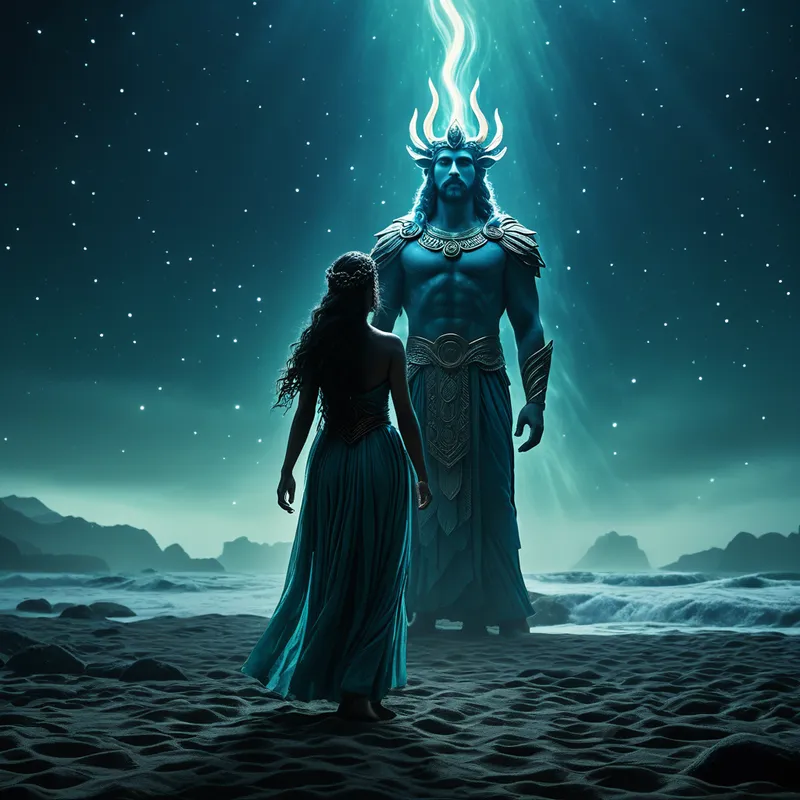
The story does not begin with [death](/myths/death “Myth from Tarot culture.”/), but with a final breath. In a high, wind-scoured place where [the earth](/myths/the-earth “Myth from Hindu culture.”/) meets [the sky](/myths/the-sky “Myth from Persian culture.”/), the body—now a lus, a mere physical vessel emptied of its animating principle—is prepared. It is washed with milk and barley wine, then folded into a fetal position, bound with white cloth. This is not a corpse to be hidden, but an offering to be presented.
Before dawn, the rogyapa, the body-breakers, carry the lus on their backs up the steep, silent paths to the durtrö, the chosen charnel ground, often a flat rock platform high upon a mountain. The air is thin, cold, and scented with juniper smoke from smoldering incense, a fragrant summons to the unseen guests. The lama chants, the rhythms of the [Bardo](/myths/bardo “Myth from Buddhist culture.”/) Thödol—the Great Liberation upon Hearing in the Intermediate State—guiding the consciousness of the departed through the bewildering landscapes between lives.
As the first rays of the sun gild the highest peaks, the sky darkens with another kind of dawn. From the vast blue, they descend: the dakini, the sky-dancers. In the form of Himalayan griffon vultures and lammergeiers, they circle, then land with a rustle of immense wings, awaiting their due with a terrifying, sacred patience. The rogyapa unwraps the body and begins his solemn work with knife and axe, a precise and unflinching act of dismantlement. Flesh is stripped from bone; the bones themselves are crushed and mixed with tsampa (roasted barley flour). Nothing is wasted. Every fragment is returned.
Then, the feast. The birds descend in a flurry, consuming the offering with a swift, thorough grace. In moments, what was a human form is carried skyward, into the pure expanse. The soul is free, unburdened by the decaying anchor of the flesh. The body has performed its ultimate act of generosity, becoming sustenance for other beings in a final, profound gesture of jhator—“giving alms to the birds.” The story ends not in the ground, but in the soaring flight of the vulture, a liberated speck ascending into the heart of the sun.
Cultural Origins & Context
Sky burial, or jhator, finds its home in the stark, beautiful pragmatism and profound philosophy of the Tibetan Plateau. The ground here is often frozen solid or comprised of shallow, rocky soil, making earth burial difficult. Cremation requires scarce wood, a resource too precious for such use. [Water](/myths/water “Myth from Chinese culture.”/) burial is impractical in the cold, often-frozen rivers. Yet from these material constraints blossomed a spiritual masterpiece.
The practice is deeply rooted in Vajrayana Buddhism and its antecedent, the ancient Bön tradition, which held a deep reverence for the elemental forces of nature. Buddhism’s core teachings on [impermanence](/myths/impermanence “Myth from Buddhist culture.”/) (anicca) and compassion ([karuna](/myths/karuna “Myth from Hindu culture.”/)) provided the philosophical framework. The body, a temporary aggregation of elements, is seen as an empty shell after death—a “corpse” even more illusory than the living “self.” To cling to it is an act of ignorance. To lavish it with preservation is to commit a form of spiritual hoarding.
Thus, jhator became the ultimate expression of non-attachment and altruism. It is a direct, physical enactment of the Perfection of Giving (Dāna pāramitā), offering one’s very physical substance for the benefit of other sentient beings—the birds. It completes the cycle of life with radical honesty, returning the body to the ecosystem from which it came, with the vultures as sacred intermediaries. This ritual is not for everyone; it is traditionally reserved for commoners, while high lamas may be embalmed or cremated. Yet for most, it represents the most virtuous and ecologically seamless conclusion to a life.
Symbolic Architecture
The [architecture](/symbols/architecture “Symbol: Architecture in dreams often signifies structure, stability, and the framing of personal identity or life’s journey.”/) of the sky [burial](/symbols/burial “Symbol: A symbolic act of laying something to rest, often representing closure, transformation, or the release of past burdens.”/) is a [multi](/symbols/multi “Symbol: Multi signifies multiplicity and diversity, often representing various aspects of life or identity in dreams.”/)-layered [mandala](/symbols/mandala “Symbol: A sacred geometric circle representing wholeness, the cosmos, and the journey toward spiritual integration.”/) of meaning. The durtrö itself is a liminal [altar](/symbols/altar “Symbol: An altar represents a sacred space for rituals, offering, and connection to the divine, embodying spirituality and devotion.”/), a place neither fully of the [earth](/symbols/earth “Symbol: The symbol of Earth often represents grounding, stability, and the physical realm, embodying a connection to nature and the innate support it provides.”/) nor the sky, where the most fundamental [human](/symbols/human “Symbol: The symbol of a human represents individuality, complexity of emotions, and social relationships.”/) transition is mediated.
The vulture is the ultimate alchemical vessel. It transforms the corruptible—the flesh that fears decay—into the incorruptible: flight, freedom, and a return to the celestial realm. It is nature’s most efficient purifier, ensuring no energy is lost to morbid stagnation.
The [ritual](/symbols/ritual “Symbol: Rituals signify structured, meaningful actions carried out regularly, reflecting cultural beliefs and emotional needs.”/) dismantling by the rogyapa is a mirror of the [dissolution](/symbols/dissolution “Symbol: The process of breaking down, dispersing, or losing form, often representing transformation, release, or the end of a state of being.”/) of [the self](/myths/the-self “Myth from Jungian culture.”/) in the bardo. Just as [the ego](/myths/the-ego “Myth from Jungian culture.”/)-construct is broken down by the clear light of [reality](/symbols/reality “Symbol: Reality signifies the state of existence and perception, often reflecting one’s understanding of truth and life experiences.”/) after [death](/symbols/death “Symbol: Symbolizes transformation, endings, and new beginnings; often associated with fear of the unknown.”/), the physical form is deconstructed by the practitioner’s knife. The crushing of the bones symbolizes the final breaking of all [material](/symbols/material “Symbol: Material signifies the tangible aspects of life, often representing physical resources, desires, and the physical world’s influence on our existence.”/) attachment. The feeding is not a morbid consumption but a sacred [transaction](/symbols/transaction “Symbol: An exchange of value, energy, or information between parties, representing balance, reciprocity, and the flow of resources in life.”/), a transfer of [prana](/symbols/prana “Symbol: In Hindu and yogic traditions, prana is the universal life force or vital energy that animates all living beings and permeates the cosmos.”/) or [life](/symbols/life “Symbol: The symbol of ‘Life’ represents a journey of growth, interconnectedness, and existential meaning, encompassing both the joys and challenges that define human experience.”/)-force in its most direct form.
The entire rite is a profound teaching on the emptiness (śūnyatā) of form. What we cherish as “my body” is revealed to be a fleeting composition of parts, offered back to the world from which it was borrowed. The horror it might evoke in an outsider is precisely the point: it confronts the illusion of solid, permanent selfhood with terrifying, liberating clarity.
The Dreamer’s Resonance
To the Western [psyche](/myths/psyche “Myth from Greek culture.”/), accustomed to sanitized death and the sealed casket, the sky burial can initially shock. It touches a raw nerve of primal fear—the fear of annihilation, of being devoured, of becoming nothing. Psychologically, it bypasses all our cultural defenses and lands directly in [the shadow](/myths/the-shadow “Myth from Jungian culture.”/), in the part of us that has not made peace with our animal nature and mortal fate.
Yet, for the dreamer wrestling with the meaning of existence, the ritual offers a potent, if challenging, resonance. It presents death not as a failure or a defeat, but as the final, necessary act of integration. The ego, which spends a lifetime building walls of identity, must ultimately be surrendered. The sky burial is the literal enactment of that surrender. It speaks to the deep Self’s understanding that we are not in nature, we are nature—and our return must be as participatory and generous as our life.
It transforms grief from a state of powerless loss into a witness of sacred transformation. The loved one is not “gone”; they have become [the wind](/myths/the-wind “Myth from Various culture.”/) in the vulture’s wings, the light on the mountain peak. The ritual provides a container so stark and honest that it can hold the most profound despair and, through its very austerity, alchemize it into a form of awe.

Alchemical Translation
The alchemical process of the sky burial is one of [solve et coagula](/myths/solve-et-coagula “Myth from Alchemical culture.”/)—dissolve and reconstitute—applied to the human being. The solve is total: the dissolution of the physical form, the social [persona](/myths/persona “Myth from Greek culture.”/), and the ego’s final claim to a separate existence. The elements (earth, water, fire, air) are returned. The flesh is given to the birds (air), the blood soaks into the earth, the bones are crushed to powder, and the juniper smoke carries the essence skyward.
This is the alchemy of compassion. The base metal of the corpse—a source of pollution and sorrow in many traditions—is transmuted into the gold of charitable merit and ecological unity. The vulture, often a symbol of death and decay in other symbologies, becomes the philosopher’s bird, the agent of spiritual sublimation.
The ultimate product of this alchemy is not a physical substance but a state of consciousness: liberation. The soul, or consciousness-stream, is lightened, having jettisoned its heavy, material anchor. The practice is an external ritual that mirrors the internal journey of the dying, guiding them to recognize the clear light of reality without clinging to the illusory forms of their former life. The mountain platform becomes the alchemical vessel, the wide sky [the athanor](/myths/the-athanor “Myth from Alchemy culture.”/) (furnace), and the sun the source of the transforming fire.
Associated Symbols
Explore related symbols from the CaleaDream lexicon:
- Bird — The divine intermediary, often a [psychopomp](/myths/psychopomp “Myth from Greek culture.”/), that carries the soul or its essence between realms, symbolizing transcendence, perspective, and spiritual messenger-ship.
- Sky — The realm of the infinite, the divine, and consciousness; representing freedom, vastness, ascension, and the ultimate destination of the liberated spirit.
- Mountain — The sacred [axis mundi](/myths/axis-mundi “Myth from Various culture.”/) connecting earth and heaven; a place of ordeal, revelation, and proximity to the divine, where profound transformations are enacted.
- Bone — The last remnant, the essential structure stripped of all softness; symbolizing truth, endurance, the ancestral core, and the final, indestructible essence of being.
- Sacrifice — The willing offering of something of profound value—here, the very body—for a higher spiritual purpose or the benefit of others, enacting a sacred exchange.
- Cycle — The endless, turning wheel of life, death, and return; nature’s fundamental rhythm of dissolution and renewal, of which the burial is one complete revolution.
- Compassion — The boundless, altruistic heart that seeks to relieve the suffering of all beings, expressed here through the ultimate gift of one’s physical form.
- Impermanence — The fundamental truth that all compounded things, including the self and the body, are in a constant state of flux and will inevitably dissolve.
- Vulture — The sacred purifier and transmuter, an agent of nature that cleanses corruption and facilitates the soul’s ascent by consuming the mortal remains.
- [Altar](/myths/altar “Myth from Christian culture.”/) — The consecrated space, here the rocky durtrö, where the sacred exchange between the human and the divine, the mortal and the eternal, is performed.
- Gift — The act of unconditional giving, the final and most profound generosity of offering one’s own substance back to [the web of life](/myths/the-web-of-life “Myth from Various culture.”/) without expectation of return.
- Liberation — The ultimate goal of release from the cycle of suffering and rebirth; the freedom achieved when consciousness is no longer bound to illusory, decaying form.