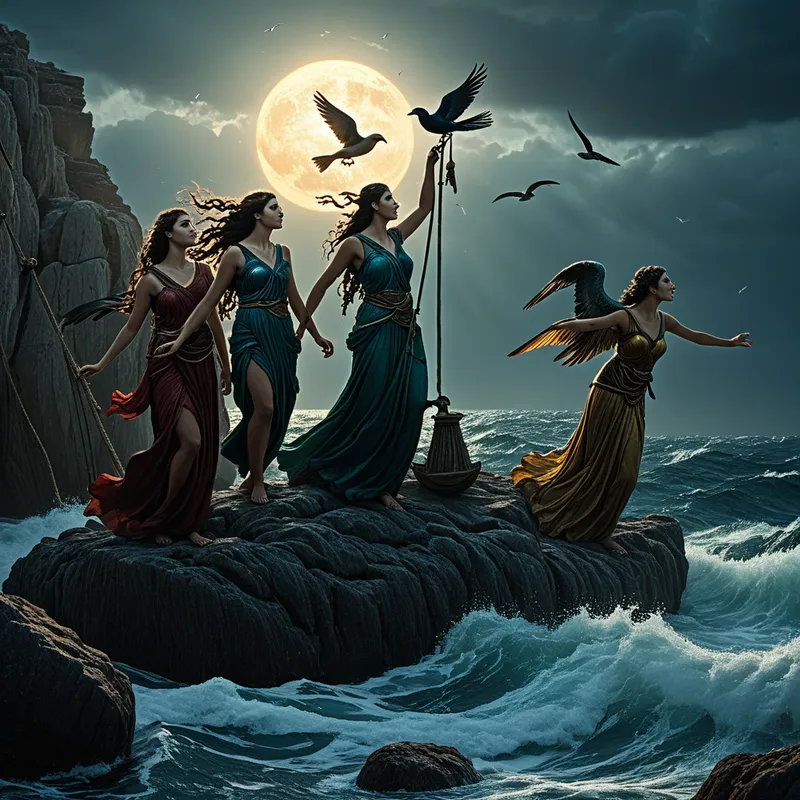
The Sirens' song luring sailor Myth Meaning & Symbolism
Enchanting voices promise ultimate knowledge and bliss, luring sailors onto jagged rocks. To pass is to confront the song within without being destroyed by it.
The Tale of The Sirens’ song luring sailor
Hear now, and listen well, for I sing of a passage no soul makes unscathed. Beyond the clashing rocks, past the whirlpool’s maw, lies a stretch of [water](/myths/water “Myth from Chinese culture.”/) so calm it is a mirror to a dead sky. And there, upon an isle of white bones and sun-bleached stone, they wait.
They are the [Sirens](/myths/sirens “Myth from Greek culture.”/). Do not picture monsters as your land-dwelling mind understands them. Their forms are of terrible beauty—the face of a goddess, the wings and talons of a raptor. They do not move. They perch, eternal sentinels, and they sing.
Their song is the sound [the world](/myths/the-world “Myth from Tarot culture.”/) made at its birth. It is the whisper of every secret you have ever longed to know: your true name, the love you lost, the shape of your death, the answer to why. It promises not pleasure, but completion. It is a hook cast directly into the human spirit, and it pulls with the gravity of a dying star.
Into this mirrored sea comes a ship, its oars dipping in silent rhythm. Upon its deck stands [Odysseus](/myths/odysseus “Myth from Greek culture.”/), his eyes already haunted by the ghosts of war and wandering. He has been warned. The sorceress Circe herself, in a moment of strange mercy, told him of the path: “Stop the ears of your men with beeswax, lest they hear and steer you to destruction. But if you wish to hear the song itself, you must have yourself bound to the mast. Command your men that no matter how you beg, how you threaten, how you weep to be released, they must only bind you tighter.”
And so it is done. The crew, their ears sealed, become deaf and dumb automata, their world reduced to the pull of the oar and the sweat on their brows. Odysseus is lashed to the sturdy pine, the ropes cutting into his flesh. The first notes drift across the water.
It is not music. It is memory and future fused. It is his wife [Penelope](/myths/penelope “Myth from Greek culture.”/) calling him home, it is the wisdom of the dead prophet [Tiresias](/myths/tiresias “Myth from Greek culture.”/), it is the very song of the stars. [The Sirens](/myths/the-sirens “Myth from Greek culture.”/) sing for him alone. “Come,” they croon, their voices honey and steel. “Come to us, glorious Odysseus, pride of the Achaeans. We know all things that come to pass upon the fertile earth. Stay, and we will tell you everything.”
Agony transfigures him. The song is a fire in his veins. He strains against the ropes, his eyes wild, his shouts becoming raw, animal pleas. He orders his men, he begs them, he curses them to [Hades](/myths/hades “Myth from Greek culture.”/). He signals with his brows, his only free movement, screaming soundlessly for release. His loyal crew, seeing their king in torment, row harder, their faces turned away. One, moved by pity, moves to loosen a knot, but another stops his hand. They obey the older command, the command from before the song. They bind him tighter.
The ship passes. The song fades, first to a whisper, then to a memory, then to a scar upon the soul. The Sirens, it is said, fell silent then, and cast themselves into [the sea](/myths/the-sea “Myth from Greek culture.”/), for their purpose was fulfilled or forever thwarted. The ship sails on, into the next terror, carrying a man who has heard the sound of his own soul’s deepest longing and lived.

Cultural Origins & Context
This core narrative is anchored in the oral epic tradition of ancient Greece, most famously preserved in Book XII of [Homer](/myths/homer “Myth from Greek culture.”/)’s Odyssey, composed around the 8th century BCE. The Sirens belong to a class of hybrid, liminal beings—like [Harpies](/myths/harpies “Myth from Greek culture.”/) or Gorgons—that populated the mental map of the ancient Greek world, representing the specific dangers of the unknown sea.
The myth functioned on multiple levels. For a seafaring culture, it was a dire navigational warning about very real perils: hidden rocks, deceptive currents, and the madness of isolation. Societally, it was a parable about the perils of akrasia—weakness of will, acting against one’s better judgment. The story was told by bards (like Homer himself) who were, in a sense, practitioners of enchanting speech, making it a profound meta-commentary on the power and danger of the very art of storytelling. To be captivated could mean enlightenment or annihilation.
Symbolic Architecture
The myth presents a perfect symbolic equation for the [human](/symbols/human “Symbol: The symbol of a human represents individuality, complexity of emotions, and social relationships.”/) confrontation with irresistible, [soul](/symbols/soul “Symbol: The soul represents the essence of a person, encompassing their spirit, identity, and connection to the universe.”/)-level temptation. The Sirens are not mere monsters; they are the embodiment of the unintegrated allure. Their song is the promise of total, effortless [knowledge](/symbols/knowledge “Symbol: Knowledge symbolizes learning, understanding, and wisdom, embodying the acquisition of information and enlightenment.”/)—omniscience without the labor of the [journey](/symbols/journey “Symbol: A journey in dreams typically signifies adventure, growth, or a significant life transition.”/), [bliss](/symbols/bliss “Symbol: A state of profound happiness and spiritual contentment, often representing fulfillment of desires or alignment with one’s true self.”/) without the burden of [consciousness](/symbols/consciousness “Symbol: Consciousness represents the state of awareness and perception, encompassing thoughts, feelings, and experiences.”/).
The Sirens do not offer death; they offer the end of seeking. The rocks are merely the physical consequence of accepting that offer.
Odysseus represents the conscious ego on its arduous journey (nostos). The wax in the [crew](/symbols/crew “Symbol: A crew often symbolizes collaboration, teamwork, and collective purpose, suggesting a need for shared goals and support from others in one’s journey.”/)’s ears symbolizes the necessary, sometimes brutal, suppression of instinct and curiosity for collective survival—the “autopilot” that gets us through daily tasks. Being bound to the mast is the supreme act of pre-commitment, a recognition by [the ego](/myths/the-ego “Myth from Jungian culture.”/) that it cannot trust itself in the face of certain experiences. The ropes are the constraints of wisdom, [oath](/symbols/oath “Symbol: A solemn promise or vow, often invoking a higher power or sacred principle, binding individuals to specific actions or loyalties.”/), and forethought that paradoxically preserve [the self](/myths/the-self “Myth from Jungian culture.”/). The struggle is not against the Sirens, but against the part of himself that would willingly embrace [dissolution](/symbols/dissolution “Symbol: The process of breaking down, dispersing, or losing form, often representing transformation, release, or the end of a state of being.”/) for the sake of the song.
The Dreamer’s Resonance
When this myth pattern erupts in the modern dreamscape, the dreamer is at a psychic crossroads where a deep, alluring promise threatens to derail their life’s direction. The “song” may manifest as the seductive whisper to abandon a difficult career for a fantasy, to dive into an obsessive but destructive relationship, or to embrace an ideology that promises total answers.
Somatically, the dream may involve feeling physically pulled, magnetized, or paralyzed by a beautiful sound or voice in an otherwise mundane setting (an office, a home). The “rocks” may appear as looming deadlines, the collapse of a relationship, or a sudden failure. The dreamer might be both Odysseus and his crew—part of them is lashed in place, screaming to give in, while another part is mechanically, blindly trying to move forward, unable to hear the conflict. This dream signals a critical moment of choice through pre-commitment: the need to bind oneself to one’s deeper values before the siren call of a regressive fantasy becomes irresistible.

Alchemical Translation
The alchemical process modeled here is the sublimation of the most potent and dangerous contents of the unconscious into fuel for the continuing journey. The Sirens represent an aspect of the shadow and the anima/animus—not as a dark monster, but as a captivating, fatal ideal. To integrate this force is not to crash upon it, nor to sail past in ignorant deafness.
The alchemical goal is not to hear the song and survive, but to hear the song and, by containing its agony, transmute its promise into wisdom.
Odysseus’s ordeal is a brutal but precise individuation ritual. He chooses to experience the full, unmediated power of the lure (the [nigredo](/myths/nigredo “Myth from Alchemical culture.”/), the blackening, the despair). He is bound (the albedo, the whitening, the submission to a higher structure). He is carried through by the silent, faithful servants of his own [psyche](/myths/psyche “Myth from Greek culture.”/) (the disciplined functions of consciousness). The result is not that he gains the Sirens’ knowledge, but that he gains knowledge of the Sirens—and thus of a part of himself. He leaves the encounter scarred and bereft, for the ideal must be mourned, but he is immeasurably more real. The song’s energy, once a external force of destruction, becomes an internal compass point, a memory of what he was willing to suffer for his journey home. He has not conquered temptation; he has incorporated its meaning, and thus can sail on, whole.
Associated Symbols
Explore related symbols from the CaleaDream lexicon: