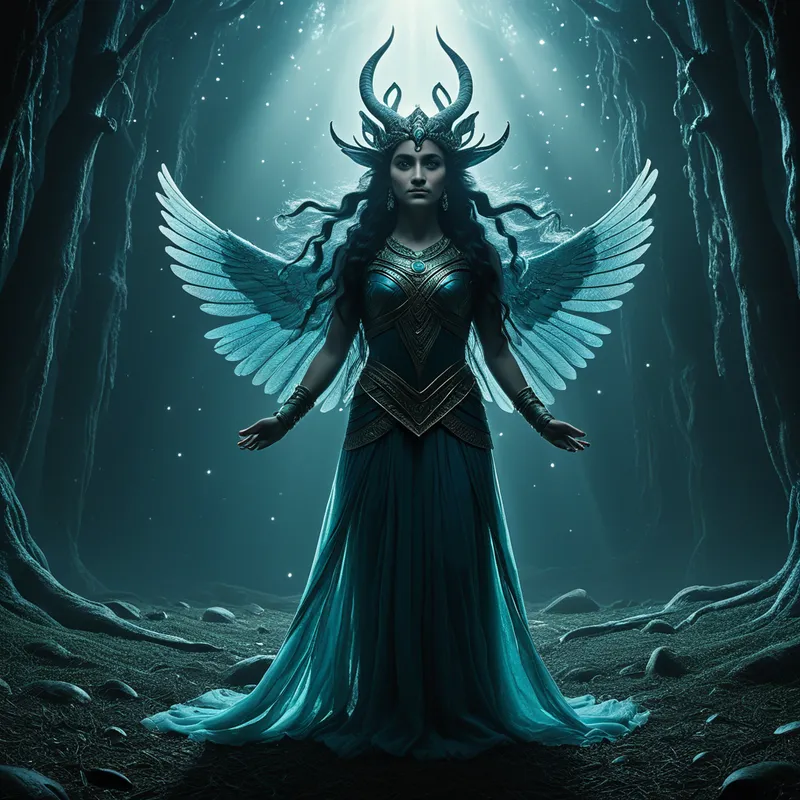
The Simurgh in Sufi Tradition
A mythical bird representing divine unity and spiritual enlightenment in Sufi mysticism, guiding seekers toward ultimate truth.
The Tale of The Simurgh in Sufi Tradition
The story begins not with the bird, but with the longing. From every corner of [the world](/myths/the-world “Myth from Tarot culture.”/), thirty birds, each a seeker of truth, weary of the world’s illusions, heard a whisper of a being called the [Simurgh](/myths/simurgh “Myth from Persian culture.”/). This was no ordinary creature. It was said to dwell on the peak of Mount Qaf, the cosmic mountain at the edge of creation, and to possess a feather of such radiant beauty that its mere sight could illuminate the soul. Compelled by a nameless yearning, they gathered and elected to undertake the perilous journey to find this king of birds.
Their quest was the path itself—a harrowing suluk. They traversed seven valleys, each a stage of annihilation. The Valley of the Quest, where all worldly attachments were stripped away. The Valley of Love, where reason burned in the fire of divine passion. The Valley of Knowledge, where what they knew was revealed as mere reflection. The Valley of Detachment, where desire and fear alike fell to dust. The Valley of Unity, where the multiplicity of creation shimmered as a single tapestry. The Valley of Astonishment, where the mind drowned in awe. And finally, the Valley of Poverty and Absolute Nothingness, where the very self was extinguished, reduced to a state of pure, receptive void.
Battered, humbled, and utterly transformed, the thirty survivors at last reached [the summit](/myths/the-summit “Myth from Taoist culture.”/) of Qaf. Before the throne of the Simurgh, they stood not as proud seekers, but as empty vessels. A chamberlain presented them with a sacred scroll. With trembling hearts, they read it, and in its words, they found not a description of another, but a revelation of themselves. The name “Simurgh” in Persian, the scroll revealed, breaks into “si” (thirty) and “murgh” (bird). They were the Simurgh. The king they sought, the divine reality, the ultimate truth, was not a distant monarch but the collective essence of their own purified souls, reflected in [the mirror](/myths/the-mirror “Myth from Various culture.”/) of unity. The seeker, the search, and the sought became one. The Simurgh was both the goal and the substance of the journey; the thirty birds, having annihilated their individual egos, became the living manifestation of the One.
Cultural Origins & Context
The Simurgh is an ancient Persian mythical bird, a benevolent, wise, and immensely powerful creature often depicted as a composite being, part peacock, part dog, and part lion, symbolizing its dominion over earth and sky. It entered the Sufi mystical imagination as a perfect vessel for expressing ineffable spiritual truths. The most profound and definitive treatment of the symbol is found in the 12th-[century](/myths/century “Myth from Biblical culture.”/) masterpiece [The Conference of the Birds](/myths/the-conference-of-the-birds “Myth from Persian culture.”/) (Mantiq al-Tayr) by the Persian Sufi poet Farid ud-Din Attar. This epic narrative poem is not merely a story but a detailed map of the Sufi path, using the allegory of the birds’ journey to describe the soul’s progression toward fana (annihilation in God) and baqa (subsistence in God).
Attar’s work crystallized the Simurgh as the central symbol of divine unity (tawhid) in Sufi psychology. The tradition thrives on paradox and the transcendence of duality, and the Simurgh embodies this perfectly. It exists as a majestic, external symbol of God or the Ultimate Reality, yet the climax reveals it as the innermost, collective truth of the purified self. This reflects the core Sufi doctrine that God is both transcendent (tanzih)—utterly beyond creation—and immanent (tashbih)—present within the heart of the seeker. The Simurgh sits on Mount Qaf, the axis of the worlds, representing this paradoxical point where the infinite touches the finite, where the divine meets the human soul that has made itself nothing in order to become everything.
Symbolic Architecture
The [architecture](/symbols/architecture “Symbol: Architecture in dreams often signifies structure, stability, and the framing of personal identity or life’s journey.”/) of this myth is a precise spiritual technology. The thirty birds represent the fragmented [human](/symbols/human “Symbol: The symbol of a human represents individuality, complexity of emotions, and social relationships.”/) [soul](/symbols/soul “Symbol: The soul represents the essence of a person, encompassing their spirit, identity, and connection to the universe.”/), scattered in its desires and illusions. The [journey](/symbols/journey “Symbol: A journey in dreams typically signifies adventure, growth, or a significant life transition.”/)’s necessity underscores that divine [truth](/symbols/truth “Symbol: Truth represents authenticity, honesty, and the quest for knowledge beyond mere appearances.”/) cannot be intellectually grasped; it must be lived, suffered, and died into. The seven valleys are the classic stages of the Sufi [path](/symbols/path “Symbol: The ‘path’ symbolizes a journey, choices, and the direction one’s life is taking, often representing individual growth and exploration.”/), each dismantling a [layer](/symbols/layer “Symbol: Layers often symbolize complexity, depth, and protection in dreams, representing the various aspects of the self or situations.”/) of [the ego](/myths/the-ego “Myth from Jungian culture.”/)’s [fortress](/symbols/fortress “Symbol: A fortress symbolizes security and protection, representing both physical and psychological safety from external threats.”/).
The supreme symbolic [mechanism](/symbols/mechanism “Symbol: Represents the body’s internal systems, emotional regulation, or psychological processes working together like a machine.”/) is the pun, the play on “si-murgh.” This is not a clever literary trick but a profound [metaphysical key](/symbols/metaphysical-key “Symbol: A symbol representing enlightenment and the unlocking of profound understanding or truths about existence.”/). It demonstrates that the recognition of the Divine is, in fact, a recognition of [the Self](/myths/the-self “Myth from Jungian culture.”/) in its deepest, most universal [aspect](/symbols/aspect “Symbol: A distinct feature, quality, or perspective of something, often representing a partial view of a larger whole.”/)—[the divine spark](/myths/the-divine-spark “Myth from Gnostic culture.”/) or the fitrah. The mirror is implied throughout; at the journey’s end, the birds do not see a feathered [beast](/symbols/beast “Symbol: The beast often represents primal instincts, fears, and the shadow self in dreams. It symbolizes the untamed aspects of one’s personality that may need acknowledgment or integration.”/), but their own true collective [image](/symbols/image “Symbol: An image represents perception, memories, and the visual narratives we create in our minds.”/). The Simurgh is thus the ultimate mirror of unity.
The journey to the Simurgh is a journey into the soul’s own depths, where the greatest discovery is that the seeker’s essence and the Sought are not two. The path is a process of burning away the illusion of separation until only the unified reality remains.
Mount Qaf is not a geographic location but the inner summit of consciousness, the point where individual awareness dissolves into the cosmic. To reach it is to have traversed the entire landscape of the self.
The Dreamer’s Resonance
For the modern dreamer or [psyche](/myths/psyche “Myth from Greek culture.”/), the myth of the Simurgh resonates as a powerful archetypal narrative of individuation and wholeness. Psychologically, the thirty birds can be seen as the complex, often conflicting aspects of the personality—the various personas, shadows, and potentials. The ego, identifying with only one or a few of these “birds,” feels incomplete and yearns for a unifying center, the Self (in Jungian terms), which is symbolized by the majestic, all-encompassing Simurgh.
The arduous journey through the valleys mirrors the necessary, often painful, process of psychotherapy or deep self-work: confronting [the shadow](/myths/the-shadow “Myth from Jungian culture.”/) (Valley of Detachment), integrating [anima/animus](/myths/animaanimus “Myth from Jungian culture.”/) (Valley of Love), and moving beyond the tyranny of the rational mind (Valley of Astonishment). The climax—the realization “I am That”—parallels the moment of profound self-realization where one moves from identifying with the ego’s limited story to experiencing the deeper, transpersonal ground of being. The Simurgh myth validates that the quest for meaning and unity is not about acquiring something new, but about removing the veils to discover what has always and already been true at the core of one’s existence. It transforms spiritual seeking from a pursuit of an external savior into a courageous act of inner homecoming.
Alchemical Translation
The alchemical process is vividly mapped onto the birds’ quest. The initial state of the thirty birds is the [prima materia](/myths/prima-materia “Myth from Alchemical culture.”/): base, confused, and leaden with worldly identity. The journey itself is [the opus](/myths/the-opus “Myth from Alchemical culture.”/), [the great work](/myths/the-great-work “Myth from Alchemical culture.”/). Each valley represents a stage of dissolution ([solutio](/myths/solutio “Myth from Alchemical culture.”/)), burning ([calcinatio](/myths/calcinatio “Myth from Alchemical culture.”/)), and purification. The ego is systematically broken down, its elements separated and tortured.
The Valley of Poverty and Nothingness is the crucial stage of [nigredo](/myths/nigredo “Myth from Alchemical culture.”/), the blackening, the utter putrefaction and [death](/myths/death “Myth from Tarot culture.”/) of the old self. It is [the dark night of the soul](/myths/the-dark-night-of-the-soul “Myth from Christian Mysticism culture.”/) where all light seems extinguished. From this absolute zero, the new consciousness is born. The arrival at the Simurgh’s court and the reading of the scroll is the [albedo](/myths/albedo “Myth from Alchemical culture.”/), the whitening, the revelation. But the final realization is the [rubedo](/myths/rubedo “Myth from Alchemical culture.”/), the reddening, the culmination: the production of the Philosopher’s Stone. Here, the Stone is not a physical object but the transformed self. The thirty birds, having died as individuals, are reborn as the golden, unified Simurgh. They achieve the unio mystica, the alchemical wedding where the microcosm (the individual soul) realizes its identity with the macrocosm (the divine). The feather of the Simurgh, which initiated the quest, symbolizes the tantalizing glimpse of this wholeness that calls the soul to begin its transformative work.
Alchemy’s solve et coagula (dissolve and coagulate) is the heart of the myth. The individual ego must be utterly dissolved in the fires of longing and ordeal so that it can be reconstituted, or coagulated, at a higher level of unity—not as thirty separate entities, but as the One Thing, the Simurgh.
Associated Symbols
Explore related symbols from the CaleaDream lexicon:
- Bird — The universal symbol of the soul, spirit, and transcendence, representing the aspiration to rise above earthly limitations toward higher truth.
- Mountain — [The axis mundi](/myths/the-axis-mundi “Myth from Chinese culture.”/), the sacred center and meeting point of heaven and earth; the arduous ascent representing the spiritual journey toward enlightenment.
- Mirror — The instrument of self-reflection and revelation, where the seeker ultimately beholds not an other, but the true, unified image of their own divine essence.
- Journey — The fundamental process of transformation, involving trials, stages of growth, and a passage from a state of seeking to a state of being.
- Light — The divine illumination, wisdom, and consciousness that guides the seeker and is ultimately recognized as the innate radiance of the realized self.
- Transformation — The alchemical process of radical change at the core of one’s being, where old forms of identity are annihilated to allow a new, unified consciousness to emerge.
- Unity — The state of oneness, the dissolution of all duality and separation, which is both the ultimate goal and the fundamental reality revealed by the myth.
- Fire — The purifying and transformative agent that burns away the dross of the ego, illusion, and attachment in [the crucible](/myths/the-crucible “Myth from Alchemical culture.”/) of spiritual experience.
- Shadow — The unconscious aspects of the self that must be confronted and integrated on the path to wholeness, represented by the trials and deaths in the valleys.
- Circle — The symbol of completeness, eternity, and the divine; the journey ends at its beginning, as the seeker finds the sought was within all along, completing the sacred circuit of return.