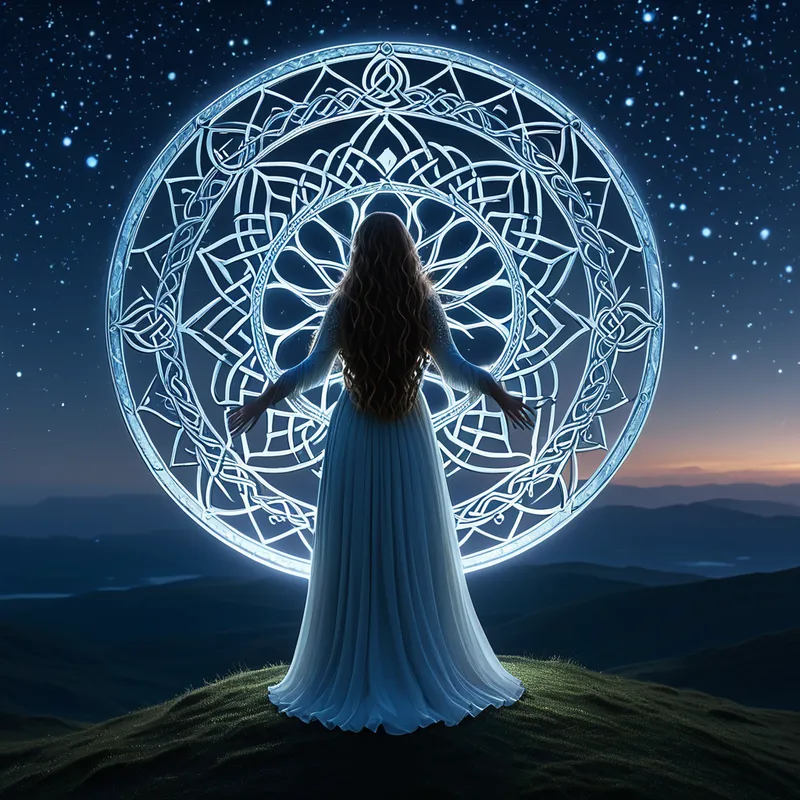
The Silver Wheel Myth Meaning & Symbolism
A goddess weaves the cosmos into a silver wheel, her sacrifice binding the heavens to the earth in an eternal, turning cycle of light and darkness.
The Tale of The Silver Wheel
Listen. Before the memory of the oak, before the first whisper in [the willow](/myths/the-willow “Myth from Celtic culture.”/), there was a time of unformed light. [The sky](/myths/the-sky “Myth from Persian culture.”/) was a featureless bowl of grey; [the earth](/myths/the-earth “Myth from Hindu culture.”/), a sleeping giant of mud and stone. Stars were but seeds, scattered and un-sprouted in the dark soil of the heavens. There was no rhythm, no turning, only a vast and breathless waiting.
Then came The Sovereignty. She who wore the land as a cloak and the sky as a veil. She walked the high, lonely places where [the wind](/myths/the-wind “Myth from Various culture.”/) has no name, and in her hands, she carried a spindle of pure potential. She saw the chaos of the unmoving heavens and the deep slumber of the earth, and a great compassion, sharp as winter frost, pierced her.
From the highest peak, where eagles fear to nest, she gathered the first light—not the harsh light of day, but the soft, promising gleam that comes before dawn. She plucked the silver threads of moonlight from the silent ponds. She sang to the genius loci of the deep caves and drew forth threads of absolute darkness, the kind that holds secrets and promises rest.
And she began to weave.
Her fingers flew, not with haste, but with the terrible, deliberate patience of creation itself. Each thread was a destiny, a season, a breath. She wove the thread of the summer sun and crossed it with the thread of the winter gale. She wove the thread of birth tight against the thread of decay. The spindle whirred, a humming that became the first sound of time. As she worked, her own vitality, the untamed wildness of her spirit, flowed down her arms and into the growing form. She was not merely crafting an object; she was binding a part of her very essence into the pattern.
The conflict was not with a monster or a rival god, but with the nature of existence itself. To create order was to impose limit. To give the light a path was to condemn it to follow that path, to set and to rise, to be forever chased by the dark threads she had woven alongside it. Her heart, a wild and free [thing](/myths/thing “Myth from Norse culture.”/), struggled against the cage of cosmic law she was building. Yet her compassion for the formless world held firm.
Finally, it was done. In her hands rested a wheel, vast and intricate, forged of silver and shadow. It was the Cathach. With a cry that was both [triumph](/myths/triumph “Myth from Roman culture.”/) and profound loss, she cast it into the sky. It caught on the axis of [the world](/myths/the-world “Myth from Tarot culture.”/), and with a groan that shook the roots of the mountains, it began to turn.
Light followed dark. Spring followed winter. Life followed death in an endless, beautiful, terrible dance. The stars found their places along its gleaming rim and began their slow procession. The wheel turned, and the world knew time. The goddess watched, her form now slightly dimmed, her wildness tempered. She had given a part of her boundless self to become the axle upon which all bounded things now turned. She became both the weaver and the wound, the creator and the consequence, forever present in the turning of the silver wheel she had sacrificed her former self to spin.
Cultural Origins & Context
The motif of the Cathach or the turning, celestial wheel is not a single, standardized myth from a unified “Celtic” canon, but a profound archetypal fragment that echoes through the insular Celtic traditions, particularly the Welsh and Irish. These cultures perceived the cosmos not as a static hierarchy but as a dynamic, interwoven tapestry of relationships. The wheel symbol is pervasive, appearing on coins, in stone carvings, and most importantly, in the rich oral tradition of the fili and bards.
These stories were not mere entertainment; they were the software of the culture’s consciousness, encoding laws of kinship, seasonal rites, and cosmological principles. A tale like that of the Silver Wheel would likely have been recited during the liminal times—at [Samhain](/myths/samhain “Myth from Celtic culture.”/), when [the veil](/myths/the-veil “Myth from Various culture.”/) thinned, or at the winter solstice, when the sun’s wheel seemed to stall. Its function was to reaffirm the sacred order (fír) of the world, to explain the bittersweet necessity of cycles, and to connect the sovereignty of the land (the goddess) directly to the turning of the heavens. It taught that order itself is a sacred, living creation, born from a primordial act of compassionate sacrifice.
Symbolic Architecture
At its core, the Silver Wheel is the archetypal [symbol](/symbols/symbol “Symbol: A symbol can represent an idea, concept, or belief, serving as a powerful tool for communication and understanding.”/) of the Great Round. It represents the inescapable and beautiful [architecture](/symbols/architecture “Symbol: Architecture in dreams often signifies structure, stability, and the framing of personal identity or life’s journey.”/) of time, [fate](/symbols/fate “Symbol: Fate represents the belief in predetermined outcomes, suggesting that some aspects of life are beyond human control.”/), and natural law. The [goddess](/symbols/goddess “Symbol: The goddess symbolizes feminine power, divinity, and the nurturing aspects of life, embodying creation and wisdom.”/) who weaves it is the Demiurge figure, but one deeply connected to her creation, not aloof from it. Her sacrifice is the key.
To create a world with form is to willingly enter the limitations of that form. The creator binds themselves in the act of binding the cosmos.
Psychologically, the wheel symbolizes the necessary structures of the [psyche](/myths/psyche “Myth from Greek culture.”/)—[the ego](/myths/the-ego “Myth from Jungian culture.”/), the [persona](/symbols/persona “Symbol: The social mask or outward identity one presents to the world, often concealing the true self.”/), the rhythms of conscious [life](/symbols/life “Symbol: The symbol of ‘Life’ represents a journey of growth, interconnectedness, and existential meaning, encompassing both the joys and challenges that define human experience.”/). The unformed light and dark represent the chaotic, potential-rich state of the unconscious. The goddess’s act is the [psyche](/myths/psyche “Myth from Greek culture.”/)’s own [journey](/symbols/journey “Symbol: A journey in dreams typically signifies adventure, growth, or a significant life transition.”/) toward [consciousness](/symbols/consciousness “Symbol: Consciousness represents the state of awareness and perception, encompassing thoughts, feelings, and experiences.”/): it must take raw, boundless inner experience (instincts, dreams, passions) and spin them into the coherent, turning wheel of a lived [life](/symbols/life “Symbol: The symbol of ‘Life’ represents a journey of growth, interconnectedness, and existential meaning, encompassing both the joys and challenges that define human experience.”/). This process inherently involves a sacrifice—the “wildness” of undifferentiated being is partly surrendered to create a functioning [identity](/symbols/identity “Symbol: Identity represents the sense of self, encompassing personal beliefs, cultural background, and social roles.”/) that can navigate time, [relationship](/symbols/relationship “Symbol: A representation of connections we have with others in our lives, often reflecting our emotional state.”/), and [mortality](/symbols/mortality “Symbol: The awareness of life’s finitude, often representing transitions, impermanence, or existential reflection in dreams.”/). The wheel is both the [achievement](/symbols/achievement “Symbol: Symbolizes success, mastery, or reaching a goal, often reflecting personal validation, social recognition, or overcoming challenges.”/) of consciousness and the cage it sometimes feels like.
The Dreamer’s Resonance
When this myth stirs in the modern dreamer, it often manifests not as a literal wheel, but as a profound sense of cosmic patterning or inescapable cycle. One might dream of being on a vast, turning platform, watching seasons flash by in moments. Or of trying to stop or accelerate a great, grinding machine that is the dreamer’s own life. The somatic experience is often one of simultaneous awe and anxiety—a feeling of being a small part of a vast, beautiful, but impersonal mechanism.
This dream signals a confrontation with the archetype of Ananke (Necessity). The psyche is processing its relationship to the structures that contain it: the routines of life, the biological clock, societal expectations, or the unfolding of a fateful life path. It can indicate a feeling of being “woven into” a situation from which there seems no escape. The healing lies not in breaking the wheel—an impossible task that leads to psychosis—but in the dreamer’s realization, mirrored from the myth, that they are both the subject on the wheel and the sacred presence that spun it. The dream invites a reconciliation with one’s own chosen and unchosen limitations.
Alchemical Translation
The alchemical journey mirrored here is the opus contra naturam—the work against nature, which is paradoxically the fulfillment of nature’s deepest goal: conscious self-realization. [The prima materia](/myths/the-prima-materia “Myth from Alchemical culture.”/) is the formless, “grey” state of psychic diffusion. The goddess’s compassionate resolve is the Mercurial fire that begins the work.
The weaving is the [separatio](/myths/separatio “Myth from Alchemical culture.”/) and coniunctio: separating light from dark, joy from sorrow, life from death, only to deliberately weave them back together into a higher unity (the wheel). The sacrifice of the goddess’s wildness is the crucial mortificatio or [nigredo](/myths/nigredo “Myth from Alchemical culture.”/). The old, unbounded mode of being must “die” or be limited to give birth to a new, structured consciousness.
Individuation is not an escape from the wheel; it is the conscious, willing ascent to its hub, where one participates in the turning without being torn apart by the rim.
For the modern individual, this translates to the arduous task of building a coherent self (the wheel) from the chaos of inner and outer experience. It requires sacrificing the infantile fantasy of limitless possibility to embrace the sacred limitation of a singular, authentic life path. The triumph is not in stopping time or avoiding pain, but in achieving the perspective of the goddess at the hub: seeing the necessity and beauty of the entire cycle—growth and decay, joy and grief—and recognizing one’s own spirit as the silent, enduring axis around which the personal cosmos turns. One becomes, through conscious engagement with one’s own fate, the sovereign weaver of one’s own silver wheel.
Associated Symbols
Explore related symbols from the CaleaDream lexicon: