The Signet Ring of Pharaoh Myth Meaning & Symbolism
A tale of Joseph's rise from prison to power, sealed by the ring of Pharaoh, symbolizing the ultimate transfer of authority and the integration of the self.
The Tale of The Signet Ring of Pharaoh
Hear now a tale woven from [the sands of time](/myths/the-sands-of-time “Myth from Greek culture.”/), a story not of gods on high, but of a man who walked the razor’s edge between [the pit](/myths/the-pit “Myth from Christian culture.”/) and the pinnacle. In the land of mud-brick and majesty, of Nile and scorching sun, a shadow fell upon the house of [Pharaoh](/myths/pharaoh “Myth from Egyptian culture.”/). A dread settled in the palace bones. The great river-god had sent two dreams, twin visions that coiled in the royal mind like vipers, drinking the peace from his sleep. Seven fat cows, sleek from [the river](/myths/the-river “Myth from Buddhist culture.”/) reed, were devoured whole by seven gaunt beasts, mere skin stretched over hunger. Seven plump ears of grain were consumed by seven thin, blasted stalks. The magicians and wise men of Egypt were summoned, their incantations like dust in [the wind](/myths/the-wind “Myth from Various culture.”/). They could name the images but not their soul; the meaning remained sealed, a terror locked in a box of ivory and gold.
The terror seeped through stone walls, down to the place of forgotten men. In the dungeon, where light was a currency more precious than gold, sat a Hebrew youth, [Joseph](/myths/joseph “Myth from Biblical culture.”/). His own dreams had once been his downfall, but here, in the darkness, they had become his lantern. He had listened to the dreams of prisoners and found their truth. Word traveled on the whispers of a desperate cupbearer, from the damp cell to the sun-drenched throne: “There is a man with the spirit of the gods in him.”
Brought from chains to court, Joseph stood before the incarnation of Pharaoh, not in finery but in truth. “It is not in me,” he said, his voice steady in the cavernous hall. “Elohim will give Pharaoh a answer of peace.” And he listened again, not as a subject, but as an interpreter of the divine script. The dreams were one, he declared. Seven years of overwhelming abundance were coming, a blessing from the very earth, to be utterly erased by seven years of a famine so fierce it would make the plenty a forgotten dream.
But the interpretation was only half the gift. The other half was counsel, forged in the fires of his own suffering. “Now therefore let Pharaoh select a man discerning and wise,” Joseph said, his gaze holding the weight of the coming years. “Let him appoint overseers… and let them gather all the food of those good years that are coming.” [The word](/myths/the-word “Myth from Biblical culture.”/) was not just prophecy; it was a blueprint for salvation.
A silence, thick and heavy, filled the chamber. Then Pharaoh spoke, not to his counselors, but to the air around this strange, luminous prisoner. “Can we find such a one as this, a man in whom is the Spirit of God?” The question answered itself. In that moment, [the world](/myths/the-world “Myth from Tarot culture.”/) turned. “You shall be over my house,” Pharaoh declared, his voice the sound of destiny shifting. “And all my people shall be ruled according to your word; only in regard to the throne will I be greater than you.”
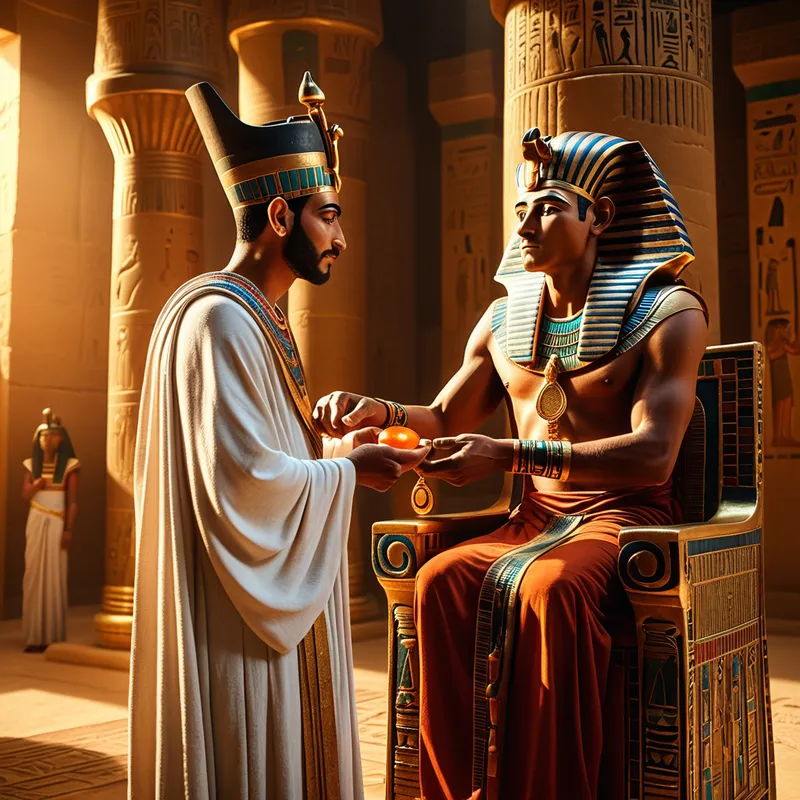
Then came the act that sealed the word in flesh and authority. Pharaoh removed his own signet ring from his hand. The circle of gold, carved with the sacred cartouche, the very essence of royal identity and immutable decree, was placed upon Joseph’s finger. The linen of finest weave was draped over his shoulders, the gold chain of office placed around his neck. He was given [the chariot](/myths/the-chariot “Myth from Tarot culture.”/) of the second-in-command, and they cried before him, “Abrek!” The prisoner was gone. In his place stood the ruler, the dreamer made [the architect](/myths/the-architect “Myth from Various culture.”/) of reality, his authority now inseparable from the seal of the king himself.
Cultural Origins & Context
This narrative is embedded in the Book of Genesis (Chapters 41-42), a foundational text of the Israelite tradition that looks back to ancestral origins. Its setting in the Egyptian court is not mere exotic backdrop; it represents the pinnacle of the known world’s power and sophistication to the early Hebrew storytellers. The tale functions as a key episode in the larger saga of Joseph, explaining how the descendants of Abraham came to be in Egypt, setting the stage for the later Exodus.
It was likely preserved and refined through oral tradition before being codified in written scripture. Its societal function was multifaceted: it was a wisdom tale about divine providence and prudent governance, a diaspora story about thriving in a foreign empire, and a theological assertion that the spirit of the Hebrew God could provide wisdom surpassing that of Egypt’s entire priestly and scholarly class. It reassured a people often under the thumb of empires that their God could elevate the humblest among them to the highest seats of power, turning the intended evil of brothers into a nation-saving good.
Symbolic Architecture
At its core, this myth is a profound [drama](/symbols/drama “Symbol: Drama signifies narratives, emotional expression, and the exploration of human experiences.”/) of authenticated [identity](/symbols/identity “Symbol: Identity represents the sense of self, encompassing personal beliefs, cultural background, and social roles.”/) and the transfer of legitimate power. The signet ring is the ultimate [symbol](/symbols/symbol “Symbol: A symbol can represent an idea, concept, or belief, serving as a powerful tool for communication and understanding.”/). It is not merely a [piece](/symbols/piece “Symbol: A ‘piece’ in dreams often symbolizes a fragment of the self or a situation that requires integration, reflection, or understanding.”/) of [jewelry](/symbols/jewelry “Symbol: Jewelry often symbolizes personal identity, social status, and emotional connections, reflecting how individuals curate their identities and express their values through adornments.”/); it is the external, tangible form of the [king](/symbols/king “Symbol: A symbol of ultimate authority, leadership, and societal order, often representing the dreamer’s inner power or external control figures.”/)‘s ka, his executive [spirit](/symbols/spirit “Symbol: Spirit symbolizes the essence of life, vitality, and the spiritual journey of the individual.”/). To possess it is to wield his voice, to make his will manifest. Its transfer is an act of total trust and total empowerment.
The ring does not grant power; it confirms an authority that has already been recognized within. The seal authenticates what the spirit has already authored.
Joseph represents the [archetype](/symbols/archetype “Symbol: A universal, primordial pattern or prototype in the collective unconscious that shapes human experience, behavior, and creative expression.”/) of the disfavored son who contains latent kingly wisdom. His [journey](/symbols/journey “Symbol: A journey in dreams typically signifies adventure, growth, or a significant life transition.”/) from the pit to the [prison](/symbols/prison “Symbol: Prison in dreams typically represents feelings of restriction, confinement, or a lack of freedom in one’s life or mind.”/) to the [palace](/symbols/palace “Symbol: A palace symbolizes grandeur, authority, and the pursuit of one’s ambitions or dreams, often embodying a desire for stability and wealth.”/) is a map of the [soul](/symbols/soul “Symbol: The soul represents the essence of a person, encompassing their spirit, identity, and connection to the universe.”/)‘s [ascent](/symbols/ascent “Symbol: Symbolizes upward movement, progress, spiritual elevation, or striving toward higher goals, often representing personal growth or transcendence.”/) from the unconscious (the pit, the [dungeon](/symbols/dungeon “Symbol: A dark, confined underground prison or labyrinth, often representing subconscious fears, psychological constraints, or hidden aspects of the self.”/)) into a position of conscious governance. His [ability](/symbols/ability “Symbol: In dreams, ‘ability’ often denotes a recognition of skills or potential that one possesses, whether acknowledged or suppressed.”/) to interpret dreams is the symbolic faculty of seeing the [pattern](/symbols/pattern “Symbol: A ‘Pattern’ in dreams often signifies the underlying structure of experiences and thoughts, representing both order and the repetitiveness of life’s situations.”/) within the [chaos](/symbols/chaos “Symbol: In Arts & Music, chaos represents raw creative potential, uncontrolled expression, and the breakdown of order to forge new artistic forms.”/)—a crucial skill for ruling both a [kingdom](/symbols/kingdom “Symbol: A kingdom symbolizes authority, belonging, and a sense of identity within a larger context or community.”/) and one’s own inner world. Pharaoh, in this psychic drama, represents the ruling principle of [consciousness](/symbols/consciousness “Symbol: Consciousness represents the state of awareness and perception, encompassing thoughts, feelings, and experiences.”/) that is initially troubled, fragmented by nightmares it cannot comprehend. It must encounter and integrate the wisdom from the “foreign” [depths](/symbols/depths “Symbol: Represents the subconscious, hidden emotions, or foundational aspects of the self, often linked to primal fears or profound truths.”/) (Joseph) to become whole and effective once more.
The Dreamer’s Resonance
When this myth stirs in the modern dreamer, it often signals a profound internal shift regarding personal authority and identity. To dream of receiving a ring, a seal, or a formal title from a powerful figure may not be about literal ambition. It is the [psyche](/myths/psyche “Myth from Greek culture.”/)‘s ritual enactment of an inner promotion.
The somatic feeling can be one of immense weight and solemnity—a gravity settling onto the dreamer’s shoulders and hands. Psychologically, the dreamer is going through the process of owning their own authority. This often follows a long “season in the prison” of self-doubt, limitation, or feeling that one’s unique gifts (one’s “dreams”) are a liability. The dream marks the moment the conscious ego ([the Pharaoh](/myths/the-pharaoh “Myth from Egyptian culture.”/)) finally recognizes the value of the insightful, pattern-recognizing unconscious (the Joseph within) and grants it executive power. The conflict is between a old, anxious mode of rule and a new, integrative one. The dream is the sealing ceremony.

Alchemical Translation
The alchemical process modeled here is the transmutation of the rejected stone into [the cornerstone](/myths/the-cornerstone “Myth from Biblical culture.”/). Joseph, sold for silver and left in a pit, is the [prima materia](/myths/prima-materia “Myth from Alchemical culture.”/)—the despised, raw material. The years of servitude and imprisonment are the stages of [nigredo](/myths/nigredo “Myth from Alchemical culture.”/) (blackening) and mortificatio (dissolution), where the old, naive identity is broken down.
The interpretation of Pharaoh’s dreams is the albedo (whitening), the illuminating insight that brings clarity from confusion. It is the moment the hidden order is revealed. But insight alone is not enough. The counsel—the practical plan for action—is crucial. This is the beginning of citrinitas (yellowing), the application of wisdom to the material world.
The final seal, the ring, is the rubedo (reddening)—the fixation of the transformation. The gold of the king’s authority is permanently fused with the substance of the once-rejected self.
For the modern individual striving for individuation, the myth instructs: Your deepest wounds and periods of confinement are where your most potent wisdom is incubated. The terrifying “dreams” or chaotic patterns that disrupt your conscious life are not enemies to be dismissed, but cryptic messages from [the Self](/myths/the-self “Myth from Jungian culture.”/), calling for interpretation. The process of healing and wholeness requires you to first interpret the pattern (understand your complexes and recurring struggles), then devise a conscious strategy to manage the coming “years of famine and plenty” within your own soul. The ultimate goal is not to escape authority, but to have your inner Pharaoh—your ruling consciousness—bestow its own signet ring upon your inner Joseph, the once-despised but deeply insightful part of you. This is the act of self-authorization, where you become the legitimate ruler of your own inner kingdom, your actions sealed with the authentic stamp of your integrated being.
Associated Symbols
Explore related symbols from the CaleaDream lexicon: