The Siege Perilous Myth Meaning & Symbolism
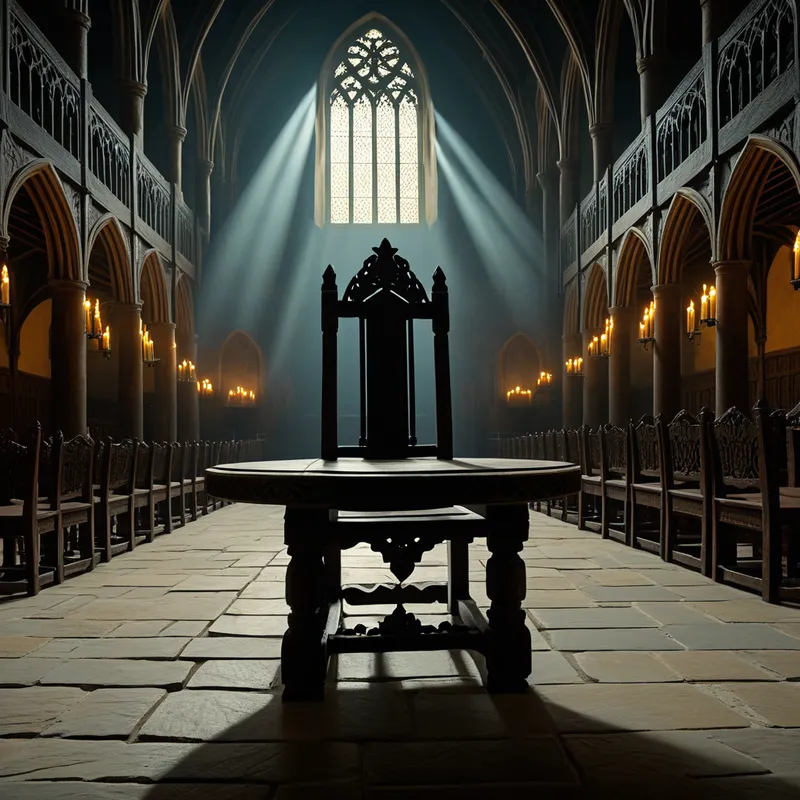
An empty seat at the Round Table, reserved by Merlin for the one pure knight destined to find the Grail. To sit unworthily is to be devoured.
The Tale of The Siege Perilous
Hear now, and listen well, for I sing of a seat that was not a seat, a place that was a promise and a doom. In the high hall of Camelot, where the light fell through high windows onto the great Round Table, there stood one chair apart. It was not like the others. Where their wood was polished and warm, this was pale, cold stone and dark, carved oak. Where their cushions were rich with embroidery, this one held only the dust of expectation. It was the Siege Perilous, and its emptiness was a roar in the silent heart of the court.
The wizard Merlin himself had fashioned it, his hands moving not with tools but with fate. He declared, with a voice that echoed from the depths of the world, that this seat was reserved. Reserved for the one knight who would come, the knight of purest heart and most perfect virtue, whose life was a single, unwavering line drawn toward God. This knight, and this knight alone, would succeed in the quest for the Holy Grail. For any other, the seat held not rest, but annihilation. To sit without the sacred worthiness was to be swallowed by the earth, consumed by fire from heaven, or unmade by invisible hands. It was a gap in the world’s order, a question mark carved in wood and stone.
For years it sat, a cold monument at the feast of fellowship. Knights of great renown—Lancelot, the flower of chivalry; Percival, of stout heart and good intent—would glance at it, a shiver tracing their spines. They saw not a chair, but a mouth. It was the unspoken fear, the flaw in the perfect circle of their brotherhood. The court thrived, but the Siege whispered of a standard not yet met, a purity not yet born into the world.
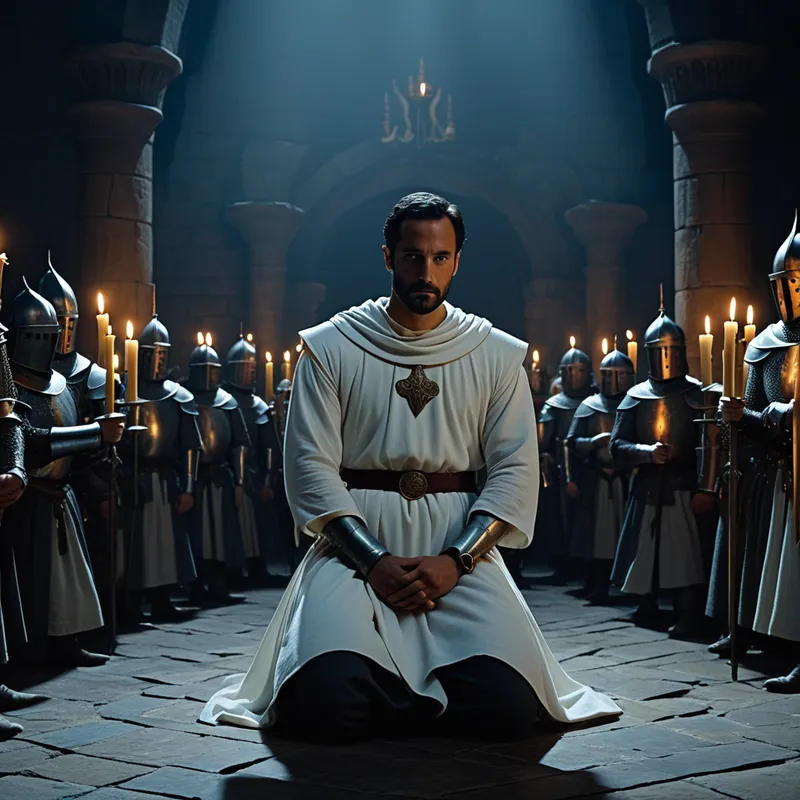
Then came a day, not heralded by storm, but by a strange, quiet light. Into the hall walked a young man, clad not in the brilliant silks of Camelot, but in simple, red-crossed white. He was Galahad. He had been led there by an aged, holy man, and a silence fell so deep the very torches seemed to hold their breath. Without a word of boast, without a glance of fear, the young knight walked past the thrones of kings and champions. He went directly to the void at the table, to the Siege Perilous. The air crackled, thick with the memory of Merlin’s curse. As he turned and sat, a collective gasp tore from the assembly. For a moment, nothing happened. Then, not destruction, but a miracle: the cold stone seemed to warm, the dark wood to glow with a gentle, inner radiance. And there, upon the barren back of the chair, letters of gold flickered and burned into being: Hic est Galahad. This is Galahad. The peril was past. The destiny had arrived. The circle, at long last, was complete.
Cultural Origins & Context
The myth of the Siege Perilous is woven into the later, more spiritual strata of the Arthurian canon, primarily emerging in the 13th-century French Vulgate Cycle and Sir Thomas Malory’s seminal 15th-century compilation, Le Morte d’Arthur. This places its flowering in the High to Late Medieval period, a time when the earlier Celtic warrior myths of Arthur were being systematically Christianized and allegorized by monastic scribes and courtly poets. The tale was not sung in mead halls for simple valor, but recited in courts and read in manuscripts as a spiritual parable.
Its primary societal function was twofold. For the aristocratic audience, it reinforced a new, exalted ideal of knighthood that transcended martial prowess—the knight as a celibate, Christ-like pilgrim whose battlefield was the soul. For the wider culture, it served as a powerful narrative vessel for themes of divine election, predestination, and the terrifying grace of God. The Siege Perilous became the ultimate symbol of a spiritual aristocracy, a seat one could not earn by blood or deed, but only by a state of being ordained from beyond. It transformed the collective quest of the Round Table from a project of secular empire-building into a sacred, interior pilgrimage, with the Siege as its silent, judging heart.
Symbolic Architecture
At its core, the Siege Perilous is the archetypal symbol of the vacant center—the place reserved for the ultimate value, the true self, which remains empty until the individual undergoes a complete and radical transformation. It is not a seat of social status, but of ontological status.
The empty throne is the most profound question the soul can ask of itself: “Who is worthy to sit at the center of my own being?”
The “peril” is the absolute, non-negotiable law of spiritual physics it represents. The seat does not judge morally in a conventional sense; it responds to a condition of wholeness. Galahad is not perfect because he never errs, but because he is entirely integrated—his will, his desire, and his action are aligned with a transcendent principle. For others, like the passionate and divided Lancelot, the seat represents the fatal split within themselves. To sit would be to bring the inner conflict into the open with annihilating force. Thus, the Siege is a symbol of the conjunctio oppositorum—the sacred marriage of opposites within the psyche—where failure to unite them results in disintegration, and success results in the birth of the divine child, the Self.
The Dreamer’s Resonance
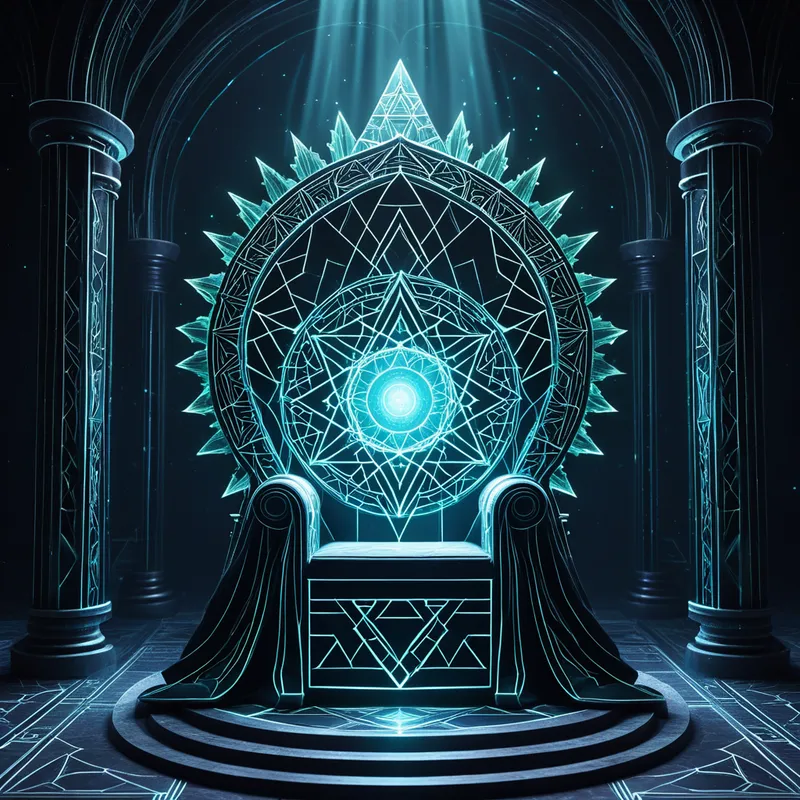
When the Siege Perilous appears in modern dreams, it rarely manifests as a literal Arthurian chair. It is more likely the dreamer’s own bed that feels ominously empty yet charged, a car seat that promises a journey they fear to take, or a throne at the head of a family table that fills them with dread. The dreamer stands before it, gripped by a somatic paradox: a deep, gravitational pull toward this centerpiece of their life, coupled with a visceral, cellular terror of claiming it.
This dream signals a critical crossroads in the process of individuation. The psyche is announcing that a central, organizing principle—a “seat of power” in one’s life—has been vacated by an old identity (the outgrown job, the finished relationship, the obsolete self-image) and is now awaiting its rightful occupant. The peril is the psychological death that comes from prematurely assuming a role not yet earned by inner work, or from allowing a false, ego-inflated self to sit in the place of the true Self. The dream is an embodied experience of the tension between destiny and dissolution, asking the dreamer: What within you must die for your authentic life to begin?

Alchemical Translation
The myth of the Siege Perilous is a perfect map of the alchemical opus, the great work of psychic transmutation. The empty seat is the vas or crucible, the sealed vessel that must be pure to contain the transformative process. The long years it sits vacant correspond to the nigredo, the blackening—a period of melancholy, confusion, and dissolution where the old, unworthy elements of the personality are broken down.
The quest for the Grail does not begin with a journey outward, but with the terrifying patience to leave the central seat empty until the alchemy is complete.
The knights who fear the seat are aspects of the ego undergoing this purification. Percival represents the honest striving, Lancelot the passionate conflict. Their inability to sit is not failure, but necessary stages in the process. Galahad’s arrival symbolizes the birth of the filius philosophorum, the philosophical child or true Self, from the completed work. He is the product of the alchemical marriage, the embodiment of the lapis (the stone). His act of sitting is the rubedo, the reddening—the final stage of glorification and permanent integration. For the modern individual, this translates to the agonizing but essential practice of not filling the void with quick fixes, addictive identities, or others’ expectations, but holding the center perilously, sacredly open until one’s own inherent worthiness—forged in the fires of experience and reflection—finally, and irrevocably, takes its place.
Associated Symbols
Explore related symbols from the CaleaDream lexicon: