The Shirt of Nessus Myth Meaning & Symbolism
A poisoned garment, given as a love charm, becomes an inescapable second skin that consumes the hero from the outside in.
The Tale of The Shirt of Nessus
Hear now of the gift that was a curse, the love that was a poison, and the hero who was undone not by a monster’s claw, but by a lover’s hand.
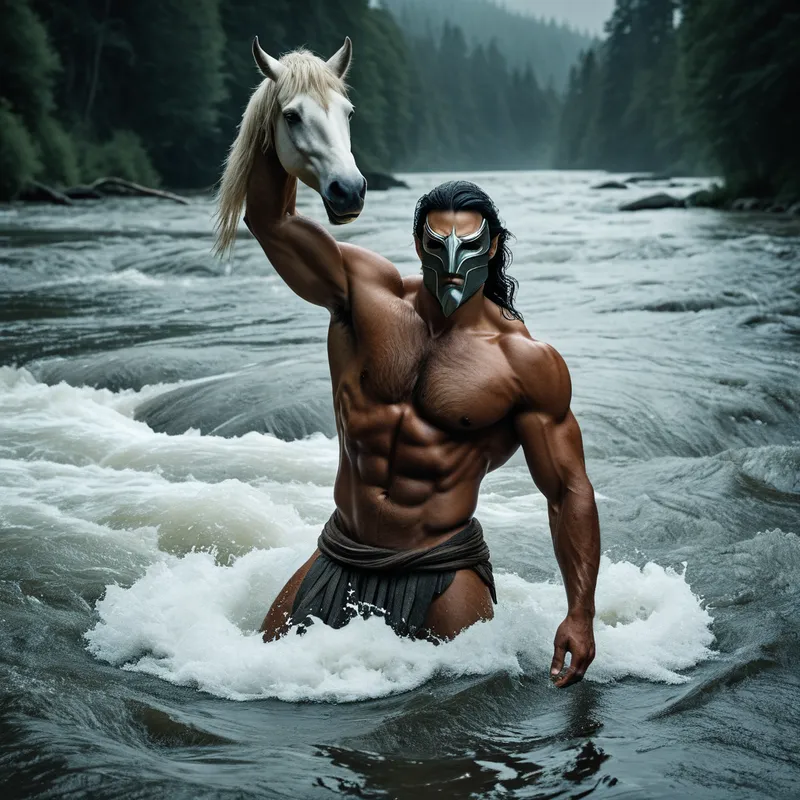
The air over the river Evenus was thick with the scent of mud and fear. Heracles, mightiest of men, stood on the bank, his famed lion-skin cloak heavy on his shoulders. By his side was Deianira, his new bride, her face pale as moonflower. They needed to cross the swift, treacherous waters, but the current was a roaring beast. Then came the splashing approach of Nessus, the ferryman-centaur, his equine flanks slick with river spray, a false smile upon his human face.
“Great hero,” Nessus called, his voice like grinding stones. “The lady cannot brave these waters. Place her upon my back. I am strong; I will bear her safely across.”
Heracles, trusting in his own strength to follow, lifted Deianira onto the centaur’s broad back. Nessus entered the flow, but as the water reached his chest, a darker current stirred within him. Greed and lust ignited in his eyes. Instead of the far shore, he turned mid-stream, his powerful legs driving him downstream, away from the hero’s reach. Deianira’s cry was swallowed by the river’s roar.
From the bank, a sound like thunder answered. Heracles fitted an arrow to his great bow, an arrow whose tip was stained with the black blood of the Lernaean Hydra. He drew, the sinews of his arms standing like cables, and let fly. The shaft sang across the water and found its mark, piercing Nessus through the back. The centaur bellowed, a sound of agony and bitter triumph. As his life fled, he crawled to the bank where Deianira had stumbled, weeping.
With his last, rattling breath, Nessus spoke. “Princess… take my tunic. Soak it in the blood from my wound. It is a powerful philtre. If ever your hero’s love should wane… if ever another woman should catch his eye… have him wear this shirt. It will bind his heart to yours, forever.” He pressed the simple, woolen garment into her trembling hands, his eyes glazing over with death and deceit. She took it, seeing not a centaur’s venom, but a charm for love, a safeguard for her fragile happiness.
Years passed. Heracles, ever the wanderer, was away at war. A rumor, carried by a sly messenger, reached Deianira’s ears: her husband had taken a captive princess, the beautiful Iole, as a concubine. The old fear, seeded by the centaur’s dying words, blossomed into panic. Remembering the “love charm,” she took the shirt from its cedar chest. It felt cold. She anointed it with oil and sent it by messenger to her husband, with instructions to wear it during a sacrifice to the gods.
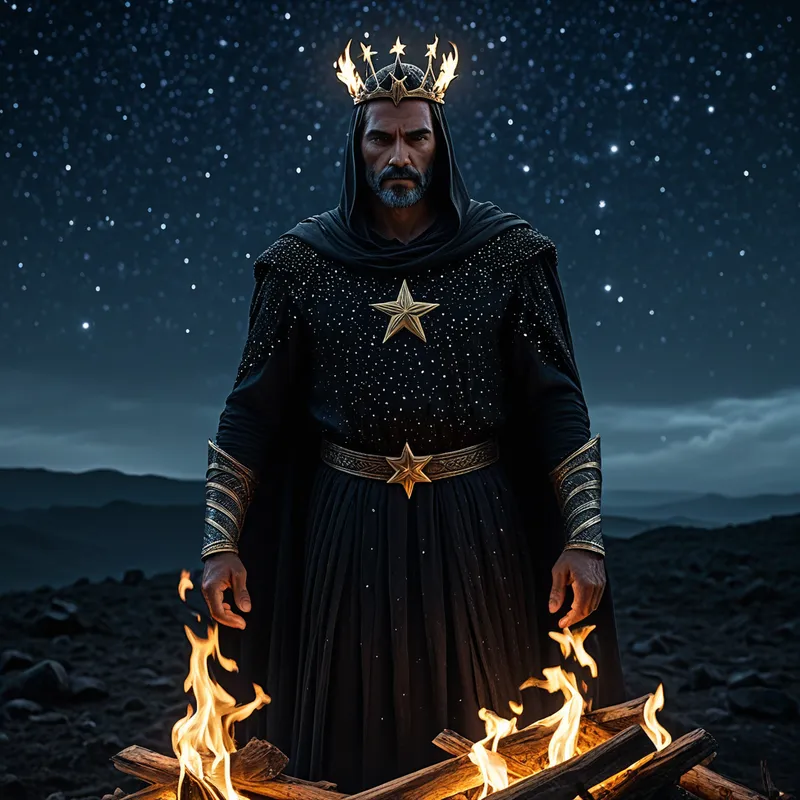
On a high promontory, Heracles donned the gift from his wife. The moment the sun-warmed wool touched his skin, the Hydra’s poison, fermented by the centaur’s own vengeful blood and bile, awoke. It was not love that seeped into his pores, but a fire more terrible than any he had faced. The shirt fused to his flesh, becoming a second skin of agony. He screamed, tearing at the fabric, but it would not come free. It burned and ate into him, an unquenchable fire from without. In his madness and torment, he built his own funeral pyre. As the flames took him, offered not to the gods but to oblivion, the final image was not of a monster slain, but of a hero consumed by a gift he could not remove.
Cultural Origins & Context
This harrowing tale is a pivotal episode from the later cycles of Heracles mythology, most famously recorded in the tragic play Women of Trachis by Sophocles. It functions as the capstone to the hero’s saga, moving his narrative from triumphant labors to profound, mortal suffering. Unlike the earlier tales of clear-cut monsters and divine tasks, this story emerges from the messy, human realm of marriage, jealousy, and unintended consequences.
Passed down through epic poetry and Athenian tragedy, its societal function was complex. For the Greeks, it served as a powerful reminder of Moira—even the greatest hero could not escape his destined end. It also explored the tragic flaws of its characters: Heracles’s uncontrollable passions and Deianira’s naïve trust. The myth was told not just to glorify strength, but to warn of the vulnerabilities that strength cannot defend against—the poison that comes disguised as aid, the doom woven into the fabric of our closest relationships.
Symbolic Architecture
The Shirt of Nessus is one of mythology’s most potent symbols of inescapable fate and projected shadow. It represents the toxic introject—a poisonous belief, a traumatic memory, or a destructive complex that we mistake for a part of ourselves, or even for a solution.
The most fatal garments are those we are given by others, but which we willingly put on.
Heracles, the Hero archetype, conquers all external monsters. Yet he is undone by an internal process he cannot fight with club or bow: the poison of his own past actions (the Hydra’s blood) weaponized by a betrayed other (Nessus) and administered through the conduit of love and fear (Deianira). The shirt symbolizes the “complex” that adheres to the ego. Deianira represents the innocent, anxious part of the psyche that, fearing abandonment, reaches for a manipulative “cure”—often a pattern of control, jealousy, or people-pleasing—that ultimately destroys the very connection it sought to save. Nessus is the Shadow in its most vindictive form: the bearer of our repressed rage and lust who, when wounded, leaves behind a legacy of psychic poison.
The Dreamer’s Resonance
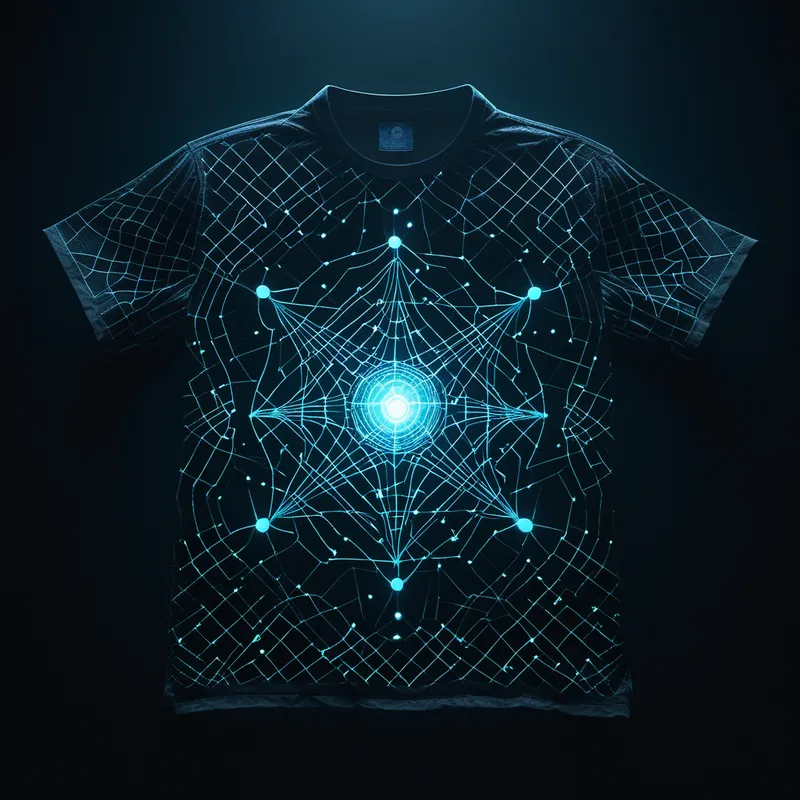
When this myth stirs in the modern dreamer, it often manifests as a profound somatic nightmare. One may dream of wearing clothing that is burning, crawling with insects, or made of lead—garments that feel foreign yet inseparable from the body. The dreamer might be trying to remove a skin that is not their own, or find themselves paralyzed as a stain spreads across their chest from a loved one’s touch.
Psychologically, this signals a confrontation with an “introjected poison.” The dreamer is likely experiencing the toxic effects of a belief system, a family narrative, or a relational dynamic they have unconsciously “put on.” It is the feeling of being consumed by a role—the dutiful child, the perfect partner, the relentless achiever—that was perhaps given with good (or manipulative) intentions but which has become a prison of suffering. The dream points to a recognition that the source of agony is not an external enemy, but something that has been accepted and integrated as part of one’s identity, and which must now be consciously, and painfully, differentiated from the true self.

Alchemical Translation
The alchemical process modeled here is the Nigredo, the blackening, taken to its most extreme conclusion. It is the utter dissolution of the heroic ego. Heracles’s entire identity—as invincible strongman, as conqueror—is incinerated by a force he cannot overpower. For the modern individual on the path of individuation, the myth presents a brutal but necessary truth: some patterns cannot be fought; they must be fully experienced and burned away.
The pyre is not merely an end; it is the ultimate crucible. Only through the total consumption of the old, poisoned identity can an untainted essence be liberated.
Our “Shirts of Nessus” are the inherited traumas, the co-dependent bonds, the corrosive self-images we wear. The alchemical work is first to recognize the garment as a garment—not as our skin. This is Deianira’s realization, which comes too late: seeing the love-charm as the murder weapon. Then comes the horrific, necessary step: to stop trying to tear it off (which only embeds it deeper), and to submit to the transformative fire it ignites. This is not literal death, but the death of an old way of being. The triumph of the myth, in its darkest sense, is that Heracles is released from his mortal suffering and achieves apotheosis—becoming a god—only after the shirt and the mortal identity it poisoned are consumed. For us, it means that the inescapable pain of confronting a core complex becomes the very fire that forges a consciousness no longer defined by it. We must be willing to let the old, poisoned hero perish on the pyre, so that a more integrated self can rise from the ashes.
Associated Symbols
Explore related symbols from the CaleaDream lexicon: