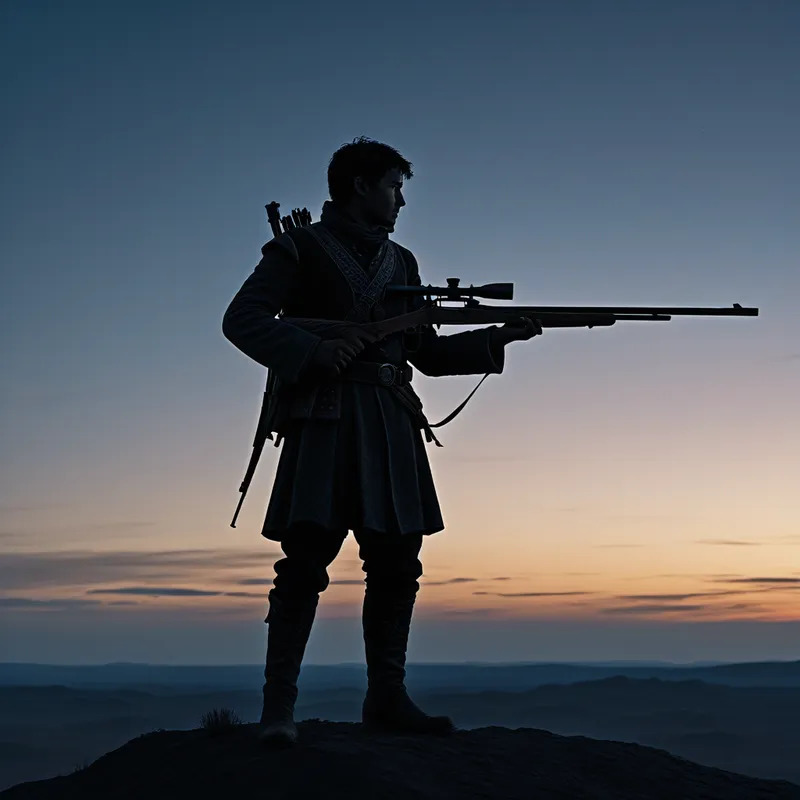
The Sharpshooter/Marksman Myth Meaning & Symbolism
A lone figure, gifted with impossible aim, must choose between a life of glory and a final, world-redeeming shot that demands everything.
The Tale of The Sharpshooter/Marksman
Listen. The wind doesn’t just blow out here on the edge of the world—it tells secrets. And the oldest secret it carries is the story of the one who could hear the silence between its gusts. They say he was born under a dead star, a child who never cried, only watched. His eyes were the color of a winter creek, seeing not just the rabbit in the brush, but the path of its next three hops. He was given a name, but the land forgot it. It only remembered his title: The Sharpshooter.
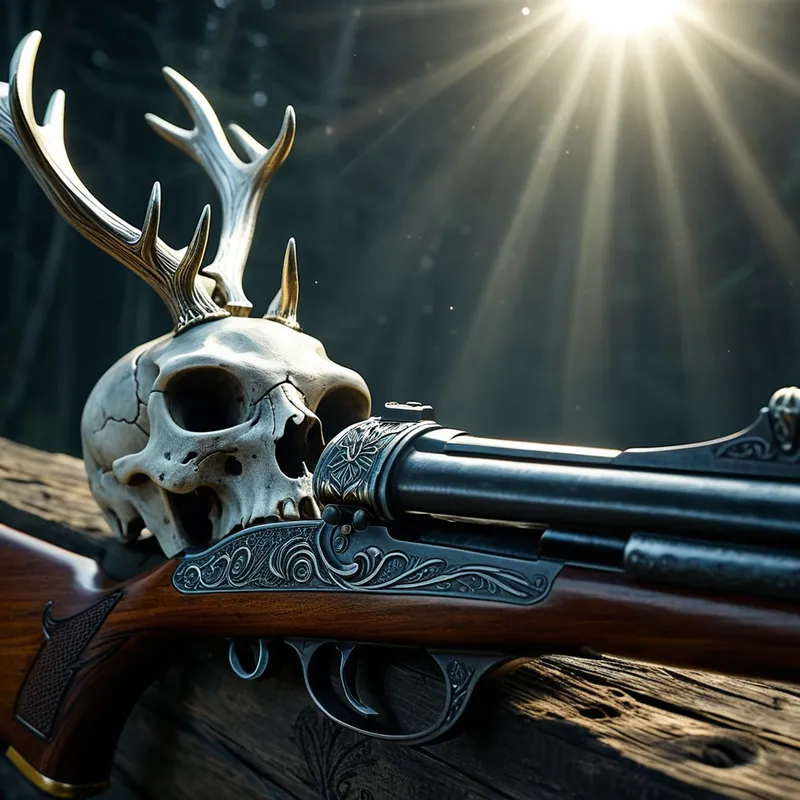
He walked the raw-boned earth where the mountains shrugged their shoulders and the plains stretched out like a tired god. He carried a rifle not made of wood and iron, but of a single, straightened bone from the Great Dust Bison and a river-smoothed stone for a stock. He needed no powder; his breath was the charge. His bullets were carved from the teeth of mountain lions, each one whispering a different fate.
For a time, he was a bringer of balance. He shot the fever from a sick child’s brow by striking a specific icicle from a mile-high cliff. He felled the marauding Canyon Worm with a single shot to a scale no larger than a coin, saving a settlement from being swallowed whole. His legend grew like sagebrush fire. Men sought him for glory, women for fortune, and the land itself seemed to hold its breath when he took aim.
But the world’s equilibrium is a fragile thing. A deeper sickness began to stir. Not in flesh, but in the spirit of the frontier itself. The winds grew bitter and confused. The rivers ran backwards one day and dry the next. Shadows began to move with a mind of their own. The elders whispered of the Unwoven, a force that frayed the very threads of reality at the world’s ragged hem. It had no heart to shoot, no head to pierce. It was a spreading stain of chaos.
The Sharpshooter walked until his boots wore through, seeking a target that did not exist. In his deepest despair, as he knelt by a poisoned spring, his reflection did not show his face. It showed the land—cracked, bleeding, and unraveling. And in that moment, he understood the terrible truth. The rifle was not for killing the sickness outside. The final, perfect shot was an act of supreme sacrifice. To mend the Unwoven, he would have to shoot the very concept of chaos itself—a target that existed only in the precise, singular moment of his own absolute focus and self-annihilation.
He climbed to the highest spire, a needle of black rock piercing the belly of the sky. He did not load a tooth-bullet. Instead, he placed his own still-beating heart, offered freely, into the chamber. He did not aim at the chaotic lands below. He aimed at the nexus of all the errant winds, the convergence of every broken shadow—a point in the empty air that only his perfected sight could perceive. He took a breath that gathered all the silence of the world. He exhaled.
There was no sound. Only a flash of light that was not light, a vibration that was not sound. The Sharpshooter was gone. The rifle, now cold stone and dead bone, clattered to the rock. But the winds sighed back into their proper courses. The rivers remembered their flow. The shadows clung meekly to the feet of the trees. He had not destroyed chaos, for that is impossible. He had, with one impossible shot, given it a shape so precise and contained that the world could hold it without coming apart. The cost was everything he was. The reward was the world, continuing.
Cultural Origins & Context
This myth emerges not from a single tribe or settled people, but from the collective soul of those who inhabited the liminal spaces—the scouts, trappers, settlers, and nomadic bands of the vast frontier. It is a story born around campfires that fought back an immense darkness, told by voices made rough by dust and solitude. It belongs to “Various Frontier Lore” precisely because it is a psychic artifact of the frontier condition itself: a place of immense possibility shadowed by profound vulnerability, where individual skill was the thin line between community and catastrophe.
The tale was not written but breathed, passed down as an oral tradition among those who understood that survival depended on a fusion of keen observation, patience, and a moment of decisive, irreversible action. It functioned as more than entertainment; it was a moral and psychological compass. It taught that supreme talent is not a gift for personal gain, but a debt owed to the whole. It grappled with the frontier’s central paradox: the iconic self-reliant individual ultimately finds their highest purpose in an act of total self-expenditure for the greater web of life.
Symbolic Architecture
At its core, the myth of the Sharpshooter is an allegory for the focused consciousness confronting the diffuse unconscious. The frontier landscape symbolizes the untamed, potentially chaotic psyche. The Sharpshooter represents the emerging ego—the part of the self that can observe, take aim, and act with intention.
The rifle is the instrument of directed will, but the bullet must be carved from one’s own substance.
His miraculous aim symbolizes the power of conscious attention, the ability to isolate a single point of change amidst a field of noise. The Unwoven is the shadowy, formless threat of psychosis, dissolution, or meaninglessness—the terror that the structures of reality (or self) are inherently fragile. The myth’s profound turn is the realization that this chaos cannot be defeated externally. It must be transformed through a supreme internal act.
The final shot, using his own heart, is the ultimate symbol of sacrificial precision. It is not a violent destruction of the self, but a willing offering of the ego’s central organizing principle (the heart) to a purpose beyond itself. The act re-weaves chaos into the cosmic order not by fighting it, but by containing it through an act of conscious love and sacrifice.

The Dreamer’s Resonance
When this myth stirs in the modern dreamer, it often manifests as dreams of impossible aiming: trying to thread a needle with a trembling hand, shooting at a target that keeps moving, or holding a weapon that feels both familiar and alien. Somatic sensations include a tightness in the dominant shoulder, a hyper-focus of vision, or a feeling of breath being held.
Psychologically, this signals a critical point of discernment. The dreamer is likely facing a life situation—a relationship, career crossroad, or internal conflict—that feels chaotic and unmanageable. The psyche is invoking the Sharpshooter to advocate for extreme focus. The dream is asking: What is the one, precise action you must take? What is the “heart” of the matter that you must be willing to risk? The anxiety in the dream mirrors the myth’s tension: the target is known, but the cost of the perfect shot is terrifying. It is the process of the conscious mind learning to take responsibility for containing and shaping its own inner chaos.
Alchemical Translation
In the alchemical journey of individuation, the Sharpshooter’s path models the stage of Separatio and Unio in one devastatingly pure act. The initial phase of developing a skilled, observant ego (the Sharpshooter’s training) is necessary but ultimately insufficient. It leads to a crisis: the adept realizes their refined consciousness is powerless against the massa confusa—the primal, disordered material of the soul—if approached as an enemy.
Individuation is not about building a fortress of self, but about becoming a precise vessel for a transformative act that includes the self in its offering.
The alchemical translation is this: the “lead” of the diffuse, chaotic life problem (the Unwoven) cannot be turned to “gold” by attacking it. It must be transmuted by the “gold” of the individual’s most concentrated, willing consciousness. The dreamer must locate the precise, psychological “nexus point”—often a core belief, a frozen trauma, or a lifelong pattern—and be willing to “shoot” it with the full force of their acknowledged truth and vulnerability. This is the shot that uses the heart as ammunition. It feels like ego-death, for it is the moment the ego relinquishes control to serve the greater Self. The result is not annihilation, but a profound reorganization. The chaos is not gone; it is integrated, given a place in a newly stable and more expansive psychic structure, just as the mended frontier contains the memory of the Unwoven. The individual becomes both the shooter, the shot, and the healed field.
Associated Symbols
Explore related symbols from the CaleaDream lexicon: