The Shaman Myth Meaning & Symbolism
A chosen one is broken by spirits and remade into a healer, becoming a bridge between the human world and the unseen realms of power.
The Tale of The Shaman
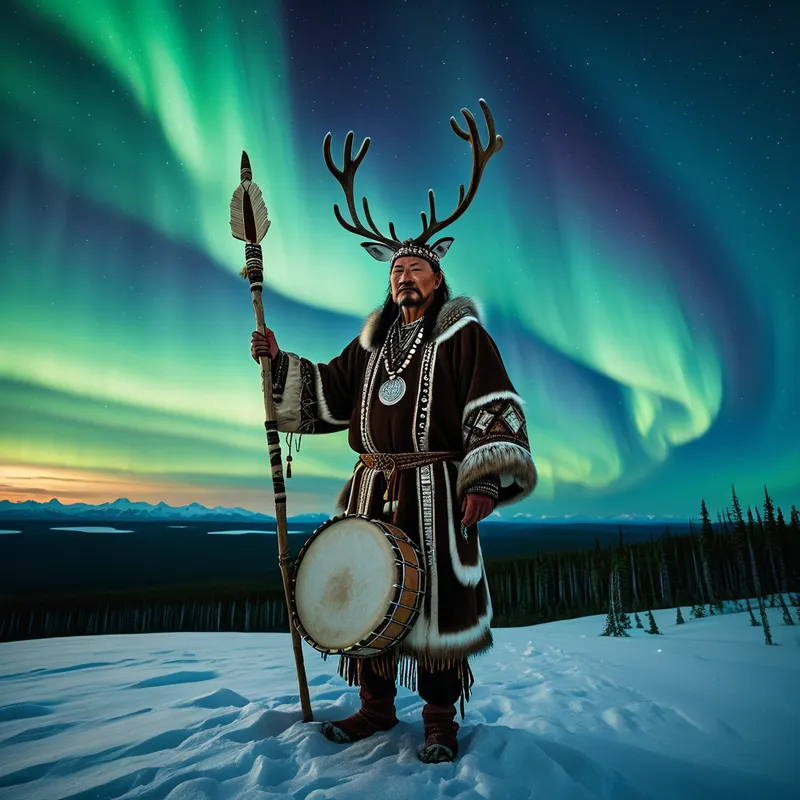
Listen. The wind does not just blow across the taiga; it carries voices. The ice does not merely crack on the river; it speaks in the tongue of the deep earth. And in a time when the world was closer, when the veil between the seen and the unseen was thin as birch bark, there lived a person marked by the spirits.
This one was often solitary, drawn to the edges of the campfire’s light, their gaze following the flight of the raven or the path of a storm cloud. Perhaps they fell gravely ill, a fever burning away the ordinary world. Or perhaps, in the deep silence of a winter hunt, they witnessed something that could not be unseen—the dance of the Aurora too close, the eyes of an old bear holding a human wisdom.
Then, the Calling came. It was not a gentle whisper but a rupture. In dream or in waking vision, the spirits arrived—the Masters of the Animals, the Ancestors, the Lords of the Lower and Upper Worlds. They did not come to comfort. They came to claim.
They took the chosen one to a lonely place, a sacred mountain or a clearing ringed by ancient larches. There, under a moon that was an eye, the great work began. The spirits, manifesting as helping animals—the Bear of raw power, the Eagle of far sight, the Wolf of the pack-soul—set upon them. This was not a murder, but an unmaking. With claws of shadow and light, they dismembered the candidate. Bones were separated from flesh, skull opened, eyes plucked out. The body was dissolved into its raw elements.
The candidate experienced it all—the terror, the agony of annihilation. The self they knew was utterly destroyed. Then, in the terrible silence that follows the end of all things, the spirits began again. They counted the bones. They washed the organs in the light of the moon and the heat of the sun. They forged new eyes from quartz and starlight. They reassembled the body, but now it was a different body. Iron was hammered into the spine for strength. Symbols of power were sewn into the soul. The candidate was put back together, but not as they were. They were remade. They were given new sight to see the spirit-lines of the world, new ears to hear the lament of the sick and the songs of the ancestors, and a new voice to speak to the powers that govern life, death, and health.
They awoke, shivering on the cold earth, whole and yet utterly changed. They had died as a human and were reborn as a shaman. Their first act was often to find the tree—the sacred Bereginya—and from its living wood, fashion their drum. This drum would become the hoofbeat of their spirit-horse, the vessel for their journeys. They returned to their people, not to rejoin the ordinary flow of life, but to stand at its threshold, a wounded healer, a bridge between worlds.
Cultural Origins & Context
This narrative is not a single, codified myth from one text, but the core initiatory pattern found across the diverse shamanic traditions of Siberia—from the Evenki and Nenets to the Sakha and Buryat. It was an oral tradition, passed from elder shaman to apprentice, and woven into the epic songs and chants performed during rituals. Its primary function was explanatory and legitimizing: it answered why this particular person had the authority to conduct soul-retrievals, heal the sick, and guide the dead. Their power was not chosen but bestowed—and paid for with a psychological death. The myth served as the sacred blueprint for the shaman’s role in society: they were the essential technician of the sacred, maintaining cosmic and communal balance through their arduous, ecstatic journeys.
Symbolic Architecture
The myth is a profound map of a radical psychological transformation. The initial “sickness” or oddness represents the stirring of a deeper calling that the conscious ego cannot yet integrate—what Jung might term the emergence of the Self. The ordinary personality must become dysfunctional for a new, more complex one to be born.
The violent dismemberment by spirit-animals symbolizes the complete deconstruction of the old identity, values, and ego structures. It is a descent into chaos, where everything one believed oneself to be is taken apart.
The path to wholeness requires first a shattering. The old vessel must be broken so a new one, capable of holding a greater spirit, can be fashioned from the pieces.
The careful reassembly with new elements (iron, quartz) signifies the reconstruction of the personality on a new foundation. This is not a return to normalcy, but an ascent to a different order of being. The shaman is grafted with the qualities of the helping spirits (Bear’s strength, Eagle’s vision), integrating powerful unconscious archetypes. The tüngür itself is a symbol of the reconstructed cosmos and the shaman’s own restored—and now magical—body, its beat the pulse of the journeying soul.
The Dreamer’s Resonance
When this mythic pattern stirs in the modern dreamer, it often manifests not as a literal narrative, but as a series of powerful somatic and symbolic experiences. One may dream of teeth falling out, limbs detaching, or the body dissolving—not in horror, but with a strange, ritualistic inevitability. Dreams of being operated on by unknown figures, of bones being cleaned, or of mechanical parts being inserted into the body are common translations. The setting is frequently a sterile hospital, a laboratory, or a ruined building—modern equivalents of the sacred grove.
Psychologically, this indicates a profound process of initiatory crisis. The psyche is forcing a dismantling of outworn attitudes, a rigid persona, or a life structure that can no longer contain the individual’s potential. The ego is experiencing its own “dismemberment.” The process is terrifying and isolating (the “sickness”), but the presence of animals or enigmatic helpers in the dream suggests the unconscious itself is the agent of this transformative ordeal, guiding the process toward a necessary rebirth.

Alchemical Translation
For the modern individual, the shaman’s myth models the alchemical process of individuation—the journey toward psychological wholeness. The “spirit-calling” is that undeniable, often disruptive, inner voice demanding a more authentic life. The “dismemberment” is the inevitable crisis: the loss of a job, the end of a relationship, a depression, or a burnout that utterly destroys one’s former sense of self. This is the nigredo, the blackening, the descent into the meaningless void.
The key is that the spirits (the unconscious archetypal forces) perform the dismemberment and the reassembly. The work is not done by the conscious will, but by surrendering to a process larger than the ego.
The psyche’s intelligence does not seek to destroy us, but to break open the calcified shell of who we think we are, so that who we are meant to become can emerge.
The modern “shamanic work” is the conscious engagement with this breakdown. It is in therapy, in creative expression, in deep introspection, that we “count our bones”—examine our core complexes and inherited structures. We “wash our organs” by processing old emotions. We “insert the iron” by cultivating resilience and new values. The rebirth is the emergence of an ego that is no longer the sole ruler, but a conscious partner with the deep Self. One becomes a “bridge” within oneself, able to translate between the primal energies of the unconscious and the demands of conscious life, healing inner divisions and bringing fragments of the lost soul back home. The drumbeat becomes the steady, grounding rhythm of a life lived in authentic dialogue with the depths.
Associated Symbols
Explore related symbols from the CaleaDream lexicon: