The Shades of the Underworld Myth Meaning & Symbolism
A journey into the Greek underworld to confront the silent, insubstantial Shades, revealing the soul's confrontation with its own forgotten and unlived life.
The Tale of The Shades of the Underworld
Listen, and let your soul descend. Not to a place of fire and torment, but to a realm of profound, chilling silence—the land of Hades. Here, beneath the roots of the world, the sun is a forgotten memory. The air is still and scentless, a breath that does not nourish. This is the domain of the Shades.
To reach them, one must cross the final river, the Acheron, its waters dark and slow. The ferryman, Charon, poles his skiff, his hollow eyes judging the coin upon the tongue of the newly dead. On the far shore, the three-headed hound Cerberus watches, a beast of teeth and loyalty, ensuring none who enter may easily leave.
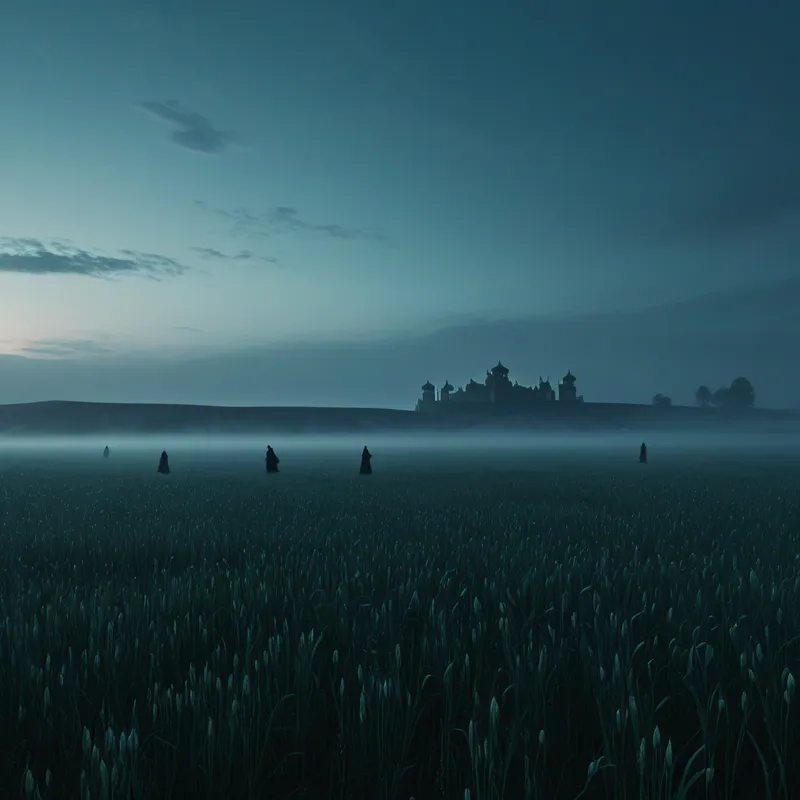
Beyond him lies the true kingdom: the Asphodel Meadows. Picture a plain, endless and grey, under a sky that is neither day nor night. Pale, ghostly asphodel flowers bloom, their roots in the dust of memory. And here they dwell—the countless Shades. They are not monsters, not demons. They are echoes. Their forms are smoke and shadow, retaining the faintest outline of the bodies they once wore. They move with a soundless drift, their voices, if they can be called that, a mere whisper like dry reeds in a forgotten wind. They have forgotten the passions of life, the taste of wine, the warmth of love, the sting of anger. They are insubstantial, incapable of touch or embrace. To grasp one is to clutch at mist.
This is the fate of most mortals. Not punishment, but erosion. A hero, driven by love or duty, may walk here. He sees a beloved face in the crowd of shadows and rushes forward, his heart full. But his arms pass through her. Her eyes, if they meet his, hold no recognition, only a vacant, reflective sheen. She may speak, but the words are empty, a recitation of the past with no feeling behind them. The hero’s greatest battle here is not with a monster, but with this unbearable, silent negation. The conflict is the rising horror that this oblivion is the common destiny, that the fire of the soul can be so utterly banked into grey ash. The resolution is not victory, but the terrible, necessary knowledge he must carry back to the land of the living: that to live half-heartedly is to rehearse for this grey eternity. The journey out is often harder than the journey in, for he carries the chill of that plain in his bones forever.

Cultural Origins & Context
This vision of the afterlife was not the doctrine of a priesthood but the collective imagination of a people, crystallized in epic poetry. It finds its most potent expression in Book 11 of Homer’s Odyssey, where Odysseus performs a blood rite to summon the Shades to speak. This Nekyia was a central, chilling episode. Later poets like Hesiod refined the geography, and Virgil would later adapt it profoundly for Rome.
The myth functioned as a societal mirror. In a culture that prized kleos (glory), arête (excellence), and vibrant engagement with life, the Asphodel Meadows presented a potent warning. It was a fate worse than Tartarus for most Greeks—not agony, but irrelevance. The myth was told at symposia, in epic recitations, and in tragic plays to provoke existential contemplation. It asked: What makes a life substantial? The answer was clear: action, memory, and the remembrance of the living. To be forgotten on earth was to fade faster in Hades. The Shades thus served as a cultural memento mori, not urging fear of punishment, but advocating for a life lived with such intensity that its echo might resist the dissolving mists of the underworld for a little longer.
Symbolic Architecture
The Shades are not merely ghosts; they are the psyche’s symbols for the unlived life. They represent all the potentials, passions, and identities we neglected, denied, or abandoned in our conscious journey.
The Shade is the psychic residue of a choice not taken, a love not pursued, a truth not spoken. It is the self we buried in order to become who we are.
The Asphodel Meadows symbolize the inner landscape of the unconscious where these discarded selves reside—a flat, undifferentiated state of psychological stagnation. The hero’s descent is the ego’s necessary, terrifying journey into this inner hinterland. Confronting a specific Shade (a lost love, a fallen comrade) is the psyche’s attempt at recognition and dialogue with a complex that has been split off. The chilling inability to make contact, the failure of the embrace, symbolizes the ego’s initial shock when it realizes how alienated these parts have become. They are not integrated; they are merely haunting. The blood Odysseus offers is a powerful symbol of life-force—only by sacrificing a part of our vital, conscious energy (our attention, our feeling) can we temporarily animate these buried aspects and hear their stories.

The Dreamer’s Resonance
When this myth pattern emerges in modern dreams, it signals a profound encounter with the personal shadow—not the dark, repressed impulses, but the neglected self. The dreamer may find themselves in a vast, grey, bureaucratic building (a modern Asphodel), a deserted train station at night, or an endless, foggy suburb. The people there are faceless, indifferent, or familiar yet distant. The overwhelming somatic sensation is one of profound loneliness, chill, and existential dread. The dream ego feels invisible, unheard, or is itself becoming grey and insubstantial.
This is the psyche’s alarm. It indicates a life being lived on autopilot, where the individual is identifying solely with a persona—the efficient worker, the reliable parent, the agreeable friend—while other vital parts of the self are starved of energy and left to wander the inner wastelands. The psychological process is one of soul loss. The dream is both a depiction of the current, fragmented state and a call to retrieve those lost shades before the ego itself succumbs to the inner twilight.

Alchemical Translation
The alchemical journey mirrored in this myth is the nigredo—the blackening, the descent into the prima materia, the chaotic, leaden state of the soul. The modern process of individuation demands this descent. We must willingly cross our own Acheron, leaving behind the bright, known shores of our conscious identity.
The alchemical gold is not found by avoiding the grey plains, but by learning to walk through them without becoming grey oneself.
The hero’s failed embrace is not the end of the work, but its crucial beginning. It creates the coniunctio oppositorum—the tension of opposites between the living, seeking ego and the dead, indifferent shadow. This tension is the furnace. The transmutation occurs not in the underworld, but in the return. The chill of the Shades must be carried back up. The psychic task is to warm those grey memories with feeling, to animate the neglected potentials with conscious attention, to give voice to the silent stories. We integrate our shades not by becoming them, but by acknowledging their claim on our life-force. We feed them not with blood, but with authentic action, creative expression, and felt experience in the upper world. In doing so, the inner Asphodel Meadows begin to transform; what was grey and silent gains color and murmur, not as a haunting, but as a reclaimed part of the soul’s vast, now more complete, territory. The journey to Hades becomes, ultimately, a journey to a more fully inhabited self.
Associated Symbols
Explore related symbols from the CaleaDream lexicon: